
The electronic silence had its origins weeks earlier, in the damp, cool hills south of San Juan. An examination of supply chain records from early 1942 reveals a shortfall that began not on the battlefield, but within the Army’s own supply network. Specific, high-value components started vanishing from official inventory manifests with no corresponding issue orders. The missing items were not random bulk supplies. They represented a carefully selected list of equipment essential for command, control, and mobility.
Operational logs from the period detail the disappearance of dozens of vacuum tubes for SCR-series radios, entire crates of magnetos and carburetors for the new Willys MB jeeps, and a small number of M1911A1 pistols. This was not common pilfering. The targeted removal of these specific parts suggested a sophisticated understanding of U.S. Army technological dependencies during its rapid mobilization for a global war. The loss of a single carburetor could disable a vehicle. The loss of a transmitter tube could deafen an entire sector.
The source of this bleeding was an Army supply depot. It was located in a repurposed agricultural warehouse complex on the outskirts of Comerio.
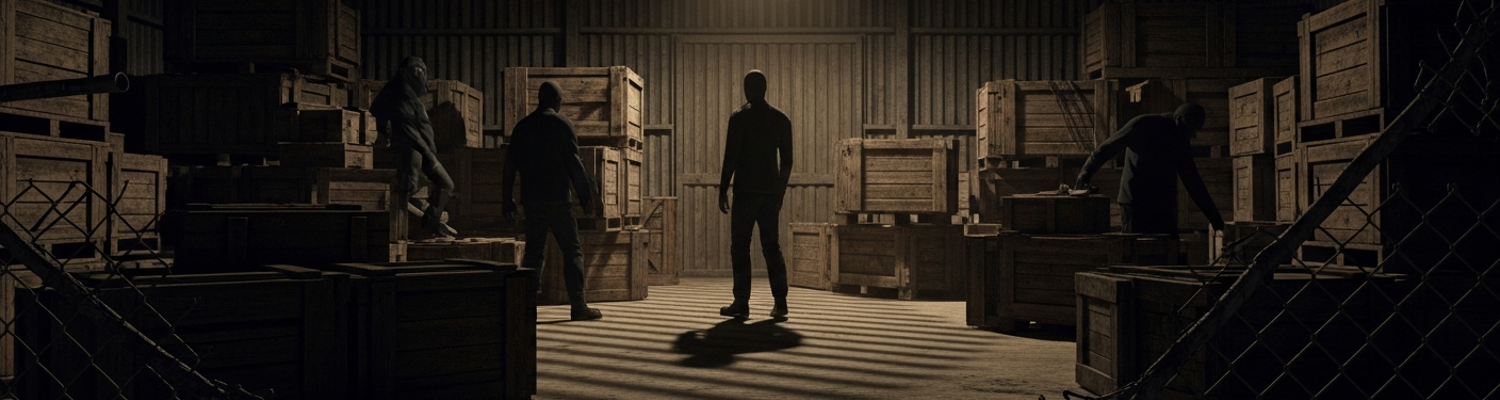
Its position in the rugged topography of Puerto Rico’s Cordillera Central offered concealment but also created significant security vulnerabilities. A close review of the depot’s layout from period schematics shows a facility ill-suited for its purpose. The perimeter was defined by a single, sagging chain-link fence, easily breached and offering more of a guideline than a barrier. Lighting was sparse, casting long shadows that defeated the observation capabilities of the few sentries on duty. Responsibility for guarding this node fell to a detachment from the Puerto Rican National Guard's 296th Infantry Regiment, a unit composed of undertrained and poorly equipped soldiers. Patrols were infrequent. They followed predictable patterns. Inside the warehouses, there was no formal inventory management system. Stacks of wooden crates sat untracked, their contents logged only in handwritten ledgers prone to error and falsification. The depot was a weak point in the supply chain, a fact known to local command but left unaddressed due to the competing priorities of a military force expanding at an unprecedented rate.
The initial disappearance triggered an investigation by a small team of military police from the Department of Puerto Rico’s headquarters. Their procedural approach treated the incident as a case of routine, low-level theft. The investigators interviewed the guards, who reported nothing out of the ordinary, and conducted a cursory search of the surrounding area. The handwritten nature of the inventory logs made it nearly impossible to pinpoint the exact timeframe of the losses, allowing them to be dismissed as clerical errors or opportunistic pilfering. The MPs operated under the assumption that the stolen goods were destined for local black markets. A missing jeep carburetor could be sold to a civilian mechanic. A vacuum tube might find its way into a household radio. Archival records of their preliminary report (NARA Record Group 338) show a complete failure to recognize the strategic pattern of the missing equipment. The investigation concluded with a recommendation for improved fencing and a more rigorous check-in/check-out process for personnel, classifying the event as simple pilferage before closing the file.
The classification of the Comerio incident as mere pilferage held for less than three weeks. A review of the case files from the U.S. Army's Puerto Rico Department shows the file was forcibly reopened in late March 1942. The catalyst was a new, more audacious loss reported from the very same depot. An entire pallet of SCR-536 "handie-talkie" radios, freshly arrived and not yet entered into the flawed ledger system, disappeared from a supposedly secure holding area. This specific loss directly contradicted the initial investigation’s conclusion. The handie-talkies were advanced, short-range tactical communication devices with no discernible black market value in a civilian context but of enormous utility to a coordinated infantry force. The theft demonstrated foreknowledge of shipping schedules and an operational need that went far beyond selling parts. The report reached the desk of Lieutenant General Frank Maxwell Andrews, the new commander of the Caribbean Defense Command and the Puerto Rico Department. His assessment, recorded in a terse memo to his G-2 intelligence chief, was that the initial military police investigation had been fundamentally incompetent.
A new inquiry was launched, this time under the direct authority of the department’s G-2 section, bypassing the military police entirely. Responsibility fell to a small, specialized counter-intelligence team whose operational procedures were radically different. They did not focus on the physical crime scene. Instead, archival evidence shows their first step was to impound all supply and personnel logs from Fort Brooke, the Comerio depot, and the associated transport units dating back six months. The team began a painstaking cross-referencing of manifests, guard rosters, and civilian employee records, building a social network analysis of every individual with access to the supply chain. They operated under the working theory that the thefts were not the objective but a symptom of a larger, hostile intelligence operation on the island. The profile of the missing equipment pointed toward the outfitting of a clandestine paramilitary or espionage unit. The G-2 investigators treated every local employee and Puerto Rican soldier as a potential source of information or a possible security risk, a posture that immediately created friction with the local population and authorities.
This aggressive military-led investigation quickly collided with the island’s civil administration. The Army’s G-2, citing wartime necessity, began operating with a degree of autonomy that Governor Rexford Tugwell’s office found intolerable. The conflict crystalized when Army investigators placed several civilian depot workers under continuous, overt surveillance without notifying the Insular Police. From the Army’s perspective, the Insular Police were an unknown quantity, potentially infiltrated and lacking the security clearances to be briefed on a matter of national security. To Governor Tugwell, this was a violation of his government’s authority and an infringement on the civil rights of U.S. citizens. A series of increasingly sharp letters, preserved in the archives of both Fort Brooke and the governor’s mansion, were exchanged. General Andrews asserted his authority under the broad powers granted to the military for the defense of the hemisphere. Governor Tugwell countered by demanding that all investigative actions involving civilians be conducted by or with the full participation of the Insular Police. The Insular Police, caught between the two powerful entities, attempted to assert their own jurisdiction by opening a parallel investigation. This created a situation where Army counter-intelligence agents found themselves being shadowed by local police detectives while trying to surveil their own suspects. The investigation into the stolen equipment was effectively paralyzed by a three-way jurisdictional standoff.
The bureaucratic paralysis in San Juan unfolded against a backdrop of intense and escalating violence just beyond the horizon. A review of German naval archives from the period reveals the full scope of Operation Neuland, a concerted U-boat offensive launched in February 1942 to sever the Caribbean’s arteries of oil and bauxite. Admiral Karl Dönitz, exploiting the almost complete lack of Allied anti-submarine preparedness, unleashed a handful of long-range Type IXC U-boats into the region. Boats like Werner Hartenstein’s U-156 and Albrecht Achilles’s U-161 did not operate as wolfpacks but as individual hunters, using the cover of darkness to conduct audacious surface attacks on tankers and freighters that were often unescorted and fully illuminated. The initial attacks were a complete surprise. On February 16, U-boats executed near-simultaneous raids on shipping and port facilities in Aruba and Curaçao. U-156 torpedoed multiple tankers anchored off Aruba before attempting to shell the Lago refinery itself. In the weeks that followed, the Mona Passage, the key waterway flanking Puerto Rico, became a killing ground. U-boat commanders sank ships with impunity. By March, a U-boat even surfaced and fired shells at Mona Island, an act that caused no damage but served as a brazen declaration that the front lines of the war had arrived.
Every torpedo that struck a tanker in the Florida Straits or the Anegada Passage sent a new shockwave through the island’s supply system. The sea lanes were Puerto Rico’s lifeline, and by mid-1942, that lifeline was being systematically cut. Shipping losses were catastrophic; in 1942 alone, U-boats would sink over 330 ships in the Caribbean. At first, ships sailed independently, making them easy prey. The eventual implementation of the TAG (Trinidad-Aruba-Guantanamo) convoy system in August 1942 offered some measure of protection but was far from a perfect solution. Early convoys like TAG 5 and TAG 18 suffered significant losses. For Puerto Rico, the consequences were immediate and severe. The island experienced widespread shortages of food, fuel, medicine, and construction materials. Governor Tugwell’s administration was forced to implement rationing. From the military perspective of General Andrews' Caribbean Defense Command, the situation was just as dire. Every piece of equipment, from ammunition to spare parts, had to run the U-boat gauntlet. A single lost freighter could mean a crippling delay in the fortification of a key airfield. The supplies that did successfully arrive were now exponentially more valuable, rendering the ongoing pilferage at the Comerio warehouse an act of direct operational sabotage.
This new strategic context transformed the G-2’s investigation from a counter-intelligence problem into an urgent matter of battlefield security. The jurisdictional squabbling with Governor Tugwell’s civil administration was no longer a simple bureaucratic headache; it was a clear and present danger to the defense of the entire theater. An analysis of the G-2’s internal memoranda from this period reveals a palpable sense of alarm. The stolen equipment was now viewed through the lens of the U-boat threat. The missing SCR-536 handie-talkies were not just for a local resistance group; they were the perfect tool for a clandestine spotter on a secluded beach to communicate a convoy’s heading and composition to a lurking U-boat. The carburetors and magnetos were not just for black market sale; they were essential for keeping vehicles running to move those spotters and their equipment into position along Puerto Rico’s coastline. The pattern of theft, once seen as evidence of a sophisticated intelligence operation, now pointed to something far more immediate: active collaboration with the enemy’s naval offensive. The failure to secure a single, poorly guarded supply depot in the hills of Comerio could now be directly linked to the sinking of Allied ships. G-2 investigators, convinced they were hunting active enemy agents, saw the Insular Police and the Governor’s office as impediments, their insistence on civil procedure a potential shield for saboteurs.
The jurisdictional battle between Governor Rexford Tugwell and General Frank Maxwell Andrews did not remain a local island affair. When the Army G-2’s alarming reports arrived in Washington, they landed on the desks of officials already locked in a struggle over the nature of territorial administration. The Department of the Interior, which had assumed oversight for Puerto Rico from the War Department's Bureau of Insular Affairs in 1934, found itself defending its civilian governor against a War Department now convinced that island security was compromised. Archival records from the War Department show a sharp shift in tone. The initial pilferage was a footnote. The G-2’s new assessment, arriving at the height of Operation Neuland’s U-boat offensive, was treated as a direct threat to the defense of the Western Hemisphere. The Comerio incident became a lightning rod, attracting the focused attention of congressional committees and cabinet-level departments. The narrative was potent: at the same time German submarines were sinking tankers, military equipment was vanishing from a U.S. Army depot, potentially into the hands of Axis spotters. This transformed a supply-chain issue into a political crisis.
The argument was no longer about a few dozen carburetors.
The controversy provided powerful ammunition for opponents of Governor Tugwell and his New Deal-style reforms. A review of the congressional record for 1942 reveals a concerted effort by conservative congressmen to use the Comerio incident as proof that Tugwell’s administration was a liability to the war effort. These political opponents framed the dispute between the governor and the military not as a legitimate jurisdictional question, but as evidence of a civilian administration actively obstructing national security. Debates within the House Committee on Military Affairs began to feature pointed questions regarding the security of all military installations in Puerto Rico. The core of the debate revolved around a fundamental question of territorial governance during wartime: did the civil rights of U.S. citizens in a territory, and the authority of their appointed governor, supersede the military’s authority to investigate and neutralize a perceived national security threat on its own terms? For Tugwell’s allies, his stand was a defense of democratic principles. For his enemies, it was proof that his progressive agenda was dangerously incompatible with the necessities of war.
This political firestorm directly fueled a separate but related controversy over the allocation of wartime resources. The U.S. was undergoing a massive and often chaotic economic mobilization. Agencies like the War Production Board struggled to manage the distribution of scarce materials. The news that high-tech military hardware like SCR-536 radios had disappeared from a poorly secured warehouse raised immediate red flags within the appropriations committees. A close analysis of the period’s logistics shows that every piece of equipment sent to the Caribbean was done at the expense of another theater. The loss at Comerio was not just a local security failure; it was a waste of strategic assets. In closed-door hearings, War Department officials were forced to answer for why such valuable equipment was stored in a repurposed agricultural facility with minimal fencing and an undertrained guard force. The incident exposed the immense strain on the U.S. military’s burgeoning global supply chain. It provided a concrete example for critics who argued that the rapid expansion of the armed forces was outpacing its ability to properly manage and secure its own assets.
The investigation into the Comerio equipment thefts was, for all practical purposes, stillborn. A detailed examination of the procedural records from mid-1942 reveals that despite the G-2’s aggressive reopening of the case, the foundational flaws of the initial military police inquiry were never corrected. That first report, which dismissed the disappearances of high-technology radio vacuum tubes and Willys MB jeep carburetors as routine pilferage, had already set a course from which it was difficult to deviate. When the G-2 counter-intelligence team took over, they inherited a cold case file built on a faulty premise.
No one was in charge.
The new investigation, while more sophisticated in its counter-intelligence approach, immediately slammed into a wall of institutional friction. The core of the problem was a conflict embedded in Puerto Rico's unique political status. The U.S. Army, under the authority of Lieutenant General Frank Maxwell Andrews’ Caribbean Defense Command, operated with the urgency of a front-line theater. From the G-2’s perspective, Governor Rexford Tugwell’s civil administration and the local Insular Police were, at best, impediments and, at worst, potential security risks. Tugwell, a staunch defender of civil administration, refused to allow the military to operate with impunity, particularly when it came to the surveillance of Puerto Rican civilians who were also U.S. citizens. This created an operational paralysis. Archival correspondence between Fort Brooke and the governor’s mansion details a standoff where Army G-2 agents attempting to track suspects found themselves being followed by Insular Police detectives who were, in turn, trying to investigate the Army’s unsanctioned activities.
This inter-agency combat effectively guaranteed there would be no accountability. The Army could not press its investigation without violating the Governor’s directives and provoking a larger political crisis. Governor Tugwell could not assert his authority without being accused of obstructing a security investigation during wartime, a charge his political opponents in Washington were eager to levy. The Insular Police, caught in the middle, possessed neither the authority to compel military cooperation nor the technical resources to investigate a sophisticated espionage ring on their own. The result was a complete breakdown. Leads went cold. Evidence was compromised. Potential witnesses were left un-interviewed as the three entities circled each other. The system designed to provide security had instead created a sanctuary for the very threat it was meant to eliminate.
The political shockwaves from the Comerio depot thefts and the subsequent interagency paralysis triggered an immediate reaction from the War Department. A review of directives issued by the Army Service Forces in late 1942 reveals the creation of a new layer of military police oversight designed to prevent any repeat of the incident. The core of this initiative was the activation and deployment of specialized Military Police battalions designated specifically for “Zone of Interior” security. The 759th Military Police Battalion was dispatched to the Puerto Rico Department with an unprecedented mandate. Its companies did not merely patrol perimeters; they were embedded within the supply chain itself. They conducted surprise, round-the-clock audits of depot stocks, demanding that Quartermaster personnel halt operations to physically verify manifests against crate contents. Every civilian worker and locally enlisted soldier was subjected to a new, invasive background check process managed by the MPs, creating an atmosphere of deep-seated suspicion.
The operational tempo of the Caribbean Defense Command, already strained by the U-boat threat, was immediately impacted. A depot commander needing to rush a new aircraft magneto to Ramey Field or a replacement radio set to a coastal watch station now found his orders second-guessed by an MP lieutenant. The system required dual sign-off for any sensitive item, grinding the formerly ad-hoc, crisis-driven supply process to a halt. A study of logistics records from Fort Brooke (document reference AFHRA-K112.43) shows a marked increase in parts-request-to-delivery times in the months following the MP deployment. The new oversight, while sealing the vulnerabilities exploited at Comerio, introduced a bureaucratic friction that hampered the very readiness it was meant to protect.
The arrival of the 759th MP Battalion intensified the volatile political relationship between the military and the island’s territorial administration. General Andrews’ command now had a dedicated force to execute the kind of intrusive security measures that Governor Rexford Tugwell had previously blocked. The conflict was no longer a matter of jurisdiction over a specific G-2 investigation but a permanent, institutional struggle. Archival correspondence shows Tugwell vehemently protesting the MPs’ actions, particularly their authority to detain and interrogate Puerto Rican civilian depot workers without the involvement of the Insular Police. The Army, citing its responsibility for internal security during wartime, refused to limit the MPs’ authority. Insular Police officers would pointedly shadow MP patrols near depot gates, while MPs would deny local police access to incident reports involving civilian employees. Governor Tugwell, a New Deal reformer, saw the military’s actions as an assault on his government. His political opponents in Washington and on the island used his resistance to paint him as an obstacle to the war effort.
The long-term implications of the Comerio failure rippled out far beyond Puerto Rico, fundamentally altering the U.S. Army’s approach to wartime resource management. The theft served as a case study for the Quartermaster Corps and the Army Service Forces. A review of Quartermaster Corps organizational changes through 1943 and 1944 shows a direct response to these lessons. The reliance on informal, handwritten ledgers was forcefully replaced by standardized, multi-part carbon-copy inventory control forms that were centrally audited. New regulations were enacted that mandated specific tiers of physical security based on the strategic value of the equipment being stored. A depot holding sensitive electronics or ordnance now required double-fencing, enhanced lighting, and a guard force commanded by a commissioned officer. These protocols, born from the loss of radios and jeep parts in a Puerto Rican warehouse, were implemented across the Army’s global network of depots, from supply dumps in England to forward-area facilities in the Pacific. This created a far more secure, but also more cumbersome, logistics system built on the hard-won lesson that the fight to supply the front lines began with securing the warehouses in the rear.