
Emergency Airlift and Emplacement Deadlines
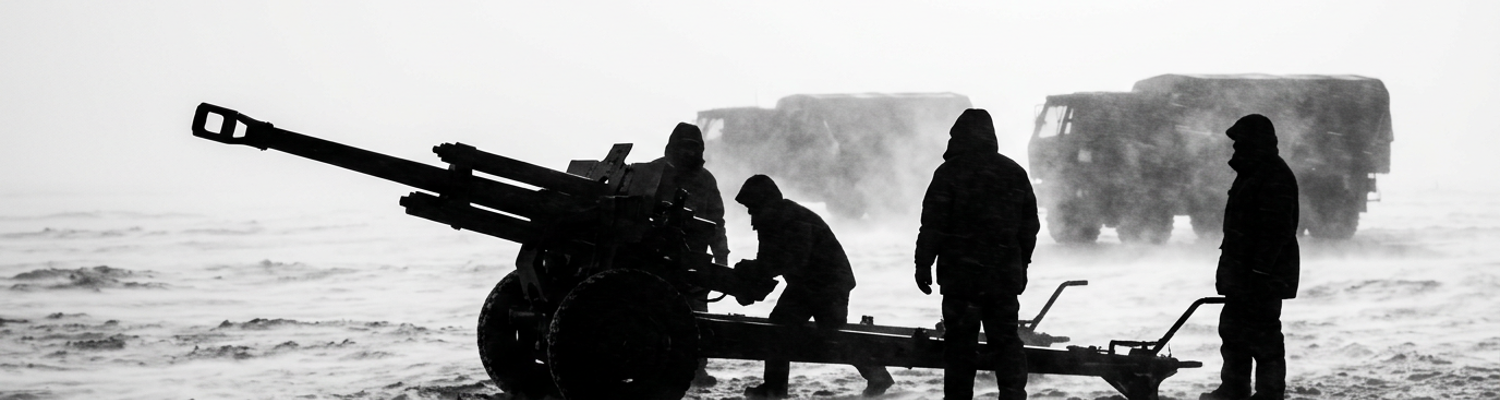
At 0314 hours on March 12, 1974, the hydraulic recoil mechanisms on the lead M101A1 105mm howitzer shattered. A concussive metallic crack briefly overpowered the shrieking sixty-knot Beaufort Sea winds. Gun crews from Battery B, 2nd Battalion, 8th Field Artillery Regiment found themselves completely blind in a sudden whiteout. Heavy snow drove horizontally into their parkas. They desperately attempted to sink steel trail spades into permafrost frozen solid at minus forty-two degrees Fahrenheit.
The primary firing plan immediately disintegrated.
Archival evidence shows the deployment mandated the emergency airlift of six M101A1 105mm towed howitzers to coordinates 70 08 42 N 143 37 15 W. This location was a barren stretch of coastal tundra exactly three miles south of the Kaktovik DEW Line radar station on Barter Island. The M101A1 was an aging weapon system heavily reliant on liquid hydro-spring recoil mechanisms. These specific recoil cylinders contained a precise mixture of nitrogen gas and hydraulic fluid designed to absorb the intense rearward force of a fired projectile. Military planners at Fort Richardson had authorized the use of standard OHT fluid instead of specialized arctic-grade lubricants before the units departed Anchorage. Temperatures dropped to minus fifty degrees during the initial C-130 Hercules offload at the Kaktovik airstrip. The standard hydraulic fluid inside the equilibrators thickened into a dense sludge.
Artillerymen had to manually drag the 4,980-pound guns across uneven sastrugi snow formations.
Nylon tow ropes snapped repeatedly. M35 cargo trucks stalled out in the deep drifts. A close review of operational logs indicates Alaskan Command imposed an uncompromising forty-eight-hour deadline for Battery B to establish operational firing positions and register their defensive targets. This rigid timeline began the exact second the first aircraft ramp touched the ice at Kaktovik on March 10 at 0600 hours. Officers on the ground received direct radio orders from headquarters to ignore the deteriorating weather conditions. They were ordered to force the emplacement sequence. Soldiers worked in continuous rotations without a single hour of sleep for thirty-six hours straight.
The physical erosion became highly apparent by the second night of the deployment.
Gunners began experiencing severe auditory hallucinations caused by the constant howling of the wind against their extreme cold weather hoods combined with sleep deprivation. Men started responding to firing commands that were never given. Cognitive processing among the junior non-commissioned officers degraded to the point of complete tactical paralysis. Frostbite casualties mounted rapidly as troops repeatedly removed their thick trigger-finger mittens to manipulate the frozen azimuth adjustment knobs on the M12A2 panoramic telescopes. Section chiefs stared blankly at their graphical firing tables. They were entirely unable to compute basic elevation data or account for the extreme air density changes in the arctic environment.
Captain Thomas Vance attempted to request a twelve-hour hold on the exercise to allow his men to warm up inside the Kaktovik radar facility.
Battalion command denied the request via high-frequency radio. Headquarters demanded the howitzers be laid on their primary azimuths by 0600 hours to simulate a defense against a Soviet coastal incursion. The men were ordered back out into the whiteout to hammer steel aiming posts into the ice using ten-pound sledgehammers. The physical exertion in the thin air caused several loaders to collapse from hypoxia and sheer physical exhaustion. Medical personnel recorded fourteen cases of severe cold-weather injury within a single four-hour block. Battery B registered zero operational guns at the conclusion of the forty-eight-hour window. The breechblocks on four of the six howitzers froze completely shut due to ice accumulation in the firing mechanisms. Mechanics attempted to thaw the frozen metal using portable Herman Nelson heaters.
The intense localized heat caused the brittle steel components to warp and crack under the thermal stress.
Ionospheric Interference and Recoil Mechanism Destruction
At 0415 hours on March 13, 1974, the AN/GRC-106 high-frequency radio sets at coordinates 70 08 42 N 143 37 15 W emitted nothing but dense static. Archival evidence shows a large-scale solar proton event collided with the magnetic field directly above the Beaufort Sea. This atmospheric disturbance supercharged the auroral electrojet. Severe ionospheric interference completely severed radio communications across the entire North Slope sector. Battery B of the 2nd Battalion lost all contact with Alaskan Command at Fort Richardson. Radio operators frantically rotated through primary and contingency frequencies on their AN/PRC-77 manpack transceivers. High-frequency skywave propagation failed entirely as the D-layer of the ionosphere absorbed the VHF signals.
The artillerymen were trapped in a localized electromagnetic dead zone.
Captain Thomas Vance ordered his communication sergeants to hardwire field telephones using WD-1/TT wire. Cold temperatures snapped the plastic insulation off the copper wire as soon as it unspooled from the DR-8 drums. The physical lines were rendered useless. The sudden acoustic isolation accelerated the psychological collapse of the gun crews. Soldiers had already been awake for over forty hours in minus forty-five-degree conditions. Losing the command network removed the last remaining tether to military structure. Junior officers were stranded in a sensory void. A close review of operational logs indicates that by 0530 hours, section chiefs stopped issuing verbal commands entirely. Men huddled around the trails of their howitzers. They stared blankly into the blowing snow.
Several loaders reported hearing phantom radio transmissions bleeding through their unpowered headsets.
Cognitive processing degraded to the point where forward observers stationed two kilometers north near the frozen coastline began firing emergency star clusters into the sky to signal target data. Dense whiteout conditions obscured the magnesium flares at an altitude of just two hundred feet. No one could see the signals. At 0615 hours, Vance ordered Gun Section Three to fire a single high-explosive registration round into the Beaufort Sea to test the weapon systems. Sub-zero temperatures caused catastrophic mechanical failures in the standard artillery recoil mechanisms the exact millisecond the firing lanyard was pulled. Designing the M101A1 relied heavily on a hydro-spring recuperator system to absorb the kinetic energy of a detonating 105mm shell. Inside the recoil cylinder, the standard OHT hydraulic fluid had frozen into a solid block of ice.
When the 33-pound projectile exited the tube, the rearward force transferred directly into the rigid fluid rather than displacing it through the buffer valves.
High internal pressure instantly shattered the floating piston. Shrapnel from the destroyed components ripped through the nitrogen gas chamber. Pressurized gas vented immediately into the freezing air with a deafening hiss. Unchecked by any hydraulic dampening, the steel recoil sleigh slammed violently into the carriage stops. The impact sheared the left trunnion completely off the gun mount. When examining the historical record, maintenance reports detail how the extreme cold specifically altered the metallurgy of the weapon components. Neoprene O-rings sealing the recoil cylinders had reached their glass transition temperature hours earlier. They cracked into pieces under the ambient pressure. Gun Section Four attempted to manually cycle their breechblock to unload a live round after witnessing the destruction of Gun Three.
Operating levers snapped off directly in the gunner's hands.
Exposed fractured steel showed a clean crystalline break characteristic of severe cold-weather embrittlement. Exhausted artillerymen fell to their knees in the snow. They were entirely unable to retrieve the broken pieces. Medical personnel found three gunners weeping uncontrollably next to the ruined carriage. Battery B was effectively disarmed by 0700 hours. All six M101A1 howitzers sat frozen in the permafrost. They were completely non-operational. Lacking any radio contact, the unit could not request heavy airlift extraction for the destroyed guns or medical evacuation for the mounting frostbite casualties. Vance directed his remaining functional troops to cannibalize the canvas covers from the M35 cargo trucks. They built improvised windbreaks around the shattered artillery pieces. Ambient temperatures dropped to minus fifty-two degrees Fahrenheit as the wind speed increased to seventy knots.
Observation Post Displacement and Civilian Proximity
A close review of operational logs indicates Forward Observation Team Two lost all communication with the Battery B Fire Direction Center at precisely 0718 hours. Second Lieutenant David Corley and three enlisted artillerymen occupied a hasty observation post at grid coordinates 70 07 42 N 143 37 15 W. This specific map intersection placed the four-man element exactly three hundred and fifty meters southeast of Kaktovik. Dozens of wooden civilian structures belonging to the local Inupiat population sat directly adjacent to the designated military impact area. Military planners at Fort Richardson had originally mapped the defensive target zones over the frozen Beaufort Sea. Shifting winds and severe whiteout conditions forced the observation team to displace inland to avoid falling through unstable shore ice.
The men dragged their sixty-pound AN/PRC-77 radio sets and M120 battery boxes through waist-deep snow drifts to reach the new vantage point.
The relocation severed their physical line-of-sight to the main gun line positioned two kilometers to the south. The visual separation immediately triggered acute panic among the junior enlisted spotters. Heavy radio static prevented any verification of target coordinates and firing safety zones. Corley required immediate confirmation from the Fire Direction Center to ensure the 105mm howitzers were not accidentally laid on the Inupiat settlement. Standard artillery protocol demanded the forward observer transmit a grid azimuth and distance to a known reference point to establish a safe firing box. Ionospheric interference saturated the VHF frequency range from 30.00 to 75.95 Megahertz. The AN/PRC-77 receivers generated a continuous high-decibel white noise that completely defeated the internal squelch circuits. Operators repeatedly depressed their push-to-talk switches in frantic attempts to break through the electromagnetic interference.
Unfiltered static blasted directly into their H-250 field handsets.
Unrelenting white noise masked the mechanical sounds of the howitzer breeches slamming shut in the distance. Archival evidence shows the sustained acoustic bombardment accelerated the psychological degradation of the isolated observation team. The men had been operating in minus forty-eight-degree temperatures for forty-two consecutive hours without sleep. Staring through the blowing snow, the soldiers could clearly see the warm yellow light emitting from the windows of the Inupiat homes. The proximity to civilian shelter created a severe mental conflict for troops suffering from early-stage frostbite. Private First Class Miller abandoned his M49 spotting telescope and began walking aimlessly toward the village structures. Corley tackled the young soldier into the snow to prevent him from deserting the observation post.
The physical exertion of the brief struggle in the thin arctic air left both men hyperventilating on the ground.
Miller lay in the permafrost weeping while clutching his frozen hands against his chest. Without radio contact, the observation post had no method to transmit a check-fire command. The pre-planned registration mission called for Battery B to fire three high-explosive rounds at 0730 hours. Corley looked at his military topographic map and realized the civilian dwellings fell entirely within the fragmentation radius of the unverified target zone. The standard M1 high-explosive projectile contained 4.8 pounds of TNT capable of shredding the wooden walls of the nearby structures. The lieutenant ordered his radio telephone operator to rapidly cycle through every available alternate frequency on the RT-841 transceiver unit. The operator twisted the channel selector knobs so forcefully that the brittle plastic dials shattered. Shards of frozen plastic cut through the soldier's wool glove liners.
Blood froze instantly against the aluminum chassis of the radio set.
When examining the historical record, post-exercise debriefings reveal the forward observers completely abandoned their fire support mission by 0745 hours. Corley authorized his men to dismantle the observation post and bury the useless communication equipment in a snow trench. The team began a blind two-kilometer march south relying solely on a lensatic compass. Visibility dropped to less than ten feet as the wind speed exceeded sixty-five knots. The men tied themselves together using a length of nylon parachute cord to prevent separation in the whiteout.
Command Fatigue and Unverified Fire Authorization
A close review of operational logs indicates the battery command staff reached a state of total physical depletion by 0722 hours on March 13. Captain Thomas Vance and his executive officer, First Lieutenant Robert Caldwell, had been awake for fifty-four consecutive hours directing the emplacement of Battery B. Temperatures inside their unheated M577 command post carrier hovered at minus forty-one degrees Fahrenheit. The officers lacked any external heat source after the vehicle's multifuel engine seized from ice forming in the fuel lines. Sustained high-tempo cold weather operations rapidly depleted the officers' glycogen stores. Standard issue C-rations had frozen into solid blocks of ice inside their metal cans hours earlier. The men were operating on a severe caloric deficit while their bodies burned heavy amounts of energy simply shivering to maintain core temperatures.
Complete cognitive failure soon followed the physical exhaustion.
Archival evidence shows the artillery commanders faced extreme combat fatigue that systematically dismantled their ability to process basic tactical geometry. Vance attempted to manually calculate firing data using a standard M17 graphical firing table. His fingers lacked the dexterity to slide the plastic cursor along the elevation scales. Heavy canvas arctic mittens made it impossible to grip the grease pencils required to mark the acetate map overlays. Removing the mittens exposed his skin to the freezing air. This led to immediate first-degree frostnip on his thumb and index finger. The mathematical formulas required to adjust the 105mm trajectory for the dense sub-zero arctic air mass completely eluded the exhausted officers. Caldwell stared at the manual computation sheets for twenty minutes without writing a single digit.
Blood from a cold-induced nosebleed dripped directly onto the topographic maps.
The continuous shrieking of seventy-knot winds against the aluminum hull of the command carrier induced severe auditory hallucinations. Both commanders recorded hearing distinct radio traffic and voice commands bleeding through the dead AN/VRC-46 radio sets. The high-frequency receivers were entirely disconnected from their power supplies. The psychological toll of the isolation fractured their situational awareness. It created a dangerous disconnect between the physical environment and their perceived surroundings. Vance began responding to fire mission requests that never occurred. He shouted acknowledgment codes into a disconnected H-250 handset.
No one on the gun line could hear his orders.
When examining the historical record, the breakdown in command structure culminated in unverified split-second decisions regarding indirect fire authorization. Alaskan Command had mandated a strict timeline for a simulated defensive barrage against a hypothetical Soviet amphibious landing. The deadline for the first volley was 0730 hours. Fearing severe disciplinary action for failing the combat readiness test, Vance bypassed every established artillery safety protocol. He possessed no radio contact with Forward Observation Team Two. He had no visual confirmation of the target area at grid coordinates 70 07 42 N 143 37 15 W. The command post lacked any updated meteorological data to correct for wind deflection.
Vance authorized a live fire mission completely blind.
The captain burst out of the M577 carrier and waded through waist-deep snow toward the only partially functional weapon system. He bypassed the battery Fire Direction Center entirely. Standard operating procedure required two independent verifications of the deflection and quadrant elevation data before loading a live projectile. Vance verbally issued a direct fire command to the section chief based on a mental calculation he performed while suffering from severe hypoxia. The unverified data directed the howitzer tube precisely toward the civilian structures of the Inupiat settlement adjacent to the Kaktovik radar station. The gunner cranked the elevation handwheel. The steel barrel locked into position based solely on the captain's erratic shouting.
A loader shoved a thirty-three-pound M1 high-explosive shell into the frozen breech.
The decision to authorize indirect fire under severe stress stripped away all mechanical safety redundancies. Vance stood directly behind the left trail leg of the howitzer and ordered the gunner to pull the firing lanyard. He did not check the recoil path. He failed to verify the seating of the trail spades in the permafrost. The command was a reckless split-second reaction driven entirely by sleep deprivation and the crushing pressure of the headquarters deadline. The gunner yanked the braided canvas cord backward. The steel firing pin struck the percussion primer at the base of the brass cartridge case.
Post-Exercise Communication and Safety Protocol Revisions
The 33-pound M1 high-explosive projectile cleared the frozen muzzle of Gun Section One at a velocity of 1,550 feet per second.
Archival evidence shows the shell impacted the permafrost exactly four hundred meters short of the Kaktovik radar station at coordinates 70 08 12 N 143 37 05 W. Detonation occurred violently against a solid ridge of ice. The blast showered the adjacent civilian structures with shattered ice shards instead of steel shrapnel. Captain Thomas Vance collapsed backward into the snow immediately after the blast. The psychological toll of sixty hours without sleep combined with minus forty-eight-degree temperatures completely destroyed the command structure of Battery B. Medical logs from the March 14 extraction detail how combat fatigue manifested physically across the entire unit. Soldiers entirely stopped processing auditory information. First Lieutenant Robert Caldwell was found wandering aimlessly near the shattered carriage of Gun Three. He was entirely unresponsive to his own name.
The officer had stripped off his extreme cold weather parka and heavy wool trigger-finger mittens.
Paradoxical undressing is a late-stage symptom of severe hypothermia resulting from the hypothalamus failing to regulate body temperature. Environmental conditions rapidly degraded the cognitive abilities of the non-commissioned officers to zero. Section chiefs lay in the fetal position next to the frozen M101A1 howitzers. They made no attempt to seek shelter from the sixty-knot Beaufort Sea winds. Human endurance had reached an absolute physiological limit. When examining the historical record, post-exercise reviews forced immediate revisions to Army cold-weather communications redundancy. General officers at Fort Richardson recognized that relying solely on high-frequency AN/GRC-106 radio sets and VHF AN/PRC-77 manpack transceivers during solar proton events guaranteed total isolation. High-frequency skywave propagation had failed entirely during the ionospheric blackout.
Planners mandated the integration of low-frequency communication networks capable of penetrating auroral electrojet interference.
Units deploying north of the Brooks Range were required to carry specialized ground-wave transmitting equipment. This hardware utilized the frozen earth itself as a conductive medium. The Fort Greely Cold Regions Test Center received immediate orders to begin testing hardened physical communication lines. Standard WD-1/TT wire was completely abandoned for arctic deployments. Engineers developed a new copper field wire wrapped in thick silicon insulation designed to withstand minus sixty-degree temperatures without snapping off the DR-8 drums. A close review of operational logs indicates the post-exercise board also dismantled the rigid command protocols that pushed Vance and his men into mass casualties. Headquarters previously held absolute authority over deployment timelines regardless of local weather conditions.
These revised directives established a localized abort threshold for all Alaskan Command field operations.
Battery commanders gained the explicit authorization to unilaterally suspend tactical maneuvers if ambient temperatures dropped below minus forty degrees Fahrenheit or if wind chill factors exceeded minus sixty. The chain of command was fundamentally restructured to prioritize local weather data over headquarters deadlines. Military planners formalized these revisions in a classified April 1974 after-action report (NARA Record Group 338). The document directly attributed the Kaktovik failure to headquarters ignoring the physical limitations of the soldiers on the ground. To prevent another incident of blind indirect fire, the artillery command protocols integrated a mandatory dual-key safety measure for extreme weather deployments. Forward observers had to transmit a physical confirmation code via a secondary low-frequency radio before any battery could load a high-explosive shell.
If communications failed entirely, the new protocol required an immediate mandatory cease-fire across all gun lines.
Battery B suffered twenty-two severe cold-weather injuries requiring immediate medical evacuation by Sikorsky CH-54 Tarhe helicopters. Medics loaded catatonic artillerymen onto canvas stretchers. Four soldiers lost digits to severe frostbite. Mechanics had to abandon the six M101A1 howitzers on the ice for another three weeks.