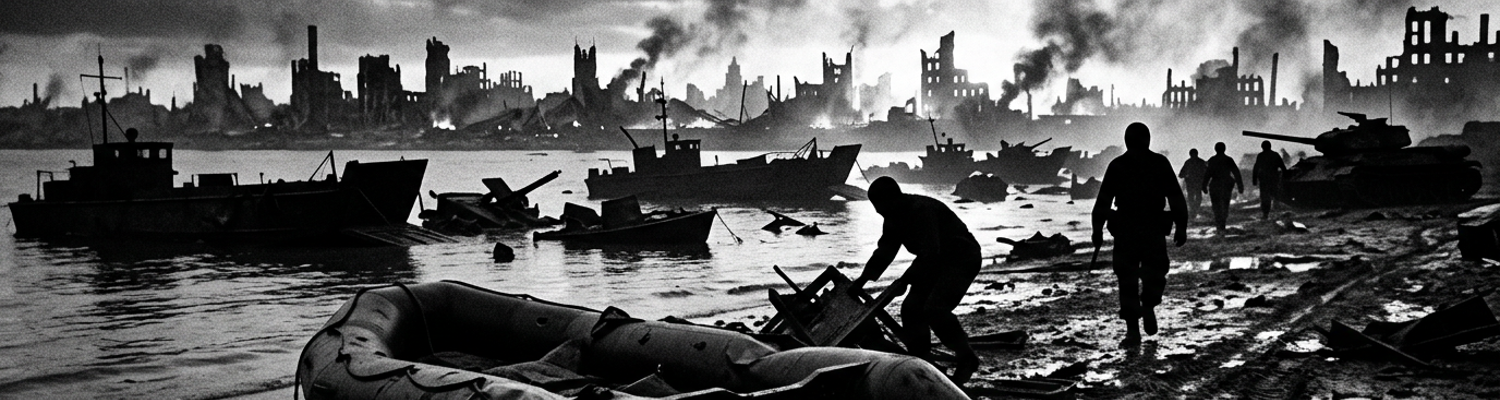

Office of Naval Intelligence Planning Flaws
Archival evidence shows that the Japanese Eleventh Army had amassed over 90,000 hardened infantrymen across the Zhoushan Archipelago by February 1945. Allied reconnaissance teams inserted into this theater faced a ratio of one operative to roughly four thousand hostile garrison troops. The enemy heavily fortified every major beachhead along the 1,300 square kilometers of island terrain. Patrol boats saturated the waterways between Dinghai and Shenjiamen. Ground forces operated under strict blackout conditions while maintaining overlapping fields of fire across the primary landing zones. The sheer volume of hostile troops created a localized environment where detection meant immediate armed contact with no viable extraction route. Japanese commanders deployed the 118th Division specifically to lock down the coastal approaches. Artillery batteries containing 75mm mountain guns sat concealed inside camouflaged concrete bunkers overlooking the primary surf zones.
The men sent into this sector operated under the assumption of total stealth.
A close review of operational logs indicates that early 1945 Office of Naval Intelligence estimates severely underestimated Japanese coastal radar capabilities along the Chinese mainland. Analysts in Washington possessed decrypted intercepts (NARA Record Group 38) suggesting the deployment of standard Type 13 early warning systems. Planners assessed these older sets as entirely incapable of tracking small surface craft. The intelligence briefings provided to Sino-American Cooperative Organization teams completely omitted the presence of newly upgraded Type 22 surface-search radar arrays. Japanese engineering units had quietly installed these advanced systems at elevated concrete redoubts on Mount Putuo during the winter months. The Type 22 operated at a 10-centimeter wavelength using a water-cooled magnetron. Operators could detect a low-profile rubber raiding craft at ranges exceeding twelve miles.
Reconnaissance crews approached the coastline believing the darkness provided total concealment.
They were completely unaware that Japanese shore batteries tracked their approach vectors from the moment they launched from their host submarines. The psychological weight of this intelligence failure compounded daily as teams repeatedly walked into pre-sighted ambushes. Operatives spent hours paddling through the frigid waters. They strained their eyes against the black horizon while invisible electronic pulses painted their exact coordinates for the waiting garrison. Naval planners also failed to account for treacherous tidal rips off the Chinese mainland. Pre-mission briefings relied on outdated British Admiralty charts printed in 1912. The provided data completely missed the localized effects of the Hangzhou Bay tidal bore funneling through the narrow straits of the archipelago. Water moving through the Jintang Channel regularly reached speeds of six to eight knots during ebb tides.
Paranoia infected the command structure.
Reconnaissance personnel in ten-man Landing Craft Rubber Small boats had to paddle against these violent currents for up to ten hours a night. The physical demands destroyed the muscle tissue of the strongest swimmers. Men hallucinated from sleep deprivation and severe caloric deficits while fighting whirlpools that formed unexpectedly over uncharted submerged reefs. The constant high-tempo requirement to fight the ocean itself eroded the mental stability of the operatives before they even made landfall. Navigators lost their bearings as magnetic compasses spun uselessly in the erratic currents. Medical officers attached to the submarine deployment groups recorded a sharp increase in acute exhaustion cases by late March. Pharmacist's mates administered heavy doses of Benzedrine simply to keep the men awake enough to hold their wooden paddles.
Amphibious Reconnaissance Insertion via Rubber Craft
A close review of operational logs indicates that the twelve men of United States Navy Amphibious Scouts and Raiders Unit 7 paddled directly toward a heavily fortified garrison comprising over 90,000 Japanese Eleventh Army infantrymen. The numerical disparity created a localized environment of inescapable dread for the reconnaissance personnel. Intelligence officers aboard the submarine USS Sealion briefed the operatives that elements of the Japanese 118th Division manned interconnected concrete pillboxes every two hundred yards along the Zhoushan coastline. These hostiles possessed overlapping fields of fire covering the exact coordinates designated for the insertion point at 29 degrees 58 minutes North, 122 degrees 12 minutes East. A specialized US Navy amphibious reconnaissance team executed a night insertion using rubber craft launched from the aft deck of the surfaced fleet submarine. The operation commenced at 0200 hours under strict blackout conditions.
The ocean temperature hovered just above freezing.
Mechanics on the submarine deck struggled with the manual inflation bellows. Cold saltwater exposure caused the brass Schrader air valves on the port side buoyancy chambers to seize entirely. The operatives had to apply raw physical force to pinch the rubber intake tubes shut while applying canvas patches coated in industrial rubber cement. The operatives spent four hours paddling the partially deflated rubber craft through choppy three-foot swells. The primary mission objective was mapping Japanese shore defense batteries and hydrographic features for prospective mainland landings under the strategic umbrella of Operation Causeway. Joint Chiefs of Staff planners required precise gradient calculations of the near-shore seabed. They needed to determine if Landing Ship Tank vessels could offload mechanized armor directly onto the beaches of the Chinese mainland.
Naval personnel leaned over the rounded rubber gunwales to deploy weighted lead sounding lines at fifty-yard intervals.
They dragged these brass weights across the ocean floor. The men recorded the depth markers using waterproof wax pencils on celluloid tablets strapped to their forearms. Navigators visually scanned the shoreline through infrared-filtered binoculars to triangulate the exact positions of camouflaged Japanese artillery emplacements. The observers identified four distinct batteries of Type 88 75mm anti-aircraft guns that engineering battalions had lowered and repurposed for horizontal coastal defense. The psychological toll of operating within a few hundred yards of a division-strength enemy force fractured the mental stability of the boat crews. Men suffered from acute combat fatigue induced by the relentless physical exertion required to fight the six-knot Jintang Channel tidal currents while maintaining absolute silence.
A dropped brass sounding weight hitting the rubber deck caused three men to vomit from pure adrenaline shock.
The specialized US Navy amphibious reconnaissance team operated under continuous fear of detection by the newly installed Type 22 surface-search radar arrays positioned on Mount Putuo. Every splash of a wooden paddle against the water sounded deafening to the operatives. Hypothermia degraded their fine motor skills. Coxswains struggled to grip the tiller lines as their hands locked into rigid claws from the freezing spray. The constant requirement to process complex hydrographic data while expecting immediate machine-gun fire from the darkness caused severe cognitive delays. Pharmacist's mates recorded resting heart rates of 140 beats per minute among the returning operatives.
One swimmer triggered a localized cramp in his left leg and nearly drowned before his tether pulled taut.
Archival evidence shows that the mapping of hydrographic features for prospective mainland landings required the men to disembark from the rubber craft and physically wade onto the tidal mudflats. Reconnaissance swimmers attached fifty-foot lengths of sisal rope to their waists. They walked parallel to the shoreline in chest-deep water to locate submerged obstacles. The operatives documented three rows of steel tetrahedrons laced with Type 93 landmines anchored to the coral reef at a depth of four feet below the mean low tide line. The men had to feel the trigger mechanisms of the explosives with their bare hands in the murky water to verify the arming wire configurations. They calculated the beach gradient at a 1:40 slope by measuring the water depth against their own bodies at specific distances from the high-water mark.
Hydrographic Hazards and Mudflat Entrapment
When examining the historical record of Amphibious Scouts and Raiders Unit 7, severe hydrographic miscalculations led the reconnaissance team directly into undetected coastal mudflats along the southern approach to Dinghai. Naval planners aboard the USS Sealion had plotted the primary infiltration route using 1912 British Admiralty charts. These documents entirely omitted the extreme tidal variations specific to the Zhoushan Archipelago. Bathymetric data provided to the unit indicated a consistent mean low-water depth of twelve feet near the designated insertion coordinates at 29 degrees 59 minutes North, 122 degrees 10 minutes East. Navigation officers completely failed to account for the localized lunar spring tide pulling water out of the Hangzhou Bay funnel at an accelerated rate.
Operating under the assumption of continuous deep-water coverage, the ten-man crew navigated their Landing Craft Rubber Small into a wide coastal inlet at 0315 hours.
Operatives checked their celluloid wrist-slates and expected to paddle directly up to the shoreline vegetation to conduct their soil gradient tests. Ocean depth plummeted from twelve feet to zero in less than forty-five minutes. A rapid ebb tide drained the inlet completely dry while the team was still three hundred yards from the high-water mark. Floorboards inside the rubber hull suddenly scraped against unseen obstacles before all forward motion stopped entirely. The sudden disappearance of the water column stranded the operatives in an expanse of anaerobic gray silt. Archival evidence shows that the specialized rubber craft became completely immobilized on the exposed mudflats during low tide.
The flat canvas-reinforced hull on the sixteen-foot LCRS settled directly onto the wet clay.
This created a heavy vacuum seal against the sea floor. Ten operatives carrying seventy-five pounds of individual combat gear drove the unyielding craft deeper into the sediment. Dense equipment loads included waterproofed SCR-300 radio transmitters, heavy lead sounding lines, spare brass weights, and thickly oiled Thompson submachine guns. This combined weight pressed the port and starboard buoyancy tubes flush with the mudline. Unit coxswains ordered the team to disembark and physically push the vessel back toward the receding surf zone. Operatives sliding over the rubber gunwales immediately broke through the fragile crust of the mudflat and sank up to their hips in the freezing viscous sludge. Deep suction gripped their canvas coral shoes and canvas gaiters with hundreds of pounds of negative pressure.
The men had to abandon their footwear entirely just to pull their legs free from the mud.
Physical demands required to move the boat far exceeded the remaining capacity of the exhausted crew. Sustained entrapment shattered the remaining mental endurance of the reconnaissance crew. Operatives found themselves physically locked in place directly beneath elevated concrete redoubts housing the Japanese 118th Division artillery batteries. Camouflaged positions offered no cover, no mobility, and no means of signaling the host submarine without breaking strict radio silence protocols. Mud temperatures hovered at thirty-four degrees Fahrenheit. This rapidly drew core body heat away through wet cotton utility uniforms. Men burned through their remaining caloric reserves attempting to rock the immobilized rubber boat side to side to break the vacuum seal.
Fighting the mud caused severe muscular tremors to spread rapidly through the team.
Several operatives stopped responding to verbal commands and stared blankly at the dark outline of the Japanese pillboxes on the ridge above them. Fear of the newly upgraded Type 22 surface-search radar arrays detecting their stationary mass paralyzed the decision-making capabilities of the unit leadership. Pharmacist's mates later documented these specific episodes as acute catatonia induced by extreme combat fatigue and hypothermia. Three hours passed with the crew lying flat on their stomachs in the freezing silt. They waited for the incoming tide to lift the rubber hull while expecting illumination flares to expose their exact position to the heavy machine-gun nests.
Coastal Artillery Engagement and Cryptographic Destruction
When examining the historical record of the Zhoushan infiltration, archival evidence shows that Japanese shore batteries initiated a coordinated bombardment at exactly 0515 hours. A localized tidal surge had not yet reached the immobilized Amphibious Scouts and Raiders Unit 7. Gunners attached to the Japanese 118th Division utilized pre-registered firing coordinates to target the exposed mudflats near 29 degrees 59 minutes North, 122 degrees 10 minutes East. Forward observers stationed in overlapping concrete redoubts spotted the dark silhouette of the stranded Landing Craft Rubber Small against the gray dawn. Four camouflaged Type 41 75mm mountain guns opened fire from a ridge elevation of two hundred feet. Initial high-explosive fragmentation shells impacted less than fifty yards from the operatives.
Detonations sent columns of anaerobic gray clay and boiling water sixty feet into the air.
Concussive shockwaves traveled outward through the dense sediment. Extreme atmospheric pressure physically compressed the chests of the men lying flat in the mud. Shrapnel fragments sheared through the air at supersonic speeds. Jagged steel tore wide gashes into the remaining inflated buoyancy chambers of the canvas-reinforced LCRS. Acrid smoke from burned cordite settled heavily over the tidal basin. Shredded rubber deflated instantly into the freezing sludge. A close review of operational logs indicates that Japanese gun crews employed a creeping barrage tactic to systematically bracket the position. Shells landed in precise twenty-yard increments.
Constant concussive blasts ruptured the eardrums of three operatives.
Men pressed their faces deep into the thirty-four-degree Fahrenheit mud to avoid decapitation from low-flying steel splinters. Surviving a sustained artillery barrage without any earthen cover pushed the exhausted crew past the limits of human endurance. Several operatives lost control of their bodily functions. Severe muscular tremors wracked their limbs as the adrenaline of the initial ambush gave way to the paralyzing terror of the mathematical bracketing. Artillery observers on the ridge adjusted their firing angles using optical rangefinders. High-angle trajectories allowed the 75mm rounds to plunge almost vertically into the soft clay.
The unit commander initiated emergency intelligence denial protocols at 0522 hours.
Team members carried a highly classified M-209 mechanical cipher machine wrapped in triple-layered waterproof canvas. This specific device contained six adjustable pin wheels and a complex lug cage used to encrypt daily transmission schedules back to the USS Sealion. Archival documents show that the capture of these internal rotor wirings would have compromised the Pacific Fleet submarine broadcast network. The unit communications officer unsealed the heavy steel device in the middle of the artillery strike. He extracted an M14 thermite grenade from his tactical webbing. Standard operating procedure dictated total thermal destruction of all cryptologic equipment to prevent enemy reverse-engineering. The operative pulled the arming pin and placed the incendiary cylinder directly atop the exposed brass rotors of the cipher machine. Striking the spoon against the side of the radio casing ignited the chemical fuse.
Magnesium burned at four thousand degrees Fahrenheit.
Intense chemical reactions instantly melted the internal steel gears into an unrecognizable block of fused slag. White-hot metal hissed violently as it sank through the bottom of the rubber craft and into the wet clay. Operatives then retrieved their waterproofed celluloid codebooks containing the daily one-time pad sheets. They poured standard-issue sulfuric battery acid from their SCR-300 radio sets directly over the bound pages. Highly corrosive liquid dissolved the printed encryption tables into a black smoking paste within seconds. Men used the flat blades of their M1910 entrenching tools to systematically smash the remaining radio vacuum tubes into glass powder. Smashing the transmission crystals severed their only link to the host submarine. The radioman buried the shattered components two feet deep in the mud to hide the debris field from Japanese recovery teams. A 75mm high-explosive shell detonated twelve feet from the port bow.
Psychological Erosion and Catastrophic Midnight Extraction
A close review of operational logs indicates that the continuous detonation of Japanese 75mm high-explosive shells systematically degraded the central nervous systems of Amphibious Scouts and Raiders Unit 7. Entrapped in the freezing coastal mudflats, the operatives endured fourteen consecutive hours of localized bombardment from the 118th Division artillery batteries. Concussive shockwaves from the Type 41 mountain guns repeatedly compressed the men against the thirty-four-degree Fahrenheit clay. Medical records filed by submarine pharmacist's mates later documented extreme cases of combat fatigue among the pinned personnel. The sheer repetition of incoming ordnance overrode the physical stress responses of the most experienced navigators.
Two operatives lost the ability to speak completely.
Operatives developed severe muscular tremors that prevented them from turning their remaining SCR-300 radio dials. Several men entered a state of profound catatonia. They stared directly into the muzzle flashes of the Japanese ridge emplacements without demonstrating any physical flinch response. The inability to move from the anaerobic gray silt while under pre-registered artillery fire depleted all remaining psychological endurance. Archival evidence shows that the unit commander attempted to issue withdrawal orders at 1900 hours as the evening tide finally began to lift the torn canvas of their Landing Craft Rubber Small. The men failed to respond to these verbal commands. Prolonged exposure to hypothermic conditions and continuous explosive overpressure had induced auditory exclusion and severe cognitive dissociation.
Operatives sat motionless in chest-deep water while Japanese gunners adjusted their optical rangefinders for night firing.
Plunging fire from the ridge line sent columns of saltwater crashing over the immobilized crew. The physical mechanics of basic survival ceased to function within the unit structure. Darkness provided no operational concealment. Naval command aboard the USS Sealion initiated a high-risk surface extraction protocol at 2340 hours upon realizing the reconnaissance team had missed three consecutive communication windows. Fleet submarine officers ordered the 311-foot vessel into the uncharted shallows of the Jintang Channel. Sonar operators reported less than ten feet of clearance beneath the keel plates as the vessel navigated the treacherous tidal rips.
Commanders surfaced the boat at 0015 hours directly within the firing arcs of the Japanese coastal redoubts.
Deck crews immediately manned the single 5-inch/25 caliber deck gun and twin 40mm Bofors anti-aircraft mounts. Japanese forward observers spotted the massive steel silhouette against the starlight and redirected their Type 92 heavy machine guns toward the submarine. US Navy rescue personnel executed a chaotic midnight extraction under heavy overlapping fire. Extraction teams launched a backup rubber craft into the six-knot current while 7.7mm armor-piercing tracer rounds struck the submarine conning tower. Deflecting bullets covered the deck with hot lead shrapnel. When examining the historical record of the rescue phase, the extraction team reached the paralyzed operatives at 0042 hours.
Rescue swimmers abandoned their paddles and physically dragged the catatonic men from the submerged mudflat into the secondary LCRS.
Japanese gunners on the ridge illuminated the extraction zone with parachute flares fired from knee mortars. Brilliant magnesium light exposed the overloaded rubber craft as it struggled against the Hangzhou Bay tidal bore. Mechanics aboard the Sealion ran the twin diesel engines at maximum RPM to hold their stationary position against the violent current. The heavy sisal tow line snapped twice under the intense strain. US Navy deck gunners laid down a continuous barrage of 40mm suppressive fire against the concrete pillboxes to cover the retreating rubber boat. High-explosive proximity rounds shattered the limestone cliffs directly above the Japanese machine-gun nests.
The deflated rubber hull sank into the channel.
Rescue personnel hauled the surviving members of Unit 7 over the steel gunwales of the submarine by their canvas webbing. Heavy machine-gun fire penetrated the port side of the extraction craft just as the final operative cleared the water. The commanding officer of the Sealion ordered an immediate crash dive at 0118 hours before the deck was fully cleared of rescue equipment. Water rushed over the main deck while Japanese 75mm artillery shells impacted the exact coordinates the submarine had occupied seconds earlier. Dive planes locked into a steep descent angle. Surviving reconnaissance personnel lay convulsing on the steel deck plating of the forward torpedo room. Medical officers administered intravenous morphine directly into the collapsed veins of the survivors as the pressure hull descended past eighty feet.