
The Gadget's First Light
The pre-dawn darkness over the Jornada del Muerto desert in New Mexico shattered at 5:29 a.m. on July 16, 1945. A plutonium implosion device, known clinically as the 'Gadget', detonated with a force of 21 kilotons of TNT. The 100-foot steel tower supporting it vaporized instantly. Desert sand fused into a green, radioactive glass later called Trinitite. This event, the Trinity Test, was the violent culmination of the Manhattan Project, a sprawling, top-secret enterprise run by the U.S. Army Corps of Engineers. Major General Leslie R. Groves, a man defined by logistical genius and unyielding drive, managed the project. He worked alongside the scientific director, J. Robert Oppenheimer, a theoretical physicist whose intellect guided the weapon's creation. The project employed over 130,000 people across sites like Oak Ridge, Tennessee, and Hanford, Washington, yet its true purpose remained a secret guarded by extreme compartmentalization. Workers knew only their specific task, forbidden from discussing it. A state within a state existed, its sole purpose to build a weapon of theoretical power.
The success at Trinity was not guaranteed. Top scientists had wagered on its outcome, from a dud to the atmospheric ignition they privately feared. With the brilliant flash, a scientific experiment became a military asset. The transition was immediate and decisive. General Groves had already integrated the Army Air Forces (AAF) into his planning. He understood that the device was useless without a reliable delivery method. The formal order came on July 25, 1945, signed by Secretary of War Henry Stimson. It directed the AAF's 509th Composite Group to deliver the first 'special bomb' as soon as weather permitted after August 3rd. This directive marked a profound operational shift. The AAF had built its doctrine around massive fleets of bombers systematically grinding down an enemy's industrial capacity. Now, it was handed a single device that could eclipse the destructive power of a thousand-bomber raid. The responsibility for wielding this power fell to a single, specially created unit.
Wendover's Secret Warriors
The instrument for this new form of warfare was the 509th Composite Group, a self-contained unit activated on December 17, 1944. Its commander, Colonel Paul W. Tibbets, was a decorated combat pilot and one of the AAF's most experienced B-29 test pilots. In September 1944, Groves and General Uzal Ent briefed Tibbets on the nascent atomic weapon. His orders were direct: form and train a unit to deliver it. Tibbets selected Wendover Army Air Field in Utah as his base of operations. Its extreme isolation on the edge of the Great Salt Lake Desert provided the perfect cloak of secrecy. He reportedly called it 'the end of the world', which suited his purpose perfectly. The base was secured with a perimeter fence and patrolled by military police on horseback. Agents of the Counter Intelligence Corps moved among the men, posing as ordinary personnel, listening for any breach of security.
The 1,800 men of the 509th were handpicked for their skill and psychological resilience. They knew their mission was important, but its true nature was a complete mystery. This fostered an environment of intense speculation, rumor, and professional isolation. Their training regimen was bizarre and physically demanding. Crews flew relentless practice missions, dropping inert, concrete-filled bombs or large orange-painted mock-ups filled with high explosives. These 'pumpkin bombs' simulated the ballistics of the real weapon. Immediately after release from 30,000 feet, pilots executed a violent, 155-degree diving turn. This maneuver, practiced over and over, was designed to escape the blast wave of a weapon whose power they could only guess at. The high-G turn placed immense stress on the B-29 airframe and the crew, a constant physical reminder of the unknown danger they were preparing to face. Only Tibbets and a handful of others, like the unit's weaponeer Captain William 'Deak' Parsons, knew the full truth until the final briefings for the combat mission.
Engineering the Atomic Sword
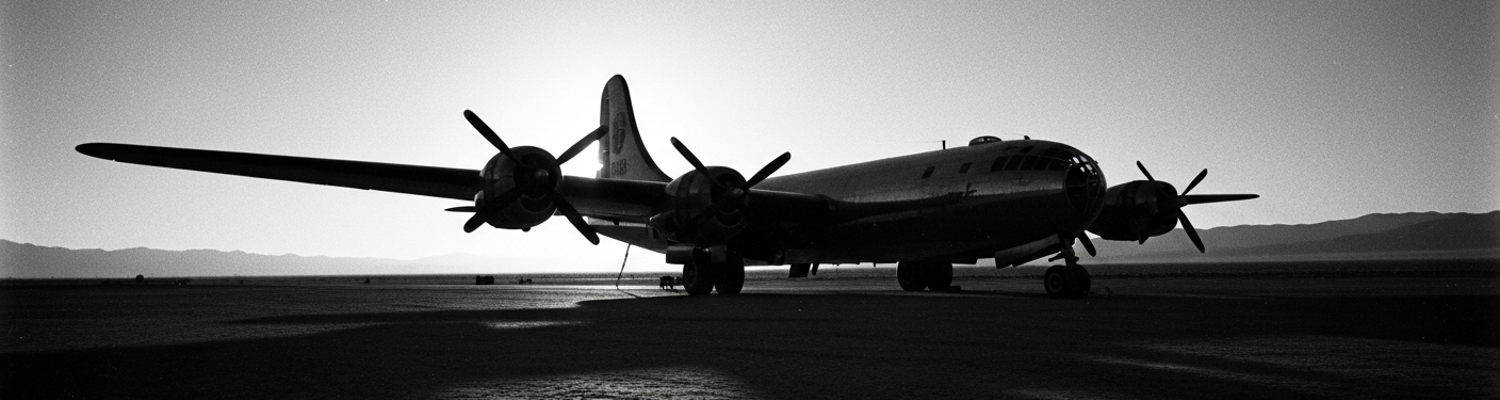
The B-29 Superfortress, the most advanced bomber of the war, required significant alteration to carry an atomic weapon. The modification program, codenamed 'Silverplate', began in late 1943 at Wright Field, Ohio. Engineers had to ensure the bomber could accommodate the large and heavy physics packages being designed at Los Alamos. The initial 'Thin Man' plutonium gun-type design was over 17 feet long. This required removing the bulkhead between the B-29's two bomb bays and fabricating new, longer bay doors. While the 'Thin Man' project was eventually abandoned in favor of an implosion design, the airframe modifications proved essential for the bulbous 'Fat Man' weapon.
Specialist modification centers, primarily the Glenn L. Martin Company facility in Omaha, Nebraska, transformed standard B-29s into Silverplate aircraft. The process was subtractive as much as it was additive. To increase altitude and speed for the escape maneuver, all defensive armament and armor plating were removed, except for the tail gunner's position. This stripped over 6,000 pounds from the aircraft. The standard Wright R-3350 radial engines were replaced with fuel-injected versions for improved performance at high altitude. Curtiss Electric reversible-pitch propellers were installed to shorten the landing roll on the limited runways of Pacific islands. Inside the aircraft, a new station was created for the weaponeer. This position featured a complex control panel to monitor the bomb's internal systems and execute the final arming sequence. The bomb bay doors were actuated by rapid-acting pneumatic systems, designed to snap open in less than a second for a clean release. These were not bombers in the conventional sense. They were highly specialized, single-purpose delivery systems, representing the apex of wartime aeronautical engineering, each one a closely guarded national asset.
A New Calculus of Power
The light from the Trinity Test reached across the globe to Potsdam, Germany. President Harry S. Truman was there, negotiating the postwar order with Winston Churchill and Joseph Stalin. On July 16, he received a coded message from Secretary Stimson:
Operated on this morning. Diagnosis not yet complete but results seem satisfactory and already exceed expectations.
A more detailed report followed, confirming the immense power of the test. This knowledge fortified Truman's diplomatic position. American reliance on the Soviet Union's promised entry into the war against Japan was suddenly and dramatically reduced. On July 24, Truman approached Stalin and casually mentioned that the United States had a 'new weapon of unusual destructive force.' Stalin, already informed of the Manhattan Project by his own intelligence network, showed little outward reaction. He simply replied that he was glad to hear it and hoped they would make 'good use of it against the Japanese.'
Stalin's feigned calm did not reflect the reality of the situation. Within the AAF high command, the bomb forced an immediate and radical strategic re-evaluation. For years, General Henry 'Hap' Arnold, the commander of the AAF, and strategic bombing advocates like General Carl 'Tooey' Spaatz had argued that air power could be decisive. They believed it could win wars by destroying an enemy's industrial capacity and will to fight. The bloody air campaigns over Europe, however, had shown that this was a costly, attritional process. The atomic bomb changed the equation completely. It offered the possibility of achieving strategic objectives not in months, but in hours. A single aircraft could now deliver a city-destroying blow, a task that previously required a thousand heavy bombers. This validated the core theory of strategic air power in the most absolute terms. The AAF was no longer just a supporting arm for ground forces. It was now the primary instrument of national power, capable of projecting overwhelming force across the globe. The atomic dawn over New Mexico did more than signal the end of World War II. It secured the AAF's future as an independent service and laid the foundation for the nuclear deterrence strategy that would define the next fifty years of global conflict.