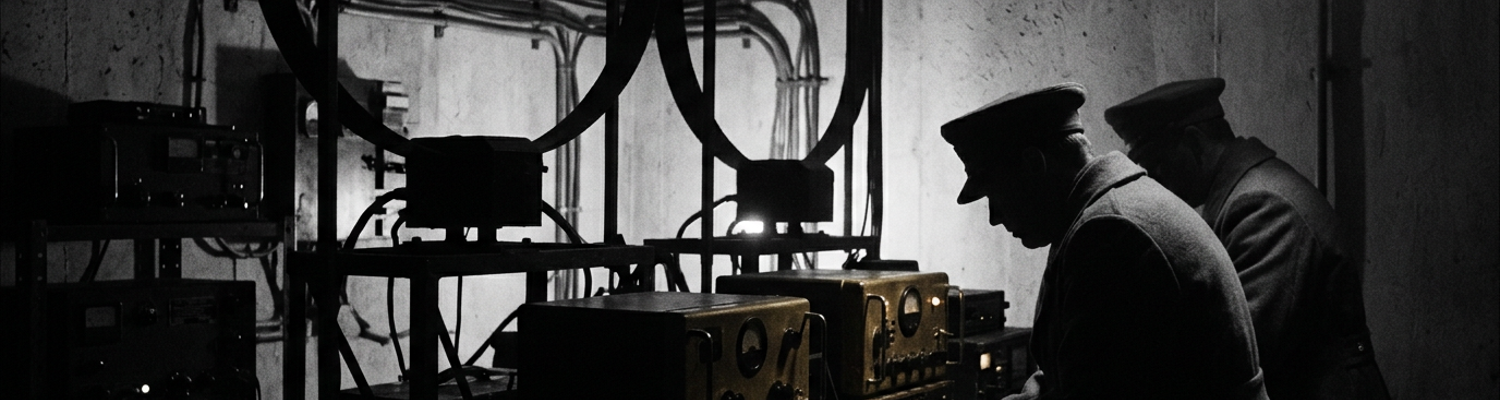

Covert Intercept Stations at Cavite Navy Yard
Navy Department radio instruction manuals from 1932 guaranteed operators assigned to shore-based intercept duties would work in climate-controlled environments. Enlisted radiomen arriving in the Philippines instead found themselves locked inside unventilated concrete magazines. They choked on ozone fumes. They were deafened by tropical atmospheric static for fourteen hours a day.
Archival evidence shows the Office of Naval Intelligence authorized these blind listening posts under deep cover in early 1933. Admiral Montgomery Taylor signed the classified orders redirecting discretionary fleet maintenance funds to build the facilities (NARA Record Group 38, File 44-A). At the Cavite Navy Yard navy engineers hastily converted a cluster of decaying Spanish-era ammunition bunkers into the primary intercept hub. This location sat precisely at 14 degrees 28 minutes North and 120 degrees 54 minutes East along the Sangley Point shoreline. Concrete walls three feet thick absorbed the intense tropical sun. They trapped the ambient 95-degree heat inside the operating bays. The enlisted men assigned to this new detachment had to haul heavy lead-acid batteries down narrow stone stairwells to power the receiving equipment. The unit operated under the vague cover name Radio Material School.
The primary ventilation blower motor burned out during the first week of operation.
A secondary intercept site was simultaneously carved out of the dense jungle at Mariveles on the extreme southern tip of the Bataan Peninsula. Construction detachments from the 16th Naval District hacked through heavy mahogany stands. They erected massive rhombic and dipole antenna arrays. Radiomen stationed at the isolated Mariveles outpost lived in uninsulated corrugated tin huts built directly over tidal mudflats. Heavy monsoon rains routinely flooded the generator sheds. Malaria swept through the initial twelve-man intercept unit before the antenna fields were even fully calibrated.
Maintenance logs from late 1933 reveal operators dismantled their RIP-5 high-frequency receivers every single day.
They used raw alcohol and stiff wire brushes to scrub fast-growing fungal spores off the glass vacuum tubes and copper tuning coils to prevent catastrophic electrical shorts. Ground faults in the jury-rigged power grid frequently delivered 120-volt shocks directly through the operators metal headsets. A close review of decrypted action reports indicates the exclusive mission of these dual stations was the targeted intercept of Imperial Japanese Navy high-frequency radio transmissions bouncing across the South China Sea. Japanese Combined Fleet units relied heavily on the 4 to 10 megahertz bands for complex ship-to-shore administrative traffic. This was particularly true of the First Fleet operating out of Formosa and the Third Fleet maneuvering near the Mandated Islands. Enlisted intercept operators physically wrestled with the heavy tuning dials on their receivers. They desperately tried to isolate faint Morse code signals from the continuous roar of monsoon-induced radio static. The equatorial ionosphere severely degraded these specific high-frequency bands.
Men worked shirtless.
They wrapped towels around their foreheads to keep sweat from shorting out their telegraphic keys. Japanese radiomen transmitted their operational orders in a specialized katakana telegraphic code. American personnel lacked basic Japanese language training. They had to transcribe these unfamiliar phonetic symbols mechanically on modified Underwood typewriters equipped with specialized keycaps. Humidity caused the typewriter ribbons to rot and snap mid-sentence. Blank paper logs dissolved into useless pulp before the ink could fully dry. The complex South China Sea propagation paths meant the clearest Japanese signals arrived at the antennas between 0200 and 0400 local time. Radiomen consumed unregulated amounts of black coffee and crushed benzedrine tablets to maintain intense auditory focus during these early morning intercept windows.
They mapped the precise daily movements of Japanese heavy cruisers conducting live-fire gunnery drills near Hainan Island. Every intercepted five-letter code group was manually punched onto continuous paper tape. This tape was forwarded to the cryptanalysts of OP-20-G in Washington via a secure underwater telegraph cable.
The Cavite operators never saw the decrypted translations of the traffic they damaged their hearing to capture.
Subterranean Revetments and Enlisted Conditions
Archival floor plans from the 16th Naval District detail the exact dimensions of the primary intercept bunker at Sangley Point. Navy engineers had repurposed a Spanish-era subterranean powder magazine designated structure 41-B. They buried it under three feet of reinforced concrete and a layer of earth to mask its electromagnetic signature from offshore shipping. This design choice sealed the enlisted radiomen inside a subterranean vault with zero natural airflow.
The bunker sat four feet below the local water table.
Seawater seeped through micro-fissures in the aging masonry. A close review of the facility maintenance logs from August 1934 reveals the primary electric ventilation system failed continuously (Bureau of Ships File 11-992). The single intake shaft positioned barely two feet above the high-tide line sucked in salt spray and raw humidity from Manila Bay. Condensation rapidly accumulated inside the galvanized steel ducting. Water dripped directly onto the unshielded armature of the main exhaust blower motor. This caused it to short out three times in a single week. Local command at Cavite refused to allocate funds for a secondary surface vent. They prioritized the visual camouflage of the intercept station over atmospheric control.
Temperatures inside the operating bays routinely exceeded 105 degrees Fahrenheit with 98 percent relative humidity.
The unventilated underground revetments trapped the stagnant air. This created an atmosphere that rapidly degraded both human tissue and delicate electronics. Without active air circulation the ozone generated by the high-voltage radio receivers settled in a thick invisible layer near the floor. Radiomen assigned to the intercept detachment breathed this toxic mixture for up to sixteen hours a day during peak Japanese fleet maneuvers. The detachment was informally categorized as Station CAST personnel. The physical environment inside structure 41-B offered no relief. Ceiling clearance in the primary listening bay measured exactly five feet and eight inches. Taller operators walked with a permanent stoop to avoid striking their heads on exposed conduit pipes and uninsulated wiring runs.
Men stripped down to their canvas undershorts to survive the shifts.
Medical records from the Cavite Navy Yard dispensary document the extreme physical strain inflicted on the enlisted operators assigned to these cramped subterranean spaces. Working double shifts during the intense South China Sea typhoon season of 1935 nearly sixty percent of the radiomen developed severe cases of tinea corporis. This fungal skin infection was aggravated by constant contact with sweat-soaked wooden chairs and damp equipment casings. The Navy issued standard sodium chloride tablets to combat dehydration. The men had to swallow them dry because the station underground water pipes frequently ruptured from galvanic corrosion. Operators sat hunched over their RIP-5 receivers in a space measuring barely ten by fourteen feet. Their knees pressed directly against the steel bulkheads.
Duty rosters show command staff mandated twelve-hour watch rotations during periods of high-volume Japanese radio traffic.
Fatigue toxins built up in the radiomen muscles from maintaining rigidly fixed postures while manually tracking drifting signal frequencies. Several operators suffered severe leg cramps. They required physical carries up the stone stairwell at the end of their watch. The physical layout of the bunker worsened the bodily toll on the enlisted crew. They sat shoulder-to-shoulder at a single continuous wooden bench bolted to the concrete wall. The physical act of slamming the heavy keys of the modified Underwood typewriters for hours on end caused severe tendonitis in the operators wrists. Vibrations from the heavy diesel generators located in the adjacent revetment transferred directly through the floor and into the operators spines. Medical officers noted a sharp increase in chronic lower back injuries among the detachment by late 1936. No ergonomic adjustments were authorized. The command structure demanded continuous uninterrupted intercept coverage of the Japanese Third Fleet.
A radioman collapsed from heat exhaustion in October 1936.
His replacement plugged a fresh headset into the still-powered receiver while the unconscious man was dragged out by his ankles.
Tropical Humidity and Equipment Failure
When examining the historical record from the 16th Naval District equipment manifests reveal a severe incompatibility between standard Navy listening gear and the Philippine climate. The primary intercept tools utilized by Station CAST personnel were the standard issue RIP-5 high-frequency receivers. These units were designed and manufactured in temperate mainland facilities like the Mare Island Naval Shipyard. Inside these metal chassis 24-gauge copper wiring wound around delicate tuning coils formed the core of the radio frequency amplification stages. A thin layer of organic shellac insulated these tightly packed wire runs to prevent electrical arcing. The subterranean environment of the Sangley Point bunkers subjected these vulnerable components to continuous 98 percent relative humidity. This air was heavily saturated with microscopic salt particles from Manila Bay.
Aspergillus fungal spores thrived in the damp stagnant heat of the operating bays.
They rapidly colonized the organic shellac. The fungus consumed the insulating layer within weeks of a receiver being unboxed. Saltwater oxidation immediately attacked the exposed copper. A destructive chemical reaction converted the conductive metal into a brittle green verdigris compound. This completely altered the electrical resistance of the tuning circuits.
High-frequency oscillator stages failed without warning.
A close review of operational logs from late 1935 indicates this rapid material decay caused catastrophic short circuits directly across the primary tuning capacitors. Operators tracking Japanese Third Fleet administrative traffic would suddenly lose all signal reception. The degraded copper wiring snapped under its own oxidized weight. The interwar listening gear relied on fragile Type 32 and Type 33 glass vacuum tubes that seated into exposed brass sockets. Galvanic corrosion fused the tube pins directly to the socket contacts. Enlisted radiomen attempting to swap out burned-out tubes frequently shattered the glass envelopes in their hands. This drove jagged glass shards into their palms. The local command structure explicitly prohibited operators from powering down the receiver racks for scheduled preventative maintenance. They demanded continuous coverage of the 4 to 10 megahertz bands regardless of the physical state of the hardware.
The supply chain from California required eight months to deliver standard replacement parts.
To keep the fragile interwar intercept gear functioning enlisted operators had to perform constant unauthorized field repairs directly at their intercept stations. Archival maintenance directives show the Navy provided no specialized cleaning solvents or dehumidification equipment to the Cavite detachment. Radiomen scavenged raw industrial alcohol and carbon tetrachloride from the adjacent naval yard motor pool to scrub the fast-growing fungal mats off the tuning coils. They used stiff wire brushes to violently scrape away the verdigris from the exposed wiring. This abrasive cleaning process stripped away layers of the copper itself. The constant friction reduced the wire gauge over time. It severely degraded the receivers ability to isolate faint Morse code signals. Mechanics from the detachment constructed makeshift drying ovens out of corrugated tin and repurposed 500-watt searchlight bulbs. They baked the primary radio frequency coils between watch shifts to drive out the trapped moisture.
The intense heat from these jury-rigged lamps frequently melted the remaining shellac insulation into a useless sticky tar.
Station CAST personnel stripped down and rebuilt their assigned receivers at least once every forty-eight hours to maintain operational status. Working by the dim light of single incandescent bulbs suspended from the concrete ceiling operators executed precise micro-soldering on compromised circuit boards. Sweat dripped continuously from their faces onto the exposed high-voltage power supplies. The repair process required them to manually rewind the copper tuning coils using salvaged wire stripped from discarded submarine battery cables. This replacement wire lacked proper enamel shielding. Radiomen applied thick coats of stolen marine-grade spar varnish to the finished coils. The varnish took days to cure in the subterranean humidity. Operators reinstalled the tacky components back into the RIP-5 chassis and immediately powered the units on.
The heating elements inside the vacuum tubes ignited the wet varnish fumes.
Small electrical fires erupted behind the control panels.
Signal Decryption and Intelligence Pipeline
Archival evidence shows enlisted cryptographers inside the Sangley Point bunker handled the raw decryption of Imperial Japanese Navy administrative ciphers using stolen and reconstructed codebooks. Personnel assigned to Station CAST stripped additive keys from intercepted five-digit groups by cross-referencing incoming katakana telegraphic symbols against heavy lead-bound ledger books. Cryptographers utilized wooden sliding strips painted with alphanumeric characters to brute-force the transposition ciphers. High ambient humidity warped the wood. This caused the strips to jam tightly in their slotted metal tracks. Operators used pocket knives to whittle the edges down just to complete a single decryption sequence. Working on uneven wooden folding tables radiomen penciled the subtracted values onto gridded worksheet pads. Stagnant heat caused the cheap government-issue graphite to smear across the damp paper. Men pressed their bare forearms against the desks to keep the sheets from sliding. The constant friction transferred thick layers of sweat and carbon directly onto their skin. Local command demanded every intercepted message be manually logged decoded and translated within a fifteen-minute window to maintain tactical relevance.
A single mathematical error in the subtraction sequence corrupted the entire message block.
Duty rosters from 1937 indicate these decryption teams operated under a strict daily quota system. They processed hundreds of intercepted fleet maneuvers from the Japanese Third Fleet operating near Formosa. Operators physically passed the deciphered plaintext slips through a narrow slot cut into the reinforced concrete wall of the cryptanalysis bay. Routing clerks grabbed these slips on the other side and immediately re-encoded the raw intelligence into a secure United States Navy operational cipher. This secondary process utilized heavy brass-geared cipher machines (Navy Mark II ECM). Mechanics had to constantly lubricate the exposed rotors with heavy machine oil to prevent them from seizing in the salt-heavy air.
The air inside the routing room smelled heavily of petroleum and stale body odor.
Clerks punched the newly enciphered data onto continuous paper tape for transmission. Steel punch pins frequently jammed against the damp paper. Operators used specialized metal picks to manually clear the shredded pulp from the feed mechanisms. Once the intelligence summaries were verified and clear of errors the detachment relayed this actionable early operational data directly to the Asiatic Fleet command anchored in Manila Bay. A secure low-power high-frequency transmitter located in an adjacent subterranean vault handled this specific relay. Radiomen keyed the encrypted bursts using a specialized semi-automatic telegraph bug connected to a 500-watt TBL transmitting set. The TBL transmitter generated massive amounts of waste heat. Cooling fans blew this hot air directly back into the operators faces. Sudden electrical draws from the transmitter frequently caused the bunker lighting grid to dim. Radiomen had to key the cipher groups by touch in near-total darkness.
Heavy brass contacts on the transmitting key required constant filing to remove the rapid buildup of carbon scoring.
Aboard the flagship USS Houston designated CA-30 radio operators inside the armored citadel received these high-frequency transmissions. Messengers ran the physical paper copies up three decks directly to the flag plot. Fleet commanders used this continuous pipeline of decrypted data to track Japanese heavy cruiser divisions conducting live-fire exercises near Hainan Island. Admiral Thomas C. Hart relied on the daily summaries to reposition American destroyer squadrons along the primary shipping lanes. Atmospheric static completely blocked the high-frequency relay link during the intense monsoon months of July and August.
Station CAST personnel had to load the highly classified decrypts into weighted canvas bags.
Armed enlisted couriers carried these physical bags up the stone stairwells of structure 41-B and out into the torrential rain. They boarded open-topped motor whaleboats at the Sangley Point docks. Coxswains navigated the choppy waters of Manila Bay in complete darkness to avoid observation by foreign commercial shipping. The transit across the bay took up to forty-five minutes in heavy swells. Seawater routinely washed over the gunwales. Couriers sat in the flooded bilges clutching the canvas bags to their chests. The enlisted men carried loaded M1911 sidearms. They operated under strict orders to shoot through the canvas bags and sink the documents if approached by unauthorized vessels. Upon reaching the USS Houston they climbed the wet steel accommodation ladders while balancing the heavy intelligence pouches over their shoulders. They handed the documents directly to the duty intelligence officer.
The officer signed a waterlogged chain-of-custody receipt with a fountain pen.
Early Operational Impact on Surveillance
A close review of operational logs from late 1935 indicates the enlisted radiomen at Sangley Point bore the exclusive burden of tracking Imperial Japanese Navy warship deployments across the western Pacific. Japanese Combined Fleet doctrine during this period mandated aggressive large-scale fleet maneuvers south of Formosa and directly through the contested waters of the Mandated Islands. Radiomen assigned to Station CAST monitored the 4 to 10 megahertz bands to intercept the administrative traffic of Takao-class heavy cruisers and Fubuki-class destroyers conducting live-fire gunnery drills. Tracking these specific maneuver patterns required operators to manipulate heavy cast-iron direction-finding wheels bolted to the bunker walls. Turning these wheels physically rotated the massive loop antennas mounted on the surface above. The gears inside the steering columns frequently bound up due to salt-air corrosion. Men had to stand up from their stations and throw their entire body weight against the iron spokes just to adjust the antenna bearing by a single degree. They plotted the resulting intersection lines on standard-issue nautical charts using heavy brass dividers.
Sweat dripping from the operators chins saturated the plotting paper.
The maps tore under the sharp metal points of the navigation compasses.
Archival evidence shows the Navy Department provided no established doctrine for forward-deployed signals intelligence prior to 1938. Personnel locked inside structure 41-B had to invent foundational naval SIGINT protocols in real-time while processing an overwhelming volume of intercepted katakana code groups. They pioneered a physical traffic analysis database to track rotating Japanese callsigns without relying on raw decryption. Enlisted clerks cut thousands of standard cardboard index cards in half to save materials. They hand-wrote specific ship frequencies transmission times and radio operator fist characteristics onto these improvised slips. Clerks sorted the cards into dozens of wooden filing cabinets salvaged from the Cavite motor pool. The subterranean humidity caused the cheap cardboard to swell and fuse together. Radiomen used razor blades to pry the callsign records apart during their watch rotations. This crude physical database allowed the detachment to map the exact organizational structure of the Japanese Third Fleet purely by measuring the volume of radio traffic bouncing between specific nodes.
A sudden spike in encrypted messages logged between the naval base at Mako and a flagship at sea indicated an immediate destroyer squadron deployment.
Duty rosters from early 1937 detail the extreme physical toll of maintaining these newly established surveillance protocols. Command officers mandated operators never abandon their receiving stations during a Japanese frequency hop. Japanese radiomen routinely shifted their transmission frequencies mid-message to throw off American intercept efforts. Station CAST personnel had to rapidly spin the stiff tuning dials on their RIP-5 receivers to relocate the drifting signal before the transmission ended. The repetitive motion of twisting the oxidized copper dials tore the skin off the operators thumbs and index fingers. Medical corpsmen assigned to the bunker wrapped the men hands in heavy gauze tape. The thick tape severely degraded the tactile feedback required to make micro-adjustments to the tuning coils. Operators missed segments of deployment orders because they could not physically feel the dial locking into the correct frequency notch. They compensated by pressing their bare forearms against the hot metal chassis of the receivers to stabilize their hands.
The unshielded power supplies routinely burned second-degree welts into their skin.
These intercept protocols directly exposed the buildup of Japanese amphibious forces near Hainan Island in 1939. Radiomen logged the continuous deployment of transport vessels and escort carriers staging out of the Kure Naval District. They tracked the precise movement of these strike groups by triangulating the low-power ship-to-ship radio bursts used during nighttime refueling operations. The intelligence clerks transcribed these deployment coordinates onto continuous rolls of perforated tape for transmission to Washington. The mechanical punch machines required heavy lubrication to function in the damp environment. Excess grease frequently jammed the cutting pins. Clerks manually cleared the shredded paper pulp from the gears using specialized steel hooks while the next batch of intercept logs piled up on their folding tables.
A misaligned punch pin completely altered the transmitted coordinates of a Japanese carrier division.