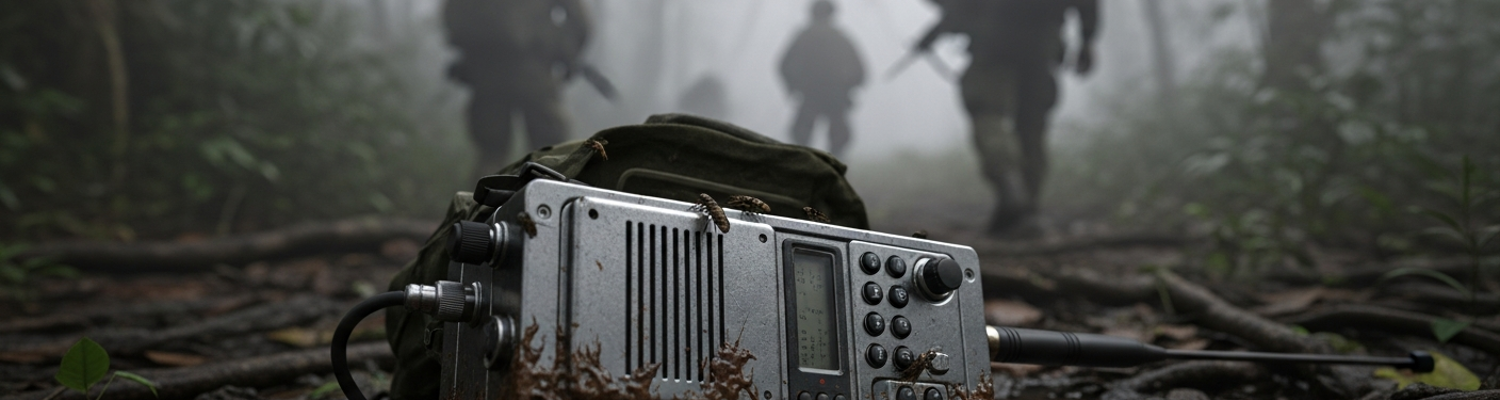

Operational logs from the 11th Airborne Division’s Philippines campaigns (NARA Record Group 407) document a corrosive, recurring failure. At the most decisive moments, command-level communication simply ceased to exist. This was not inconvenient signal loss. It was a systemic collapse that produced tactical paralysis, blinding commanders and stranding their subordinate units. During the fight to clear the mountain passes between Burauen and Ormoc on Leyte in late 1944, the problem became acute. Division headquarters under Major General Joseph Swing expected progress reports from the 511th Parachute Infantry Regiment (PIR). They received hours of dead air.
The SCR-300, the 35-pound backpack radio that was the primary link between company, battalion, and regiment, proved incapable of handling the environment. Its FM signals were absorbed by the triple-canopy jungle. Constant humidity corroded sensitive electronic components and rapidly drained the heavy BA-70 batteries. A battalion commander, waiting for an update from a lead company before committing his reserve or calling in fire support from the 457th Parachute Field Artillery Battalion, was effectively neutered. He could not make a sound tactical decision without knowing if his forward elements were pinned down, flanking the enemy, or walking into an ambush. The information vacuum created a command paralysis born of total ignorance. The battle plan stalled. Momentum was lost. Paratroopers on the front line were left to fend for themselves, disconnected from the command structure designed to support them.
This prolonged radio silence directly translated into uncoordinated maneuvers. The intended synchronization of complex operations, the hallmark of an airborne unit, became impossible. One example occurred during the advance on Manila in early February 1945. The 187th and 188th Glider Infantry Regiments (GIR) pushed north towards the formidable Genko Line south of the city. They were supposed to execute coordinated assaults with the 511th PIR. Archival evidence shows that company-level and even battalion-level nets frequently went down for extended periods. A company from the 511th might successfully seize a key intersection but be unable to report its success. Lacking this information, an adjacent unit from the 188th GIR, instead of moving to support and exploit the gain, would remain fixed in its previous position. It would still operate under last-received orders to assault what was now a friendly-held objective. This lack of coordination meant that fire support from the division’s mobile 75mm pack howitzers was frequently delayed or canceled. Forward observers, unable to transmit targeting data or corrections, could not bring artillery to bear on Japanese machine gun nests or mortar positions holding up the advance. The result was a sequential attack where American units were committed one by one, allowing Japanese defenders to shift their forces and concentrate fire on each isolated element.
These communication failures led to a measurable increase in the division's attrition rate, most tragically through incidents of friendly fire. With front lines that were fluid and poorly marked on headquarters maps, the risk of misdirected fire became a constant threat. In the close-quarters fighting in the mountains of Leyte and the urban sprawl of southern Manila, units could advance or be pushed back several hundred yards in minutes. A platoon that overran a Japanese position but could not get a message out was in immediate danger from its own supporting arms. Mortar teams and artillery batteries, firing on coordinates reported as hostile just 30 minutes prior, could unknowingly drop rounds onto their own men. The high turnover rate among frontline infantrymen, including the radiomen assigned to carry the troublesome SCR-300s, meant that unit-level expertise in maintaining communications under combat conditions was often lost. The attrition was not just a result of enemy action; it was a self-inflicted wound caused by an inability to reliably track and communicate with friendly forces on a chaotic battlefield.
The physical environment of the central Philippines presented a near-insurmountable obstacle to the 11th Airborne Division’s communications architecture. Very High Frequency (VHF) radio waves, the foundation of portable tactical radios like the SCR-300, travel in a straight line. The advertised range of three to five miles for the SCR-300 was based on tests over open, unobstructed terrain. The reality on Leyte was a landscape defined by a rugged central mountain chain covered in dense, multi-layered tropical growth. Scientific analysis of VHF propagation confirms that dense, moist jungle vegetation severely absorbs and scatters radio signals. Studies show that jungle canopies can reduce VHF radio ranges by as much as sixty percent. For the paratroopers of the 511th PIR pushing west from Burauen through these mountains, their 40.0 to 48.0 MHz FM signals were effectively suffocated by the terrain. The high water content in the triple-canopy foliage acted as a sponge for radio energy, while the sheer mass of the mountains physically blocked the line-of-sight path required for a stable connection.
This had immediate and profound tactical consequences.
A close review of operational records from the Leyte campaign shows that the combination of steep ridges and deep, jungle-choked ravines created vast radio dead zones where communication was physically impossible. A platoon descending into a gully could lose contact with its company command post located on the next ridge just a few hundred meters away. These were not intermittent failures but predictable and mappable radio voids inherent to the geography. As the 511th PIR advanced along treacherous, ill-defined foot trails toward the Mahonag-Anas Pass, units became functionally isolated from each other. An SCR-300 operator might establish a clear signal one moment, only to take a few steps down a trail and fall into a complete radio shadow. This effect was the primary culprit in severing the links between forward observers and the artillery batteries they were meant to direct. The inability to overcome these dead zones forced the division to improvise. It established a series of fixed radio relay points manned by small squads from the 152nd Anti-Aircraft Battalion to pass messages along a chain, a slow and vulnerable solution.
The constant and unpredictable loss of signal severed the command and control links between dispersed airborne platoons and their battalion headquarters. The standard doctrine of a parachute regiment, which relied on light, fast-moving, and well-coordinated units, was completely undermined. A battalion headquarters for the 511th PIR, tasked with seizing key mountain passes, had no reliable method to track the progress or status of its lead companies. A rifle company that became pinned down by Japanese defenders or stumbled into an ambush was on its own. It was unable to request reinforcements or coordinate a flanking maneuver with an adjacent, equally blind unit. After-action reports indicate that this communication breakdown directly contributed to stalled advances, as commanders were unwilling to commit reserve forces without accurate intelligence from the front. The weight of the SCR-300, at over 35 pounds, and its delicate components meant that the radioman was a consistent target and that the equipment itself was prone to failure, compounding the environmental challenges. In the unforgiving mountains of Leyte, a broken radio connection meant a platoon ceased to be part of a coordinated regimental assault and became a small, isolated group of men fighting for survival.
Signal Corps operational reports and 11th Airborne Division after-action logs from the Pacific Theater reveal a consistent and debilitating pattern of equipment failure. Early airborne radio sets, particularly the SCR-300, routinely sustained damage during parachute drops, effectively silencing units before they engaged the enemy. The physics of a parachute landing imparted significant shock. The sets, while considered rugged for their time, were built around a fragile core of 18 vacuum tubes (spec number VT-107). These glass and filament components were acutely susceptible to breakage from the jolt of landing. A paratrooper executing a standard Parachute Landing Fall would often transfer the full impact through their body and into the 35-pound radio strapped to their back. The result was frequently a set of cracked or shattered vacuum tubes. In the field, this was a catastrophic failure. A radioman whose set was damaged on landing was not only out of communication but was also now burdened with a useless load of metal and glass. While signal personnel were trained to replace tubes, spare parts were often just as vulnerable to drop damage. They were packed in the same A-5 aerial delivery containers that could themselves land with destructive force.
Beyond the internal components, the external casings and fittings were also a point of failure. The Bakelite knobs and metal antenna mounts could easily shear off or crack upon impact with the hard, uneven ground of a drop zone. A damaged antenna base rendered the set incapable of transmitting or receiving effectively, regardless of the condition of its internal electronics. The problem was so widespread that post-drop assessments frequently noted entire platoons or companies being immediately cut off, their radios having been destroyed in the first few seconds of the ground insertion.
The dense jungle canopy of islands like Leyte and Luzon introduced another vector for destruction. This often occurred before the paratrooper even reached the ground. During the 11th Airborne’s operations, troopers descending into triple-canopy jungle were not aiming for an open field but for a solid wall of vegetation. The expectation was to become entangled in the trees, a technique that required the soldier to carry rope to rappel the remaining distance to the jungle floor. For the radioman, this was a uniquely perilous sequence. The SCR-300, typically worn on the back, would snag on thick vines and branches. This could violently wrench the paratrooper or rip the radio from its harness, sending it plummeting the final 50 to 100 feet without a parachute. The outcome of such a fall was the complete obliteration of the set. More insidious was the damage to antennas. The SCR-300 relied on a long, flexible whip antenna, either the 33-inch AN-130-A or the 10-foot, multi-section AN-131-A for longer range. As a paratrooper crashed through the layers of foliage, these antennas would whip, catch, and snap, instantly rendering the radio deaf and mute. Even if the radio survived the initial descent, landing in the canopy exposed it to immediate and corrosive moisture, a death sentence for the high-voltage electronics of the era if any crack in the casing had occurred.
Finally, the substantial weight of the signal equipment directly contributed to the high rate of impact damage. The SCR-300, with its BA-70 battery, weighed over 38 pounds. The larger SCR-284, a set for battalion-level communications, weighed over 100 pounds when factoring in its components, power generator, and accessories. This mass, strapped to a paratrooper or packed into a supply container, carried significant momentum. The force of the landing was often too great for the radio’s internal shock-mounting, which was rudimentary by modern standards. The heavy lead-acid batteries could break free from their internal restraints, smashing delicate tube sockets and wiring looms. For the soldier, jumping with a 38-pound rigid block of metal on his back made a controlled, injury-avoiding landing fall exceedingly difficult. The weight altered their center of gravity and increased the likelihood of a hard landing on the radio itself. Examination of damaged sets showed a clear correlation between impact force and failure; cracked chassis, deformed battery cases, and sheared mounting brackets were common. This created a situation where the need for command and control necessitated jumping with heavy radios, but the weight of the radios themselves made their survival of the jump a low-probability event.
An examination of Signal Corps equipment logs points to a fundamental weakness in the 11th Airborne’s communication net. The two most common sets, the backpack-sized SCR-300 and the handheld SCR-536, were constructed around a core of deep fragility. The SCR-300, the primary company and battalion link, was built with 18 delicate glass vacuum tubes. These tubes, essential for amplifying and processing signals, were acutely vulnerable to the shock and vibration inherent in military operations. The internal mountings could not consistently protect the glass envelopes and fine filaments from sharp impacts. The outer casings presented their own problems. Many components were fabricated from Bakelite, an early form of plastic prized for its electrical insulating properties but known for being hard and brittle. Control knobs, antenna mounts, and connector housings made from this material could easily crack or shatter if the radio was dropped or slammed against a hard surface, exposing the sensitive electronics within.
This was not a theoretical vulnerability.
The tropical environment of the Philippines was an accelerant for these design weaknesses. U.S. military studies during the war identified that high humidity and fungal growth were destroying electronic equipment at an alarming rate. The SCR-300 and SCR-536, while designed to be water-resistant, were not hermetically sealed. Constant exposure to near 100% humidity allowed microscopic water molecules to penetrate seals and seams. This moisture would then condense on high-voltage internal components, causing short circuits and catastrophic failure. Fungal spores, abundant in the jungle air, found an ideal breeding ground on the internal surfaces of the radios. Some species actively consumed the materials used for wiring insulation and component boards. This biological attack would corrode delicate copper wiring and create new, unintended electrical pathways, rendering the radio useless. Field reports document SCR-536 Handie-Talkies, which had been treated with anti-fungal compounds during manufacturing, still succumbing to moisture and mold, which degraded their already limited battery performance.
Beyond physical breakage and environmental decay, the core technical specifications of the radios proved insufficient for the operational demands of the jungle. The power source for the SCR-300 was the BA-70 battery, a heavy dry-cell unit that weighed nearly 15 pounds by itself. In the high temperatures of the Philippines, the chemical reactions inside these batteries accelerated dramatically, drastically shortening their operational life from the advertised 20-25 hours to sometimes less than a single day of normal use. A unit going into a multi-day operation could not carry enough of these heavy batteries to guarantee sustained communication. The SCR-536 was even more limited, powered by a combination BA-37 and BA-38 battery pack that offered roughly one day of use under ideal conditions. The choice of AM transmission for the SCR-536 made it susceptible to the significant atmospheric interference common in tropical zones. The FM signal of the SCR-300 was heavily absorbed by the dense, wet jungle foliage, a problem compounded by its relatively low 0.3-watt power output. A company commander equipped with both radio types was thus trapped between two failing systems: one whose signal was often lost to atmospheric noise and another whose signal was physically smothered by the very jungle he was fighting in.
Signal Corps maintenance logs reveal that the division’s communication network was not just failing in combat; it was being dismantled by a logistical nightmare. The physical destruction of radios during parachute drops and combat operations created an insatiable demand for replacements and spare parts. In the forward jungle outposts of Leyte and Luzon, this demand went almost entirely unmet. The SCR-300, a complex machine built around 18 fragile vacuum tubes, was the single most common point of failure. A single failed tube could render an entire set useless. The problem was that spare parts kits, containing these tubes and other high-failure components like antenna sections and Bakelite knobs, were just as vulnerable to destruction as the radios themselves. They were often packed in the same aerial delivery containers, which suffered identical damage upon impact. For a forward platoon deep in the mountains, a broken radio meant scavenging. A radioman would often have a small pile of two or three non-functional SCR-300s, attempting to create one working set by cannibalizing parts, a desperate and often futile exercise in field electronics.
The scarcity of parts was compounded by a shortage of men who knew how to use them. The 11th Airborne Division, like all airborne units, was structured to be lean and combat-focused, which left little room for extensive support personnel. The responsibility for anything beyond the most basic troubleshooting fell to a small number of technicians within the 511th Airborne Signal Company or the signal detachments at the regimental level. These were men who had undergone specialized training at facilities like Fort Monmouth, New Jersey, and were skilled in diagnosing and repairing the complex internal circuitry of the radios. These technicians were few and far between on the front lines. Standard infantry radiomen were primarily trained in operation, not in-depth repair. The Signal Corps simply could not produce enough skilled specialists to embed them at the platoon or even company level across the entire army. This created a severe maintenance bottleneck. A radio with a complex internal failure had to be sent back from the front, a journey that could take days or weeks. The high casualty rates among radiomen, who were priority targets due to their conspicuous antennas, meant that this small pool of experienced operators and technicians was constantly being depleted, taking their irreplaceable knowledge with them.
Getting a damaged radio out or a replacement radio in was a monumental challenge. The terrain of the Philippines was the enemy of efficient resupply. The dense, mountainous jungles of Leyte lacked a usable road network, forcing reliance on primitive and unreliable methods. A request from a platoon of the 511th PIR for a new SCR-300 or even a box of BA-70 batteries would begin a slow journey from a rear depot. It might be loaded onto a truck, which would drive as far as the roads went, before being transferred to a mule train or, more often, to the backs of Filipino porters for the final, grueling leg of the journey over muddy, jungle-choked trails. The alternative was airdrop, but this method was notoriously inaccurate and often just as destructive as a combat parachute insertion. A bundle containing a new radio could easily miss its drop zone and fall into enemy hands or be smashed beyond repair on impact. This logistical friction meant that a unit could be without its primary means of communication for an extended period, functionally deaf and isolated while waiting for a replacement that might never arrive in working condition.