
The air in the Rung Sat Special Zone was a physical weight, a humid mix of diesel fumes and decay. A soldier from the 9th Engineer Battalion worked a wrench on the hydraulic feed line of a Caterpillar D7 bulldozer’s blade assembly. His knuckles were scraped raw, stained with grease and mud. It was a daily, repetitive motion. A single loose fitting or a pinhole leak could sideline the twenty-ton machine. Here, a dead bulldozer was an invitation for an attack. The saline mud, a viscous and abrasive paste, worked its way into every mechanical joint and bearing. Brackish water accelerated corrosion on any exposed metal. He gave the fitting a final, firm turn. Fifty meters away, a faint splash in the mangrove thicket went unnoticed, easily mistaken for a wading bird or a jumping fish. It was not.
The 9th Engineer Battalion, attached to the 9th Infantry Division, was assigned to a unique form of warfare. Their mission was to support infantry operations in a region the Vietnamese called the Forest of Assassins. This was a sprawling, 485-square-mile mangrove swamp interlaced with thousands of kilometers of tidal streams and rivers south of Saigon. A review of operational logs (Record Group 472, NARA) shows their primary tasks were not grand construction projects. They fought a grueling, repetitive battle against the environment itself. They built fire support bases by dredging sludge from riverbeds, creating small islands of semi-solid ground. They laid down perforated steel planking for helicopter pads that would inevitably sink back into the mire. They constantly repaired equipment being consumed by the terrain. Troops and machinery occupied dredged pads that were perpetually wet, surrounded by an ecosystem actively trying to reclaim them. This was not combat engineering. It was a desperate effort to impose temporary order on an environment that resisted at a molecular level.
This constant fight against decay defined the unit’s operational capacity. The combination of saltwater from high tides and riverine silt created a highly corrosive and abrasive sludge that was destructive for heavy machinery. A close examination of maintenance records from the period reveals a pattern of recurring, specific failures. The hydraulic systems of the D7 and D8 bulldozers were especially susceptible. Fine, sharp-edged silt particles would infiltrate gaskets and O-rings, scoring piston shafts and contaminating hydraulic fluid until the systems seized. Radiators became clogged with a baked-on mixture of mud and mangrove leaves, leading to chronic engine overheating. The electrical systems of trucks, generators, and radios frequently shorted out from the inescapable moisture and salt. A significant portion of the 9th Engineer Battalion's heavy equipment was non-operational at any given time, awaiting replacement parts that had to be flown in or shipped up the contested Long Tau River.
Mechanical failures had immediate tactical implications. The engineers' main job in the Rung Sat was clearing and maintaining patrol routes, often little more than narrow causeways built from packed earth and laterite. These were the only means of overland movement for the 9th Infantry Division’s troops and supplies through an area heavily infested with Viet Cong units. VC tactics centered on mining these exact routes, often using command-detonated devices fashioned from unexploded American ordnance. Daily engineer operations became a predictable and perilous cycle. A lead bulldozer would clear the path of vegetation, followed by infantry providing security while teams searched for buried mines. The loss of a bulldozer to a mine or mechanical failure on one of these narrow tracks did not just halt the operation. It could trap an entire column, creating a stationary and vulnerable target for a well-planned ambush.
The senior leadership of the 9th Infantry Division operated from a different world. At the division’s main base in Đồng Tâm, the Tactical Operations Center was a universe of controlled temperatures, humming generators, and clean Plexiglas map boards. The Rung Sat Special Zone was not a malarial swamp of sucking mud. It was an intricate cartographic rendering, a series of grid squares and operational symbols. A company of the 9th Engineer Battalion was a grease-pencil icon, its agonizingly slow progress represented by a neat, straight arrow. This physical and psychological disconnect, the headquarters bubble, created a chasm between perception and the situation on the ground. Information from field units arrived stripped of its chaotic context. A report of a stalled bulldozer became a simple note on an equipment status chart, not a vision of a 20-ton machine sinking into tidal sludge, its crew now an exposed target.
Distance bred distortion.
A review of communications logs from the era reveals a systemic problem in the information pipeline. The standard field radio, the AN/PRC-25, was a 25-pound transceiver and the primary link between squads in the swamp and the command net. Its VHF line-of-sight signal was severely degraded by the triple-canopy jungle and the sheer lack of elevation in the delta. An RTO fighting to get a signal out might have to rig an improvised long-wire antenna just to achieve a broken, static-filled connection. A message detailing contact or an equipment failure would be relayed up the chain, each step filtering and compressing the raw data. The version that reached the Đồng Tâm TOC was hours old and dangerously simplified. A commander making a decision at 1500 hours was often working with a picture of the battlefield from noon, an eternity in a fluid combat environment. The handset of the PRC-25 was also notoriously vulnerable to moisture, a design flaw in an operational area that was part swamp, part river.
This fractured communication stream forced an over-reliance on the most available, yet most deceptive, form of intelligence: aerial reconnaissance. Light Observation Helicopters, primarily the OH-6 Cayuse, and fixed-wing assets like the OV-1 Mohawk provided commanders with their eyes over the battlefield. From an altitude of 1,500 feet, the Forest of Assassins presented an unbroken, uniform carpet of green. A pilot flying over the engineer’s route could see the muddy track and the line of trees, but he could not see the Viet Cong squad concealed in a mangrove thicket less than fifty feet from that track. His report of no visual contact was factually correct from his perspective, but it painted a lethally misleading picture for the commanders who received it. Analysis of aerial photographs was no better. The time required to fly film back to a rear base, develop it, and have intelligence analysts scrutinize it meant any resulting report was a historical document, not actionable intelligence. A photograph showing a clear canal crossing on Monday offered no guarantee it was not a prepared ambush site by Tuesday morning.
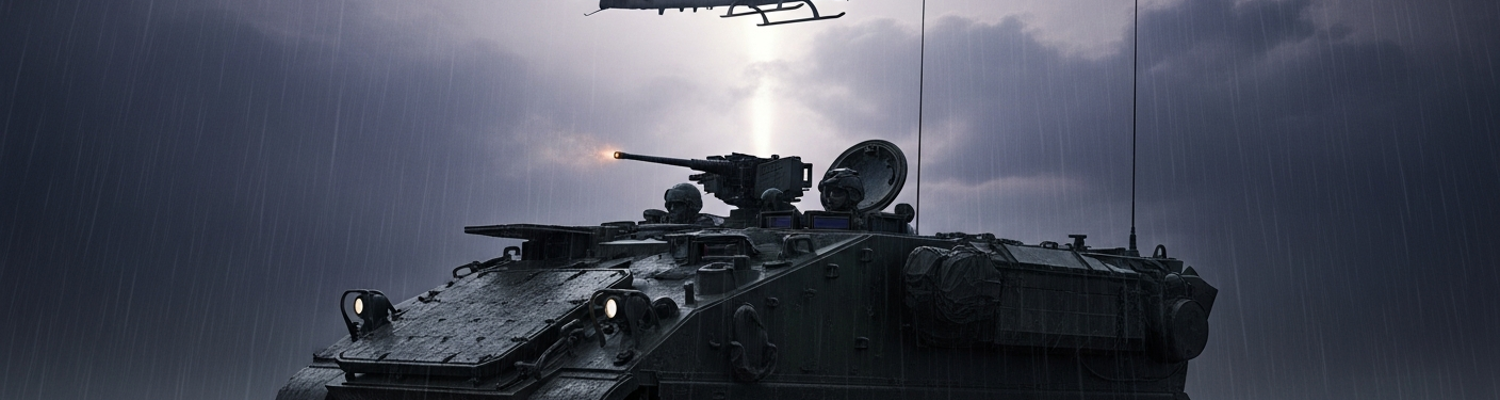
A company from the 9th Engineer Battalion was tasked with route clearance. They relied on the M113 Armored Cavalry Assault Vehicle, or ACAV. Originally designed as a simple battle taxi, the M113 in Vietnam was up-gunned and modified by troops in the field for direct combat. The engineers’ variant was a workhorse, its aluminum hull providing just enough protection to stop small arms fire and shrapnel. On this particular afternoon, one such M113A1 was providing flank security for a column of D7 bulldozers carving a new path. Inside the commander’s cupola, a sergeant scanned the monotonous green wall of vegetation as the first heavy drops of a monsoon squall began to spatter against the vehicle’s hull. The diesel-powered M113 was positioned on a slight rise of dredged earth, its tracks slowly churning mud as it kept pace with the lead dozer. Its low freeboard made it vulnerable in flooded terrain, and its armor could be defeated by heavier enemy weapons.
The storm broke with tropical finality.
A torrential downpour erased the horizon, turning the landscape into a churning, grey smear. From the cockpit of an AH-1 Cobra gunship orbiting at 2,000 feet, the world below was an indecipherable mess of shadow and water. The pilots were hunting. A garbled radio message from an isolated outpost had reported suspected enemy armor movement, a rarity in this region, sending the hunter-killer team scrambling. Through the rain-streaked canopy, the Cobra’s gunner strained to find a target. On the ground, the boxy silhouette of the 9th Engineer’s M113, partially obscured by the deluge and the shimmering heat from its engine, bore a passing resemblance to the low profile of a Soviet-made PT-76 amphibious tank. The North Vietnamese Army was known to use the PT-76. This was a catastrophic case of mistaken identity, born from bad weather, high pressure, and fatally incomplete information relayed from a distant tactical operations center.
The attack was not a single, mistaken pass. It was sustained. The lead Cobra pilot, convinced he had a high-value target cornered, rolled in for the first gun run. The M113 was struck by a volley of 2.75-inch rockets. The explosions ripped through the thin aluminum armor. Inside the vehicle, the world dissolved into a concussive roar of shorn metal and searing light. Before the crew could react or their frantic calls for a ceasefire could penetrate the radio static, the second gunship initiated its attack. A torrent of 7.62mm minigun fire stitched across the M113’s hull, penetrating the crew compartment and turning the interior into a maelstrom of ricocheting rounds. The engineers on the ground were pinned down, unable to signal their identity effectively. The assault only ceased when the gunships expended their ordnance and broke station, leaving behind a smoking, crippled vehicle.
An after-action review of the incident would later reveal the cascade of failures. The pilots, operating under restrictive rules of engagement but pressured to act on a threat, made a visual confirmation under impossible conditions. The communication breakdown between the ground unit, the command bubble, and the air assets was total. For the company of the 9th Engineer Battalion, the result was multiple casualties, including two killed in action, and the loss of a piece of equipment. The M113, designed to protect them, had become a target due to its own ambiguous profile seen through the distorted lens of a monsoon storm.
A forensic analysis of the incident relies on after-action reports and transcribed radio logs. These documents chronicle the disaster with a detached, procedural coolness. Archival evidence shows these mimeographed reports became the definitive record. The initial transmission from the engineer platoon’s radio telephone operator is logged at 14:12H. It was a broken, frantic message, half-swallowed by static from the storm and the limitations of the AN/PRC-25 transmitter. The log notes a call of taking incoming fire, followed by an unintelligible string of words and the grid coordinate of the route clearance operation. Almost simultaneously, the separate aviation command net recorded the lead Cobra pilot reporting positive contact with a suspected enemy armored vehicle at a nearly identical location. Within the battalion Tactical Operations Center, two conflicting narratives were now competing for attention on two separate radio receivers. The engineers on the ground were screaming that they were being hit by friendly aircraft. The pilots overhead were reporting a successful attack on a high-value enemy target.
The request for positive ground identification languished for forty-seven minutes.
This delay, detailed in witness statements appended to the main report, was a direct result of the fractured communication chain. The engineer platoon leader’s urgent demand to identify the ground units at the target location first had to travel from his handset to the company command post. From there, it was relayed to the 9th Engineer Battalion’s fire support coordinator. A close review of operational logs from this period indicates such a process, even under ideal conditions, could take upwards of fifteen minutes as RTOs fought for clear signals. In this case, the battalion TOC was attempting to deconflict the engineer’s position, last updated on a map board an hour prior, with the real-time targeting data supplied by the Cobra pilots. The pilots were circling, their fuel state a constant concern, pressuring the TOC for clearance to re-engage what they were still reporting as a hostile PT-76 tank. The standard procedure of using a forward air controller or a Light Observation Helicopter for low-altitude visual confirmation was impossible. The monsoon storm had grounded all such assets, leaving the high-flying Cobras as the only available eyes. The forty-seven-minute gap represents the sum of these systemic failures: the time spent re-transmitting garbled messages, the physical act of plotting and cross-referencing on outdated maps, and the inability to deploy a proper observer to look underneath the storm clouds.
The problem compounded with every echelon. The connection to brigade headquarters at Đồng Tâm was the final, and slowest, link. The report from the battalion to the 9th Infantry Division’s brigade TOC was a third-hand summary, stripped of the raw panic audible in the initial radio calls. To the brigade duty officer, the situation was presented as a targeting conflict at a specific grid square, not an active fratricide event. His primary information stream was the air-support channel, which was still confidently reporting a confirmed enemy armor kill. A formal CHECK FIRE command, the absolute order to cease all firing, faced a procedural bottleneck. Before issuing such a command that could allow a genuine high-value target to escape, the brigade staff had to be certain. That certainty never came. By the time the jumbled reports from the engineer net were deemed credible enough to warrant a definitive halt, the gunships had already completed their second and third firing passes. The official log shows the final, all-stations CHECK FIRE order was acknowledged by the flight lead at 15:01H. Fifty-nine minutes after the first call from the ground. More than twenty minutes after the last rocket had struck the M113.