
Operation Cedar Falls and Initial Tunnel Breaching
Tropical humidity exceeded ninety percent across the laterite plains north of Saigon. Stagnant ground water collected in bomb craters. This water mixed with decomposing jungle mulch. Ambient air temperatures consistently climbed past one hundred degrees Fahrenheit before midday. Heat baked the topsoil into a brittle red crust. Trapped moisture boiled directly beneath the surface. Decaying bamboo thickets produced a constant stench of sulfur and rot. Biting ants and ground hornets coated any exposed surface within seconds. Monsoon squalls regularly broke the heat. These storms transformed the compacted dirt into viscous clay mud. Tracked vehicles lost traction along unpaved cart tracks.
Standard army doctrine offered no solutions for the subterranean environment.
Archival evidence shows operational planners in the 1st Infantry Division originally anticipated a conventional search-and-destroy mission. Operation Cedar Falls launched on January 8, 1967. Planners targeted the sixty-square-mile expanse of the Iron Triangle. Field commanders rapidly discovered a tactical problem. Aerial bombing and heavy artillery barrages failed to neutralize the entrenched headquarters of the Viet Cong Military Region IV. High explosives compacted the iron-rich soil above deep multi-level complexes. Lower chambers remained structurally sound.
On January 10, the 1st Engineer Battalion formed improvised subterranean clearance detachments directly in the field.
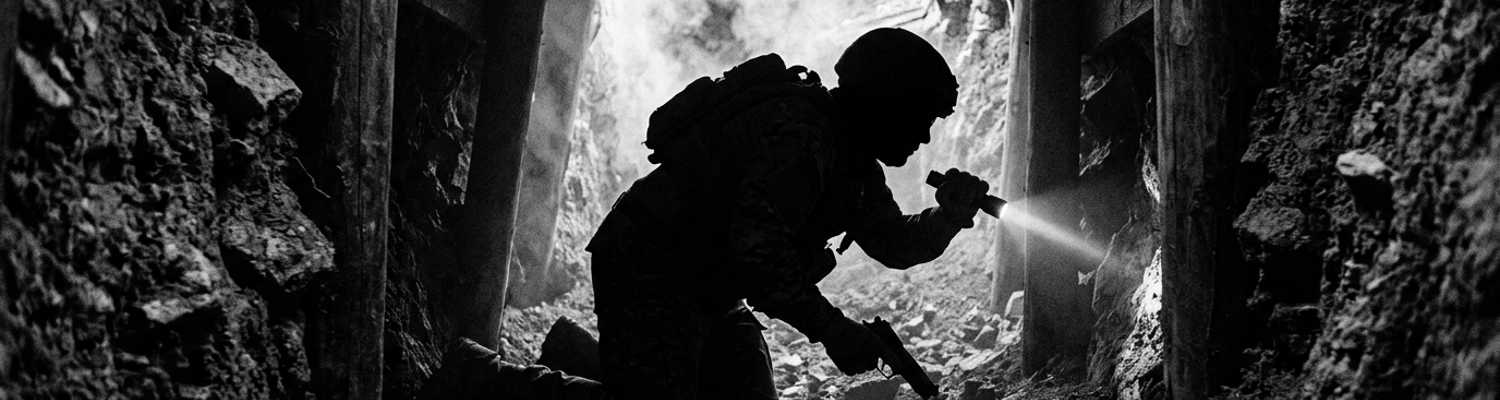
Officers drew soldiers from Company A and Company C. Military doctrine provided no dedicated equipment for subterranean combat. Battalion officers assembled ad hoc four-man teams. These units carried standard-issue Colt M1911A1 .45-caliber semiautomatic pistols and commercial flashlights. Soldiers tied lengths of commo wire to their ankles. This wire acted as a manual extraction cord (NARA Record Group 338, Box 42). Troops hauled commercial gas-powered air blowers to tunnel entrances. These devices, designated as Mighty Mites, forced CS chemical powder down shafts. Engineers then entered the dark wearing bulky M17 protective gas masks. Sweat fogged the mask lenses almost immediately.
Descending into a spider hole meant total tactical separation from the surface world.
A close review of operational logs indicates clearance teams breached the Iron Triangle tunnel networks entirely on foot. They operated isolated from conventional artillery and close air support. Standard AN/PRC-25 tactical radio frequencies could not penetrate more than three feet of dense laterite clay. Wireless voice communication ceased the moment a soldier cleared the entrance shaft. Batteries inside the issue flashlights corroded rapidly in subterranean moisture. Illumination reduced to dying yellow beams within minutes of descent. Artillery shells from nearby fire support bases could not be called onto coordinates directly above the tunnels. 105mm and 155mm howitzer batteries at Di An and Phu Loi risked causing catastrophic cave-ins. Such collapses would bury the clearance teams alive. Air support from F-4 Phantoms dropping five-hundred-pound bombs was unusable against targets beneath thirty feet of clay.
Soldiers crawled forward on elbows and knees.
Passages measured barely two feet wide by three feet high. Engineers probed blind soil with bayonets to locate tripwires. Firing a .45-caliber pistol inside an unventilated six-foot earthen pocket ruptured eardrums. Muzzle flash destroyed night vision. Toxic cordite smoke displaced oxygen and caused immediate vomiting.
By January 18, clearance teams operating near the village of Ben Suc uncovered multi-level command posts. These chambers contained over five hundred thousand pages of enemy operational documents.
Booby Traps and Subterranean Environmental Hazards
Archival evidence shows the 1st Engineer Battalion encountered passage geometries deliberately engineered to kill through mechanical entrapment. This occurred inside the underground sectors surrounding coordinates XT635485 near the Thi Tinh River. Vietnamese sappers constructed corridors with abrupt ninety-degree doglegs every ten to fifteen feet. These angles eliminated long sightlines. Surface weapons could not fire down shafts.
Builders carved the tunnels directly into bare red clay without wooden shoring.
Walls sloughed off under the friction of moving bodies. Soldiers crawling on their stomachs hit dead-end switchbacks concealing false floors in total blackness. Drop pits lined with fire-hardened bamboo punji stakes lay beneath thin bamboo lattice covers. A dusting of dry dirt concealed the traps. A scout shifting forward on his elbows would trigger the counterweighted platform. The soldier dropped into a six-foot pit. Stakes coated in human excrement or venomous pit viper bile waited to impale thighs and lower abdomens.
Every turn carried lethal tension.
Technical debriefs confirm tripwire-activated grenade traps protected nearly every transition between primary corridors and secondary supply bunkers. Sappers strung hair-thin green tripwires across subterranean choke points at ankle height. Wires also sat directly behind wooden hatch frames. These lines linked to friction igniters on Chinese Type 67 stick grenades. Soviet-made F-1 fragmentation charges wedged into wall niches at head level provided another threat. An engineer catching the wire with a knee triggered the mechanical pull-igniter. This action initiated a three-second delay fuse inside an unyielding earthen tube. Clay walls channeled the entire blast wave inward.
Zero ambient light prevented clearance personnel from visually identifying these wires.
Engineers pushed forward using individual fingertips to sweep the clay floor in millimeter increments. They felt for the slight metallic tension of taut wire against skin before advancing an inch.
Batteries died within minutes.
A close review of operational logs indicates clearance teams pushed into these oxygen-depleted crawlways equipped with basic field tools. This equipment consistently degraded under subterranean conditions. Soldiers carried standard-issue Fulton MX-991/U angle-head flashlights and lensatic compasses. Carbon dioxide settled into the lowest levels of air pockets thirty feet underground. Stagnant mud absorbed remaining oxygen. Breathable concentrations dropped to levels that induced hyperventilation and loss of motor coordination within twenty minutes.
Lensatic compasses spun erratically due to dense iron-ore deposits throughout the surrounding laterite.
Directional orientation became completely useless. Moisture fogged the flashlight lenses. Rapid corrosion of D-cell zinc-carbon batteries in saturated mud forced troops to switch off the beams. They preserved power by crawling in suffocating blackness. Firing the M1911A1 inside these unventilated chambers generated a shockwave exceeding one hundred and sixty decibels against bare ears. Concussive overpressure blew out eardrums and stripped surrounding soil loose in immediate cave-ins. Blinding potassium nitrate residue filled the crawlway. Chemical smoke burned the eyes and triggered involuntary vomiting.
DASPO Combat Photography Inside Confined Spaces
Department of the Army Special Photographic Office teams operated out of the DASPO Pacific Detachment during the clearance runs near Ben Suc. Archival evidence shows these units assigned combat cameramen directly into the crawlways behind Company A and Company C engineers. Photographers crawled on their bellies eighteen inches behind the soles of the lead tunnel rat combat boots.
Shafts measured twenty-four inches across.
Two men could not squeeze past one another. This eliminated any possibility of tactical retreat or weapon repositioning during an ambush. Cameramen carried no rifles or shoulder-fired weapons into the holes. Pushing forward through blind switchbacks required holding an optical unit in one hand. The photographer dragged an emergency sidearm through the loose clay with the other. An enemy soldier opening fire with an AK-47 or SKS carbine from a concealed earthen bunker meant the point engineer received the incoming rounds point-blank. The unarmed cameraman remained wedged against a wounded or dead body with no room to maneuver.
Operational records from mid-January indicate DASPO personnel accompanied multiple subterranean probes along coordinate grid XT614468.
Teams descended past twenty feet into secondary levels. Stagnant air temperatures reached 105 degrees Fahrenheit. Carbon dioxide pooled on the tunnel floors.
Retreat was physically impossible.
A close review of operational logs indicates cameramen relied on customized Nikon F and Leica M-series 35mm rangefinders. They paired these cameras with subminiature incandescent lighting fixtures and portable battery-powered strobe units. This equipment recorded room-clearing actions under direct fire. Laterite grit infiltrated mechanical gear trains. Titanium shutter curtains froze. Manual focusing helicoids jammed within thirty minutes of underground exposure.
Saturated subterranean humidity corroded exposed copper terminals on flash synchronization cables.
Continuous electrical shorts drained nickel-cadmium power packs before photographers reached deep chambers. Incandescent flash bulbs regularly shattered from rapid temperature shifts. Sweat droplets hitting heated glass surfaces during rapid fire sequences caused these fractures. Detonating a battery strobe inside an enclosed clay bunker produced an instant white burst. This flash stripped both the photographer and the lead engineer of their low-light vision for up to three minutes. Combat clearance turned into an extreme tactical liability during active contact. The clearance team remained defenseless against subterranean counterattacks launched from adjoining unmapped spider holes.
Dust from weapon concussions reflected flash beams.
When examining the historical record of photographic negatives processed by DASPO laboratories in Saigon, the recovered 35mm frames exposed the physical degradation of clearance personnel. Images documented soldiers who had discarded their regulation steel pots and protective flak jackets. Troops stripped down to olive-drab undershirts or bare skin. Standard-issue equipment snagged on unreinforced clay projections. Troops appeared with split skin and open sores while crawling through raw sewage and pools of concentrated CS chemical powder.
Field records confirmed engineers used communication wire tied around their ankles as a tactile signaling system.
Three sharp pulls requested an emergency backward drag from surface teams when encountering booby-trapped false walls. Point men cleared blast-damaged chambers holding non-standard suppressed .38-caliber revolvers in one hand. They used bayonets to disarm pressure-release anti-personnel mines wedged beneath subterranean sleeping mats.
On January 22, DASPO laboratory technicians filed eighty-four underground exposure frames under catalog sequence MACV-67-1102 at the Tan Son Nhut processing facility.
Discovered Ordnance Workshops and Captured Pneumatic Tools
Archival evidence shows elements of Company C penetrated a reinforced three-room subterranean complex twenty-five feet beneath the jungle floor on January 14, 1967. This occurred at coordinate grid XT628472. Excavation teams did not find an ordinary living shelter. Tunnel rat point men crawled through a reinforced earthen bulkhead into an operational underground armory. Heavy fabrication machinery filled the space.
Illumination from hand-held carbide lanterns revealed wooden workbenches bolted directly to laterite support pillars.
Clearers cataloged industrial bench vises and overhead steel guide cables. Multiple pneumatic impact wrenches and salvage air ratchets sat on the tables. Heavy drive sockets bore United States Department of Defense procurement stamps. Insurgents stole these items from shipping yards at the Port of Saigon. Other tools were siphoned out of forward support depots along Highway 13. These American-made Chicago Pneumatic tools sat hooked to copper pressure lines. A buried manifold system routed compressed air across the chamber floor. A modified two-cylinder gasoline compressor housed in an adjoining sound-baffled earthen pocket provided the pressure.
The tools ran on captured American fuel.
Technical reports confirm Viet Cong insurgent armorers utilized these salvage air wrenches for heavy demolition work. Enemy ordnance technicians clamped unexploded American munitions into wooden v-blocks to strip out their mechanical fuzes. They operated deep in unventilated chambers where room temperatures hovered near one hundred degrees. US Air Force strikes and artillery barrages routinely deposited hundreds of duds across Binh Duong Province. These included 500-pound Mark 82 low-drag bombs and 750-pound M117 general-purpose bombs. Unspent 155mm high-explosive artillery projectiles littered the surface.
Threading damaged steel fuze assemblies out of these casings with hand wrenches risked friction strikes.
Such strikes ignited volatile booster charges instantly. Pneumatic impact tools provided the steady high-torque counter-rotation needed to unscrew seized M904 nose fuzes and M905 tail assemblies without delivering concussive hammer blows.
Friction killed entire armory squads in an instant.
A close review of operational logs indicates clearing teams found casings subjected to direct thermal extraction once armorers removed the mechanical fuze components. Insurgent sappers channeled boiling water down the nose wells of defuzed bomb casings. This heat liquefied the high-explosive matrix. Solidified blocks of Composition B softened under steady heat. This castable mix contained sixty percent RDX and forty percent TNT. Workers scraped out the high-yield explosive paste using brass spoons and wooden dowels.
Engineers discovered racks of cast-iron pipe sections.
Hollowed-out bamboo segments and empty C-ration cans waited on assembly tables to receive the extracted compound. Armorers repacked these containers with salvaged RDX mixtures and sheared artillery casing fragments. This reclaimed explosive supplied the main charges for anti-tank pressure mines buried along tracked-vehicle routes. It also filled directional DH-10 fragmentation weapons aimed at infantry approach corridors.
Field logs compiled by the 1st Engineer Battalion recorded a massive haul.
Troops recovered thirty-eight defuzed artillery shells and four partially gutted 500-pound aerial bombs. Two functional air compressors and fourteen heavy pneumatic wrenches sat in this single workshop complex. Demolition squads then dropped sixty pounds of M112 C-4 demolition blocks down the exhaust flues.
MACV Firepower Doctrine and Subterranean Realities
Military Assistance Command Vietnam based its containment strategy in Binh Duong Province on maximum kinetic tonnage. Operation Cedar Falls committed over thirty thousand Allied soldiers. Round-the-clock aerial bombardment targeted the sixty-square-mile triangle between the Saigon and Thi Tinh rivers. B-52 Stratofortress bombers flew Operation Arc Light sorties out of Andersen Air Force Base. They dropped strings of 750-pound M117 demolition bombs directly across suspected Viet Cong base areas.
General William Westmoreland and II Field Force planners operated under a specific calculation.
They believed concentrated surface explosions would fracture subterranean cavities through ground shock. This force would rupture air systems and crush structural spaces hidden beneath the tree canopy.
Arc Light strikes left the deep bunker network intact.
When examining the historical record of subsequent engineer sweeps, excavation teams uncovered fully operational manufacturing centers. Multi-room fabrication factories ran less than thirty feet beneath carpet-bombed grid squares. Blast overpressure from delay-fuzed aerial bombs dissipated horizontally across the top layers of iron-rich laterite. Downward kinetic force failed to penetrate the compacted subsoil. Company C soldiers broke into a two-level manufacturing facility at coordinate grid XT641490. This space contained metal-turning lathes and casting pots. Five separate layers of timber and packed red clay sheltered the equipment.
B-52 strikes excavated craters fifteen feet deep directly above the complex.
The lower chambers retained structural integrity. Internal lighting and working telephone lines wired back to regional command bunkers remained functional. Defective mechanical fuzes and the natural elasticity of tropical clay neutralized high-angle artillery concentrations. 175mm M107 self-propelled guns from nearby base camps caused minimal subterranean damage.
High explosives only shifted topsoil over working factory floors.
A close review of operational logs indicates the physical costs sustained by Company A and Company C forced an abrupt doctrinal shift within American command. Improvised clearance methods generated high casualty ratios. Sending young soldiers down dark shafts with unsuppressed .45 pistols and failing dry-cell flashlights proved ineffective. Discovered networks were not permanently denied to enemy units. Gassing tunnels with portable Mighty Mite commercial blowers only pushed CS powder through porous lateral ducts. Parallel branches remained unaffected. Insurgent sappers reoccupied cleared sectors within forty-eight hours.
Standard demolition blocks and bulldozer backfilling failed to collapse the deeper hubs.
II Field Force command directed the creation of standardized subterranean clearance units. Military planners formalized this requirement by establishing dedicated tunnel rat detachments within engineer and infantry battalions across the theater. They integrated specialized clearance tables of organization directly into division structures. Training cadres at the 1st Infantry Division base camp at Di An drafted the first standardized subterranean combat field guides. They drew volunteers specifically under five feet five inches in height.
Requisition officers replaced heavy M1911A1 pistols with commercial .38-caliber Smith and Wesson revolvers.
These weapons fired low-velocity ammunition to prevent hearing loss. Supply chains issued battery-powered headlamps and sound-powered chest microphones. Short-barreled bayonets replaced standard infantry knives. On February 3, 1967, the division command published formal operational instructions. These orders required all subsequent subterranean exploration to deploy specialized four-man teams with dedicated surface recovery crews. Ad hoc infantry descent ended on that date.