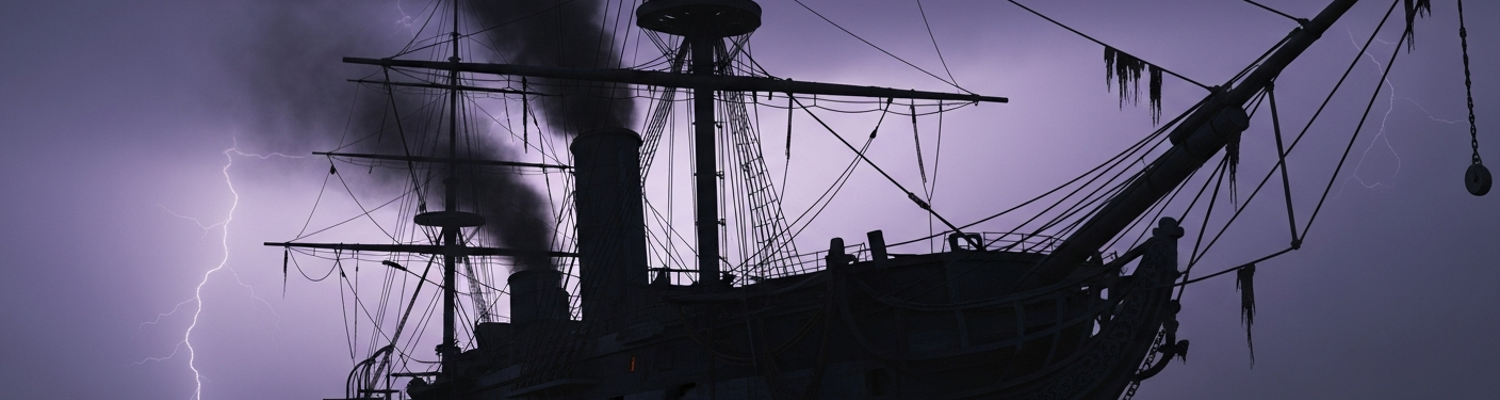

The United States Navy that emerged from the War of 1812 was determined to project power. To deter foreign aggression, Congress passed the Act for the Gradual Increase of the Navy of the United States on April 29, 1816. This legislation authorized the construction of nine ships-of-the-line, each to rate no fewer than 74 guns. These were instruments designed for a single purpose: to stand in a formal line of battle and exchange broadsides with the most powerful warships of European navies. They were the capital ships of their day.
The keel of the future USS Alabama was laid down at the Portsmouth Naval Shipyard in Kittery, Maine, in June 1819. The construction was a monumental undertaking, utilizing a live oak frame and copper fastenings. By 1825, the ship was reportedly ready for launch. The geopolitical climate, however, had shifted. The post-war urgency faded, and a long peace settled over the Atlantic. National focus and federal funding turned inward and westward. Manning and maintaining a large ship-of-the-line was a significant expense, so an official policy was adopted to keep the nearly-finished hulls preserved on the stocks under the cover of large ship-houses. This was presented as an economical measure, keeping the vessels ready for rapid launch should an emergency arise.
The Alabama sat in its shiphouse for decades.
This extended inactivity, stretching for nearly forty years, created a chasm between the ship’s original design and the realities of naval warfare. While the massive wooden frame was sheltered at Portsmouth, a technological revolution was occurring. French artillerist Henri-Joseph Paixhans developed shell-firing guns in the 1820s that could shatter wooden hulls with explosive force. Steam propulsion, introduced in the following decades, freed warships from the constraints of the wind, making sailing vessels tactically inferior. By the 1850s, the development of ironclad warships had sounded the final death knell for the unarmored wooden ship of the line. The concept for which the Alabama was designed was now a historical artifact.
When a crisis finally demanded the vessel’s completion, it was the American Civil War. The ship was renamed USS New Hampshire on October 28, 1863, partly because its original name now belonged to a Confederate state. It was finally launched on April 23, 1864. It did not enter service as a 74-gun combatant. The U.S. Navy of 1864 had no need for a sailing ship-of-the-line; it needed logistical support for its steam-powered, blockading squadrons. The New Hampshire was completed and commissioned not as a battleship, but as a storeship and depot ship. Its armament was a mix of a few Parrott rifles and Dahlgren guns for self-defense. Its debut was not as a frontline warship, but as a floating warehouse and hospital ship, serving off the coast of South Carolina.
When the hull of the USS New Hampshire slid down the ways at the Portsmouth Naval Shipyard on April 23, 1864, it was a 2,633-ton anachronism. Its design, conceived under the 1816 Act for the Gradual Increase of the Navy, was for a 74-gun ship-of-the-line intended to anchor a battle formation of similar wooden warships. By 1864, such a contest was a historical fantasy. The U.S. Navy was a force defined by steam-powered sloops, armored ironclads, and specialized gunboats designed for blockade and riverine warfare. The Monitor and Virginia had already dueled two years prior, and the explosive shells perfected by Paixhans decades earlier had made the unarmored wooden wall an explosive-filled coffin. The New Hampshire, with its sail-only propulsion and acres of vulnerable oak planking, was a weapon for a war that no longer existed.
The Navy Department had no use for a sailing battleship.
Union naval strategy in 1864 was dictated by the relentless demands of logistics. The South Atlantic Blockading Squadron, operating off the coasts of South Carolina, Georgia, and Florida, was strangling the Confederacy’s connection to the outside world. Its steam-powered warships, however, were voracious consumers of coal, ammunition, water, and provisions. They required constant maintenance. A command decision was therefore made, and on May 13, 1864, the USS New Hampshire was commissioned for support. The ship’s commissioning orders, under Commodore Henry K. Thatcher, stipulated its immediate outfitting as a storeship and depot vessel. Its vast, empty gun decks, designed to house rows of cannon, were repurposed into cavernous warehouses. The intended complement of over 800 sailors and marines was drastically reduced.
The ship’s armament was a testament to this redefinition of purpose. Stripped of its intended line-of-battle configuration, it was fitted with a small, defensive battery: four 100-pounder Parrott rifles and six 9-inch Dahlgren smoothbore guns. This was just enough firepower to deter a casual Confederate raider. On June 15, 1864, the New Hampshire sailed from Portsmouth. Its destination was not a fleet action but a humid anchorage at Port Royal, South Carolina, the logistical heart of the blockading squadron. On July 29, it arrived on station and officially relieved its sister ship, the USS Vermont, which had been performing the same duties. There, surrounded by the modern steam warships it was meant to supplant, the New Hampshire began its true service: a floating supply depot, repair tender, and hospital ship.
Upon arrival at Port Royal, South Carolina, on July 29, 1864, the USS New Hampshire became a fixed point in a fluid theater of war. Anchored in the harbor, the vessel was a ship-of-the-line rendered immobile and repurposed as a floating warehouse. Its three gun decks, engineered to withstand the recoil of 74 heavy cannon, were now storage bays. Instead of ordnance, they were piled high with crates of hardtack, barrels of salted beef and pork, sacks of coal for the squadron’s steam-powered vessels, and fresh water. The ship designed for a fleet action was now a quartermaster’s depot.
The war demanded logistics, not broadsides.
The vessel’s function as a depot was an exhaustive, non-stop enterprise. Operational logs for the South Atlantic Blockading Squadron indicate that as much as twenty percent of the fleet could be off-station at any given time for coaling or repairs, a vulnerability the New Hampshire was positioned to mitigate. The ship became the mechanical and metabolic heart of the squadron. Its holds contained not just food and water, but also engine parts, replacement sailcloth, and ammunition for the fleet’s modern guns. Small launches and cutters constantly swarmed its hull, loading shells for Dahlgren smoothbores and the heavy projectiles for Parrott rifles that were battering Confederate fortifications. The ship’s reduced crew were not gunners but supply clerks, storekeepers, and laborers.
Beyond its role as a warehouse, the ship absorbed the human cost of the blockade. Its spacious decks made it a receiving hospital. Wounded sailors from engagements with shore batteries and sick men ravaged by malaria, dysentery, and yellow fever were ferried from the cramped confines of gunboats to the New Hampshire. Here, in makeshift wards, they received care that was impossible on the active vessels of the fleet. The ship was simultaneously a supply depot for the tools of war and a sanatorium for its victims. Its presence ensured that the blockading fleet could remain on station longer, maintaining the pressure of the Anaconda Plan. The New Hampshire did not fire a single shot in anger, yet its contribution to the Union war effort was substantial. The ship remained in this static role at Port Royal through the end of the conflict.
A detailed examination of the USS New Hampshire’s ship’s log from October 1865 through July 1866 reveals a vessel transitioning from civil war to the routine of peacetime naval administration. Having departed the wartime anchorage at Port Royal, the ship was assigned to Norfolk, Virginia, on June 8, 1866, to serve as a receiving ship. The entries, recorded in meticulous cursive, cease to mention Confederate movements and instead document the tasks of a massively downsizing military. The log speaks of a ship at anchor, its existence dictated by the needs of the newly-formed North Atlantic Squadron. Days are marked by the activity of winches and the keeping of ledgers. Entries detail the methodical offloading of surplus munitions, the cataloging of thousands of barrels of hardtack and salted meat, and the transfer of sailors whose terms of enlistment had expired. The ship became an administrative clearinghouse.
Its war was over; its work was not.
This period saw the ship’s crew institute a daily mission of proactively identifying non-combat threats to the squadron. With dozens of ironclad monitors and steam sloops moored nearby, many with skeleton crews awaiting decommissioning or reassignment, the potential for a catastrophic accident was high. Each morning, cutters from the New Hampshire conducted systematic patrols of the anchorage. Their mission was to forestall disaster born of neglect. A review of operational patterns shows these teams performed visual inspections of mooring chains on other vessels, reporting signs of advanced corrosion. They monitored the trim and waterlines of unmanned monitors, whose complex hull plates were prone to unseen leaks. The patrols identified potential fire hazards, such as improperly stored coal dust or oil-soaked rags on the open decks of warships whose crews were no longer at full vigilance. This was a battle waged against entropy, decay, and the complacency of peace.
The greatest threat to the post-war fleet was its own internal vulnerabilities. Disease remained a potent danger in the crowded anchorages. Sanitary practices, while improved, were still inconsistent, and the New Hampshire’s patrols were the first line of defense in identifying potential outbreaks. Its cutters would report back on ships showing signs of dysentery or ships whose water barrels were fouled, allowing the squadron’s medical officers to intervene before an outbreak could spread. The supply chain was equally fragile. The new steam-powered navy was entirely dependent on a network of colliers and supply vessels. When the monitor USS Agamenticus reported both a boiler leak and an outbreak of scurvy among its reduced crew, the limitations of the new fleet were laid bare. The vessel was combat-impotent. It was the New Hampshire that dispatched a launch with not only a skilled engineering detail carrying replacement gaskets and specialized tools, but also a medical team with crates of fresh lemons and preserved vegetables. This single event demonstrated the depot ship’s function as the squadron’s immune system, fighting the interconnected threats of mechanical failure and human illness.
An examination of the USS New Hampshire’s service record after its arrival in Norfolk, Virginia, on June 8, 1866, reveals the beginning of a new, undeclared war. This conflict was not against a foreign navy but against the relentless forces of material decay. The ship’s massive live oak hull, having sat on the stocks for four decades before its launch, was not as well-preserved as designers had hoped. The shift from the cold waters of the North Atlantic to the more temperate, brackish environment of the Chesapeake Bay area accelerated decomposition.
The ship was being eaten alive.
The primary adversaries were fungal dry rot and the naval shipworm, Teredo navalis, a mollusk that could chew devastating tunnels through submerged timber. Archival maintenance logs from similar wooden vessels of the period detail the nature of this work. Teams of carpenters would spend their days with mallets, sounding the enormous hull frame by ear, listening for the dead, hollow report that signaled compromised wood within. Repair was a brutal, structural affair. To replace a single rotted frame timber, workers first had to painstakingly peel back the protective layer of copper sheathing below the waterline. Then, using handsaws and adzes, they would cut away the diseased section of a beam that could be several feet thick. The replacement, a new piece of oak, had to be perfectly shaped to fit the complex curves of the hull, lest it create a new weak point. This was shipyard-level work, attempted by a reduced peacetime crew while the ship was still active at anchor.
This fight for the ship’s physical survival ran directly into the wall of post-war naval administration. The U.S. Navy was downsizing at a ferocious rate, and its focus had shifted entirely to the new generation of steam-and-iron warships. An aging, sail-powered wooden anomaly like the New Hampshire, no matter how useful as a depot, was a low priority. A close review of the bureaucratic patterns of the era shows a system of grinding attrition. Requisitions for high-quality, seasoned live oak for repairs were likely delayed or filled with cheaper, less-durable pine. Requests for specialized tools or additional skilled shipwrights would have been buried under paperwork for refitting the new ironclad fleet. The Navy Department was not actively trying to destroy the New Hampshire; it was simply starving it. This administrative neglect meant that the crew’s repairs were often temporary fixes.
The ship’s operational history shows the inevitable result of this dual assault. While serving as a receiving ship and later as the flagship for the Apprentice Training Squadron in Newport, the vessel was fighting a losing battle. Every man-hour spent replacing a rotted plank was an hour not spent on training or administration. Every dollar allocated to its upkeep was a dollar the Navy Department increasingly wished to spend elsewhere. The decision to decommission the ship on June 5, 1892, was the logical endpoint of this process. The Navy was not just retiring an obsolete vessel; it was conceding defeat to the combined forces of biological decay and its own institutional indifference.
The ship's final years show a vessel that had become a floating liability. After its decommissioning and its renaming to Granite State in 1904, the old ship-of-the-line was loaned to the New York Naval Militia, serving as a stationary training ship and armory moored in the Hudson River. By 1921, its oaken hull was over a century old. It was a wooden tinderbox floating in the heart of a modern industrial port. The end began on May 23, 1921. A report from the time indicates that oil, leaking from a six-inch Standard Oil Company pipe, had pooled on the river’s surface around the ship. The backfire from a passing captain’s gig ignited the slick. The resulting inferno was immediate, engulfing not just the Granite State but also a three-story naval office and storehouse on the pier. Fireboats rushed to the scene, but low water pressure onshore hampered firefighting efforts. Onboard, a skeleton crew managed one last act of service, flooding the ship’s powder magazine to prevent a massive explosion that would have devastated the waterfront. With that done, there was nothing left to do. The fireboats pumped tons of water into the flaming hulk, not to save it, but to sink it. The ancient warship, burning to the waterline, settled into the Hudson River’s mud, listing heavily to port, held from completely capsizing only by its thick mooring chains.
The hulk was not allowed to rest.
The burned-out shell was sold for $5,000 on August 19, 1921, to the Mulholland Machinery Corporation for scrap. The value was not in the ship but in its components: an estimated 100 tons of copper sheathing and fastenings, two five-ton anchors, and a hundred tons of chain were still aboard. After being refloated in July 1922, the wreck began its final journey under tow by the tug Perth Amboy, bound for a scrapping yard in the Bay of Fundy. It never arrived. Five days out of New York, while off the coast of Massachusetts, a fire of undetermined origin broke out aboard the wreck around 10:00 AM on July 26, 1922. The two-man crew aboard the hulk abandoned ship as flames spread rapidly through the charred, dry timbers. The heat became so intense that the towline connected to the flaming bow parted, and the Granite State was once again adrift and burning. All day it burned, the smoke visible for miles, preventing the Perth Amboy from re-securing a line. At midnight, the flames were suddenly extinguished as the hulk ran aground on the granite shoals off Graves Island, near Manchester-by-the-Sea. There, broken and beyond recovery, the sea and surf finished the job, tearing the last remnants of the ship apart.