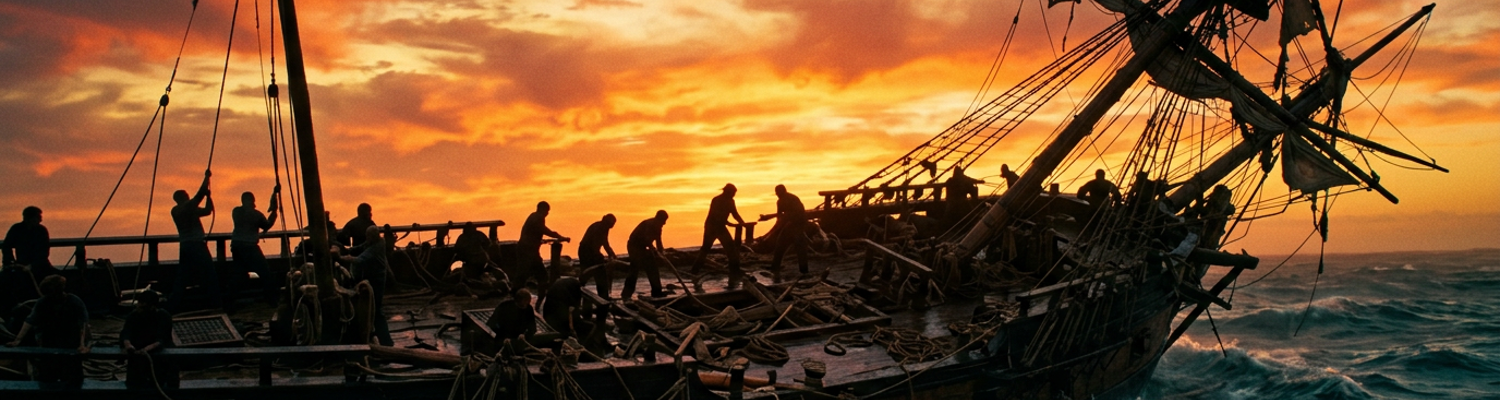

Dismasted Frigate on the Grand Banks
Watchstanders detected the first sign of catastrophic structural failure when fractured deck planks began shifting violently underfoot. The November 7, 1779 storm had sheared away all three masts and the bowsprit of the 36-gun frigate Confederacy, leaving the warship paralyzed in heavy Atlantic swells southeast of the Grand Banks. Winds that had reached hurricane strength during the night finally backed away into a quiet drizzle, exposing the full extent of the wreckage across the upper deck. Carpenters quickly measured the splintered timber stubs where the foremast, mainmast, and mizzenmast had snapped off flush with the deck carlings. Crewmen swung heavy boarding axes to chop away tangled shrouds, stay cables, and shattered spar sections that hung over the bulwarks and battered the hull planks below.
Axes severed the final hemp lines holding the wreckage against the ship, dropping tons of tangled cordage and splintered timber into the sea to relieve the pounding against the outer hull. Six feet of seawater flooded the lower hold as failing mechanical bilge pumps forced continuous emergency bailing by exhausted sailors. Wood shavings, dislodged oakum, and ballast sediment repeatedly jammed the pump chambers, splitting the internal leather valves and rendering the suction mechanisms useless. Sailors organized continuous bucket lines along the main hatchways, passing wooden buckets hand to hand from the bilges up to the open gun deck. Sounding leads dropped down the pump wells showed the flood level holding stubbornly against the bulkheads despite the endless manual labor.
Captain Seth Harding descended into the sloshing lower hold to take stock of the flooding alongside diplomatic envoy John Jay and French Minister Gerard. Lantern light illuminated deep water swirling over the ballast stones as the three men waded past strained frame timbers that creaked under every passing wave. John Jay, en route to Spain on a diplomatic mission to secure wartime funding and political recognition, inspected the cracked ceiling planks and helped mark the waterlines along the bulkheads with chalk. Minister Gerard, traveling back to Europe after his service as the first French envoy to Philadelphia, pointed out several sheared iron bolts where the frigate framing had begun to pull loose from the outer skin. Harding traced the worst leaks along the forward garboard strakes, recognizing that the dismasted hull was flexing so severely that the caulking was working free of the seams.
Caulkers pounded fresh oakum and tallow into the open seams below the waterline while Harding returned to the main deck to organize survival operations. Crew members cleared the tangled deck wreckage and began sorting through spare topmasts, booms, and canvas to construct improvised jury rigs. Watch officers recorded their estimated drift in the ship's logbook, noting that the crippled thirty-six-gun warship had drifted dozens of miles away from safe shipping lanes into open ocean. Harding divided the remaining able-bodied seamen into two rotating teams, assigning one group to maintain the frantic bucket lines while the other raised a temporary spar on the foremast stump. Sailors hauled on heavy tackles to hoist the improvised yard, securing the lower stays before the rolling swells could twist the fragile wooden assembly overboard and cause further injuries.
Orlop Deck Casualties and Makeshift Surgery
Tackle falls groaned against the upper deck bitts as litter teams carried these newly battered sailors and earlier storm casualties down through the hatchways into the flooded orlop deck. Seawater swirled knee-deep across the oak deck planks below the waterline, sloshing against chests and bulkheads as the wallowing frigate rolled into deep troughs. Swiveling horn lanterns hanging from the low overhead beams cast dim yellow light over the flooded compartment, revealing dozens of seamen laid out on wet sailcloth bags and mess tables. Medical personnel conducted emergency triage by this dim lantern light to address severe head trauma and fractures from falling rigging, broken blocks, and splintered spars that had crashed from aloft during the storm. Attendants braced themselves against the straining bulkheads to keep helpless, semi-conscious sailors from sliding across the wet decking into the dirty bilge runoff. Casualties quickly overwhelmed the small sick berth, creating a severe shortage of medical hands that left the primary surgeon unable to treat the flood of broken seamen on his own.
Marine Seth Kennedy stepped into the role of surgeon's mate to treat crushed sailors amid these desperate medical staff shortages. The young marine waded through the icy bilge water from one injured man to the next, rolling up his wool uniform sleeves to assist the surgeon with urgent surgical procedures. Sturdy barrel staves and split pine planks served as makeshift splints as Kennedy bound shattered leg bones and crushed ribs that had been broken under the weight of collapsing topmasts. Tight hemp cords and canvas strips were twisted down around mangled limbs to control massive bleeding, while Kennedy washed open lacerations with vinegar and salted water to clear out ground-in grime and wood splinters. Deck hands physically pinned struggling patients against heavy sea chests so Kennedy could extract jagged bone fragments from torn muscle tissue without anesthesia. Kennedy maintained a steady hand despite the pitching deck, working systematically through the flooded berth to stabilize men whose survival depended on immediate care.
Care shifted from broken limbs to severe head trauma as Kennedy and the surgeon confronted skull fractures caused by falling ironwork and heavy stay blocks. Lanterns were held close to examine crushed cranial bones, unresponsive eyes, and deep scalp gashes where heavy rigging lines had struck men down across the upper deck. Attendants used linen strips and scraped lint to pack open head wounds, wrapping tight cloth bands around swollen foreheads while holding each patient's head steady against the rolling motion of the hull. Seamen who slipped into unconsciousness were propped upright against the forward bulkhead so their faces stayed clear of the dirty seawater sloshing across the deck. Improvised wooden frames held several crewmen with fractured spines immobilized on mess benches, ensuring that sudden hull lurches would not worsen their internal injuries before the heavy swells eased.
Surgeon's notes frantically recorded each treated man's condition across damp paper sheets to establish immediate casualty accounting for Captain Harding. Clerks tallied the crew into separate operational categories, distinguishing between sailors permanently disabled by shattered bones, men recovering from severe concussions, and those with minor injuries who could still stand. Precise casualty tracking was critical because the flooded hull required every available set of hands to bail water and manage the improvised spars. Mess runners carried the finished casualty tallies up the companionway ladders, delivering the casualty counts directly to watch officers organizing survival efforts on the main deck. Watch officers immediately used these medical reports to draft unwounded marines and lightly bruised topmen into the ongoing work at the mechanical bilge pumps and the newly raised jury rig.
Emergency Fabrication of Jury-Rigged Spars
Topmen dragged split spars and severed stay cables from the deck waterways to build more upright timber frames across the ruined deck. Ship carpenters sorted through cracked oak yards, retrieving usable sections of splintered pine and hemp rope to reinforce the short wooden uprights lashed to the stump of the foremast. Working crews hauled spare topmasts and studding-sail booms out of the remaining waist racks, binding the heavy poles together with tight turns of salvaged cordage to serve as replacement yards. Riggers spliced together frayed lines and salvaged intact wooden tackle blocks from the wreckage, running new stays from the improvised masthead down to the gunwales to absorb the brutal shocks of the rolling Atlantic swells. Sailors hauled up torn strips of heavy canvas sailcloth, cutting them down with rigging knives and sewing new clews so the shortened sails could hang from the fragile wooden framework. This rudimentary jury rig caught the light morning breeze, giving the wallowing frigate its first bit of forward steerage as helmsmen wrestled the double steering wheel.
Helmsmen held the heavy rudder straight, but the sluggish response of the vessel proved that the makeshift masts could never survive the fierce winter gales of the open North Atlantic. Captain Seth Harding gathered John Jay and French Minister Gerard on the quarterdeck to review their real nautical chances, pointing out that the catastrophic spar loss left the ship incapable of clawing against head winds. The frigate could barely carry enough canvas to stay ahead of following seas, and pushing forward along the northern route toward Spain or France would inevitably bring more devastating Atlantic storms that would tear the fragile jury masts out of the deck carlings. John Jay reviewed the charts alongside Harding, agreeing that preserving the lives of three hundred men and protecting the diplomatic mission took absolute priority over their original timetable for reaching Europe. Harding officially canceled the transatlantic voyage, noting in the logbook that the total loss of the mainmast, foremast, and mizzenmast had eliminated any realistic possibility of completing the crossing.
Charts spread across the cabin table revealed severe operational dangers along the direct route back to the American mainland. Royal Navy battle squadrons closely patrolled the approaches to Boston, New York, and the Delaware Capes, meaning that an unmaneuverable American warship with truncated masts would face almost certain capture or destruction before reaching a safe continental harbor. Winter gales howling along the North American coastline would also batter the weakened hull against dangerous shoals, where the crippled steering and weak sail plan would leave the frigate with no room to escape. Harding chose instead to steer directly south into warmer latitudes, where gentle trade winds would allow the jury-rigged vessel to run easily before the wind toward friendly French ports in the West Indies. Martinique offered safe anchorages, French naval dockyards, and timber supplies to rebuild the frigate while keeping John Jay safe from British warships. Helmsmen hauled the wheel over to bring the bow toward the south, catching the following air in the newly raised canvas to begin the long, fragile crawl toward the Caribbean.
Passage South to Martinique Under Jury Rig
Canvas sails snapped against the improvised pine yards as the crippled frigate Confederacy began a voyage of over a month through enemy-patrolled waters at severely reduced speed. Helpless to outrun or outfight any standard Royal Navy cruiser, the warship wallowed through heavy Atlantic swells at barely two or three knots under its stubby jury rig. Captain Seth Harding enforced strict blackout discipline every night, ordering all cabin deadlights heavily blanketed and open lantern flames extinguished to avoid attracting British patrols hunting along the western shipping corridors. Topmen clustered on the makeshift spar platforms through blinding daytime heat, scanning the horizon for hostile sails while gun crews remained stationed at the lashed cannon for immediate defense. Crewmen pumped the bilges in continuous four-hour rotations to keep pace with leaking hull seams, while diminishing food supplies forced every sailor onto half-rations of putrid water and dry ship bread. Sounding rods lowered into the hold confirmed that the water level remained manageable, allowing the slow-moving vessel to limp steadily southwest until warm trade winds pushed the battered hull toward the Caribbean.
Mountain peaks of the Windward Islands broke through the southern haze to greet the exhausted lookouts after six punishing weeks of open-ocean survival. Captain Seth Harding skillfully guided the jury-rigged vessel into the neutral French anchorage of Saint-Pierre, Martinique, on December 18, 1779. French naval officers, colonial merchants, and local harbor pilots gathered along the stone quays in complete amazement as the dismasted American frigate crawled past the outer headlands, showing only shortened pine timbers and patched sailcloth where three towering masts had once stood. Harding navigated the sluggish ship through the crowded roadstead with delicate helm corrections, easing past anchored merchant craft while topmen stood ready at the stays to spill the wind from the makeshift sails. Heavy iron anchors plunged from the bow catheads into twenty fathoms of clear water, their flukes biting firmly into the sandy roadstead beneath the protective stone batteries of the French royal garrison.
Anchors secured the vessel to the harbor floor, allowing landing boats from the French naval station to pull alongside the frigate within hours of its arrival. John Jay and the diplomatic entourage disembarked safely onto the stone waterfront of Saint-Pierre, leaving the battered warship behind. Jay surveyed the buckled deck beams, split waterways, and truncated spar stubs from the harbor quays, recognizing that the shattered Confederacy required months of structural carpentry and completely new pine masts before it could ever face the open sea again. French colonial administrators and naval commanders welcomed the American envoy with formal honors, promptly arranging alternative passage across the Atlantic aboard the French frigate Aurore. Seamen loaded diplomatic trunks, confidential dispatches, and personal baggage into wooden harbor lighters, transferring the mission's valuable papers directly to the armed French warship anchored nearby. John Jay boarded the Aurore alongside his wife Sarah, French Minister Gerard, and the diplomatic secretaries to resume their interrupted voyage toward Spain, leaving Captain Harding in Martinique to oversee the long refit of the battered Continental warship.
Logistical Disarray at Saint-Pierre Harbor
Captain Seth Harding turned back to the stripped deck of the Confederacy to confront a paralyzing supply bottleneck inside Saint-Pierre harbor. French colonial naval stores held almost none of the towering white pine timbers required to fashion replacement lower masts, topmasts, or a bowsprit for a thirty-six-gun Continental warship. Martinique's tropical forests produced only dense, brittle hardwoods that were too heavy and inflexible for naval rigging, while the few imported northern spar sticks in government storage were earmarked exclusively for the French royal battle fleet. Tar, pitch, oakum, hemp cordage, and heavy duck canvas were equally unobtainable along the civilian quays, where local merchants demanded exorbitant prices in hard coin that Harding simply did not possess. French naval dockyards were already working beyond capacity to patch king's ships battered in West Indian operations against the Royal Navy, meaning that skilled colonial shipwrights, caulkers, and master mast-makers could not be spared to work on an American hull. These severe resource deficits brought physical reconstruction to an immediate standstill, stalling major repairs for months while the unrigged frigate sat idle beneath the harbor batteries.
Stretcher parties moved through the suffocating heat of the roadstead to row injured sailors and fever-racked soldiers ashore, offloading casualties into French colonial hospital facilities. Tropical infections and dysentery quickly surged through the weakened crewmen in the damp shore wards, incapacitating experienced topmen who had survived weeks of emergency bilge bailing on the open Atlantic. Marine officers divided their remaining able-bodied detachment to assume armed guard assignments over French ordnance depots, colonial customs storehouses, and local supply magazines to earn subsistence rations for the men. Other uninjured Continental seamen took temporary billets aboard armed French coastal schooners, island transports, and merchant craft to relieve Harding of daily victualing costs and to prevent idle sailors from rioting on the waterfront. This outward dispersal broke the operational cohesion of the fighting crew, scattering more than half the ship's company across shore hospitals and island duty stations while leaving only a small watchstanding detail to guard the battered warship.
Muster books originally drafted at New London and Philadelphia fragmented into administrative confusion as ship clerks tried to track the scattered personnel across Martinique. Water damage sustained during the Grand Banks gale had already smeared lines of iron-gall ink across the Connecticut enlistment pages, leaving dozens of names, ratings, and bounty payouts unreadable. Clerks worked by candlelight in the humid wardroom to draft provisional rosters, but continuous transfers between shore hospitals, island vessels, and harbor security details outpaced their daily accounting. Pay records and operational rolls compiled during the frigate's Delaware River outfitting fell out of alignment with the men actually present for duty, generating deep administrative gaps between official Continental Navy records and real waterfront numbers. Purser assistants posted daily lists along the gun deck carlings to note which missing crewmen were officially detached, which were dead of tropical fevers, and which had deserted into the Caribbean merchant fleet, but the muster rolls remained broken into contradictory fragments as the skeleton crew struggled to maintain the ship.
Carpenters among this skeleton crew lashed the surviving cannon into the waterways and struck the remaining top-hamper below decks to preserve the frigate's hull while awaiting outside relief. Harding assembled his few remaining petty officers to scrape the exposed hull timbers, pump the stagnant bilge water daily, and stretch awnings across the upper deck to shield the drying pine planks from the intense tropical sun. Watch officers stored salvaged blocks, stays, and iron fittings into the forward storerooms, locking every hatch to guard against pilfering by waterfront scavengers and foreign deserters. Harding finalized urgent operational dispatches to the Continental Marine Committee in Philadelphia, documenting the shattered status of his command and pleading for emergency funds, replacement timber, and new crew drafts to save the stranded frigate.
Postwar Verification in Pension File S 31789
Clerks of the Continental Marine Committee took custody of Harding's dispatches in Philadelphia, but the fragmented muster lists from the Caribbean anchorage created lasting administrative gaps for the men who had saved the ship. Seth Kennedy confronted these missing paper trails decades later when he petitioned the War Department for Revolutionary War service compensation under the Act of 1832. Kennedy submitted his formal application from Hancock County, Georgia, detailing his initial enlistment as a marine corporal and his emergency promotion to surgeon's mate during the catastrophic 1779 gale. Pension clerks unrolled the surviving naval registries in Washington to check his statements against official Continental Navy logs, seeking verifiable proof of his active service aboard the thirty-six-gun frigate. Records from the ship's initial outfitting confirmed his presence on the Delaware River, but the paperwork ended abruptly before the Atlantic storm. Examiners verified Kennedy's name on early Connecticut recruitment lists, but they discovered zero official muster entries confirming his medical duties or rank changes after the dismasted frigate reached Saint-Pierre.
Auditors in the War Department Pension Office seized upon these archival omissions to dispute Kennedy's dual role as marine and surgeon's mate due to missing Martinique muster rolls. Government accountants argued that federal regulations strictly barred paying officer-level benefits without authenticated ship rolls signed by Captain Harding or primary medical officers. Bureaucrats pointed out that while Kennedy drew rations as an enlisted marine, the government possessed no payroll records showing that he ever received surgeon's compensation on the flooded orlop deck. Treasury officials insisted that temporary field assignments adopted during maritime crises could not be recognized as permanent naval appointments without contemporaneous paperwork. Federal reviewers maintained that emergency medical tasks performed by sailors or soldiers fell under general military duty rather than professional medical ratings. Pension examiners suspended Kennedy's claim, demanding that the aging veteran produce sworn eyewitness testimony from surviving shipboard officers to substantiate his wartime duties.
Kennedy collected sworn depositions from surviving Continental veterans and former shipmates across New England to rebuild his military timeline. Affidavits arrived from former crewmen who remembered carrying crushed sailors down through the hatchways and watching Kennedy dress wounds beside the ship's physician in the flooded hold. Surviving officers verified that the loss of medical personnel during the dismasting had forced Captain Harding to assign capable crewmen directly to the surgeon's berth. Attorneys assembled these notarized statements alongside fragments of Harding's operational correspondence to demonstrate that the casualty crisis off the Grand Banks had forced marines into critical surgical roles. War Department clerks cross-checked these testimonies against Harding's known command decisions, confirming that severe staff shortages had indeed required enlisted men to perform complex medical procedures. Reconstruction of service documentation and officer affidavits permanently preserved within Kennedy's pension file S. 31789 proved that he had served as both a marine and a surgeon's mate through the storm and the long island refit.
Examiners accepted the reconstructed dossier and officially approved Kennedy's pension at the enlisted rate for a private and marine. Board members confirmed that the sworn testimony of his former shipmates successfully filled the void left by the lost West Indian rolls. Clerks inscribed the validated payment amounts onto the Treasury Department ledgers, calculating retroactive compensation back to the passage of the 1832 statute. Archivists bound the affidavits, muster extracts, and departmental letters into a single ledger jacket marked with file number S. 31789. Treasury messengers carried the final payment warrant to the postal wagons, delivering the authorized pension certificates to Kennedy in Hancock County.