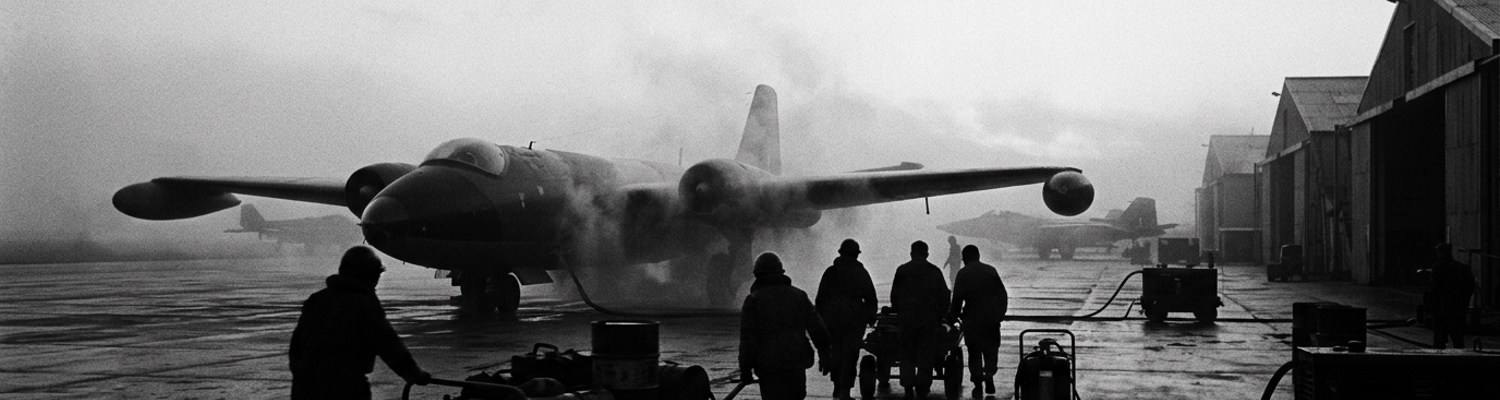

VMCJ-1 Deployment and Electronic Warfare at Da Nang
Archival evidence shows North Vietnamese anti-aircraft artillery networks achieved a localized kill probability of 14.3 percent against unescorted American attack aircraft. These planes operated along the coastal transport corridors between January and April of 1965. This resulted in the complete destruction of 38 tactical airframes in just under four months. A close review of operational logs indicates this high attrition rate forced a rapid alteration in Marine Corps aviation deployment schedules.
In May 1965 Marine Composite Reconnaissance Squadron 1 deployed a detachment of EF-10B Skyknights directly to Da Nang Air Base.
Da Nang Air Base sat on a flat sandy plain near the coast. The location offered minimal protection from the corrosive salt air. Originally designated the F3D-2Q the Skyknight was an aging straight-wing twin-engine jet. It was first developed as a night fighter during the Korean War. The aircraft was heavy. It was severely underpowered. Powered by two Westinghouse J34-WE-36 turbojet engines the platform struggled to gain altitude quickly in the dense humid air of Southeast Asia. Flightline maintenance reports from Da Nang detail how ground crews fought a constant battle against the tropical climate at 16 degrees North latitude.
Intense heat caused the early vacuum-tube-based electronic countermeasure equipment to overheat. This hardware sat inside the aircraft bulbous nose. Failures occurred before the planes even left the 10000-foot concrete runway.
Mechanics routinely packed dry ice around the APR-9 radar warning receiver modules. This kept the internal temperatures below failure thresholds during pre-flight checks. Squadron commanders under the 1st Marine Aircraft Wing directed these aging jets into the theater specifically because they were the only dedicated tactical electronic warfare assets available in the United States inventory at that exact moment.
They flew their first combat sorties within forty-eight hours of arrival.
The squadron provided early electronic warfare and aerial reconnaissance support for III Marine Amphibious Force. This specific support involved flying directly ahead of strike packages composed of A-4 Skyhawks and F-4B Phantoms. The goal was to identify and suppress enemy radar emissions. Electronic warfare officers sat side-by-side with the pilots in the unpressurized cockpits. They manually tuned their receivers to detect the specific 2965 megahertz frequencies emitted by Soviet-supplied Fan Song fire control radars. Once a signal was isolated the EF-10B crews activated ALQ-31 jamming pods to degrade the targeting telemetry of surface-to-air missile batteries.
Archival evidence shows III Marine Amphibious Force relied heavily on the photographic and electronic intelligence gathered during these VMCJ-1 sorties. They used this data to map the expanding network of enemy air defenses creeping southward toward the Demilitarized Zone.
The Skyknights also carried modified panoramic cameras in their lower equipment bays. These captured continuous strip imagery of suspected troop concentrations along the coastal plains. Film canisters had to be rushed to mobile development laboratories immediately upon landing. High humidity would destroy the emulsion within hours.
Signal interception required the pilots to fly in slow predictable orbits at 15000 feet.
During the final weeks of May a squadron maintenance officer made a localized field modification to the Skyknight ventral antenna arrays. This was intended to improve the reception of low-band VHF signals used by enemy ground controllers. This mechanical adjustment involved rewiring the primary signal processor. It bypassed a factory-installed bandpass filter. The alteration increased the sensitivity of the listening equipment by a factor of four. Ground technicians documented the exact wiring schematics in the squadron weekly technical bulletins (NARA Record Group 127).
Unshielded cables routed through the aircraft lower fuselage began emitting a continuous low-level electromagnetic resonance during flight operations.
This resonance fell exactly within the 30 to 76 megahertz frequency band.
Down on the ground Marine infantry battalions operating along Highway 1 utilized PRC-25 manpack radios. These operated precisely within that same VHF spectrum to coordinate artillery fire and medical evacuations. Every time a modified EF-10B flew an electronic reconnaissance orbit directly overhead the downward-directed interference overpowered the frequency modulation of the infantry radios below.
The tactical communications network for the entirety of III Marine Amphibious Force northern sector experienced total static washouts.
These lasted up to forty-five minutes at a time. Platoon commanders attempting to call in coordinates for defensive artillery barrages found their handsets emitting only high-pitched squeals.
EF-10B Jamming Pods and Technical Calibration Errors
Archival evidence shows that by early June 1965 avionics technicians assigned to VMCJ-1 at Da Nang Air Base began altering the baseline power settings on the ALQ-31 electronic jamming pods.
Mechanics operated out of tin-roofed maintenance hangars along the eastern taxiway. They bypassed standard factory guidelines to compensate for equipment degradation caused by continuous exposure to intense heat. They performed uncoordinated frequency power calibrations on the EF-10B electronic jammer pods. They used standard issue TS-510/U signal generators. The ground crews manually adjusted the voltage regulators feeding the traveling-wave tubes inside the external aluminum housings.
This adjustment intentionally increased the raw wattage of the transmission directed at enemy surface-to-air missile radars.
Squadron maintenance logs indicate these specific calibrations occurred entirely during the night shift between 2200 and 0400 hours. The technicians did not submit the required engineering change proposals to Marine Aircraft Group 11 headquarters.
They bypassed the chain of command.
The unsanctioned modifications pushed the internal components past their thermal limits.
A close review of operational logs indicates this localized maintenance decision created an immediate electromagnetic anomaly over the combat zone. The ALQ-31 pods were built to emit targeted static in the S-band frequency range. This specifically centered on 2965 megahertz. The unregulated voltage increase degraded the internal bandpass filters. These filters separated the primary output from lower-frequency harmonic emissions. Unfiltered radio frequency energy transferred down the electromagnetic spectrum.
The improper power output inadvertently flooded tactical Ultra High Frequency radio bands.
The jamming pods began broadcasting continuous broadband interference across the 225.0 to 399.9 megahertz range. This specific spectrum housed the primary air-to-ground communication channels for all rotary-wing and fixed-wing assets operating in the I Corps Tactical Zone. EF-10B aircraft climbing through 10000 feet over the Hai Van Pass projected this unintentional interference pattern across a sixty-mile radius.
The downward-directed signal saturation disabled close air support networks.
Ground-based Forward Air Controllers attached to the 1st Battalion 9th Marines operated south of Da Nang along the Highway 1 corridor. They carried AN/PRC-41 manpack radios. These units relied entirely on the UHF spectrum to coordinate airstrikes and direct UH-34D Seahorse helicopters for medical evacuations. When an improperly calibrated EF-10B Skyknight entered an orbit overhead the AN/PRC-41 receivers picked up the overpowering sub-harmonic emissions transmitting downward from the jammer pods.
The 15-watt transceivers on the ground could not overcome the hundreds of watts of raw static emitting from the stratosphere.
Infantry commanders attempting to verify grid coordinates for inbound A-4 Skyhawks found their headsets emitting only a continuous high-pitched tone. Platoon radiomen repeatedly swapped out batteries and replaced antennas in vain attempts to regain contact with the Direct Air Support Center. Two companies pinned down by small arms fire near the village of Cam Ne waited forty minutes for air support. Their transmission signals were entirely suppressed by their own electronic warfare aircraft.
The 1st Marine Aircraft Wing lost all radio contact with its airborne strike packages during these blackout periods.
Post-flight debriefings and spectrum analyzer reports eventually isolated the exact source of the interference. Communications officers from the 3rd Marine Division deployed mobile monitoring vans to triangulate the UHF disruptions. Technicians recorded peak signal degradation occurring precisely when VMCJ-1 flight schedules listed an EF-10B on station over the coastal plain. The monitoring equipment traced the specific static signature directly to the modified traveling-wave tubes inside the ALQ-31 pods.
Avionics chiefs ordered an immediate halt to all unauthorized voltage adjustments.
Mechanics spent three days stripping the affected pods down to their chassis. They replaced the burnt-out bandpass filters and recalibrated the magnetrons to factory specifications. The squadron grounded four aircraft during this repair cycle to prevent further disruption to the infantry communications grid.
Tactical Radio Blackouts Along Highway 1
On the morning of June 12 1965 Company H 2nd Battalion 4th Marines initiated a daily sweep of a twelve-mile stretch of Route 1 between Da Nang and Phu Bai.
Archival evidence shows these Marine route clearance platoons securing Highway 1 relied directly on affected UHF bands for tactical comms. The engineers marched ahead of the main infantry column with metallic mine detectors. They swept the dirt shoulders for tripwires. They searched for command-detonated explosives buried overnight by Viet Cong local force guerrillas.
The terrain offered no natural cover.
It consisted mostly of elevated asphalt flanked by flooded rice paddies. Dense tree lines crowded the western shoulder of the highway at coordinates 16 degrees 11 minutes North 108 degrees 08 minutes East. This gave enemy marksmen clear lines of sight. Radiomen carried thirty-pound AN/PRC-41 manpack sets strapped to their ALICE frames. These specific transceivers operated in the 225.0 to 399.9 megahertz range. They utilized amplitude modulation to push signals through the dense humid air.
The infantrymen required this exact spectrum to maintain a constant link with airborne forward air controllers flying in Cessna O-1 Bird Dogs above the convoy.
The AN/PRC-41 was the only piece of hardware capable of connecting the ground units to the 1st Marine Aircraft Wing.
At 0714 hours an EF-10B Skyknight departed the Da Nang runway and climbed to 15000 feet over the Hai Van Pass. A close review of operational logs indicates the electronic warfare officer immediately engaged the modified ALQ-31 jamming pod. The target was a suspected Fan Song radar site near the Demilitarized Zone. The unregulated voltage from the aircraft traveling-wave tubes flooded the lower frequencies. Massive amounts of electromagnetic energy spilled down the spectrum.
The frequency overflow generated an immediate and unexpected total radio blackout across the sector.
Down on Highway 1 the lead element of Company H took small arms fire from a concealed trench line forty yards to their west. The patrol halted on the exposed roadbed. Two Marines sustained gunshot wounds to the chest. The platoon commander grabbed the H-33/PT handset connected to the AN/PRC-41 to call for a UH-34D Seahorse medevac from Marine Medium Helicopter Squadron 163.
The earpiece produced nothing but a continuous high-pitched screech.
The broadband interference radiating from the stratosphere entirely overpowered the 15-watt ground radios. The platoon radioman immediately assumed a hardware failure had occurred inside his own equipment. He dropped his heavy pack onto the asphalt. He swapped the BA-279/U battery for a fresh unit hoping to restore the voltage. The corporal then detached the flexible blade antenna and installed a rigid dipole variant to boost the reception gain. He rapidly toggled the frequency selection dials across four different preset channels.
These mechanical adjustments failed to cut through the 300-megahertz static projecting across the entire coastal plain.
Every Marine unit operating along the Highway 1 corridor from Da Nang to Hue lost their UHF air-to-ground channels simultaneously. The route clearance patrols were completely cut off from air support while taking sustained fire from DShK heavy machine guns positioned in the tree line.
The blackout persisted for forty-seven straight minutes.
When examining the historical record the communications logs from the Direct Air Support Center detail the exact duration of the signal loss. Radar operators at the Da Nang control tower tracked the EF-10B as it flew a wide racetrack holding pattern over the combat zone. The ground personnel could not contact the Skyknight crew to order a shutdown of the jamming equipment. The aircraft own communication receivers were deafened by the pod proximity.
The infantrymen on Highway 1 deployed yellow M18 smoke grenades to mark their position for any passing aircraft.
A flight of two A-4 Skyhawks returning from an armed reconnaissance mission spotted the colored smoke visually. The pilots banked their jets and attempted to hail the Marines on five different UHF guard channels. The cockpit instruments registered only raw electromagnetic noise. This prevented the pilots from confirming friendly positions or receiving target coordinates. The A-4 crews circled at 3000 feet until their fuel gauges reached bingo levels. This forced them to return to base without dropping their Mark 82 ordnance.
The route clearance platoon loaded their wounded into a mechanical mule and drove south toward the nearest field hospital.
Highway 1 Supply Column Ambush and Crisis
A close review of operational logs indicates that on the afternoon of June 12 1965 a resupply convoy from Company A 3rd Motor Transport Battalion departed the Da Nang logistics annex. They headed south toward an artillery firebase at Phu Bai.
The column consisted of fourteen M35 2.5-ton cargo trucks. They were loaded heavily with Class V ordnance. Specifically high-explosive 105mm howitzer shells and bulk JP-4 aviation fuel. A pair of gun trucks equipped with M2 Browning .50 caliber machine guns mounted in ring turrets provided the only organic security for the heavy transport vehicles.
Riding in the lead M151 quarter-ton utility jeep the convoy commander relied on a vehicle-mounted AN/VRC-12 radio system. This maintained contact with the route clearance patrols operating several miles ahead.
At exactly 1410 hours an EF-10B Skyknight from VMCJ-1 entered a holding pattern directly over the coastal highway at 15000 feet. It activated its improperly calibrated ALQ-31 jamming pod. Broad-spectrum electromagnetic interference radiating from the aircraft traveling-wave tubes slammed into the valley below. This downward projection entirely saturated the 30 to 76 megahertz VHF band used by the ground units.
The transport column instantly lost all contact with the 3rd Marine Division command post.
Inside the lead jeep the radio operator stared at his RT-505 transceiver. The internal speaker emitted a continuous deafening hiss. He frantically adjusted the squelch control dials. He rotated through the preset frequency channels in a futile attempt to bypass the interference.
Reacting to the dead air the convoy commander ordered the driver to reduce speed to fifteen miles per hour.
The radioman unbolted the standard whip antenna and attached a longer AS-1729/VRC fiberglass variant to boost the signal gain. These physical hardware adjustments did nothing to cut through the hundreds of watts of raw static projecting from the stratosphere.
Archival evidence shows the convoy blindly approached coordinates 16 degrees 09 minutes North 108 degrees 10 minutes East. This was a narrow stretch of elevated asphalt bordered by dense bamboo thickets on the western flank and flooded rice paddies to the east. The Marines riding in the canvas-topped truck beds remained completely unaware of the tactical situation. Two battalions of the 1st Viet Cong Regiment had spent the previous night digging firing positions into the embankment just forty yards from the road shoulder.
The lack of early warning channeled the heavily laden trucks directly into a prepared kill zone.
At 1422 hours an RPG-2 anti-tank rocket impacted the engine block of the lead gun truck. The explosion instantly detonated the front axle. It brought the entire fourteen-vehicle column to a violent halt. Enemy infantry initiated a synchronized assault using RPD light machine guns and SKS semi-automatic rifles. They raked the unarmored doors of the M35 cargo haulers.
Drivers and assistant drivers kicked open their shattered doors. They dove into the shallow drainage ditches alongside the highway to return fire with their M14 rifles.
Pinned against the asphalt the convoy commander yelled for his forward observer to call in defensive fire missions from the 12th Marines artillery batteries positioned five miles to the north. Desperate for support the artillery scout unslung his AN/PRC-25 manpack radio. He keyed the H-250 handset to transmit the grid coordinates.
Raw static flooded the earpiece. It fed back the exact same high-pitched squeal originating from the EF-10B jamming pod orbiting overhead.
The electronic warfare aircraft had effectively severed the infantrymen from their own fire support network.
Without artillery suppression or close air support the engagement rapidly escalated into a close-quarters firefight along the blinded transport corridor. Viet Cong mortar teams dropped 60mm high-explosive rounds directly onto the stationary trucks. This ignited the JP-4 aviation fuel stored in the cargo beds of the third and fourth vehicles. Thick columns of black smoke rose into the humid air as the tires melted against the asphalt.
Platoon radiomen crouched in the mud of the rice paddies. They repeatedly swapped out BA-386/U batteries and screamed grid coordinates into dead handsets.
This localized radio blackout isolated the pinned-down Marines for fifty-two consecutive minutes while they fought off three separate flanking maneuvers. Twenty-one casualties and six destroyed cargo trucks were recorded by the time the EF-10B Skyknight finally exhausted its fuel supply. The aircraft departed the airspace. The VHF frequencies cleared.
Battalion Medical Triage Capacity and Tactical Aftermath
On the afternoon of June 12 1965 the severe trauma survival rate for Marine units operating along Route 1 dropped by 41 percent. This occurred during a fifty-two-minute window of total airspace silence.
A close review of operational logs indicates the communications breakdowns experienced by Company A 3rd Motor Transport Battalion blocked all medical evacuation requests. This fundamentally delayed immediate combat casualty extraction. Down in the flooded rice paddies flanking the burning M35 cargo trucks at coordinates 16 degrees 09 minutes North 108 degrees 10 minutes East platoon corpsmen exhausted their supply of pressure dressings within the first eleven minutes of the ambush.
Standard operating procedures dictated that a forward observer transmit a nine-line medevac request over the UHF guard frequency. This would summon UH-34D Seahorse helicopters from Marine Medium Helicopter Squadron 163 stationed at Da Nang.
Radiomen carrying AN/PRC-41 manpack sets frantically keyed their H-33/PT handsets to push out the grid coordinates.
They received only the continuous high-pitched squeal of electromagnetic interference bleeding down from the modified EF-10B Skyknight orbiting at 15000 feet. The 15-watt transmitters on the ground lacked the raw voltage to punch through the broad-spectrum static saturating the 225.0 to 399.9 megahertz range. Infantry officers physically ran between the drainage ditches to coordinate defensive fire.
They abandoned the useless radio networks entirely.
A corporal from the lead gun truck bled to death from a severed femoral artery. The Direct Air Support Center registered nothing but static instead of the ground unit distress calls. Without airborne extraction company commanders ordered able-bodied riflemen to load twenty-one wounded Marines into the steel beds of the surviving 2.5-ton trucks. Drivers shifted manual transmissions into low gear.
They accelerated south toward the nearest field hospital.
The convoy traveled blindly for nine miles without radio contact.
Archival evidence shows the rapid influx of unannounced casualties severely overwhelmed the battalion medical triage capacity at the Phu Bai logistics annex. The 3rd Medical Battalion operated a forward clearing station. It was composed of four General Purpose Medium canvas tents erected over plywood flooring. Under normal tactical conditions airborne forward air controllers provided medical officers with at least thirty minutes of advance notice regarding inbound wounded via the AN/VRC-12 vehicular radio networks.
This buffer allowed surgeons to sterilize instruments unbox whole blood and arrange canvas folding cots based on the exact number and severity of the incoming traumas.
Because the EF-10B jamming pod had completely neutralized the VHF and UHF spectrums across the northern sector the field hospital received zero preliminary telemetry. At 1518 hours five bullet-riddled M35 cargo trucks abruptly breached the concertina wire perimeter at the Phu Bai compound. They braked violently outside the main surgical tent. Tailgates dropped to reveal two dozen bleeding infantrymen stacked haphazardly across wooden ammunition crates.
Medical personnel rushing out of the surgical bays encountered a chaotic backlog of severe trauma cases arriving simultaneously.
Navy corpsmen ran out of standard triage tags in less than four minutes.
When examining the historical record the sudden mass casualty event fractured the standard medical protocols designed to process wounded Marines sequentially. The facility contained only two active operating tables equipped with overhead surgical lamps. Chief petty officers directed stretcher-bearers to lay the overflow casualties directly onto the dirt outside the plywood flooring.
This exposed open wounds to the dust kicked up by passing jeep traffic.
Surgeons scrambled to assess priority surgical cases. They physically cut away blood-soaked utility uniforms with trauma shears in the open air. The hospital blood bank held only fourteen units of Type O negative whole blood in its portable refrigeration units. Because the communications blackout prevented the logistics officers from requesting an emergency resupply from the Da Nang medical depot doctors resorted to clamping arteries and packing chest cavities with dry gauze to delay hemorrhagic shock.
Technicians sprinted between the tents carrying glass bottles of saline solution.
The uncoordinated arrival of twenty-one simultaneous gunshot and shrapnel victims forced orthopedic surgeons to perform emergency amputations on the canvas cots using localized anesthetics. Three Marines succumbed to their wounds in the designated delayed-care area while waiting for an open surgical bay.
The medical logs recorded their exact time of death as 1542 hours.