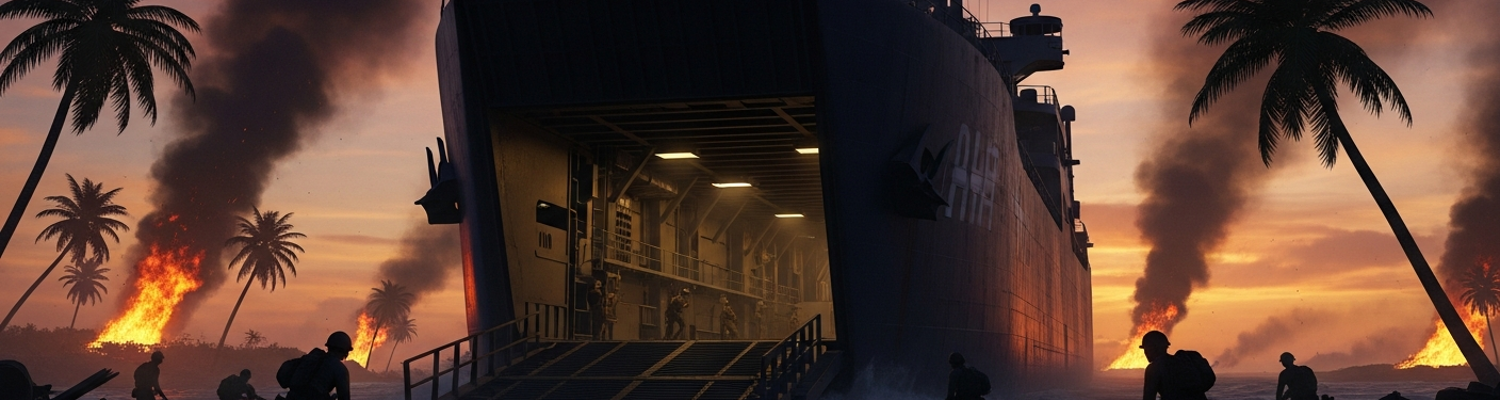

The timeline for Operation Galvanic dictated every decision. Planners understood the capture of the Gilbert Islands was a prerequisite for the advance across the Central Pacific, but the six-week window to gather intelligence, stage forces, and launch the invasion created intense pressure. This unforgiving clock shaped the violent arithmetic of the assault on Betio and left no margin for error. When the 76 hours of intense fighting ceased on November 23, 1943, the island of Betio was not a captured asset. It was a pulverized ruin. The preliminary naval bombardment had systematically shattered every piece of usable infrastructure. A review of V Amphibious Corps logs shows the primary pier, a 1,600-foot-long structure essential for offloading heavy equipment, was rendered completely unusable. On both Betio and the more lightly defended Apamama, captured on November 25th, any structure of value had been leveled. This included Japanese radio stations, power generation facilities, and water distillation systems. The destruction meant every gallon of potable water and every piece of engineering equipment had to be manhandled ashore from landing craft, a slow process that crippled the initial timeline for establishing a functional base.
The island was a minefield.
Archival evidence from Marine and Navy intelligence reports (NARA Record Group 38) documents a landscape seeded with thousands of pieces of unexploded ordnance. The Japanese garrison had deployed at least four different types of mines, including the Model 93 anti-vehicle mine and a crude anti-boat mine, laid in dense patterns along the southern and western beaches. These were often placed in the water just beyond the double-apron barbed wire, invisible at high tide. The problem was compounded by the sheer volume of munitions expended. Betio, an island of only 290 acres, was littered with dud American naval shells, unexploded artillery rounds, grenades, and mortar shells. The task of clearing this fell to the first Naval Combat Demolition Units and bomb disposal squads, whose formation was directly influenced by the failures at Tarawa. These teams worked in hellish conditions, clearing paths for bulldozers often by hand. A single discovered anti-boat mine or 14-inch naval shell could halt all logistical work in a sector for hours. Every attempt to build, bury the dead, or establish a command post carried the risk of a catastrophic detonation.
Visibility was often reduced to mere yards. The source was a thick, choking pall of smoke and dust that hung over the island for days. The pre-invasion naval bombardment and subsequent fighting had ignited everything that could burn. Japanese fortifications, constructed heavily from coconut palm logs, smoldered endlessly, releasing a greasy, acrid smoke. This was mixed with fumes from burning fuel dumps and other destroyed materiel. The constant movement of vehicles across the pulverized coral landscape kicked up a fine, abrasive dust that combined with the smoke into a toxic haze. After-action reports from the 2nd Marine Division note the difficulty in maintaining command and control. Survey teams tasked with platting the new airfield found their line-of-sight instruments were frequently defeated by the perpetual gloom. The mixture of smoke and coral dust also had a severe mechanical effect, clogging the air intakes of vehicle and generator engines, leading to frequent failures that further snarled the difficult supply situation.
The immediate aftermath of the fighting on Betio presented a landscape of human suffering that complicated every calculation. Beyond the thousands of American and Japanese dead, the island’s civilian population was in crisis. Archival records indicate some 1,200 Korean laborers and about 1,200 Gilbertese inhabitants were discovered alive amidst the wreckage. The Japanese had destroyed their fishing canoes and coconut groves, leaving them entirely dependent on outside aid. The island’s water was gone. Bombardment had obliterated the Japanese distillation systems, and the shallow freshwater lens that naturally exists on coral atolls was hopelessly contaminated by ruptured fuel dumps, shattered latrines, and decomposing bodies. This created an immediate and severe risk of dysentery. U.S. Naval Construction Battalions, the Seabees, landed to find not a single functioning pier, forcing them to drag every crate of supplies ashore on barges over the treacherous reef flats. Their first priorities were burying the dead, clearing debris, and establishing a water supply by installing evaporators capable of producing 20,000 gallons daily. This took time. The 3,166 casualties from the 2nd Marine Division required care, evacuation, or burial, a task that strained the available medical personnel and landing craft.
This was a humanitarian and logistical emergency.
Looming over the crisis on Tarawa was a global shortage of one specific, unglamorous, and essential vessel: the Landing Ship, Tank. A review of operational logs from late 1943 shows a fleet-wide deficit of these ships. With a flat bottom and a large bow ramp, the LST was one of the only ship types capable of driving directly onto a beach to discharge heavy cargo like tanks, bulldozers, and bulk supplies without requiring a deep-water port. The demand was astronomical. In the Pacific, both Admiral Nimitz in the Central Pacific and General MacArthur in the Southwest Pacific were competing for the same limited pool of ships. This competition was made worse by the enormous requirements for the upcoming invasion of Normandy, which was allocated the lion's share of new LST construction. By the fall of 1943, this shortage had become a primary impediment to strategic planning. For CINCPAC, the problem was acute. The very same LSTs needed to ferry water, food, and engineering equipment to the garrison on Betio were already scheduled for the next major offensive, Operation Flintlock, the invasion of the Marshall Islands, set for January 1944.
Planners in Pearl Harbor faced a zero-sum game. Every LST sent south to Tarawa was an LST that could not be used for staging and rehearsals for the far larger Marshall Islands campaign. The strategic momentum of the entire Central Pacific drive depended on maintaining the operational timetable. A delay to Flintlock to alleviate the situation in the Gilberts would give the Japanese more time to fortify their island defenses, potentially leading to even greater casualties. The core of the dilemma was a direct conflict between the immediate needs of the men on the ground and the long-term strategic imperative. A decision had to be made about which risk was more acceptable: the continued suffering and potential disease outbreak on Betio, or the potential derailment of the offensive that was seen as the fastest path to ending the war.
Archival evidence shows CINCPAC chose momentum. The Joint Chiefs of Staff had established a Basic Logistical Plan in March 1943, which gave theater commanders like Nimitz the authority to set priorities for shipping. Operational records from December 1943 show a clear prioritization of combat resupply for future operations over reconstruction efforts for secured objectives. While Seabees on Betio worked to build a functional base with the limited resources on hand, constructing a new pier, a 4,400-foot runway, a 100-bed hospital, and fuel tank farms, the bulk of the amphibious shipping was directed north. These assets were used to move the 4th Marine Division and 7th Infantry Division and their equipment into position for the assault on Kwajalein and Roi-Namur. It was a calculated gamble, weighing the human cost on Tarawa against the perceived necessity of adhering to a relentless operational tempo. The decision confirmed that in the cold calculus of a theater-wide campaign, the needs of the next battle would almost always outweigh the consequences of the last one.
A review of CINCPAC message traffic from early December 1943 (Msg 041235Z DEC 43) reveals a command grappling with the consequences of Tarawa. Reports from V Amphibious Corps detailed a crisis spiraling beyond combat casualties. With the island’s infrastructure nonexistent and its natural freshwater lens contaminated, the risk of a catastrophic disease outbreak among the garrison and surviving civilians was imminent. This threat to the thousands of personnel on Betio jeopardized the island’s primary function as a forward airbase. In response, Admiral Nimitz’s staff at Pearl Harbor issued an unconventional directive that knowingly introduced significant risk into the operational timeline for the invasion of the Marshall Islands. The order was a direct intervention, rerouting assets already earmarked for combat operations toward what was functionally a civil affairs and reconstruction emergency.
The directive’s most controversial clause involved shipping.
The order mandated the immediate diversion of a number of Landing Ships, Tank from their forward staging duties for Operation Flintlock. These vessels were the backbone of the upcoming invasion, with 45 LSTs allocated to the Joint Expeditionary Force tasked with landing the 4th Marine Division and 7th Infantry Division on Kwajalein and Roi-Namur. The LST was the only vessel capable of driving its flat bottom onto an enemy beach and disgorging heavy equipment like tanks, artillery, and the engineering assets of the Naval Construction Battalions. Pulling even a small number of these ships, such as LST-479 and LST-480 which had participated in the initial Gilberts operation, from the Flintlock force was a major disruption. Each LST taken offline meant a reduction in the combat power that could be landed in the critical opening hours of the Marshalls invasion and a compression of the loading and rehearsal schedules for the assault troops. It was a trade, readiness for the next fight to solve the crisis of the last one.
Tied directly to the LST diversion was the reallocation of potable water production assets. The Seabee battalions possessed large, heavy, and complex mobile water distillation units. These skid-mounted evaporators were essential for supporting large bodies of troops in areas with no reliable water source. An after-action report from the 2nd Marine Division specifically noted that water distillation plants were not landed during the assault phase. The CINCPAC directive ordered that several of these units, originally slated for shipment with the main Flintlock invasion force, be loaded onto the diverted LSTs and rushed south to Betio. The goal was to establish a reliable source of fresh water to halt the spread of dysentery. This decision created a new logistical problem, stripping the Marshalls-bound invasion force of its own organic water-production capability and forcing planners to recalculate how they would sustain the tens of thousands of soldiers and Marines hitting the beaches of Kwajalein in just a few weeks. The diverted LSTs, carrying the heavy distillation machinery, represented a tangible transfer of capability from a future offensive to a current emergency.
The immediate civil affairs response on Betio was not a structured plan. It was a desperate improvisation executed amidst the wreckage. V Amphibious Corps logs indicate that the first humanitarian aid stations were little more than designated points in the rubble where Seabees and Marine shore parties distributed supplies directly from landing craft. There were no permanent structures. These distribution points, often shifting daily to accommodate ongoing bomb disposal work, became chaotic hubs where surviving Gilbertese and Korean laborers gathered. The supplies themselves were a direct diversion from combat stocks: cases of K-rations and C-rations intended for the assault troops, five-gallon water cans filled by the newly landed distillation units, and salvaged Japanese clothing or American blankets. American personnel, struggling to clear thousands of bodies and unexploded ordnance, handed out this aid to a population whose entire subsistence economy had been erased by the fighting.
This ad-hoc system was unsustainable.
To clear Betio for its primary purpose as an airbase and to manage the escalating humanitarian crisis, a decision was made to create temporary displacement camps. Archival evidence points to the nearby, less-damaged islet of Bairiki as the designated collection area for all non-combatants. This required a second, smaller amphibious operation, as hundreds of Gilbertese civilians and surviving Korean laborers were gathered from shell holes across Betio. They were then ferried by LCVPs across the lagoon to Bairiki. There, elements of the 18th and 74th Naval Construction Battalions, using bulldozers and salvaged Japanese building materials, erected a sprawling tent city. This camp was a rudimentary solution, providing basic shelter and centralized aid distribution but creating a dense concentration of people suffering from malnutrition and exposure, a perfect breeding ground for epidemic disease. The entire civilian population of Betio, along with the captured laborers, was effectively concentrated into this single, heavily guarded compound.
Disease was the second wave of the assault.
The medical response fell to specialized units organic to the invasion force itself. A message dispatched by Colonel David M. Shoup on November 22nd ordered B Company of the 2nd Medical Battalion to land on Bairiki and establish a field hospital. This small detachment of Navy doctors and corpsmen, part of the 2nd Marine Division, was equipped for combat casualties but found itself facing a public health catastrophe. Their facility on Bairiki was a collection of tents where they treated a constant flow of Gilbertese and Koreans suffering from severe malnutrition, infected wounds from shrapnel, and the initial signs of a dysentery outbreak. Working with limited supplies of plasma, morphine, and dressings, the medical teams implemented basic sanitation measures and triaged hundreds of patients. Their primary function shifted from battlefield surgery to public health and disease prevention in an effort to stabilize the more than 2,000 civilians and laborers under their care.
The entire American strategy for the Central Pacific rested on relentless, forward momentum. CINCPAC planners envisioned the island-hopping campaign not as a series of discrete battles, but as a continuous, rolling offensive. Each captured atoll was a necessary stepping stone, specifically a forward airbase, from which land-based bombers could neutralize and survey the next target. The victory at Tarawa in late November 1943 was a prerequisite for Operation Flintlock, the invasion of the Marshall Islands, scheduled for the end of January 1944. This two-month window left no room for error. The crisis on Betio was a direct threat to the strategic clock of the entire Pacific War. Every day that Betio remained a non-functional wreck was a day the air groups could not move in, a day that reconnaissance flights over the Marshalls could not be flown, and a day the logistical machinery for Flintlock could not move forward.
A delay to future combat operations was the most significant risk. Planners in Pearl Harbor understood that any postponement of the Marshalls invasion would grant the Japanese a priceless opportunity to reinforce their garrisons. Intelligence gathered after the Tarawa landings confirmed this fear, indicating that the Japanese were already adapting. In response to the fall of the Gilberts, elements of the 1st Amphibious Brigade were rushed to Eniwetok in early January 1944 to bolster its defenses. Even a few weeks’ delay could mean the difference between assaulting a hastily prepared position and attacking a fully developed fortress. This created a difficult choice for Admiral Nimitz's staff. Diverting resources to fix the humanitarian and logistical nightmare on Tarawa could directly increase the casualty count for the 4th Marine Division and 7th Infantry Division in the next battle. The momentum of the island-hopping strategy was itself a weapon, designed to keep Japanese forces off-balance. Ceding that initiative was seen as a strategic error.
The diversion of assets for humanitarian aid, while a risk to the Operation Flintlock timeline, generated a measurable return in Gilbertese cooperation that directly influenced the strategic utility of the captured atolls. A review of V Amphibious Corps and Naval Construction Battalion logs from December 1943 through early 1944 shows a clear pattern. As American aid stabilized the civilian population, Gilbertese men began to volunteer for labor details. This was not a conscripted workforce. They were volunteers who provided the manpower needed to accelerate the transformation of Betio from a wreck into a functioning forward base. Organized into labor battalions, they worked alongside Seabees clearing debris, grading the new bomber runway, and offloading the very ships that had been controversially diverted to bring them food and water. This cooperation had a tangible effect on the operational clock. The rapid construction of Hawkins Field on Betio, which became a base for B-24 Liberators of the Seventh Air Force, was directly attributable to this combined American and Gilbertese effort. These bombers would soon begin neutralization raids against Japanese bases in the Marshall Islands, softening the targets for the upcoming invasion.
This support was a direct result of a stark comparison.
The strategic value of this local support extended beyond manual labor into intelligence and security. The Gilbertese people had endured nearly two years of Japanese occupation. Eyewitness accounts gathered by Allied intelligence officers detailed a regime of forced labor, resource confiscation, and arbitrary violence. This experience stood in sharp contrast to the American arrival. Though the pre-invasion bombardment was destructive, the post-battle phase was defined by the distribution of K-rations and the establishment of medical clinics on Bairiki. This created a powerful psychological shift. Gilbertese islanders, with their intimate knowledge of the atoll's reefs, channels, and hidden paths, became invaluable guides. They led Marine patrols to pockets of Japanese holdouts in the weeks following the main battle, preventing ambushes and speeding up the final pacification of the entire Tarawa atoll. This active cooperation turned the civilian population from a logistical burden into a security asset, allowing garrison forces to focus on base construction and preparations for the Marshalls campaign.
Survival on Betio had been a matter of pure chance, and this randomness profoundly shaped the Gilbertese perception of the new occupying force. For three days, death came from the sky and the sea indiscriminately. A family might survive by hiding in one shell crater while another was obliterated a few yards away. This arbitrary destruction, however, was fundamentally different from what had preceded it. A year before the invasion, on October 15, 1942, Japanese forces on Betio had systematically executed 22 unarmed European coastwatchers and civilians as a reprisal for an American air raid. This event, known as the Betio Massacre, was an act of targeted, cold-blooded murder witnessed by the local population. The Japanese had established a clear pattern of deliberate brutality. The American violence, while immense, was impersonal and directed at the Japanese defenders. In the aftermath, the Americans offered medical aid and food, a stark reversal of the occupier-subject dynamic. This contrast between the calculated cruelty of the Japanese and the chaotic, but ultimately humanitarian-oriented, actions of the Americans was a decisive factor in securing Gilbertese allegiance. The shared experience of surviving the battle’s randomness, followed by the unexpected provision of aid, forged a pragmatic bond that would pay strategic dividends for the remainder of the Central Pacific drive.