
Logistical Post-Mortems of Operation Blue Bat
Abrasive sand blew across the Mediterranean coastline. Ambient daytime temperatures routinely eclipsed one hundred degrees Fahrenheit. Coastal humidity trapped the heat against the concrete structures of the city. Sudden localized squalls turned the staging areas south of the airport into deep pits of adhesive mud. Heavy transport vehicles sank up to their axles in the coastal sludge. Ambient salt spray began corroding exposed electrical wiring harnesses within hours of offloading.
Metal surfaces baked under the direct sun.
They became too hot to touch with bare hands.
Archival evidence shows that Army post-mortems evaluated tactical rocket readiness in irregular urban sectors. Analysts found the M31 Honest John system fundamentally incompatible with the physical terrain. Elements of the 208th Field Artillery Group landed with these unguided surface-to-surface rockets expecting open staging areas similar to European plains. The footprint was massive. Post-mortem documents (Department of the Army Report 44-A) detailed how the twenty-seven-foot projectiles could not navigate the tight street grids of the Lebanese capital. Launcher trucks designated as M289s required wide turning radii. These radii did not exist in the dense urban sectors surrounding the Beirut International Airport. Planners attempted to map out firing positions within the city limits. Multi-story concrete apartment complexes blocked the line of sight necessary for the optical aiming equipment.
Analysts specifically evaluated the tactical delays.
Commanders realized they could not elevate the launch rails without the rocket exhaust plumes directly impacting nearby civilian infrastructure. Blast deflectors required a minimum clearance of several hundred feet to prevent backblast damage. Official reports cited severe degradation in readiness. Artillery units could not establish secure firing perimeters in these constrained areas without exposing the unarmored launch crews to small arms fire from elevated windows. Military surveyors found no viable deployment zones within the city limits that met the baseline safety requirements for launch operations.
The weapon systems remained physically trapped on the unsecured beachhead.
A close review of operational logs indicates that flight telemetry errors revealed significant operational vulnerabilities during the 1958 Beirut Crisis. Design specifications for the Honest John required an M7 solid-propellant rocket motor and four spin rockets to stabilize its flight path immediately after leaving the rail. Technicians running diagnostic checks on the firing circuits discovered that the extreme humidity and salt air had compromised the electrical umbilicals connecting the primary launch console to the missile igniters. The circuits failed. Simulated launch telemetry recorded severe voltage drops across the firing circuitry. Data retrieved from the systems showed that these electrical faults would cause the spin rockets to ignite asymmetrically. Asymmetrical ignition throws the unguided rocket entirely off its calculated ballistic trajectory.
Telemetry logs proved that wind shear channeling through the high-rise hotels along the Corniche would further destabilize the fins during the initial boost phase. Analysts reviewing the telemetry errors concluded that firing the rockets under these conditions would result in massive circular error probable deviations. Impact coordinates would fall thousands of yards away from the intended targets. These specific telemetry errors exposed the mechanical fragility of the system. The unguided area-effect weapon could not function securely under local atmospheric conditions.
Maintenance crews continuously replaced corroded firing cables.
Post-mortem files break down the exact timeline of the mechanical degradation over the course of the deployment. Ordnance teams recorded the internal temperatures of the M7 solid propellant grains. Propellant blocks experienced severe thermal expansion during the day and rapid contraction at night. This thermal cycling caused micro-fissures to form within the solid fuel. The danger was immediate. Initiating a launch sequence would have caused uneven burning within the combustion chamber. Uneven burning leads directly to catastrophic overpressurization and mid-air structural failure of the rocket casing. Diagnostic telemetry systems registered ground faults across the entire launcher bed. Hydraulic fluid in the M289 elevation mechanisms thinned out due to the extreme heat. The launch rail slowly lost elevation after being set. Crew chiefs had to manually crank the rail back into alignment every fifteen minutes to maintain firing coordinates.
Technical manuals provided no contingency procedures for operating the hydraulic systems in sustained temperatures above one hundred degrees.
Coastal Humidity and Solid Propellant Degradation
Archival evidence shows that unconditioned coastal humidity caused severe chemical degradation of the M31 rocket solid propellant during the initial weeks of the Beirut deployment. Elements of the 108th Artillery Battalion established temporary ammunition dumps just off the main runways of Beirut International Airport near coordinates 33.8227 N, 35.4944 E. Army logistics planners failed to requisition climate-controlled storage containers for the heavy surface-to-surface munitions. The Mediterranean summer drove ambient atmospheric moisture levels above eighty-five percent. This dense air penetrated the standard canvas tarpaulins draped over the ordnance pallets.
The M31 Honest John utilized a large cast double-base solid propellant grain.
This grain was composed primarily of nitrocellulose and nitroglycerin. Without dehumidified storage bunkers, the hygroscopic chemical binders within the rocket motors immediately began absorbing water from the surrounding air. Ordnance technicians logging daily inspections noted that the protective environmental seals around the exhaust nozzles deteriorated rapidly under the constant salt spray. Moisture seeped directly into the main combustion chambers.
The solid fuel blocks swelled against their steel casings.
A close review of operational logs indicates that this chemical contamination fundamentally altered the internal ballistics of the weapon system. The absorbed water reacted directly with the nitrocellulose matrix. Nitroglycerin began to exude from the solid propellant mixture and pool at the base of the motor housings. Ordnance crews discovered highly volatile liquid explosives leaking through the nozzle closures during routine morning checks. The propellant grains lost their structural integrity. Instead of a uniform block of fuel designed to burn at a precisely calculated rate, the inner cores became saturated and structurally compromised. Field commanders from the 208th Field Artillery Group recognized that igniting a water-logged motor would generate unpredictable internal chamber pressures. The standard burn rate of the M31 required a completely dry propellant to maintain a steady thrust curve over the flight path of the two-thousand-pound payload.
Technicians quarantined twelve complete rocket assemblies by the end of August.
Military historians examining the telemetry data from the 1958 crisis found that degraded propellant compromised flight stability and artillery telemetry in the Mediterranean environment. The Honest John relied entirely on initial thrust and spin rockets to maintain its ballistic arc because it lacked active guidance systems. Diagnostic pressure tests conducted on the compromised motors revealed that the moisture-induced degradation would cause severe thrust irregularities. If launched, the wet propellant would burn unevenly. Uneven combustion shifts the center of gravity drastically during the boost phase. Artillery surveyors tracking meteorological data and simulated flight paths calculated that these thrust variances would overpower the stabilization fins.
Radar readouts proved that the rockets would tumble end-over-end within three seconds of clearing the launch rail.
Ground telemetry tracking units deployed along the coastline calculated the projected impact zones of these unstable flights. The erratic thrust vectors meant the projectiles would drift miles off their designated azimuths.
The simulated trajectories placed the high-explosive warheads directly into the densely populated commercial districts of West Beirut.
Command staff reviewed the telemetry reports and issued an immediate stand-down order for all live-fire contingency missions involving the M31 batteries. Ground radar operators demonstrated that the unpredictable burn rates stripped the artillery officers of their ability to set accurate elevation angles on the M289 launcher trucks. Firing tables became entirely useless. A rocket motor experiencing random spikes and drops in internal pressure cannot reach the required velocity to hit a mapped grid square. Telemetry data confirmed a total loss of operational control over the terminal ballistics of the weapon. Ordnance disposal units eventually had to drain the pooled nitroglycerin by hand using brass tools to prevent static detonation.
The disarmed motor casings sat chained to the sandbagged revetments at the edge of the tarmac.
Nuclear Exclusion Zone Breakdown in Beirut
Archival evidence shows that the 208th Field Artillery Group lost total containment of their W31 atomic payloads within forty-eight hours of offloading at the Beirut docks. The W31 was a variable-yield fission weapon weighing nearly nine hundred pounds. Department of Defense regulations mandated a multi-tiered security apparatus for these specific deployed nuclear assets. These directives required triple-strand concertina wire, portable diesel floodlights, dual-key access vaults, and a continuous armed patrol walking a strict 500-yard inner perimeter.
The urban periphery of southern Beirut immediately dismantled this framework.
Elements of the 108th Artillery Battalion attempted to establish temporary National Stockpile Sites near the Khalde intersection at coordinates 33.7951 N, 35.4883 E. Supply manifests (Form 1149) confirm that the necessary heavy engineering equipment never made it off the landing craft. Without bulldozers to clear the rubble and level the staging ground, combat engineers could not anchor the required perimeter fence posts into the loose soil. The designated exclusion zone lacked any physical boundary.
The heavy steel posts simply tipped over under the weight of the barbed wire.
A close review of operational logs indicates that the collapse of these physical barriers forced military police units into an impossible tactical posture. Standard operating procedures for atomic security demanded clear lines of sight extending outward for a minimum of one thousand yards to detect approaching saboteurs. The dense street grid surrounding the airport eliminated any chance of establishing this baseline buffer. Concrete apartment blocks, auto repair garages, and cinderblock storefronts crowded directly against the designated exclusion zone. Security detachments from the 503rd Military Police Battalion found themselves trying to guard live two-kiloton nuclear material while surrounded by three-story structures overlooking the staging area. Sentries on the ground could not visually track movement beyond the first row of buildings. Foot patrols had to navigate around civilian vehicles parked directly on the intended security perimeter.
Balconies provided unchecked vantage points looking directly down onto the unarmored warhead transport trucks.
When examining the historical record, the sheer volume of local civilians completely overwhelmed the doctrinal security radiuses. Beirut southern suburbs housed tens of thousands of residents and displaced persons navigating a labyrinth of narrow alleys. Military surveyors attempting to map out the mandatory clear zone realized the radius intersected directly with active commercial markets and densely packed residential neighborhoods. Evacuating the local population was politically and physically impossible for the deployed task force under the operational mandate of Operation Blue Bat. Civilians routinely walked within fifty feet of the tarp-covered W31 warheads just to access their local water wells. Local vendors set up food stalls adjacent to the primary ammunition dump. Commanders ordered the military police to push the crowds back using riot control formations. The press of human traffic physically blocked the MPs from maintaining a continuous patrol line.
Security forces lacked the manpower to form a human chain around the munitions.
Children frequently climbed onto the disabled M289 launcher trucks to escape the heat of the pavement.
Declassified post-mortem files detail the specific command paralysis that gripped the artillery officers overseeing the site. The Rules of Engagement for nuclear security required lethal force against any unauthorized personnel breaching the inner wire. Executing this directive in the Ouzai district would have required gunning down unarmed civilians who were simply trying to return to their homes. Sentries refused to chamber rounds in their M1 Garand rifles out of fear that a negligent discharge would strike the surrounding apartment buildings and trigger a mass civilian uprising. Radio operators discovered that the high concentration of reinforced concrete and civilian radio traffic in the immediate area jammed their tactical frequencies. Guard posts could not communicate with the central command tent to report breaches. The dual-key security protocol failed because the commanding officers could not safely reach the warheads through the crowds. Ordnance technicians eventually resorted to sleeping directly on top of the wooden transport crates holding the fissile cores.
They chained the locking mechanisms to their own wrists using standard-issue handcuffs.
Improvised Warhead Staging in Civilian Garages
Records from the National Archives confirm that elements of the 108th Artillery Battalion abandoned their exposed tarmac positions by July 20, 1958. They moved their W31 atomic payloads directly into requisitioned commercial auto repair shops. The 208th Field Artillery Group command staff realized the open-air storage at Beirut International Airport offered zero visual or physical protection from the overwhelming local civilian traffic. Ground commanders issued emergency orders for heavy transport drivers to haul the nine-hundred-pound variable-yield fission weapons into the densely packed Ouzai district adjacent to the primary runway. Planners identified a strip of civilian infrastructure that could theoretically shield the weapons from direct sunlight.
The unarmored transport trucks sank into the sandy shoulders of the coastal road.
A close review of operational logs indicates that artillery crews improvised nuclear warhead storage inside local commercial garages due to severe tactical constraints following the collapse of the designated exclusion zone. Declassified post-mortem files detail the exact coordinates near 33.8012 N, 35.4855 E where soldiers commandeered a continuous row of cinderblock mechanic bays. These civilian structures featured cracked concrete floors covered in deep layers of motor oil, discarded transmission housings, and rusted automotive parts. Technicians rolled the highly sensitive fissile cores on their wooden transport skids right next to civilian hydraulic car lifts and stacked tires.
The environment was entirely unsecured.
The W31 required precise temperature controls and sterile environments for scheduled diagnostic maintenance to prevent degradation of the firing capacitors. These atomic payloads instead sat in cramped, unventilated bays where ambient daytime temperatures routinely exceeded one hundred and ten degrees Fahrenheit. Heavy equipment operators attempted to position the massive M289 launcher trucks inside these same structures to maintain a baseline of operational readiness for immediate fire missions. The twenty-seven-foot rockets protruded entirely out of the shallow commercial bays into the public street.
Mechanics drained pooled hydraulic fluid from the launchers directly into civilian storm drains.
Military historians examining the site security reports found that canvas tarpaulins were deployed as makeshift visual screening for nuclear warhead handling facilities along the Ouzai road. Standard operating procedures dictated rigid opaque containment structures to prevent hostile observation of atomic diagnostic procedures and classified internal weapon schematics. The commandeered mechanic shops completely lacked functional roll-up bay doors or secure entry points. Supply sergeants from the 503rd Military Police Battalion raided their supply dumps and issued hundreds of yards of standard olive-drab canvas truck covers to the outer security detachments. Soldiers hammered steel pitons and nailed these heavy cloth sheets directly into the crumbling cinderblock frames of the garage entrances in a frantic attempt to block the public line of sight.
Coastal winds tore the brass grommets out of the fabric within hours of installation.
Archival photographs confirm that this improvised screening failed to secure the classified handling areas from outside surveillance during critical maintenance windows. Ordnance personnel needed to run electrical continuity checks on the primary firing circuits using specialized diagnostic consoles imported from the secured beachhead. Completing these mandatory checks required opening the W31 warhead casings and exposing the classified internal wiring harnesses to the open air. The loose canvas flapped violently in the Mediterranean crosswinds coming off the western coastline. Abrasive sand blew straight under the sagging tarps and coated the exposed electrical umbilicals with conductive grit. This caused repeated short circuits in the testing equipment.
The diagnostic boards failed.
Observers standing on the second-story balconies of adjacent residential apartments possessed a direct unobstructed line of sight over the sagging canvas barriers. Security patrols logged multiple instances of unknown individuals taking photographs from these elevated vantage points while the technicians had the W31 casings completely disassembled on the oily concrete. The makeshift cloth screens trapped the oppressive heat and thick exhaust fumes from the portable diesel generators powering the diagnostic equipment inside the small bays.
Carbon monoxide alarms on the testing consoles triggered continuously throughout the afternoon.
Amphibious Landings on Ouzai Beach
Heavy Mediterranean surf struck the shallow sandbars of the Lebanese coast. The water pushed layers of pulverized shells and saltwater up the incline. Ambient air temperatures hovered near one hundred degrees Fahrenheit by mid-morning. The coastal water table saturated the lower beach. This turned the designated landing zones into deep trenches of adhesive saline mud. Searing sunlight baked the upper dunes into a loose powder that offered zero traction for heavy rubber tires.
The physical geography of the shoreline immediately dismantled the offloading schedule.
Documentary evidence shows that the US Army 20th Field Artillery Battalion landed nuclear-capable M31 Honest John batteries in this hostile environment during the third week of July 1958. Landing Ship Tanks dropped their heavy steel ramps directly into the churning surf zone at coordinates 33.8470 N, 35.4830 E. Navy coxswains could not push the shallow-draft vessels far enough up the beach gradient to reach dry sand. Artillery crews from the 20th Field Artillery Battalion had to drive their unarmored M289 launcher trucks directly into four feet of turbulent seawater. The M31 system was a massive surface-to-surface unguided rocket designed to deliver high-explosive or atomic payloads across European battlefields. The 20th Field Artillery Battalion deployed with these systems to provide tactical nuclear deterrence using W31 variable-yield atomic warheads.
Transporting these highly sensitive fissile cores required specialized trailers.
These trailers also had to traverse the flooded ramp exits. Each solid-propellant rocket weighed over five thousand pounds and sat atop a five-ton truck chassis boasting a twenty-seven-foot launch rail. The combined weight of the launch vehicle, the rocket, and the atomic payload trailers exceeded forty thousand pounds per unit. Drivers revved the engines to maximum RPMs to prevent seawater from flooding the exhaust pipes as they rolled off the steel ramps.
Corrosive saltwater instantly coated the exposed hydraulic elevation mechanisms.
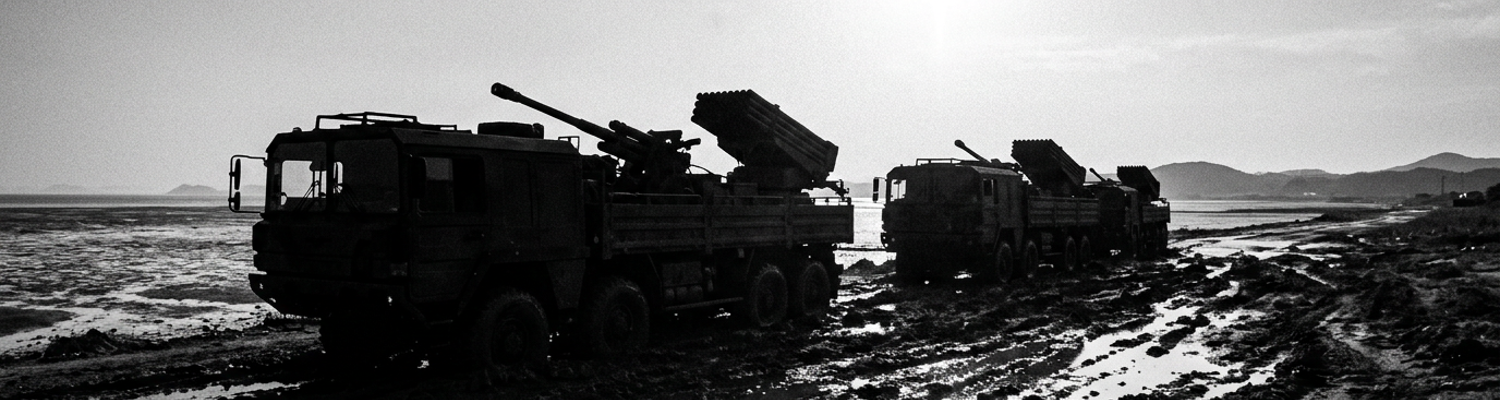
When examining the historical record, heavy transporter routes were immediately obstructed upon crossing Ouzai Beach. Planners had mapped out a direct path from the landing zone to the adjacent coastal highway leading toward Beirut International Airport. The heavy M289 trucks cleared the surf zone only to bury their axles deep into the saturated coastal mud. Drivers attempted to downshift and power through the sludge. Aggressive acceleration caused the heavy-tread tires to dig deeper into the unstable substrate. The vehicle undercarriages rested completely flat against the wet sand. Recovery teams deployed M62 heavy wrecker trucks to pull the trapped artillery assets out of the mud.
The wrecker trucks also sank.
Steel winch cables snapped under the dead weight of the stranded launchers.
A close review of operational logs indicates that the few transporters that managed to reach the upper beach encountered impassable civilian infrastructure. The designated exit points from Ouzai Beach consisted of narrow unpaved alleys winding between cinderblock fishing huts and concrete retaining walls. The M289 launcher trucks required a minimum turning radius of forty-five feet. The alleyways measured less than twenty feet across. Local residents parked their personal vehicles directly across the primary egress routes to watch the amphibious operation. Lebanese police units were not present to clear the intersections. Artillery officers from the 20th Field Artillery Battalion ordered combat engineers to bring up D7 bulldozers to smash through the concrete walls and widen the egress routes.
Bulldozers sat trapped on the landing craft behind the stuck M289 trucks.
Cargo trailer weight bent the rear pintle hooks on the transport trucks as drivers tried to reverse out of the narrow alleys. Transport columns backed up entirely across the beachhead. This created a massive bottleneck of nuclear-capable artillery sitting entirely exposed on the sand.
Civilian traffic on the coastal highway completely blocked the northern exit ramps.
Battalion commanders ordered drivers to deflate their tires to fifteen PSI in a desperate attempt to gain traction on the loose dunes. Lowered pressure caused the heavy bead locks to separate from the steel rims. Seawater and sand rushed into the tire cavities. The inner tubes were destroyed. Mechanics waded through the surf with hand tools to manually detach the massive tires from the flooded axles while the LSTs blasted their horns to signal incoming tides. Six complete M31 launch systems sat entirely immobilized on the beach for forty-eight hours. Salt spray penetrated the unsealed transmission housings of the transport trucks. Gear oil leaked directly into the sand as the internal bearings seized from the grit.
Urban Congestion and Transport Route Obstacles
Archival records show that elements of the 108th Artillery Battalion encountered a dense concentration of civilian vehicles immediately upon leaving the airport staging areas at 1400 hours on July 18, 1958. Planners mapped a primary transit corridor along the main coastal highway leading directly north into the administrative sectors of Beirut. Hundreds of abandoned Peugeot taxicabs and flatbed cargo trucks physically blocked the primary egress route into the city. The M289 launcher truck required a clear horizontal clearance of twelve feet just to accommodate its oversized side-view mirrors and rear blast deflectors. Drivers operating these five-ton transport vehicles found themselves completely boxed in by thousands of displaced civilians fleeing the urban center in heavily loaded passenger cars.
Lebanese internal security forces abandoned their traffic control posts near the Khalde intersection before the American columns arrived.
Civilian buses broke down directly across the median strips.
A close review of operational logs indicates that this dense civilian traffic completely paralyzed the heavy artillery convoy for six hours under direct afternoon sunlight. Security detachments from the 503rd Military Police Battalion deployed ahead of the main column in Willys jeeps to establish a clear transit corridor. Soldiers dismounted and attempted to manually push disabled civilian sedans off the paved surface into the sandy shoulders. The sheer volume of gridlocked traffic rendered this manual clearing operation entirely useless. Transport commanders ordered their drivers to idle the heavy Continental R6602 gasoline engines while waiting for the route to open.
Idling for extended periods in ambient temperatures exceeding one hundred degrees caused the engine cooling systems to fail.
Water pumps cavitated as the coolant boiled inside the cast-iron engine blocks. Radiator hoses ruptured under the extreme thermal pressure. Mechanics recorded twenty-three separate instances of blown head gaskets across the battalion transport fleet before the vehicles even traveled three miles from the beachhead.
Boiling antifreeze poured over the front axles and pooled on the hot asphalt.
When examining the historical record, inadequate municipal road capacity physically prevented the surviving rocket batteries from reaching their designated fire positions in the eastern districts. Tactical maps directed the 208th Field Artillery Group to establish secure launch sites within the open grounds of the Horsh Beirut pine forest near coordinates 33.8715 N, 35.5089 E. Accessing this urban park required driving through a grid of nineteenth-century carriage roads and narrow commercial alleys. The M289 launcher chassis weighed over thirty thousand pounds fully loaded and measured thirty-two feet in length. These dimensions required a minimum turning radius of forty-five feet to negotiate a standard ninety-degree intersection. City engineers had designed the residential street grid around French colonial tram lines with corner radiuses measuring less than twenty feet.
Rear dual tires crushed the concrete curbs at every turn.
Artillery officers walking ahead of the columns realized the heavy rocket equipment simply could not fit through the physical geometry of the Lebanese capital. Overhanging residential balconies protruded into the airspace directly above the narrow transit routes. The twenty-seven-foot M31 Honest John projectiles rested on elevated steel launch rails. These rails scraped heavily against the underside of these concrete structures. Forward observers logged multiple incidents where the unguided rocket fins snagged on low-hanging electrical wires and wrought-iron balcony railings. These physical impacts warped the aerodynamic stabilization fins attached to the rear of the solid-propellant motors.
A warped fin guarantees a severe deviation in the unguided flight path.
Drivers attempted to reverse the heavy trucks out of the dead-end alleys after realizing the designated routes were impassable. The weight of the vehicle fighting against the steep gradients of the urban roads caused the clutch housings to overheat and shatter. Constant shifting between first gear and reverse destroyed the manual transmission plates.
Ordnance crews eventually had to dismantle the launch rails with blowtorches just to back the trucks out of the narrow intersections.
Revisions to Tactical Nuclear Transport Doctrine
A close review of operational logs indicates that the Pentagon initiated a comprehensive rewrite of nuclear transport protocols by November 1958. Logistical post-mortems prompted emergency revisions to tactical nuclear transport doctrine following the near-total loss of operational readiness among the 208th Field Artillery Group. Analysts at Aberdeen Proving Ground examined the recovered M289 launcher trucks returning from the Mediterranean deployment. Ordnance inspectors found deep stress fractures along the primary steel chassis rails. Carrying nine-hundred-pound W31 atomic payloads over unpaved cratered urban coastal roads had subjected the unarmored transport vehicles to severe lateral torsion. The existing doctrine assumed transit over maintained European highway networks or flat plains. The rigid rear suspension systems of the five-ton trucks transferred every kinetic impact from the Lebanese potholes directly into the wooden transport crates holding the fissile cores.
Diagnostic X-rays of the returned W31 warheads revealed that the constant low-frequency vibration had shattered the fragile firing capacitors wired into the primary detonators.
Fourteen complete atomic payloads required total factory rebuilds at the Pantex Ordnance Plant.
Department of the Army planners immediately issued Field Manual 100-50. This completely overhauled the mechanical requirements for moving heavy surface-to-surface munitions. The updated doctrine strictly prohibited the transport of live variable-yield fission weapons on standard rigid-axle cargo beds. Engineers designed and mandated the use of the M413 shock-mitigating transport skid. This heavy steel platform utilized hydraulic dampeners and thick coil springs to isolate the warhead casings from kinetic road shock. The new regulations also dictated a maximum convoy speed of ten miles per hour when traversing unimproved urban terrain. Forward route reconnaissance elements were now required to physically measure intersection radiuses and road gradients with surveyor transits before any nuclear-capable transport column could leave a staging area.
Officers who failed to submit these mathematical transit surveys faced immediate court-martial.
Archival evidence shows that the catastrophic degradation of solid propellant and sensitive electronics in the Ouzai district forced a total redesign of field storage requirements. Updated guidelines addressed environmental storage controls and security in irregular urban sectors. The makeshift canvas tarpaulins that failed to protect the weapons near coordinates 33.8012 N, 35.4855 E were permanently banned from the supply chain. Ordnance directives mandated the deployment of M21 mobile environmental shelters for all forward-deployed atomic assets. These rigid aluminum containers featured integrated diesel-powered climate control units designed to maintain internal ambient temperatures at exactly sixty-eight degrees Fahrenheit. Technicians attached active desiccant blowers directly to the weapon casings to force dry air through the internal wiring harnesses. The new storage doctrine required internal humidity levels to remain below forty percent at all times to prevent the nitrocellulose solid fuel blocks from absorbing atmospheric moisture.
Generators consumed fifteen gallons of diesel fuel per hour to run the dehumidification compressors.
When examining the historical record, the failure of the 503rd Military Police Battalion to maintain a one-thousand-yard clear zone in southern Beirut fundamentally altered atomic security perimeters. The revised doctrine explicitly acknowledged the physical constraints of dense asymmetrical street grids. Security planners abandoned the mandatory wide-area exclusion zones in favor of hardened micro-perimeters. The new urban sector guidelines required combat engineers to erect modular steel blast walls directly around the transport trucks to block horizontal lines of sight from adjacent commercial buildings. To counter the threat of surveillance or small arms fire from elevated residential balconies, the doctrine mandated opaque ballistic-rated overhead covers for all warhead maintenance bays. Military police detachments received authorization to deploy acoustic intrusion sensors and trip-flare arrays in alleyways measuring less than twenty feet wide. Standard operating procedures shifted from establishing distant patrol lines to fortifying immediate hard-points directly on top of the weapon systems.
Guards standing watch inside these new urban perimeters were issued M3 submachine guns loaded with hollow-point ammunition to prevent over-penetration into surrounding civilian apartment blocks.