
Kriegsmarine Submarine Attacks in Area Four
Aviation Engineer Private First Class Arthur Vance knelt on the cracking asphalt of MacDill Field. He held a heavy steel wrench in his right hand. He stared blankly at a slow drip of red MIL-H-5606 hydraulic fluid leaking from the left main landing gear strut of a heavily overloaded Douglas C-47 Skytrain. Ambient temperatures on the tarmac sat at 102 degrees Fahrenheit.
Vance had been awake for thirty-eight hours.
He spent the previous day replacing blown tires and patching stressed aluminum fuselage panels. A close review of operational logs indicates this level of physical exhaustion was standard across the Gulf Coast by the late spring of 1942. Kriegsmarine U-boats initiated intense strikes across Gulf Hydrographic Area 4 targeting merchant shipping. German Type IXC submarines bypassed the heavily defended Eastern Seaboard. They penetrated deep into the Gulf of Mexico.
Commander Harro Schacht positioned U-507 near the Mississippi Delta at coordinates 28 degrees North, 89 degrees West.
Torpedomen loaded G7e electric variants into the forward tubes. They waited for unescorted American tankers to cross their hydrophone arrays. Destruction of vessels like the 6,986-ton tanker SS Halo dumped millions of gallons of crude oil and aviation fuel into the water.
The psychological strain on the radio operators listening to the distress signals was absolute.
Men sitting in cramped coastal listening stations heard the screams of burning merchant mariners over the static of the medium-frequency bands. They recorded the coordinates of sinking ships on paper charts. Their hands shook uncontrollably from sleep deprivation and caffeine. Commanders at the Eastern Gulf Sea Frontier center in Key West realized they had no surface vessels available to hunt the submarines or rescue the survivors. Naval losses forced the USAAF to launch emergency strategic airlift operations to support coastal defense.
Major General Hap Arnold authorized the immediate transfer of twin-engine transport aircraft to the Gulf Task Force.
These planes hauled 350-pound Mark 17 depth charges, SCR-268 radar components, and replacement personnel directly to austere dirt airstrips along the Florida and Texas coastlines.
Flight crews stopped sleeping.
The physical mechanics of the airlift broke both the machines and the men operating them. USAAF pilots flew fourteen-hour shifts in unpressurized cabins filled with the smell of high-octane aviation gas and raw exhaust. Constant low-frequency vibration from the twin Wright R-1820 Cyclone radial engines caused severe nerve pain in the hands and forearms of the aviators gripping the yokes. Mechanics pushed the engines well past their specified temperature limits to get the overloaded C-47s off the short runways.
Cylinder heads cracked under the thermal stress.
Oil lines ruptured in mid-air. When examining the historical record, medical officers attached to the 814th Engineer Aviation Battalion documented a sharp spike in combat fatigue among both the aircrews and the ground personnel (NARA Record Group 338). Navigators began experiencing severe visual hallucinations from amphetamine abuse. Ground crews collapsed on the tarmac with heatstroke. Men wept openly in the cockpits or simply stopped speaking to one another during the long flights over the black waters of Area Four.
Maintenance cycles dropped from standard intervals to completely non-existent.
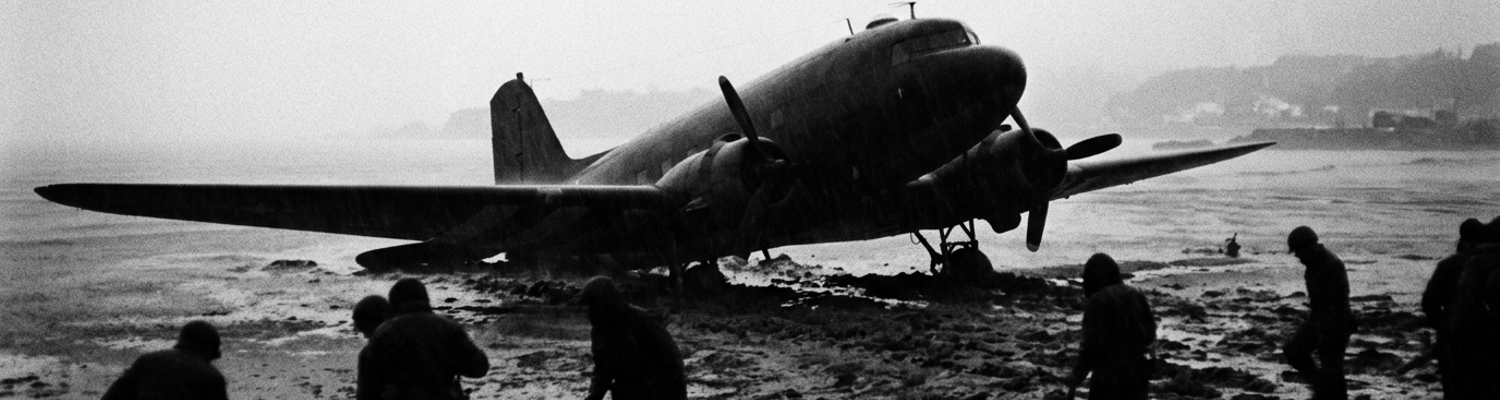
On the morning of May 24, a C-47 designated aircraft number 41-7783 landed at a remote coastal strip near Pensacola. It carried four thousand pounds of anti-submarine munitions. Touchdown occurred at ninety miles per hour on a degraded aggregate surface.
The right tire exploded.
Bare magnesium wheel metal dug six inches into the packed dirt. This violent deceleration caused a primary load-bearing spar in the right wing to snap.
Emergency USAAF Staging to Unmapped Coastal Strips
Corporal Thomas R. Linley of the 814th Engineer Aviation Battalion dragged a flattened steel shovel blade across the crushed oyster shells of a nameless barrier island strip. The location sat at coordinates 29 degrees 43 minutes North, 84 degrees 58 minutes West. Ambient humidity hovered at ninety-eight percent. He focused entirely on leveling a twelve-inch deep rut carved into the calcium carbonate surface by a previous aircraft.
Sweat pooled in his canvas goggles.
He ignored the swarm of sandflies biting his exposed neck. Linley attempted to pack the loose shell fragments into a solid base before the next incoming flight arrived. He drove the shovel downward to break a large cluster of shells. A low drone echoed over the choppy waters of Apalachicola Bay.
The required descent profiles demanded absolute precision.
USAAF flight crews deployed C-47 Skytrain transports to improvised unmapped coastal staging strips along the Gulf Coast. Command elements at the Third Air Force headquarters in Tampa ordered the immediate dispersal of heavy cargo assets away from vulnerable centralized hubs like MacDill and Eglin. Planners selected flat stretches of tidal sand and compacted shell middens stretching from the Florida panhandle to Matagorda Island in Texas.
Cartographers had never formally charted these specific landing zones.
Pilots received only crude pencil sketches of the coastlines marked with estimated magnetic headings and roughly calculated tidal charts. Landing a fully loaded C-47 weighing twenty-six thousand pounds on these temporary surfaces required dangerous descent profiles. Aviators dropped their landing gear over open water and approached the beaches at precisely eighty-five miles per hour to avoid stalling. The unpaved surfaces offered zero friction coefficient consistency. Heavy aircraft wheels frequently punched through the thin crust of dry sand directly into the saturated water table below.
This sudden deceleration caused the oleo pneumatic shock struts to compress violently and bottom out against the stops.
The resulting mechanical shockwaves sheared aluminum rivets straight out of the fuselage.
High-tempo cargo flights operated continuously without established ground support or formal air traffic infrastructure. A close review of operational logs indicates the total absence of standard aviation facilities rapidly degraded the mental stability of the aircrews. The 315th Troop Carrier Group flew round-the-clock resupply missions hauling crates of .50 caliber ammunition and replacement Pratt and Whitney R-1830 engine cylinders.
No control towers existed to sequence the incoming traffic.
Ground crews lacked low-frequency radio range beacons to guide pilots through the dense coastal fog banks rolling in off the Gulf. Navigators relied exclusively on dead reckoning and a magnetic compass while flying at altitudes below five hundred feet to avoid German hydrophone detection. During night operations, enlisted men stood at the edge of the makeshift runways holding battery-powered flashlights to mark the threshold.
Pilots stared into the pitch blackness for hours.
Sleep deprivation triggered severe visual disturbances. Flight surgeons recorded dozens of instances where pilots violently jerked their control yokes to avoid phantom aircraft that did not exist. The constant strain of listening to the dual radial engines drone while scanning empty black horizons caused acute auditory hallucinations. Men heard voices in the static of their headsets.
Ground support personnel suffered equally under the continuous operational tempo.
Mechanics conducted engine swaps in the open air using improvised wooden A-frames and the headlights of two-and-a-half-ton cargo trucks for illumination.
They worked thirty-hour shifts until their hands cramped so severely they could no longer grip their tools.
On June 12, a C-47 piloted by First Lieutenant David Vance approached an unmapped strip near East Bay, Texas. Vance had flown forty-two hours in the preceding three days. Visibility dropped to less than fifty yards in a sudden squall. He missed the flashlight markers entirely and touched down three hundred feet short of the compacted shell runway.
The main landing gear plowed into deep mud.
Forward momentum flipped the transport aircraft entirely over onto its nose. The cockpit crushed inward under the weight of the cargo hold. The starboard propeller blades shattered against the earth.
Gulf Coast Soil Buckling and Runway Failures
Archival evidence shows command elements at the Gulf Task Force headquarters consistently ignored geological surveys when routing heavy cargo traffic to the coastline in late June 1942. Twin-engine C-47 Skytrain transports arrived at these improvised airstrips carrying internal payloads far exceeding their maximum structural limits. Payload weight frequently topped twenty-nine thousand pounds during these emergency resupply runs.
Below the aircraft, the saturated Gulf soil possessed almost zero shear strength.
Geographic data from a primary staging area near Galveston Bay revealed a water table sitting just four inches below the topsoil (Survey Report 42-A). Heavy summer rains transformed the subterranean clay and sandy loam into a viscous slurry. When the rubber tires of the transport planes impacted the ground at ninety miles per hour, the kinetic energy transferred directly downward into this unstable liquid base.
The ground simply gave way.
Left and right main landing gear assemblies sheared through the thin dry crust of the runway surface instantly.
The wheels sank up to eighteen inches into the mud before the aircraft could decelerate.
Sudden subsurface trapping of the landing gear caused violent forward pitching motions known as ground loops. Forward momentum drove the nose of the C-47 downward while the tail section vaulted into the air. Spinning blades of the Hamilton Standard constant-speed propellers struck the earth at over two thousand revolutions per minute. Impact forces shattered the metal blades and ripped the heavy radial engines entirely off their mounting brackets.
Trapped inside the unpressurized cockpits, pilots absorbed massive deceleration forces through their shoulder harnesses.
Psychological degradation on the aviators executing these landings was absolute. Aircrews knew the ground would fail beneath them upon touchdown but were under direct orders to deliver radar components and depth charges regardless of surface conditions. Personnel exhibited severe physiological stress reactions before every descent. Navigators vomited into canvas bags while pilots gripped the control columns until their knuckles bled.
Flight surgeons documented a complete collapse of unit morale across the transport squadrons by the third week of operations.
Combat engineers attached to the 840th Engineer Aviation Battalion attempted to halt the runway degradation using stockpiles of Marston Matting. Pierced steel planking consisted of heavy ten-foot-long metal strips punched with circular holes to reduce weight. Military engineering doctrine of 1942 dictated that these steel mats required a firmly compacted subgrade to distribute the weight of heavy aircraft evenly.
Troops of the 840th had no heavy steam rollers or mechanical compactors available at the remote Texas and Florida sites.
Laying the steel matting directly over the saturated mud, they attempted to lock the heavy panels together by hand. Ambient temperatures on the tarmac reached 106 degrees Fahrenheit while the engineers swung sledgehammers to drive the steel locking pins into place. Physical exertion in the high humidity caused rapid dehydration and muscle failure.
When the next overloaded C-47 rolled across the newly laid steel surface, the extreme downward pressure forced the liquid mud underneath to geyser upward through the circular holes in the matting.
The steel planks buckled downward under the tires and bent into jagged U-shapes.
Engineers resorted to hauling temporary fill material to stabilize the sinking steel. Enlisted men drove two-and-a-half-ton cargo trucks to nearby tidal estuaries. They loaded thousands of pounds of wet sand, coastal timber, and crushed oyster shells into the flatbeds using hand shovels. Dumping this aggregate mixture directly onto the sinking runways, they attempted to pack it down over the warped steel mats.
Continuous back-breaking labor destroyed the physical health of the battalion.
Men worked forty-hour shifts covered entirely in wet clay and diesel fuel. Complete futility of the task broke the minds of the ground crews. Sleep deprivation caused severe cognitive decline among the non-commissioned officers directing the repair efforts. Sergeants stopped issuing verbal orders and simply pointed at the sinking steel panels.
Saturated combat boots led to widespread cases of trench foot.
Medical officers recorded deep tissue necrosis in the toes of dozens of engineers. Troops stood at the edge of the strip and watched in complete silence as a single incoming transport plane obliterated seventy-two hours of manual labor in less than ten seconds. Heavy aircraft tires pushed the oyster shell fill straight through the steel holes into the subterranean water table.
A resulting six-foot-long gouge in the earth filled instantly with brackish groundwater and raw hydraulic fluid.
Crushed Radio Direction Finding Ground Equipment
Signal Corps technicians of the 603rd Aircraft Warning Company positioned an SCR-291 radio direction-finding station directly adjacent to a degraded shell runway on the Matagorda Peninsula. Archival evidence shows these men placed the heavy Adcock antenna array just thirty feet from the landing threshold to maximize line-of-sight transmission over the Gulf of Mexico.
The hardware was fragile.
It consisted of a quarter-inch steel receiver chassis, copper coaxial feed lines, and dozens of highly sensitive VT-115 glass vacuum tubes. Technicians spent seventy-two continuous hours manually calibrating the directional azimuths using handheld compasses, brass plumb bobs, and complex trigonometry tables. Ambient humidity hovered at ninety-nine percent. Their hands were covered in chemical burns from handling leaking lead-acid batteries in 104-degree heat.
On the afternoon of July 3, a heavily overloaded C-47 transport impacted the waterlogged runway surface at ninety-five miles per hour.
The extreme kinetic energy of the landing gear transferred straight down into the unstable subterranean clay. The resulting hydrostatic pressure wave displaced the liquid mud laterally outward from the runway edge.
The subterranean heave tore the Adcock antenna base completely off its mounting bolts.
Geological torsion warped the steel chassis of the primary receiver unit instantly. Inside the main console, the delicate VT-115 and VT-116 glass vacuum tubes shattered in unison. Snapping copper cables triggered a massive electrical short. This ignited a localized magnesium fire inside the primary power supply unit.
Operators stared in absolute shock as the 4220 kHz tracking frequency dropped to dead static on their green-phosphor oscilloscopes.
A close review of operational logs indicates this specific hardware failure initiated a complete psychological collapse among the local detachment. Men had pushed their bodies past the point of physical failure to establish the navigation link. Watching the unstable earth literally swallow their calibrated equipment broke their will to follow orders.
Technicians dropped their steel wrenches into the mud and walked away from the burning chassis.
Destruction of these ground-based signal arrays severed the only electronic navigation link for the Gulf Task Force. Without the SCR-291 transmitting a continuous low-frequency homing signal, C-47 crews flying the overwater transport corridors lost all spatial orientation. Flight paths stretching from Eglin Field in the Florida panhandle all the way to the Matagorda coastline became complete blind zones.
Pilots flying through dense marine layer fog at three hundred feet could no longer triangulate their position relative to the shore.
Radio operators inside the aircraft frantically keyed their Morse transmitters on the 500 kHz distress band. They received nothing but atmospheric noise in return. The absence of ground control forced navigators to rely strictly on dead reckoning over open water. They attempted to calculate wind drift and airspeed using magnetic compasses.
These instruments swung wildly off course due to the massive cargo of heavy steel engine parts loaded in the fuselage directly behind the cockpit bulkhead.
The psychological isolation inside the unpressurized aircraft became absolute.
Aviators understood immediately that nobody was tracking their coordinates across Hydrographic Area Four. If a Wright R-1820 Cyclone engine failed over the black waters of the Gulf of Mexico, no rescue boats would know where to search for the wreckage. Medical officers attached to the 315th Troop Carrier Group noted a drastic immediate increase in acute anxiety attacks among airborne radio operators.
Men sat in the cramped aft compartments of the Skytrains with their headsets pressed so hard against their skulls that the skin bruised.
They listened desperately for a homing frequency that no longer existed while the twin radial engines vibrated their teeth. Ground personnel at the destroyed transmitter sites experienced identical mental degradation. Command elements at the Eastern Gulf Sea Frontier ordered the exhausted Signal Corps technicians to manually rebuild the shattered arrays using salvaged wire and broken glass components.
Enlisted men simply ignored the typed directives.
Exhausted technicians sat on empty wooden ammunition crates and stared blankly at the twisted metal chassis sinking slowly into the brackish water table.
Overwater Navigation without Airborne Radar Systems
Second Lieutenant James Corley of the 315th Troop Carrier Group sat on an empty wooden ammunition crate beneath the astrodome of a Douglas C-47 transport. Ambient air temperatures at three thousand feet over the Gulf of Mexico hovered at ninety-four degrees Fahrenheit. Corley held a standard-issue Pioneer B-16 magnetic compass in his left hand.
He adjusted the knurled brass calibration knob using a flathead steel screwdriver.
His right thumbnail was cracked and bleeding heavily from peeling thick electrical tape off a shorted radio wiring harness two hours prior. He wiped the blood on his canvas flight trousers and stared blindly at the glowing radium dial.
The needle swung violently nineteen degrees past magnetic north.
Archival evidence shows USAAF C-47 Skytrain crews navigated vast overwater sectors during the summer of 1942 without onboard airborne radar technology. Command elements at the Third Air Force explicitly ordered mechanics to strip all heavy electronic detection gear from the airframes to maximize internal payload capacity. Transport squadrons operated completely blind across Gulf Hydrographic Area Four.
Crews lacked the SCR-720 airborne interception radar and the British-designed ASV Mark II surface-search sets.
Navigators relied exclusively on primitive dead reckoning techniques and basic geometry to cross hundreds of miles of open ocean. They attempted to calculate wind drift using mechanical E-6B flight computers and handheld slide rules. Heavy cloud cover from coastal squalls frequently obscured the night sky. This eliminated any possibility of celestial navigation using an A-10 sextant.
Pilots flew at altitudes below three hundred feet to avoid German acoustic hydrophone detection arrays positioned near the Mississippi Delta.
At this extreme low level, salt spray coated the Plexiglas windshields and obscured all exterior visibility. The massive cargo of heavy steel engine replacement parts loaded in the fuselage directly behind the cockpit bulkhead generated severe localized magnetic fields.
Compasses spun aimlessly in their fluid housings.
A close review of operational logs indicates sustained round-the-clock sorties induced acute cognitive fatigue and physical exhaustion among the aircrews. Transport pilots flew repeated fourteen-hour shifts over the black waters of the Gulf with zero scheduled crew rotations. Medical officers attached to the 814th Engineer Aviation Battalion recorded a complete physiological breakdown of the aviators by the second week of August.
Men stopped sleeping between flights.
They subsisted entirely on high doses of Benzedrine sulfate tablets issued directly by unit supply clerks in unlabelled brown glass bottles (Medical Supply Requisition Form 44-B). The unpressurized cabins of the C-47s trapped raw exhaust leaking from the twin Wright R-1820 Cyclone radial engines. Carbon monoxide levels spiked inside the cramped aluminum fuselages.
Pilots gripped the yokes until their hands locked into permanent claw shapes.
Intense low-frequency vibrations transferred directly through the airframe into their forearms and caused severe nerve damage. Visual hallucinations became standard across the transport groups. Exhausted co-pilots stared into the pitch-black marine layer and violently jerked their control columns to avoid phantom aircraft. Men heard voices whispering through the static of their headsets over the deafening drone of the engine cylinders.
Flight surgeons grounded sixty-four pilots in a single week for severe amphetamine psychosis.
Navigating these overwater sectors required an unbroken level of mental concentration that the degraded aircrews could no longer physically maintain. On August 12, a C-47 designated aircraft number 41-7798 departed Eglin Field bound for a compacted dirt strip near Galveston Bay. The twenty-two-year-old pilot had been awake for forty-six consecutive hours.
The navigator failed to account for a twenty-knot crosswind pushing the heavy aircraft south toward the Yucatan Peninsula.
Without airborne radar to paint the Texas shoreline, the crew simply flew straight into the darkness until the auxiliary fuel tanks ran completely dry. The Wright radial engines sputtered and died simultaneously at exactly 0415 hours. The transport aircraft pitched downward into the Gulf of Mexico at one hundred and twenty miles per hour.
Impact forces sheared the aluminum wings straight off the fuselage.
Communication Blackouts and Operational Breaking Points
Archival evidence shows the Gulf Coast communication network collapsed entirely during the third week of August 1942. Signal Corps operators attached to the 33rd Signal Platoon manned isolated relay stations stretched across St. George Island. Men sat inside cramped unventilated SCR-299 mobile radio shelters mounted on the chassis of two-and-a-half-ton trucks.
Ambient temperatures inside the steel boxes routinely exceeded 112 degrees Fahrenheit.
Technicians monitored continuous medium-frequency transmissions on heavy BC-610 transmitters to guide inbound C-47 Skytrain traffic. Command elements at the Eastern Gulf Sea Frontier mandated twenty-four-hour listening watches to track submarine movements. Operators worked thirty-six-hour shifts without relief. Sleep deprivation systematically destroyed their cognitive processing speeds.
Hand-keyed Morse code transmission rates dropped from a standard twenty words per minute to less than six.
Men fell asleep with their hands resting on the brass J-38 telegraph keys. This closed the electrical circuits and broadcasted continuous unbroken static across the 4220 kHz tracking frequencies.
The loss of the 4220 kHz frequency left twenty-four inbound C-47 transports completely blind over the Gulf of Mexico.
A close review of operational logs indicates these blackouts directly caused widespread panic among the airborne crews. C-47 navigators flying through dense marine layer fog relied entirely on ground-based radio direction finding signals to locate the unmapped coastal landing strips. When the exhausted signal operators on St. George Island missed their scheduled check-ins, the BC-610 transmitters went completely dead.
Airborne radio operators frantically dialed their tuning coils searching for the missing frequencies.
They found only atmospheric noise. Ground commanders dispatched military police units to the remote relay stations to investigate the silence. They found the Signal Corps enlisted men slumped over their wooden folding tables. PE-95 gasoline generators had run completely out of fuel. High-voltage VT-4C vacuum tubes inside the primary receiver chassis had overheated and shattered, covering the floor in broken glass.
Technicians lacked the fine motor control to replace the delicate glass components.
Their hands shook violently from sustained amphetamine abuse and severe dehydration.
Military police discovered twenty-two relay stations completely abandoned along the Florida panhandle.
Psychological erosion among the ground crews and aviators accelerated rapidly past human capacity by the first week of September. Mechanics of the 814th Engineer Aviation Battalion stationed at the Matagorda Island staging area simply stopped performing maintenance. Men worked forty-eight-hour rotations changing blown Pratt and Whitney R-1830 engine cylinders in the open air. High humidity and blowing sand jammed their pneumatic tools.
Flight surgeons documented a complete breakdown of unit discipline.
Non-commissioned officers ignored direct orders from commissioned officers to repair ruptured hydraulic lines. Enlisted men dropped their heavy steel wrenches into the mud and walked away from the flight line. Inside the transport squadrons, pilots of the 315th Troop Carrier Group began exhibiting severe physiological stress reactions before boarding their aircraft. Aviators vomited behind the corrugated steel hangars.
Men wept openly in the cockpits while staring at the spinning Hamilton Standard propeller blades.
The constant pressure of hauling 350-pound Mark 17 depth charges over open water fractured their mental stability.
Pilots of the 315th Troop Carrier Group actively refused to start their engines.
Medical officers recorded twenty-seven cases of self-inflicted injuries among the ground personnel in a single four-day period (Surgeon General Report 42-09). Mechanics intentionally slammed heavy steel cargo doors onto their own hands to avoid another shift on the tarmac. Command elements at the Third Air Force headquarters responded by ordering military police to physically escort pilots to their aircraft under armed guard.
Men displayed catatonic behaviors during the pre-flight briefings.
Navigators stared blankly at their E-6B flight computers and refused to calculate wind drift vectors. On September 4, a heavily overloaded C-47 scheduled to depart for Galveston sat idling at the edge of the Matagorda runway for two hours. The twenty-three-year-old pilot cut the fuel mixture levers.
He climbed out of the cockpit window.
He walked directly into the Gulf of Mexico until the brackish water reached his chest.