
Neptune Approach and Initial Hazards
0200 Hours, 6 June 1944. Position 49°51′N 1°03′W. The vibration of the engines was a physical presence. It worked its way through the steel deck plates, up the legs of the men packed aboard the invasion fleet, and into their teeth. This was Operation Neptune. Over 5,000 vessels, from converted merchantmen to World War I-era battleships like USS Arkansas, churned the dark waters of the English Channel. They were organized into five naval assault forces, one for each designated beach. Hours earlier, they had converged in a congested rendezvous point south of the Isle of Wight, codenamed Piccadilly Circus, before turning south toward France.
For the sailors and coastguardsmen at the helms, this was the end of months of drills. A close review of operational logs indicates the ten swept channels leading to the transport areas off Normandy were perilously narrow, forcing the flotilla into tight columns. The seas remained choppy from a recent storm. For men aboard the flat-bottomed Landing Craft, Tank (LCTs) and Landing Craft, Infantry (LCIs), the constant, violent motion induced a seasickness that filled the poorly ventilated lower decks with a sour odor. There was no sleep. Only the hum of the engines and the cold spray.
The French coast appeared as a deeper shade of black against the pre-dawn sky. On the bridges of destroyers, lookouts strained their eyes. The first real sighting was a low, menacing silhouette, punctuated by the occasional flicker of a distant light. Sailors on watch passed the word in hushed tones, a current of anxiety running through the ships. Gunnery officers on warships like USS Nevada and HMS Warspite tried to get visual confirmations of targets they had memorized by codename and coordinate. Archival evidence shows what they saw was the product of Field Marshal Erwin Rommel’s efforts since late 1943 to bolster the Atlantic Wall. From the sea, crews could begin to make out the shapes of standardized German Regelbau bunkers, including concrete casemates for artillery and the smaller, half-buried Tobruk pits for machine gun crews. These structures were designed to pour interlocking fields of fire across the beaches. They were no longer pictures on a briefing room wall.
They were a tangible threat, waiting in the darkness.
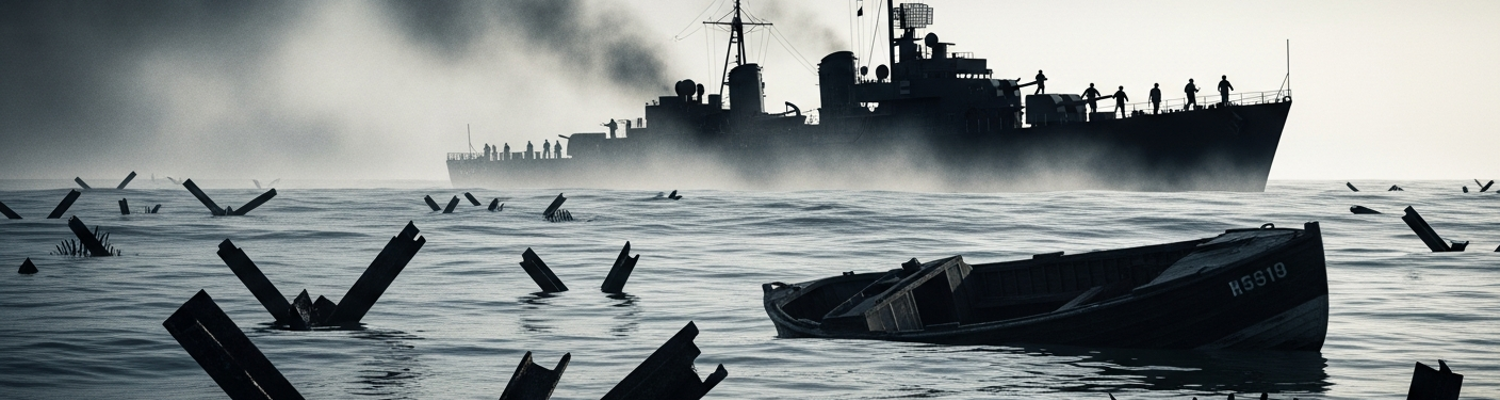
The greatest fear, however, was for what lay unseen beneath the waves. Rommel, anticipating a high-tide assault, had directed the placement of underwater obstructions designed to rip the bottoms out of landing craft. Allied planners had opted for a low-tide landing specifically to expose these traps, but navigating them in the dark, under fire, would be another matter. Naval intelligence had identified several distinct types. Furthest out were log ramps and mined wooden stakes, angled seaward and topped with a Teller mine containing over 10 pounds of high explosives. Closer to shore stood rows of "Czech hedgehogs" and heavy steel structures known as "Belgian Gates." German defensive plans show these were not randomly placed. They were laid out in successive, overlapping lines. For the men of the newly formed Naval Combat Demolition Units (NCDUs), these obstacles were their sole mission. They would be the first on the beaches, tasked with clearing 50-yard gaps for the following waves. The casualty rate for the NCDUs at Omaha Beach would reach 52 percent. In the pre-dawn hours, for every sailor staring toward the shore, the knowledge of this lethal, invisible gauntlet was a cold knot of dread.
Underwater Obstacle Design and Impact
A close review of German defensive plans reveals the systematic design behind the obstacle belts. They were a multi-layered, engineered system intended to destroy landing craft and funnel men into killing zones. Farthest out, often in water several feet deep even at low tide, began the log ramps and mined wooden stakes. These were heavy beams driven into the sand at an angle facing the sea. Atop many, German engineers had affixed a Teller mine, its pressure plate or tilt-rod detonator waiting for a landing craft’s flat bottom. Closer to shore stood the forms of Czech Hedgehogs. Industrially manufactured versions consisted of three 1.8 to 2.1-meter-long steel angle-iron beams, welded or bolted together to form a six-pronged caltrop weighing between 198 and 240 kilograms. Their purpose was to be slightly taller than the ground clearance of a tank or to catch the hull of a landing craft, causing the vehicle to roll up onto the obstacle and become impaled. The innermost line of water-borne defenses often consisted of Belgian Gates, originally designed as mobile anti-tank barriers for the Belgian Army in 1939. These were steel fences, three meters wide and two meters high, weighing approximately 1,280 kilograms each. The Germans chained them together in zig-zag patterns, creating a nearly impassable steel wall just off the shoreline.
Allied intelligence was not blind to these preparations. Archival evidence shows that planners at SHAEF had access to extensive aerial reconnaissance that mapped the obstacle belts with reasonable accuracy. The critical failure was one of interpretation and an underestimation of German thoroughness. Intelligence analysts correctly identified the different obstacle types but failed to grasp the sheer density of the fields. In some sectors of Omaha Beach, the density was three times greater than anticipated. The most significant oversight was the assumption that many of these obstacles were purely physical barriers. The widespread use of mines, especially the potent Teller anti-tank mines attached to the seaward stakes and ramps, was missed almost entirely. Planners believed a low-tide landing would expose the obstacles, allowing Naval Combat Demolition Units time to clear them. This calculation failed to account for the fact that the NCDUs would be working completely exposed to enemy fire, turning their mission into a suicidal one.
The first waves of Landing Craft, Vehicle, Personnel (LCVPs) and the larger Landing Craft, Tank (LCTs) learned the truth with finality. The sound of splintering plywood and screeching steel became the soundtrack of the approach. Operational logs from the assault on Omaha Beach detail dozens of LCVPs being torn open by Czech Hedgehogs or having their propellers fouled, leaving them to drift helplessly in the surf. The larger LCTs, needed for landing the tanks to suppress beach defenses, fared even worse against the outermost line of mined stakes. An LCT approaching the shore that made contact with one of these obstacles would trigger the attached Teller mine. The resulting detonation from over ten pounds of high explosives would blow the bottom out of the hull or shatter the forward ramp mechanism, instantly flooding compartments and sending Sherman tanks to the seabed. Post-action reports documented scores of LCVPs and multiple LCTs damaged or sunk by enemy fire and obstacles at Omaha alone. As the tide began its rise, it submerged the remaining obstacles, turning the supposedly cleared channels into an invisible gauntlet where a coxswain had no way of knowing if a dark shape beneath the waves was wreckage or a mine-topped steel beam.
Beach Obstacle Casualty Rates
The specialized units tasked with clearing the beaches were systematically reduced. At Omaha Beach, the mission fell to sixteen Gap Assault Teams, each a hybrid of U.S. Navy Naval Combat Demolition Unit personnel and U.S. Army engineers. Their task was to land at H-Hour and, in the thirty minutes before the main infantry waves, blow sixteen 50-yard-wide gaps through three distinct belts of German obstacles. They were to work completely exposed on a tidal flat that offered no cover, carrying heavy packs of explosives, all while under direct fire from the bluffs above.
Attrition was immediate.
A historical review by the War Department noted that casualties for the Special Engineer Task Force on Omaha ran to 41 percent, with most occurring in the first thirty minutes. For the NCDU sailors specifically, the numbers were more grim. Of the 175 NCDU men committed to Omaha, 31 were killed and 60 were wounded, a casualty rate of 52 percent. One team was annihilated as its landing craft ramp dropped. Another was reduced to a single survivor as it prepared its charges. The engineers from battalions like the 112th and 1st Engineer Combat Battalion suffered terribly alongside them. The 1st Engineers lost 14 men killed on D-Day, most from the company that landed first. They were not just shot. Men were blown apart by mines and mortars, or drowned, dragged under by the weight of their own demolition gear.
The German defensive scheme was predicated on this chaos. The obstacle belts were a tactical instrument designed to steer the invasion into pre-sited kill zones. The failure of the demolition teams to clear the majority of their assigned gaps before the tide began to rise had a cascading effect on the entire assault. Instead of sixteen wide channels, the incoming waves of landing craft found only a handful of partially cleared, poorly marked funnels. A coxswain of a Higgins boat, already struggling with rough seas and enemy fire, now had to navigate a lethal maze where a wrong turn could mean destruction on a submerged hedgehog. German machine gunners and artillery spotters in fortified Widerstandsnester (resistance nests) like WN62, which overlooked the Easy Red sector, did not have to guess where to shoot. They could see the landing craft being forced into these narrow lanes and saturate the mouths of the funnels with machine gun, mortar, and artillery fire. Archival analysis of German positions shows that gun emplacements were often sited to fire down the length of the beach, creating interlocking fields of fire that were effective against craft and men channeled by the remaining rows of mined stakes and steel gates.
The direct material destruction at the waterline was immense. It nearly crippled the landings before they began. The assault waves were stripped of their armored and artillery support precisely when it was needed most. The 741st Tank Battalion, launching its amphibious Duplex Drive Sherman tanks into the rough seas several miles from Omaha Beach, saw 27 of its 32 tanks founder and sink. The few tanks that did make it ashore became immediate targets. A second wave of armor from the 743rd Tank Battalion, carried all the way to the beach aboard their LCTs, fared better but still suffered losses as their landing craft were hit or impaled. The attempts to land artillery were an equivalent failure. The 111th Field Artillery Battalion lost all but one of its 105mm howitzers when the DUKW amphibious trucks they were loaded on swamped and sank. Landing Craft, Tank carrying vital engineering equipment, trucks, and ammunition were ripped open by submerged hedgehogs or detonated mines attached to log ramps. The beach became a junkyard of burning and swamped vehicles, with smashed jeeps, half-submerged trucks, and overturned landing craft creating more obstacles for the following waves. The tide washed over it all, hiding the lethal steel snares and mixing ammunition boxes with the bodies of the dead and wounded.
Logistical Bottlenecks and Rescue Urgency
A close review of the landing tables for Omaha Beach reveals a timetable undone by reality. The second assault wave was scheduled to land at 7:00 AM, just thirty minutes after H-Hour. Follow-on waves containing the 18th and 115th Regimental Combat Teams were scheduled for H+195 minutes. This schedule assumed the first wave would have secured the beach and begun neutralizing the defenses. Instead, the follow-on waves arrived to find the initial assault pinned down and the beach exits still sealed by German fire. A massive traffic jam of landing craft began to form offshore. Large Landing Ships, Tank (LSTs), carrying the bulk of V Corps' armor and vehicles, were forced to circle in the transport area nine miles out, waiting for a signal to approach that never came. This exposed the tightly packed ships to potential enemy air or long-range artillery attack.
On the beach, the plan had completely disintegrated.
The rising tide did not wash the slate clean. It submerged a scrapyard. Post-action damage assessments documented a seascape of ruin that created a new, impassable set of obstacles. Landing Craft, Vehicle, Personnel that had been shredded by mines or machine-gun fire wallowed in the surf, their ramps jammed or blown away. Further out, LCTs lay swamped or overturned, some with their cargo of Sherman tanks still chained to the deck, now destined for the bottom of the channel. One LCT, hit by shellfire, burned for hours, its black smoke a grim beacon for the confused coxswains trying to find a lane to the shore. The few channels partially cleared by the demolition teams were now blocked by this fresh crop of American wreckage. Each destroyed craft, each drowned vehicle, narrowed the possibility of landing reinforcements, creating a dam of twisted steel that held back the men and materiel needed to break the stalemate.
This chaos of wrecked steel trapped thousands of men in a medical catastrophe. The sheer volume of casualties overwhelmed the system before it could be established. Medical personnel from units like the 1st and 104th Medical Battalions were themselves casualties. German gunners saw the red crosses on their helmets and armbands not as symbols of neutrality but as priority targets. One medical company landing at Omaha reportedly lost 78 of its 90 men when their craft was hit. On the beach, battalion aid stations could not be set up in designated areas. Instead, medics established hasty collection points in the scant cover offered by the stone shingle or behind a knocked-out tank. Staff Sergeant Ray Lambert of the 16th Infantry’s medical detachment used a concrete wall as a makeshift aid station, repeatedly braving enemy fire to pull wounded men to safety. Evacuation was nearly impossible. Landing craft attempting to return to the fleet with wounded were swamped by the surf or hit by artillery. For hundreds of wounded men lying exposed on the sand, the most immediate enemy became the incoming tide, which threatened to drown them before help could arrive. By evening, it was estimated that only 830 casualties had been successfully evacuated from Omaha Beach to LSTs offshore, a fraction of the thousands wounded.
Naval Search and Rescue Efforts
No formal doctrine had prepared the Allied naval forces for the scale of the carnage in the waters off Omaha Beach. A close review of operational logs shows what unfolded was a desperate, improvised search and rescue effort, undertaken by vessels never designed for the task. The destroyers of Destroyer Squadron 18, whose primary mission was shore bombardment and anti-submarine screening, became the area’s most significant rescue platforms. Captains moved their ships, some over 300 feet long, into the dangerously congested and shallow waters, risking grounding and collision to get closer to the men floundering in the surf. Crews tossed cargo nets and lines over the side, hauling aboard exhausted and wounded soldiers. It was a clumsy, physically demanding process.
Further inshore, the smaller, flat-bottomed Landing Craft, Infantry (Large), or LCI(L)s, proved more agile. These 158-foot vessels, many crewed by the U.S. Coast Guard, had delivered troops and were supposed to retract, but many captains turned back into the chaos. They became makeshift ambulance ferries. Their crews pulled men directly from the water or transferred casualties from smaller, swamped landing craft. Even the 83-foot Coast Guard cutters of Rescue Flotilla One, the "Matchbox Fleet," originally intended to patrol near the transport ships, pushed in close to the beach. Their crews plucked men from the sea one by one. This was not a coordinated operation. It was a spontaneous reaction to human suffering, executed by individual ship commanders on their own initiative.
This humanitarian effort was conducted under the direct and continuous fire of German shore batteries. A historical review of German defensive positions shows that artillery observers on the bluffs overlooking Omaha, in fortified nests like WN62, had a commanding view of the entire bay. They could see the destroyers and LCIs lingering to rescue men and systematically walked their artillery shells onto the stationary targets. Bursts from 88mm and 105mm guns would erupt around the rescuing ships, forcing them to break off their attempts and get underway to avoid a direct hit, only to circle back moments later. The water was churned by geysers of spray, and shrapnel from near misses raked the decks. Closer to the beach, in the surf zone, the danger came from mortars and heavy machine guns. Sailors leaning over the sides to pull men from the water were completely exposed. German machine gunners did not need to be precise. They could saturate the area around a rescuing LCI with grazing fire, turning the water’s surface into a lethal gauntlet for both the rescuers and the men they were trying to save. The decision to stay and rescue men was a calculated risk against the ship’s own survival.
The physical environment was as much an enemy as the German gunners. The water temperature of the English Channel on June 6, 1944, was approximately 12 degrees Celsius, about 54 degrees Fahrenheit. A man in the water at that temperature would begin to suffer from incapacitating hypothermia in under an hour. For the wounded, shock and blood loss accelerated this process. Survivors were pulled from the water shivering uncontrollably, their limbs numb. Navigating to them was another ordeal. The sea was a junkyard of wreckage from destroyed landing craft, creating a treacherous debris field of splintered timbers and sharp, twisted steel that could hole the hull of a rescue boat or foul its propellers. Adding to this misery were thick slicks of diesel fuel and oil from foundered DD tanks and landing craft. This foul mixture coated everything, making ropes slippery and difficult to handle. It covered the men in the water, making them nearly impossible to grab, while the fumes choked rescuers and survivors alike. A sailor attempting to haul a fuel-coated, water-logged soldier from the frigid sea was a study in grim physics and desperate strength.
Channel Debris and Sailor Trauma
By the afternoon of June 6th, the waters off Omaha Beach had been transformed. Post-action reports catalogued a seascape of ruin where the English Channel was choked with the detritus of a foundered invasion. For a mile out from the shoreline, the surface was a thick slurry of wreckage and death. The angled-up corners of swamped jeeps and trucks protruded from the waves. Entire Landing Craft, Tank lay overturned, their flat bottoms pointing to the sky, while others burned, sending pillars of greasy, black smoke into the air that served as navigational markers for incoming waves. Snarled rolls of telephone wire, splintered ammunition crates, and thousands of discarded life preservers formed floating islands of debris. A review of naval salvage records shows this junk field included scores of Sherman tanks that had foundered offshore and landing craft shredded by mines and shellfire. Mixed in with the splintered wood and twisted steel were the men. Hundreds of bodies, buoyed by their kapok life jackets, washed in and out with the tide, their faces turned to the gray sky. They floated alongside ration boxes and mysterious oranges that had spilled from supply nets.
This was the new battlefield.
For the naval personnel who remained on station, the psychological assault was continuous. A coxswain piloting a Higgins boat for a follow-on wave was not afforded the luxury of looking away. He had to navigate his craft directly through this field of carnage, maneuvering to avoid fouling his propeller on a submerged wreck or a floating body. On the destroyers that had moved inshore to provide direct fire support, gun crews and lookouts had a commanding, panoramic view of the slaughter. They were compelled to watch as men drowned in the surf, as medics were cut down on the beach, and as landing craft were blown apart. There was no disengaging. Archival analysis of sailors’ experiences indicates a pervasive feeling of helpless observation, a forced witnessing of events that induced a unique form of combat stress. They were active participants in the battle, firing their guns and steering their ships, but were also trapped as spectators to a horror they could not stop and were tasked to sail through day after day.
There was no relief.
As the beachhead was slowly and bloodily secured, the mission for many sailors shifted from assault and bombardment to salvage and recovery. This work was not a neat, post-battle cleanup. It was conducted in contested waters, often under sporadic artillery and mortar fire. A primary task was clearing lanes through the wreckage for the thousands of tons of supplies and reinforcements waiting offshore. Naval Combat Demolition Units, having suffered grievously in the initial assault, exchanged their satchel charges for bulldozers to begin shoving wrecks clear of the tidal flats. Further out, specialized Navy salvage crews began the dangerous work of dealing with sunken or semi-submerged vessels. Every wreck was a potential death trap, possibly containing unexploded ordnance, unstable cargo, or the bodies of its crew. The work was slow and perilous.
The recovery of bodies from the sea was a separate, grim task that often fell to the crews of patrol craft and cutters. The men of the U.S. Coast Guard's Rescue Flotilla One had spent D-Day pulling hundreds of living men from the water under direct fire. In the following days, their mission frequently became one of recovering the dead. Sailors used boat hooks and cargo nets to haul the waterlogged corpses aboard. The process was physically and emotionally draining. Once a body was recovered, crews would search for dog tags or any other form of identification, a procedure often complicated by the effects of prolonged immersion in saltwater. The clearing of the larger wrecks from the sea lanes off Normandy would continue for years; a 2002 survey by the U.S. Navy’s Underwater Archaeology Branch was still mapping and documenting lost tanks, landing craft, and ships from the invasion.