
Greenpoint Construction and Perilous Atlantic Transit
Isaac Newton tightened the valve packings on the auxiliary steam engine with a heavy wrench as shipyard workers hammered armor plates across the deck at the Continental Iron Works in Brooklyn. Civilian laborers, boiler makers, and naval mechanics worked around the clock under gas lamps to complete the radical warship before the Confederacy could deploy its own ironclad from the Gosport Navy Yard. Navy officials conducted a hasty commissioning ceremony on February 25, 1862, officially placing USS Monitor into service while wet paint still covered the living quarters and machinists adjusted the turret gears. Lieutenant John Worden assumed command of the iron craft without standard acceptance trials, sea runs, or target practice for his handpicked volunteer crew. Naval authorities in Washington pressured Worden to bypass standard testing routines because Confederate naval movements threatened Union blockading squadrons in Virginia. Worden directed his officers to stow coal, ammunition, and rations into the cramped lower hull so the untested vessel could get underway for the open sea.
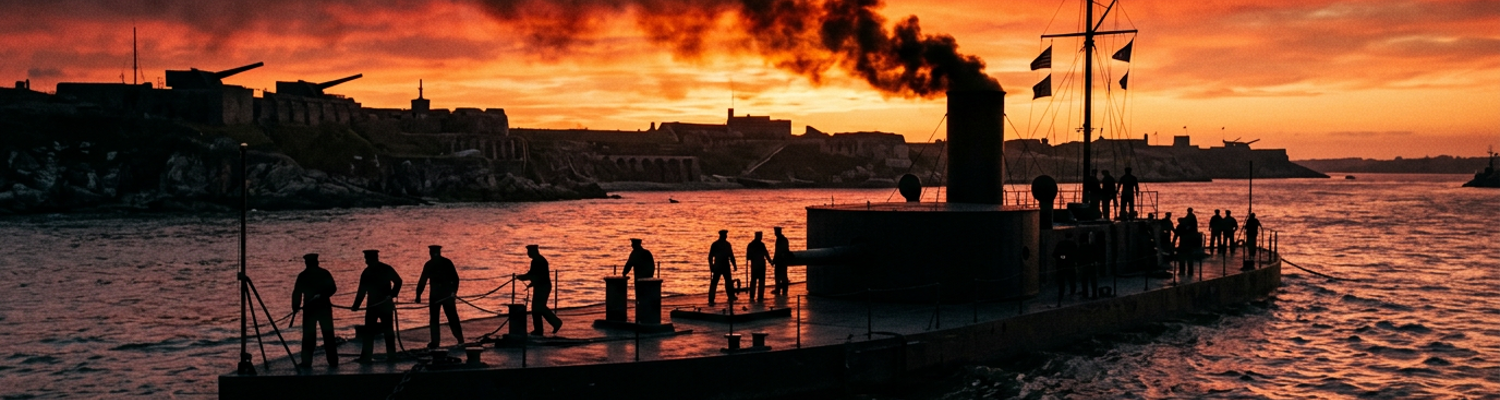
Tugboat Seth Low took Monitor in tow on the afternoon of March 6, guiding the low ironclad out of New York Harbor and down the Atlantic coastline toward the Chesapeake Bay. Severe gale winds struck the vessel early the next morning, pushing heavy ocean swells over the flat iron deck off Cape May. Crashing Atlantic rollers broke directly over the low pilot house and poured into the six foot ventilation pipes that inventor John Ericsson had installed just above the waterline. Surging seawater rushed through the intake grates and down into the machinery spaces, thoroughly soaking the leather blower belts that powered the forced draft for the coal boilers. Wet leather stretched rapidly under the strain and slipped off the drive pulleys, stopping the ventilation fans and starving the boiler furnaces of fresh air.
Coal smoke flooded the dark machinery spaces as the furnace draft collapsed and filled the lower hull with deadly carbon monoxide. Engineers Isaac Newton and Alban Stimers collapsed unconscious on the iron deckplates alongside their firemen after breathing the concentrated engine fumes. Sailors rushed into the suffocating compartment, gripped the fallen engineers by their uniforms, and dragged them up the narrow iron ladder to the open top of the gun turret for air. Extinguished boiler fires meant the ship lost steam pressure to run its primary bilge pumps while thousands of gallons of seawater continued to pour through the hull openings. Rising bilge water threatened to submerge the lower furnaces entirely and founder the low riding vessel in deep water several miles offshore. Crewmen organized an emergency bucket brigade and manned manual hand pumps in total darkness, bailing water for hours to keep the warship afloat.
Alban Stimers returned to the engine room once the poisonous gas cleared, working with surviving machinists to dry the drive mechanisms and improvise replacement belts from spare rope and canvas. Crew members rigged the handmade belts around the pulleys to restart the blowers, gradually feeding coal to the boiler fires until steam pressure rose enough to run the mechanical bilge pumps. Running pumps discharged tons of seawater through the side discharge valves, restoring buoyancy just as the vessel reached calmer coastal waters near the mouth of the Chesapeake Bay on the afternoon of March 8. Lieutenant Worden ordered his exhausted, soot covered men to secure the engine spaces and clear both eleven inch Dahlgren smoothbores for action as the rumble of heavy artillery fire echoed across Hampton Roads.
Arrival Amidst the Hampton Roads Disaster
Gunner Peter Truscott cranked the carriage gearing inside the circular turret to unlash the twin Dahlgren smoothbores while Monitor churned past Cape Henry into the lower Chesapeake roadstead at nine that night. Lookouts peering through the narrow sight slits in the forward pilot house watched the black water turn red under a massive glare stretching across Hampton Roads. Flames from the burning wooden frigate USS Congress illuminated the entire anchorage, casting a flickering glow over the masts of the sunken sloop of war USS Cumberland standing upright out of the shallow water where the Confederate ironclad had rammed her hours earlier. Shifting winds carried the smell of charred oak, burnt gunpowder, and pine resin over the iron deck as tugs and small boats ferried wounded Union sailors toward the stone ramparts of Fort Monroe. Lieutenant Worden ordered his helmsman to steer past the naval transports and push directly into the smoky roads, searching through the drifting wreckage for the surviving vessels of the shattered North Atlantic Blockading Squadron.
Lookouts spotted the towering masts of the steam frigate USS Minnesota lodged firmly on a sand spit near Newport News, immobilized after running aground during the afternoon battle. Pilot Samuel Howard brought Monitor alongside the giant wooden warship at ten that night, cutting steam so Worden could hail the deck and climb an overhanging rope ladder. Captain Gershom J. Van Brunt met Worden on the quarterdeck with grim news, explaining that Minnesota was stuck fast in the mud and completely helpless against another Confederate assault. Confederate gunners aboard CSS Virginia had already blasted Minnesota decks with heavy rifle shells before retiring at dusk, and Van Brunt feared he would have to burn his grounded ship at daybreak to prevent her capture. Worden assured the frigate commander that his strange craft would anchor alongside the stranded frigate, interpose itself between Minnesota and the deep channel, and fight the Confederate ironclad until his guns were disabled.
Worden climbed back down to the iron deck of Monitor and directed his crew to drop anchor on the exposed port quarter of Minnesota, positioning the ironclad directly across the approach route from the Elizabeth River. Crewmen hauled heavy iron canisters, powder charges, and solid shot from the hull magazines into the turret chamber, stacking the ammunition along the interior bulkhead walls for rapid firing. Exhausted sailors dropped onto the bare iron deckplates to sleep in their clothes while boiler firemen took turns shoveling anthracite into the furnaces to maintain full steam pressure throughout the dark hours. Fire reached the powder magazine of USS Congress shortly after midnight, detonating five tons of black powder with a blinding flash that threw glowing timbers hundreds of feet into the night sky before the blazing wreck collapsed into the water. Shockwaves from the blast rolled across the bay and shook the iron hull of Monitor, waking the crew and leaving the roadstead pitch black except for the signal lanterns swinging from the rigging of Minnesota.
Lieutenant Worden paced the narrow pilot house alongside his pilot during the predawn hours, studying navigational charts and checking the sights of the twin Dahlgrens to prepare his tactical perimeter. Machinists tested the steam driven turning engine beneath the turret floor, rotating the hundred ton cylinder back and forth to ensure the gear teeth meshed smoothly and would not jam under combat conditions. Morning sunlight pierced the gray river mist just after six in the morning on March 9, revealing thick black coal smoke rising over Sewells Point as CSS Virginia got underway with her escorting gunboats. Worden ordered the anchor raised, beat to general quarters, and steered Monitor out into the main channel, placing his low profile iron warship squarely between the approaching Confederate ram and the defenseless wooden hull of Minnesota.
Cabinet Panic and Washington Defense Deliberations
Telegraphers inside the War Department received frantic reports from Fort Monroe on the morning of March 9 just as Lieutenant Worden placed his low riding iron warship between the two opposing forces in Hampton Roads. Word of the Confederate ironclad sudden rampage reached the capital without clear details on the new battle, leaving officials to fear that the wooden frigates Cumberland and Congress were only the first casualties of a broader naval catastrophe. Abraham Lincoln convened an emergency cabinet session inside the White House executive office to assess the sudden threat to the seat of government. Secretary of War Edwin Stanton paced the room in extreme agitation, repeatedly peering out the tall windows toward the Potomac River and warning that the rebel warship was impervious to heavy coastal artillery. Stanton argued that the Confederate ironclad could easily destroy the grounded Minnesota, slip past Fort Monroe, and steam straight up the Potomac River to shell the Capitol, the White House, and the executive departments into smoking ruins. Stanton demanded immediate defensive action to prevent a naval bombardment, urging the cabinet to commandeer dozens of civilian canal boats, load them with heavy stone ballast, and sink them directly across the Potomac navigation channel.
Gideon Welles firmly rejected the proposal to scuttle stone filled barges across the Potomac channel, arguing that such panic would wreck Union diplomatic credibility before the major powers of Europe. Welles defended John Ericsson experimental revolving turret warship as an advanced, scientifically balanced vessel built specifically to withstand heavy enemy shot and break the Confederate ram in combat. Welles reminded the cabinet that the deep draft southern ironclad drew more than twenty two feet of water, making it physically impossible for the heavy craft to navigate the shallow shoals and mud banks of the upper Potomac without grounding. Welles stressed that maintaining faith in Ericsson radical ironclad was essential to protect northern diplomatic standing in London and Paris, where British and French leaders were actively looking for any pretext to recognize the Confederacy. European powers would interpret the deliberate obstruction of Washington own river approach as an admission that the Union blockade was legally broken and unable to protect its own capital city. Welles urged his colleagues to rely on the thick armor and twin eleven inch Dahlgren smoothbores of Monitor to win the duel rather than surrender maritime control through unprovoked panic.
Abraham Lincoln weighed the naval secretary technological arguments against the war secretary grim forecasts as aides delivered fresh bulletins from the Virginia coast. Stanton refused to rely on naval assurances and quickly issued warning dispatches to northern governors, alerting harbor authorities in New York, Boston, and Philadelphia to prepare timber booms and coastal batteries against southern naval strikes. Army engineers coordinated with quartermaster officers to gather a fleet of sixty stone laden canal boats at Kettle Bottom Shoals on the lower Potomac, keeping scuttling crews on standby to sink the hulls if the Confederate vessel cleared Hampton Roads. Heavy artillery batteries and coastal mortars took up firing positions along the river wharves of the Washington Navy Yard to challenge any enemy vessel that approached the capital docks. Telegraph operators in the War Department remained at their brass keys into the afternoon, listening for the rhythmic sequence of Morse code signals that would reveal whether Ericsson ironclad had survived its duel in the bay.
Tactical Stalemate of the Hampton Roads Duel
Telegraph wires connected to the War Department hummed without incoming reports while thick coal smoke and continuous artillery fire enveloped Hampton Roads throughout the four hour engagement on March 9, 1862. Lieutenant Worden maneuvered Monitor within yards of Virginia to draw the rebel ironclad away from the grounded Minnesota, bringing his revolving turret into direct combat against the enemy casemate. Gun crews inside Monitor worked the two eleven inch Dahlgren smoothbore guns under strict naval safety orders, loading each barrel with solid cast iron shot pushed over reduced fifteen pound powder charges. Naval ordnance officials had mandated these light powder charges to prevent the massive guns from bursting inside the confined space of the turret, but the restricted blast velocity prevented the heavy projectiles from shattering the enemy casemate. Solid eleven inch iron spheres slammed repeatedly into the angled four inch oak and iron plating of Virginia, cracking several outer bars and jarring the crew inside but failing to penetrate the Confederate shield.
Cannonballs from the broadside batteries of Virginia slammed against the revolving turret of Monitor, bouncing off eight layers of one inch rolled iron plate without piercing the circular shield. Machinists inside the Union turret struggled with the steam turning gear, discovering that the heavy revolving cylinder was difficult to stop precisely once in motion, which forced gunners to fire on the fly as their gun ports swung past the target. Speaking tubes between the pilot house and the turret broke down early in the fight, requiring Paymaster William Keeler and Captain Clerk Daniel Toffey to run back and forth along the narrow lower deck to relay steering and firing orders. Lieutenant Catesby ap Roger Jones steered Virginia directly toward the smaller craft to execute a ramming maneuver, but the agile steering and shallow draft of Monitor allowed the vessel to slip away from the direct path of the strike. The iron plated bow of Virginia merely grazed the overhanging deck of Monitor, snapping the remaining ram fittings of the Confederate vessel and leaving Monitor undamaged beneath the water line.
Gunners aboard Virginia shifted their aim from the impenetrable turret to the small, square pilothouse jutting just four feet above the forward deck of Monitor. Lieutenant Worden stood inside the cramped, iron pilothouse alongside pilot Samuel Howard, peering through a narrow half inch sight slit between the stacked nine-by-twelve-inch iron logs to direct the ship course. An explosive shell struck the iron pilothouse directly against the viewing slit, fracturing the iron roof beam and blowing gunpowder, burning flash, and sharp metal splinters through the narrow opening. Blast fragments tore directly into the face and eyes of Worden, instantly blinding the commander and knocking him backward onto the ladder leading to the berthing deck below. Blood and scorched powder covered the face of Worden as he ordered the helmsman to steer the ship away from the firing line into shallow shoals where the deeper Confederate vessel could not follow.
Samuel Dana Greene climbed down from the gun turret and rushed through the hull to take command, finding Worden blinded amidst the smoke and wreckage beneath the shattered pilothouse. The sudden injury of Worden triggered a temporary command disruption, leaving Monitor to drift into the shallows for nearly twenty minutes while Greene evaluated the steering gear and tended to his fallen captain. Greene took the helm and steered the ironclad back into the main channel to resume the engagement, but southern officers aboard Virginia had already interpreted the retreat of Monitor as a permanent withdrawal. Virginia was leaking water at her damaged bow, her pilots warned that the falling tide would strand her heavy twenty two foot hull, and her boilers had consumed nearly all their coal. Lieutenant Jones turned Virginia south toward the Elizabeth River for repairs, and Greene chose not to pursue the retreating ironclad into the shoals around Norfolk. Monitor dropped anchor alongside the surviving wooden ships of the squadron, cementing a mutual withdrawal that secured Hampton Roads while leaving the Confederate threat unresolved.
Interior Habitability and Severe Environmental Attrition
Sailors securing the deck hatches after the battle discovered that remaining anchored in the stagnant Virginia waters generated a brutal internal climate inside the sealed warship. Sunlight beat down on the flat upper deck day after day, conducting heat through four and a half inches of iron armor and heavy oak backing directly into the crew spaces below. Cramped living quarters beneath the waterline received almost no natural airflow because the low lying ironclad sat only eighteen inches above the river surface, preventing the opening of normal portholes or hatches while near Confederate artillery positions. Stagnant air settled in the narrow berthing deck and engine compartments, where heavy humidity combined with burning coal fires, hot lubricating oil, and bilge water. Firemen tending the furnaces collapsed repeatedly on the iron floorplates as heat radiating from the boilers overwhelmed their bodies, forcing shipmates to haul unconscious workers up the narrow turret ladder to revive them on the exposed deck.
Blowers intended to force fresh air through the lower hull suffered constant mechanical breakdowns, causing widespread asphyxiation and crew incapacitation in the sealed iron hull. Drive belts made of leather and canvas slipped off their pulleys or snapped under continuous friction, instantly cutting off the supply of outside air to the fire rooms. Poisonous gases, including carbon monoxide and sulfur fumes from the coal furnaces, backed up into the unventilated compartments within seconds of every blower failure. Machinists and coal heavers lost consciousness at their duty stations before they could climb the access ladders, falling limp onto the hot machinery until rescue parties crawled through the dark passages to drag them out by their limbs. Surgeon Daniel C. Logue established an emergency dressing station near the base of the turret, washing soot from the faces of gasping sailors and applying cold water compresses to men suffering from dangerous heatstroke and respiratory arrest.
Officers maintaining the daily deck log of the ship between May and September 1862 recorded interior living and boiler room temperatures exceeding 140 degrees Fahrenheit. Thermometers hung in the wardroom and galley registered constant readings well above 120 degrees, while gauges placed in the engine spaces and fire room regularly climbed past 140 degrees during routine steam generation. Iron bulkheads, metal ladders, and bunk frames absorbed so much ambient heat that contact with bare skin produced painful blisters and burns. Moisture from human sweat and boiling water condensed along the iron deck beams overhead, raining dirty water droplets continuously onto the clothing, hammocks, and dry rations of the crew. Food supplies spoiled rapidly in the dark storage lockers, turning hardtack green with mold and rotting salt pork while insect swarms invaded every corner of the wet bilges.
Lieutenant William N. Jeffers rotated sick crew members to hospital transports and wooden gunboats in the river after environmental illness incapacitated more than a third of his crew. Sailors constructed canvas awnings over the top armor plates to deflect midday sun, but the fabric covers provided minimal relief to the engineers working deep within the submerged machinery spaces. Mechanics adjusted the auxiliary steam pumps and altered the blower belts daily, struggling to maintain enough ventilation to keep the furnaces drafting and the steering gear operational. Naval authorities at Fort Monroe dispatched relief stokers and fresh provisions by steam launch to replace men who were too weak to stand watch in the lower compartments. Jeffers kept the depleted warship anchored in the main channel, preserving the river blockade while his machinists tended the boilers and prepared the vessel for further operations against Confederate defenses.
Gun Elevation Limits at Drewrys Bluff
Steam pressure drove the engines of the ironclad as USS Monitor joined the flagship USS Galena of Commander John Rodgers and three wooden gunboats to push up the James River toward the Confederate capital on May 15, 1862. Navigators charted the winding channel until the lead vessels reached a sharp bend at Drewrys Bluff, eight miles below Richmond, where Confederate engineers had constructed Fort Darling. Sunken civilian steamers, heavy pilings, and stone filled cribs obstructed the muddy water completely across the channel, stopping the naval squadron in its tracks. Confederate artillery batteries positioned on top of the steep ninety foot bluff opened fire immediately, manned by naval gunners who had recently served aboard the scuttled ironclad Virginia. Plunging artillery shot from coastal rifles and smoothbores tore through the thin iron and oak armor of Galena, wounding dozens of Union sailors and riddling the flagship with heavy metal splinters. Lieutenant Jeffers ordered Monitor to steer past the shattered flagship and anchor directly before the barrier, positioning the revolving turret to engage the Confederate redoubt on the high crest.
Gunners inside the revolving turret of Monitor cranked the mechanical elevating screws beneath the twin eleven inch Dahlgren smoothbores, only to discover a critical flaw in the design of John Ericsson. Turret gun ports had been cut with very narrow openings to prevent enemy musket balls from entering the crew space, restricting the maximum upward angle of the heavy gun barrels to just ten degrees. Drewrys Bluff loomed nearly one hundred feet above the water line at close range, placing the Confederate earthworks far above the highest line of sight the guns could physically achieve. Solid eleven inch iron shot struck low against the red clay cliff face or sailed high into the forest canopy far behind the defensive parapets, completely failing to harm the southern artillery positions. Confederate sharpshooters deployed along the riverbanks sprayed the flat iron deck with continuous rifle fire, while heavy plunging cannonballs dented the turret roof without penetrating the iron plating. Jeffers recognized that the warship remained invulnerable to catastrophic damage but was completely powerless to return effective fire against the elevated enemy fortress.
Commander John Rodgers signaled a general retreat down the James River after Galena exhausted its ammunition and suffered forty five casualties under the unanswered plunging fire. Jeffers turned Monitor around to cover the withdrawal, using the heavy armor of the ironclad to shield the crippled flagship and the wooden gunboats as they drifted away from the cliff batteries. The tactical failure at Fort Darling ruined the hope of the War Department that naval gunboats could force an immediate passage into Richmond to crush the rebellion. Major General George B. McClellan had structured the logistics of the Peninsula Campaign around the expectation that the Navy would secure the James River to protect his left flank and transport his siege artillery directly to the Confederate capital. The repulse produced immediate logistical paralysis along the waterway, forcing McClellan to rely entirely on a lengthy, vulnerable overland supply line running from White House Landing on the Pamunkey River. Union naval commanders withdrew their surviving ships to permanent anchorage stations near City Point, terminating all offensive river operations and halting strategic naval coordination with the army outside Richmond.
Transformation of Union Ironclad Grand Strategy
Gideon Welles studied the dispatches arriving from the stalled river squadron at City Point and concluded that deep draft wooden warships could never subdue fortified Confederate waterways. The Secretary of the Navy collaborated with Assistant Secretary Gustavus Fox to dismantle the traditional peacetime doctrine of the service, which had relied on massive wooden steam frigates and ocean going sloops designed for open sea patrols. High sided wooden cruisers drew far too much water to cross shallow coastal sandbars and suffered devastating splinter damage whenever they approached well placed southern shore batteries. Welles formally reoriented Union naval planning away from deep water ocean cruisers and directed the resources of the department toward building specialized shallow draft coastal ironclad flotillas. These compact armored vessels were designed to operate directly in confined bays, shallow river bends, and tidal inlets, where Confederate earthworks controlled strategic waterways. The Navy Department recognized that sealing southern harbors required low profile, impenetrable gun platforms capable of confronting shore fortifications at point blank range while navigating shoals where traditional wooden ships inevitably ran aground.
John Ericsson drafted modified engineering blueprints for an improved group of ten Passaic class monitors to eliminate the tactical and mechanical vulnerabilities exposed at Hampton Roads and Drewrys Bluff. Welles bypassed normal competitive bidding routines and signed emergency construction contracts with private Northern ironworks to mass produce the new ironclad fleet as rapidly as possible. Ericsson redesigned the turret mechanism to place the armored pilot house directly on top of the revolving cylinder rather than on the forward deck, restoring full three hundred and sixty degree visibility to the helmsman and eliminating the communication barrier between the wheel and the gun crews. Engineers altered the heavy gun ports to accommodate a massive fifteen inch Dahlgren smoothbore alongside an eleven inch piece, vastly increasing the striking power of the ship against southern masonry. Naval architects raised the side overhang of the hull and reinforced the base of the turret with a thick iron ring to prevent enemy cannonballs from jamming the turning gear during close range bombardments.
Shipbuilding firms throughout New York, New Jersey, and Pennsylvania converted commercial shipways into armored assembly lines after Welles distributed the emergency construction contracts. Continental Iron Works in Brooklyn laid down multiple monitor hulls simultaneously, while engine builders at the Novelty Iron Works and the Delamater Iron Works poured massive engine castings and forged boiler assemblies. Rolling mills operated around the clock, pressing thousands of tons of one inch rolled iron plates that workers riveted together in laminated layers along the vessel frames. Alban Stimers directed an expanded corps of naval inspectors across the Eastern Seaboard, scrutinizing armor thicknesses, testing auxiliary steam engines, and ensuring that private foundries adhered strictly to the mechanical drawings of Ericsson. Civilian shipwrights drove hot iron rivets into the hulls of Passaic, Montauk, Catskill, and their sister ships, working beneath gas flares through winter nights to deliver the ironclads to the fleet months ahead of standard peacetime schedules.
Samuel Francis Du Pont organized the newly delivered Passaic class ironclads into specialized coastal assault divisions at Port Royal to prepare for direct strikes against Confederate harbor defenses. Navy captains trained their volunteer crews to navigate treacherous inlet shoals, handle fifteen inch ordnance, and maneuver closely within narrow river channels without running aground under enemy fire. Welles deployed this shallow draft ironclad fleet along the southern coastline, shifting the primary focus of the blockade from offshore surveillance to active amphibious encirclement. Squadrons of Passaic class monitors moved into coastal bays from North Carolina to Georgia, taking up firing positions within range of Confederate harbor redoubts and closing off commercial shipping lanes at river mouths. Naval commanders anchored their entire operational posture along the southern coast on these iron flotillas, using their heavy firepower and low draft to suppress Confederate coastal forts and clear river channels for army transport vessels.