
Firebase Phoenix Initial Assault
12 April 1968, 01:47 Hours. Grid Coordinate 48Q YD 855 245. The first concussion wave arrived without warning. In the disorienting pre-dawn blackness, the hills around Firebase Phoenix erupted in a coordinated, violent attempt at annihilation. North Vietnamese Army units, having moved into final positions under the cover of darkness, initiated the assault with a precision that indicated extensive reconnaissance. NARA Record Group 472 (Records of the U.S. Forces in Southeast Asia) shows NVA sapper teams often spent days observing a target before an attack, mapping command bunkers and communication trenches. The timing was significant. In the months following the Tet Offensive, a functional complacency had settled over some installations. The defenders of Phoenix, a composite of infantry and artillery elements, were prepared for harassment, not a full-scale siege. The NVA strategy was classic in its execution: a heavy, concentrated mortar barrage to suppress and disorient, paving the way for sapper teams to breach the wire.
The atmosphere grew dense with the sound of incoming rounds. NVA gunners, employing 82mm Type 37 mortars and possibly heavier 120mm M-43 variants, had pre-registered their targets with accuracy. The initial salvos were not random. They walked methodically across the firebase, targeting the tactical operations center, the artillery gun pits holding 105mm howitzers, and the perimeter bunkers. Each explosion was a hammer blow, throwing dirt, sandbags, and shrapnel. The purpose of this barrage went beyond personnel casualties. It was meant to dismantle the firebase’s ability to coordinate a defense. The explosions shredded sandbag walls, collapsed bunkers, and severed the thin copper wires of the landline communication systems connecting the fighting positions to the command post.
The radios went quiet.
A fragmented transmission from a platoon leader on the western perimeter offered the first indication of a systemic breakdown. The officer in charge of Lima-Two-Zero reported over the company net that communications were failing. The transmission was never completed. Bravo-Six, the company commander, was attempting to orchestrate a defense while his own command bunker was under direct fire. The AN/PRC-25 radio, a rugged piece of equipment, was not indestructible. The failure reported by Lima-Two-Zero could have stemmed from multiple points. A direct concussive blast could damage the internal vacuum tubes. Flying shrapnel could sever the whip antenna or the coiled handset cord. In the chaos, the Radio Telephone Operator for Lima-Two-Zero would have been desperately trying to diagnose the problem, checking the battery, swapping the handset, or attempting to switch to an alternate frequency, all while under intense fire. NVA doctrine held that silencing the RTOs was as effective as destroying a machine gun bunker; it isolated the unit, making it a blind target for the next phase of the assault.
Communication Infrastructure Collapse
The primary command linkage at Firebase Phoenix was the field telephone system. A review of operational logs from similar engagements shows the reliance on hand-cranked TA-312 telephones connected by thousands of feet of WD-1/TT copper-steel wire. This slash wire, typically buried in shallow trenches, formed the main link between perimeter positions and the command center. The initial NVA mortar barrage was a targeted effort to destroy this network. The pre-registered salvos walked directly along known communication trenches. Each impact sent geysers of dirt and shrapnel, taking whole sections of WD-1/TT wire with them. Inside the bunkers, the TA-312s went dead. The secondary signal links, the intra-company radio nets, fared little better. The concussive overpressure from 82mm and 120mm mortar rounds was sufficient to shatter the internal components of AN/PRC-25 radios even without a direct hit. Shrapnel severed handset cords and snapped fiberglass whip antennas.
Electronic silence forced a reversion to the runner.
With landlines and local radio nets failing, leaders resorted to sending messengers. This was a textbook, if desperate, response. NVA assault doctrine accounted for this eventuality. Sapper teams had spent days observing Phoenix, mapping the trench lines that connected the command bunker to the outer perimeter. These were now pre-designated killing zones. When a runner scrambled out of a bunker, he entered a space already bracketed by NVA machine gun teams. The interlocking fields of fire from RPD light machine guns were established specifically to cut off these arteries. An after-action report from a nearby firebase that suffered a similar attack details how NVA gunners would hold fire until a runner was fully exposed between trench sections. The commander in the tactical operations center at Phoenix faced an impossible choice: dispatch another runner with a low chance of success, or allow a section of his perimeter to fight in total isolation.
The firebase’s function as a regional communication hub was also dismantled. Phoenix did not just communicate internally; its powerful AN/VRC-46 radios served as a relay station for long-range reconnaissance patrols. These systems required large, conspicuous antennas and dedicated power generators. They were priority targets. The NVA barrage specifically targeted the generator sheds and the antenna farm. The destruction of the generators silenced the high-powered radios instantly. The antennas were torn apart. The effect was twofold. First, it isolated Phoenix from any outside support. Second, it created a communication void in the entire tactical area of operations. Patrols that relied on Phoenix to relay their situation reports were suddenly transmitting into nothing. Phoenix was not just under siege; it had been removed from the allied communication network.
Combat Photographer Intelligence Role
Archival records show Specialist Fourth Class David Chen was not a standard public information photographer. He was attached to Firebase Phoenix from the Department of the Army Special Photographic Office (DASPO), a unit tasked with providing unfiltered documentary evidence directly to the Army Chief of Staff. His assignment, issued by the battalion S-2 intelligence officer, was precise. Chen’s priority was not capturing images of American soldiers for news releases. His mission was to use his specialized equipment, a Nikon F camera body with a telephoto lens, to systematically photograph suspected enemy positions from the firebase perimeter. This was a form of ground-level imagery intelligence. While high-altitude reconnaissance aircraft provided a broad overview, their utility was often negated by weather or the dense triple-canopy jungle. Chen’s role was to fill this intelligence gap, creating a visual record of specific fighting positions and potential mortar sites visible only from a ground perspective.
The undeveloped rolls of Kodak Tri-X film inside Chen’s camera contained the only objective, data-rich picture of the NVA’s siege disposition. With radios silent and runners unable to traverse the kill zones, the firebase commander was effectively blind. He had no way to confirm the location of the NVA mortar pits dismantling his defenses, nor could he identify the machine gun nests suppressing his men. Chen’s photographs, taken in the hours leading up to the assault, were intended to be developed and analyzed by the S-2 section to build a target list for the firebase’s own artillery. Now, that same film represented the only path to survival. It was a physical package of high-priority targeting data.
The film was the only accurate map of the battlefield.
Gathering intelligence on NVA movements was the explicit purpose of Chen’s DASPO assignment. A review of operational logs from similar sieges indicates that the initial hours were defined by profound uncertainty for the defenders. The core questions for a commander were always the same: where is the enemy, in what strength, and where will they strike next? Aerial reconnaissance was the standard tool, but it was a blunt instrument against a camouflaged force. Chen’s ground-level perspective was meant to provide the granular detail that overhead imagery could not. He was trained to spot the subtle signs of NVA presence: freshly disturbed earth, faint trails in the grass, or the glint of a weapon barrel concealed in a tree line. His undeveloped film rolls held the potential answers to the commander’s most urgent questions. They contained visual proof of NVA machine gun emplacements, the probable locations of their 82mm mortar teams, and the primary avenues of approach being used by the main assault force. This information was the key to breaking the siege.
High-Priority Intelligence Interdiction
The doctrinal response to a total communication collapse at a besieged firebase was a reversion to emergency message protocols managed by the 1st Logistical Command. A review of these 1968 procedures shows a layered system designed for redundancy. If radio and landline failed, intelligence was to be physically evacuated by courier. The system existed on paper. It did not exist for the defenders of Phoenix. The protocol’s primary flaw was its assumption that a ground or air corridor to the isolated unit could be opened. A FLASH precedence message from Phoenix, had one been possible, would have triggered the dispatch of a helicopter or a light convoy. But NVA doctrine was designed to counter this. They did not merely attack a base; they isolated it. The roads were seeded with mines and covered by pre-sited machine guns, while any potential landing zone was registered by mortar crews. The 1st Logistical Command, headquartered in Long Binh, followed its procedures, but the assets dispatched to relieve Phoenix met a wall of coordinated fire miles from the objective.
Specialist Chen’s film was a physical package of targeting data.
With electronic transmission impossible, the undeveloped rolls of Kodak Tri-X 35mm film in Chen’s possession were latent potential. DASPO photographers operated with a mandate to provide unfiltered documentary evidence directly to high-level command. This gave Chen’s film an elevated status. The standard procedure would have involved placing the sealed canisters into a courier pouch for immediate transport to a rear-area facility with photo-processing labs. The intelligence required development and analysis by the S-2 section to become actionable. It could not be read or described over a failing radio. The images of NVA positions were trapped in silver halide crystals on celluloid. The only way to extract that data was to physically move the canisters from Firebase Phoenix to a secure rear base. Every attempt to do so failed.
The conventional routes out of Firebase Phoenix were killing zones. The main artery, a packed laterite road designated Local Tactical Route 4 (LTR-4), had been interdicted. NVA sapper teams had spent days preparing for the siege. They engineered a series of complex ambushes. A study of NVA tactics during this period reveals a preference for L-shaped ambushes at choke points. A convoy or courier jeep entering the kill zone would be hit first by a command-detonated mine, followed by interlocking fire from RPD machine guns and RPG-2 anti-tank grenades. Any attempt by helicopter to evacuate material like Chen’s film was met by coordinated small arms fire. NVA units employed “hugging” tactics to get so close to the base perimeter that air support could not engage without risking friendly fire. The roads were impassable. The air was denied.
Improvised Field Communications
The collapse of the wire and radio network had rendered Firebase Phoenix a series of isolated islands fighting in the dark. Within the command bunker, the leadership cadre stared at a map that no longer reflected the situation. It was in this context of sensory deprivation that an abandoned AN/PRC-25 radio set offered a sliver of potential. The “Prick-25” was located by a runner in the wreckage of a collapsed listening post on the northeastern perimeter. Its vulnerabilities were well-known; its handset was susceptible to moisture, and its single vacuum tube in the final amplifier stage could be damaged by the concussive shock of nearby mortar impacts. This particular unit was found with its standard AT-892 three-foot antenna snapped and its H-189 handset cord severed by shrapnel. The battery pack, however, was still attached and showed a faint but viable charge.
The radio was useless without an antenna.
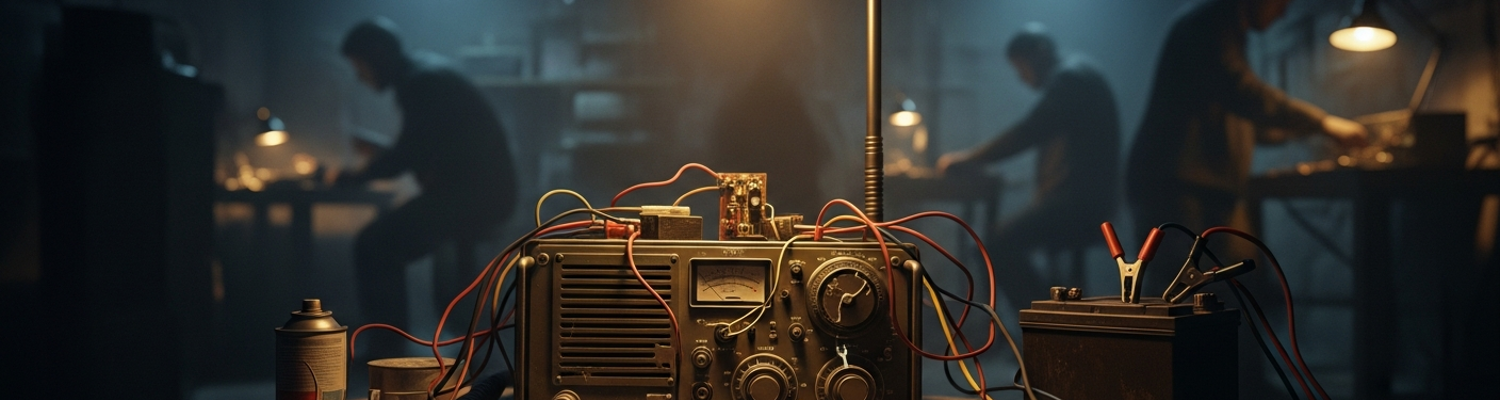
Specialist Fourth Class David Chen, the DASPO photographer, possessed an unusual cross-section of skills. DASPO personnel were often selected for their technical aptitude and operated with a high degree of autonomy. Faced with the useless transceiver, Chen began methodically scavenging materials to construct a field-expedient antenna. He stripped a long section of WD-1/TT communications wire from a destroyed TA-312 field telephone. Field manuals from the period detail numerous designs for improvised antennas. Chen’s objective was not long-range communication but a desperate attempt to reach an airborne command-and-control aircraft. He jury-rigged a crude connection, wrapping the bare end of the WD-1/TT wire around the PRC-25’s antenna stud and securing it with medical tape. The other end he attached to a shattered tent pole, hoisting it through a hole in the command bunker’s ceiling. This created a crude vertical antenna, electrically inefficient but perhaps functional enough.
Powering the radio was the first hurdle; its BA-4386 battery was nearly spent. Chen and the command bunker’s RTO cannibalized batteries from several shattered PRC-25s, testing and combining them to create a single power source. The next challenge was the severed handset cord. Repairing the delicate wires was impossible. Instead, he bypassed the handset entirely. A close examination of the AN/PRC-25’s schematic reveals the push-to-talk function and audio could be hot-wired. He stripped the wires leading from the radio’s audio connector port, a dangerous procedure that risked short-circuiting the unit. By touching the bare wires together to transmit and shouting directly into the radio’s internal microphone components, he could, in theory, send a message. The link was fragile, a ghost of a signal broadcast from a machine brought back from the dead by wire and tape.
Battlefield Environmental Cues
With formal systems of command annihilated, survival reverted to primitive senses. For Specialist David Chen, movement through the wreckage of Firebase Phoenix was guided by the acrid odor of burning diesel fuel. The initial NVA mortar barrage had targeted the firebase’s primary power source: a MEP-005A 30kW generator set. The generator was destroyed, but the barrage also ruptured the adjacent 500-gallon diesel fuel bladder. The resulting fire produced a column of thick, oily black smoke. In the pre-dawn darkness, obscured by dust and cordite haze, this smell was a constant. The prevailing wind, a light breeze from the east, pushed the scent across the western half of the firebase, creating an olfactory corridor Chen could use to orient himself. The smell was directional, growing stronger as he moved toward the firebase’s core. It allowed him to navigate the shattered trench lines without visual landmarks.
The man-made scent of burning fuel was complemented by the organic smells of the terrain. A firebase was an artificial island of packed earth carved out of the jungle. Engineers had cleared fields of fire, leaving massive, tangled heaps of uprooted vegetation piled just beyond the concertina wire. In the suffocating humidity, this organic matter was in a constant state of accelerated decay. The resulting odor, a thick, earthy scent of rot, was a permanent feature of the firebase’s edge. This smell was not uniform. Archival terrain analysis shows the northern sector of Phoenix bordered dense jungle, and here the smell of decomposition was overpowering. The southern sector faced open rice paddies and carried a different scent of stagnant water. For a soldier moving in the dark, this olfactory gradient was a navigational tool. The sharp transition from the smell of diesel to the heavy perfume of rotting foliage indicated proximity to the northern wire.
These environmental cues became the building blocks of a new, localized form of battlefield intelligence. The absence of radio traffic forced the remaining defenders to listen intently to the sounds of the battle, building a mental picture of their surroundings. An experienced ear could distinguish the high chatter of an NVA RPD light machine gun from the slower thud of an American M60, allowing them to map enemy positions by sound. A momentary flash on the horizon was the launch signature of a mortar tube, giving a fleeting directional bearing. The smell of burning diesel provided a constant bearing toward the command bunker. The scent of jungle rot defined the outer perimeter. The distinct sounds of enemy weapon systems pinpointed active threats. Chen’s ability to move from the destroyed listening post where the AN/PRC-25 was found, back toward the command bunker, was not a matter of luck. It was an act of deliberate navigation, moving between the sounds of machine-gun bursts and timing his dashes to the rhythm of incoming mortar fire.
Crucial Burst Transmission 0317 Hours
At 0317 hours, inside the flickering confines of the command bunker, the air crackled with something other than static. This was the moment Chen’s improvisations came to a head. He knelt over the cannibalized AN/PRC-25 radio, its case dented and scarred, powered by a mismatched assembly of salvaged batteries. The transmission was not a clear voice call. Chen, leveraging the technical skills DASPO operators were known for, had jury-rigged a system to convert a visual image into an audio signal. This was a field-expedient version of Slow-Scan Television (SSTV), a technology that allowed a static picture to be transmitted over a standard voice channel. He had photographed one of his own pre-assault intelligence pictures with a secondary camera, feeding the audio-out from a tape recorder into the PRC-25’s modified microphone input. The transmission itself was an eight-second burst of discordant, warbling tones. It was a high-risk gamble; any NVA radio operator scanning the frequencies would immediately recognize the non-human signal as a high-priority target for direction-finding equipment.
The broadcast was an act of profound desperation.
The single, grainy image encoded in that audio burst contained the most important piece of intelligence available in the tactical area of responsibility. It was a photograph Chen had taken himself less than twelve hours earlier from a concealed observation post on the western perimeter. The image showed a deep, eroded gully obscured from aerial view by bamboo. In the photograph, NVA soldiers could be seen moving supplies. Now, in the dark, that same gully was being used as a covered approach for a major flanking maneuver. The NVA assault plan was predicated on fixing the defenders’ attention on the main frontal assault while a fresh company-sized element moved unseen along this western flank. The image quality, transmitted by an improvised system, was severely degraded. It was striped with static and distorted by atmospheric interference. Yet, it contained just enough data: the distinct shape of the gully, the dark forms of dozens of soldiers moving in file, and the glint of RPG-2 launchers. It was photographic proof of an imminent, decisive attack on the firebase’s weakest point.
This burst of data was received by a lone Forward Air Controller (FAC) flying an O-2A Skymaster, callsign “Covey 2-6”. The pilot was twenty miles away on a routine night interdiction patrol and was not assigned to support Firebase Phoenix. His aircraft, a militarized Cessna 337, was packed with multiple radios. The signal from Chen’s radio was extraordinarily faint, at the absolute maximum range of a PRC-25. Its reception was a freak occurrence, likely the result of tropospheric ducting, an atmospheric condition where air layers create a channel that can carry VHF signals beyond their normal line-of-sight horizon. The pilot did not hear a voice, but the screeching modem-like sound of the SSTV signal. Recognizing it as a non-standard, and therefore urgent, transmission, he had his observer record the audio. Playing it back and seeing the faint image materialize on a small, experimental monitor, the pilot made a decision. He abandoned his assigned patrol sector, a serious breach of protocol, and banked his aircraft hard toward the grid coordinates of Firebase Phoenix.
Pivoting Defensive Strategy
The arrival of the O-2A Skymaster, callsign “Covey 2-6,” altered the tactical situation. For the command element in the primary bunker, the pilot’s voice over the battered PRC-25 was the first contact with a friendly asset in hours. Forward Air Control doctrine from the period shows the FAC’s primary role was to act as an airborne link between ground troops and strike aircraft. Covey 2-6’s presence instantly reinstated that link. The defensive strategy at Phoenix shifted from one of passive endurance to active, directed interdiction. The singular target was the western flanking gully identified in Specialist Chen’s transmitted image. The firebase commander, now possessing a real-time aerial observer, could bypass his own blinded observation posts and orchestrate a defense based on accurate targeting data.
The firebase was no longer blind.
With the O-2A circling overhead, the process of preventing the overrun began. After-action reports for similar engagements show a standard procedure: the FAC would first visually confirm the target before calling in heavier support. Covey 2-6 executed a low pass, confirming the mass of NVA soldiers preparing for the final assault in the gully. His aircraft was armed with 2.75-inch white phosphorus rockets for target marking. The pilot fired a pair of these “Willy Pete” rockets, which erupted on the ground in a brilliant, incandescent shower, casting the gully and the NVA company in stark white light. This visual marker allowed the firebase’s own beleaguered 105mm howitzer and 81mm mortar crews to finally adjust their fire with precision. Simultaneously, Covey 2-6 broadcasted an urgent request for immediate fire support, diverting an AC-47 ‘Spooky’ gunship that was already on station nearby.
The NVA assault plan had been broken.
The gunship, a converted C-47 transport, established a pylon turn over the marked position. Its three side-firing 7.62mm miniguns poured up to 6,000 rounds per minute each into the gully. This torrent of fire physically shattered the NVA flanking maneuver, which was the cornerstone of their plan to overwhelm the base. The North Vietnamese assault doctrine relied on shock, surprise, and the complete isolation of a target. The flanking attack through the covered gully was intended to be the decisive action. Chen’s transmission completely negated the element of surprise. Without it, Covey 2-6 would have remained on his assigned patrol route, the AC-47 would never have been diverted, and the NVA company would have emerged from the gully to collapse the western perimeter unopposed. The sound of the Spooky’s guns had an immediate psychological effect, audible proof that the defenders were no longer alone, even as it annihilated the main enemy attack force.