
Soviet Deception Nets and Captured Transceivers
Riggers hoisted heavy canvas containers, hand cranked generators, and waterproof supply bundles into the narrow cargo holds of unmarked transport planes to prepare each courier team for infiltration across Eastern Europe. Western logistics teams spent weeks balancing these bulky payloads at staging fields in West Germany, calculating the physical space and fuel reserves needed to fly long nighttime routes over the Carpathian mountain crests. Couriers strapped twenty pound battery packs to their chests alongside their reserve parachutes, while technicians secured delicate vacuum tubes inside foam padded metal boxes to survive the hard shock of forest canopy landings. Ground crews pushed stripped down transport aircraft to their maximum cargo capacities, knowing that mountain turbulence and anti aircraft fire would test every weld and rivet along the flight path. Parachutists leaped into the dark alpine valleys only to discover that local terrain funneled their descents directly into the patrol routes of waiting border troops. Soviet Ministry of State Security counter intelligence officers seized courier transceivers and initiated controlled radio playback operations back to American intelligence handlers.
Soviet counter intelligence teams established covert radio posts inside secure buildings in Kyiv and Lviv, setting up the captured American transceivers on wooden tables beside the original operational codebooks. Armed guards stood directly over the captured couriers, forcing them to power up the hand generators and tap out prearranged contact signals to establish the opening link with Western listening posts. State security specialists drafted deceptive messages designed to mimic the normal working rhythms of isolated underground cells operating in the forested hills. These staged transmissions reported successful linkups with local partisan fighters, claimed that anti Soviet resistance groups controlled isolated valleys, and requested immediate drops of weapons, currency, and replacement batteries. Soviet officers monitored every dot and dash through headphones, ensuring that each broadcast followed the authorized signal plan while feeding false intelligence to Western base stations. Western handling officers repeatedly failed to recognize missing security checks and subtle distress indicators embedded in Morse code transmissions from Ukraine.
American case officers stationed in Munich and Frankfurt reviewed the raw radio logs each morning, reading the captured transcripts as genuine evidence of field success. Radio operators in captivity deliberately altered their keying speeds, skipped scheduled check in letters, and inserted prearranged wrong numbers into their message preambles to warn their handlers that hostile forces controlled the transmitters. Evaluation desks dismissed these critical anomalies as harmless operator fatigue, damaged equipment, or atmospheric static caused by Carpathian storms. Handling officers placed total trust in the text of the messages, allowing the Soviet deception team to dictate the timing and frequency of subsequent wireless exchanges. Analysts filed each intercepted dispatch into active operation folders without verifying the mandatory authentication words that should have verified the physical safety of the transmitters. Base commanders accepted the incoming reports at face value, concluding that the courier flights had successfully established a permanent communication bridge behind Soviet lines.
Supply officers in West Germany immediately arranged new equipment shipments to answer the false radio requests sent from the captured transceivers. Technicians packed dozens of wooden containers with rifles, ammunition belts, radio parts, and medical kits, marking each bundle with colored drop tags according to Soviet instructions. Pilots received precise navigation coordinates that brought their transport aircraft across known radar sectors directly into waiting searchlight rings and anti aircraft zones. Soviet ground units tracked the inbound flights with radio direction finding vehicles, stationing ambush squads at the coordinates where the deceptive transmissions had requested drops. Parachute bundles and fresh courier reinforcements drifted down into cleared forest clearings, landing directly into the hands of waiting Soviet security battalions.
Bavarian Training Grounds and Guerrilla Recruitment
Soviet officers cataloged the American jump gear and field equipment stripped from these captured couriers, uncovering a recruitment and staging pipeline that originated deep within the American occupation zone of Germany. Displaced persons camps across West Germany held thousands of Ukrainian refugees, soldiers, and former partisans who had fled westward after the Red Army crushed their home districts. Officers from the CIA Office of Policy Coordination and US Army intelligence recognized that these refugee barracks contained experienced fighters who already knew the terrain, languages, and security checkpoints of Soviet Ukraine. American intelligence officers needed respected partisan commanders to screen these candidates, because Soviet state security services actively seeded the refugee barracks with double agents and informants. Ukrainian Insurgent Army colonel Yury Lopatinsky partnered with the CIA Office of Policy Coordination and US Army intelligence in 1949 to vet and recruit anti Soviet operatives from among these displaced populations. Lopatinsky conducted intensive personal background interviews in private rooms, checking each recruit against wartime service records, family connections, and hometown backgrounds to ensure political reliability before clearing them for clandestine service.
Recruits cleared by Lopatinsky boarded covered military trucks that moved them under armed guard to secluded facilities scattered across American occupied Bavaria. Trainers housed the volunteers inside isolated safe houses near Munich and rural villa compounds where perimeter guards barred all outside contact. Recruits underwent rigorous clandestine tradecraft, survival, and radio transmission training across secret safe houses and military training areas in American occupied Bavaria. Instructors drilled the men on memorizing false cover stories, recognizing plainclothes surveillance teams, and altering personal habits to avoid suspicion during police identity checks. Classroom sessions forced volunteers to practice handwriting disguise techniques and chemical secret writing methods using lemon juice and specialized developer powders on ordinary letter paper. Students spent eight hours each day memorizing cipher keys and operating transportable low power radios, tapping Morse code messages into practice headsets until their sending rhythm matched strict operational timelines.
Generators and portable field transceivers pushed the trainees through exhausting mechanical exercises on muddy ground. Instructors marched the teams into the dense pine forests of military training areas near Grafenwoehr and Kaufbeuren to simulate the harsh conditions of the Carpathian mountains. Trainees lived in lean to shelters made from pine branches and waterproof ponchos, surviving on dried field rations while navigating across rugged hill country in total darkness. Instructors fired live rifle rounds over the heads of crawling teams and released tracking dogs into the tree lines to force the men to mask their physical scent trails in freezing mountain streams. Signal specialists required radio operators to string wire antennas through tree branches in heavy rainstorms, establish rapid contact with base stations, and pack their equipment inside five minutes to escape simulated direction finding trucks. Candidates who failed to meet strict signal transmission speeds or showed physical exhaustion during nighttime movements washed out of the program immediately and returned to civilian holding camps.
Jumpmasters transported the surviving candidates to military airfields outside Munich to teach them nighttime parachute jumping from unmarked C-47 transport planes. Jumpmasters pushed the recruits through side cargo doors into pitch black air, training them to steer round canvas parachutes toward tight forest clearings marked only by faint flashlights. Armorers issued each operative personal equipment kits containing sterilized Soviet issue pistols, thick bundles of forged Soviet rubles, miniature cameras, and rubberized poison capsules for suicide in case of capture. Case officers grouped vetted radio operators and mountain scouts into three man courier cells, assigning each team specific landing zones and partisan contact passwords in western Ukraine. Technicians packed these final mission kits into waterproof containers and loaded the armed teams onto transport trucks bound for the staging runways at Kaufbeuren.
Infiltration Tradecraft and Specialized Operational Equipment
Kaufbeuren airfield handlers hauled the sealed containers off the trucks and carried them into private briefing rooms where case officers inventoried every piece of clandestine hardware. Technicians dismantled each modular radio assembly to verify that moisture seals and shock mounts would protect the delicate quartz crystals and glass vacuum tubes during parachute impacts. Each dropped courier carried a compact RS-1 high frequency radio transceiver, falsified Soviet internal identification documents, and lethal cyanide ampoules for immediate suicide upon capture. Radio operators tested the three separate metal boxes that formed the RS-1 system, connecting the transmitter, receiver, and power pack with thick rubber cables to ensure the miniature dials still registered clear test signals. Riggers coiled fifty feet of copper antenna wire around flat wooden spools so the couriers could string horizontal aerials between Carpathian spruce trees within minutes of hitting the frozen ground.
Antenna spools fit inside deep leg pockets alongside the falsified paperwork that case officers issued to protect the couriers during routine security checks. Document specialists in Munich manufactured internal Soviet passports, military travel permits, and collective farm employment cards using stolen Soviet paper stock and chemically aged inks. Officers pressed counterfeit rubber stamps onto the identity booklets to replicate the official seals of western Ukrainian district police stations and Soviet military commandant offices. Couriers checked their false names, birthplaces, and assigned civilian occupations against the physical stamps, memorizing every printed registration number before sewing the booklets into hidden linings inside their wool jackets. Case officers slipped glass cyanide ampoules encased in protective rubber tubing into the collar seams of those same jackets so an operative trapped by security patrols could bite through the poison capsule without using his hands.
Jackets and trouser waistbands also contained secret fabric pockets designed to conceal the currency bundles needed for buying food, bribing guards, and securing safe houses. Teams received operational funds in forged or authentic Soviet rubles alongside specialized cipher pads designed for rapid field encryption under adverse alpine conditions. American financial specialists supplied couriers with authentic Soviet banknotes collected from refugees, mixing them with freshly printed counterfeit bills that showed realistic folds, dirt stains, and worn edges. Signal instructors handed each radio operator small paper cipher booklets printed with non repeating key sequences, sizing the one time pads so that an operator wearing thick woolen mittens could still turn the pages in freezing winds. Chemists treated the thin cellulose sheets of these cipher pads with chemical oxidizers, allowing a courier to ignite the paper instantly with a match or swallow the water soluble pages if Soviet search teams closed in on his transmission site.
Canvas rucksacks held these fragile cipher sheets alongside the heavy tools and iron rations that the couriers needed to survive alone across the high passes. Couriers packed their rucksacks with dried field rations, compasses, water purification tablets, spare woolen socks, and Soviet made Tokarev pistols stripped of Western factory markings. Riggers helped each operative step into his parachute harness, strapping the thirty pound RS-1 radio bundle directly across his chest beneath his reserve chute so the equipment would not detach during the opening shock of the main canopy. Jumpmasters checked the leg straps, rip cords, and weapon holsters of all three men before escorting the heavily laden team through the hangar doors toward the waiting transport plane. Pilots ran the twin radial engines of the unmarked C-47 on the Kaufbeuren tarmac, waiting for ground crews to hoist the couriers and their container bundles through the cargo door for the flight east.
Unmarked C-47 Night Insertions Over the Carpathians
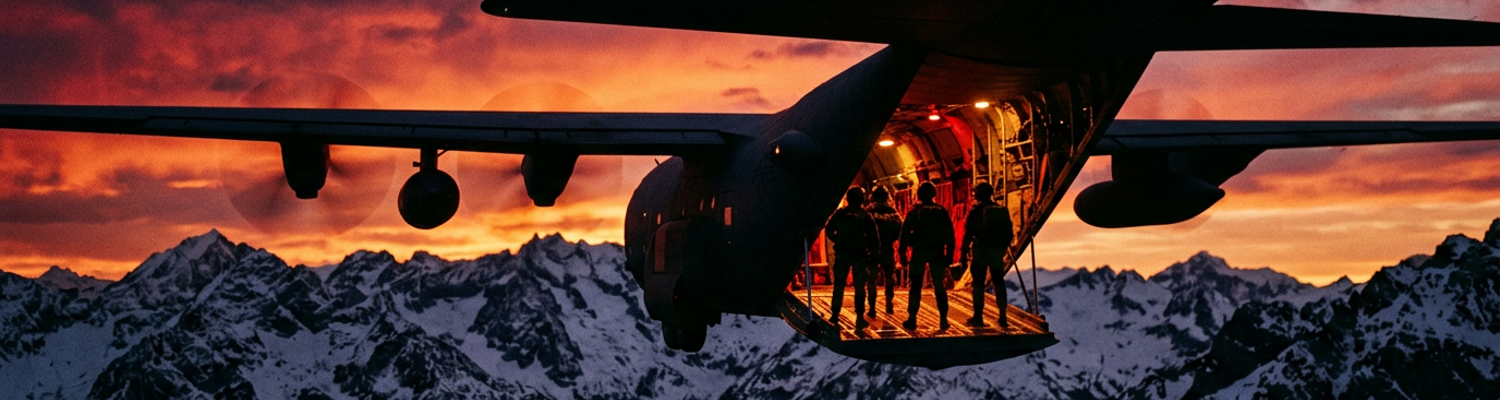
Riggers shoved the heavy equipment containers up an aluminum ramp into the dark cargo cabin and lashed each crate against the floor rings with canvas tie down straps. Technicians slammed the rear door shut, locked the exterior latch, and signaled the aircrew that the clandestine team was ready for departure. Specially modified unmarked C-47 Skytrain transports flew blind low altitude routes through mountain gaps departing from airfields in West Germany. Mechanics had scraped away all standard military markings, painted the airframes in flat matte black, and installed flame dampening exhaust shrouds over the engine cowlings to prevent Soviet border spotters from seeing glowing exhaust manifolds in the night sky. Auxiliary fuel tanks mounted inside the stripped fuselage gave the twin engine transports the range to fly deep across Czechoslovakia and reach the Ukrainian border regions before turning back toward Western allied airspace. Flight planners deliberately scheduled these infiltration runs for moonless nights, forcing pilots to stay just hundreds of feet above the valley floors to hide beneath the sweep of Eastern European radar stations.
Navigators guided the speeding Skytrains through the narrow Alpine and Bohemian gaps using only stopwatches, magnetic compasses, and dead reckoning because external radio transmissions would instantly give away their positions. Violent downdrafts along the mountain slopes threw the unpressurized aircraft upward and downward, forcing the pilots to fight the control yokes to keep the wings level while flying through zero visibility fog. Aircrews monitored their radio altimeters as the jagged terrain rose steeply beneath the fuselage, knowing that a drift of only a few miles would send the plane directly into a granite cliff face. Couriers sat silently on metal bench seats along the cabin walls, steadying their bulky jump packs against the violent shaking while cold mountain air leaked through the unheated fuselage seams. Co pilots scanned the darkness ahead with infrared night vision scopes, searching for terrain silhouettes while the pilots throttled back the engines to slow the aircraft down for the scheduled drop coordinates.
Jumpmasters turned on the red signal light near the open cargo exit, signaling the couriers to stand up, hook their static lines to the overhead steel cable, and shuffle toward the freezing slipstream. Paratroopers jumped into dense Carpathian cloud decks and heavily forested alpine peaks during zero illumination windows without ground navigation beacons. Thick clouds completely blinded the operatives during their descent, preventing them from seeing where the rocky valley walls ended and the tall spruce forests began. Static lines ripped the main parachute packs open with sharp snaps, but the strong alpine crosswinds immediately separated the three man teams and carried their supply containers miles away from the intended drop zones. Men plunged through the freezing cloud layer at high speed, unable to steer their round parachutes against the gusting winds that pushed them into jagged mountain crests.
Branches snapped violently as the descending couriers crashed into the dense mountain canopy, leaving operatives suspended dozens of feet above the rocky forest floor. Couriers used their trench knives to cut through tangled parachute suspension lines, dropping onto the frozen snowpack and bruising limbs against hidden boulders. Radiomen scrambled through the dark underbrush to recover their dropped radio containers, often finding the delicate vacuum tubes cracked and the metal casing crushed by high impact collisions with tree trunks. Operatives whistled faint identification signals into the trees, trying to regroup before daylight without alerting Soviet border guards and internal security troops stationed in nearby valley outposts. Patrol dogs barked in the distant valley bottoms as the scattered teams buried their shredded white canopies beneath pine needles and moved up the steep slopes to set up their first field hideouts.
Soviet Interception Networks and Alpine Drop Ambush Tactics
Soviet border guards and MGB internal troops utilized high frequency radio direction finding networks to pinpoint incoming courier aircraft along the frontier, guiding the search patrols and tracking hounds straight toward the slopes where the infiltrators were attempting to conceal themselves. Listening posts situated along the Carpathian border arc maintained round the clock radio watches with directional loop antennas, scanning the skies for any navigation pulses, radar reflections, or radio chatter leaked by Western transport crews. Plotting officers inside fortified sector headquarters laid cross bearings across regional topographic maps, calculating the exact speed and drift of the blacked out planes as they slipped through radar blind spots in the river valleys. Teleprinters and field telephones immediately relayed these calculated flight paths to local border detachments, triggering regional alert protocols that mobilized hundreds of security troops within minutes. Border commanders used these interception coordinates to predict which high altitude clearings and forested basins the Western flights were targeting for parachute drops. Dispatchers sent armed search battalions and dog handlers racing along narrow logging roads in four wheel drive trucks to deploy waiting ambush units directly around the anticipated landing clearings.
MGB ambush units established tripwire flare perimeters around known drop zones, capturing couriers almost immediately upon contact with the terrain. Security troops moved silently through the dark spruce timber to string spools of thin iron wire between tree trunks, anchoring spring loaded magnesium flare canisters a few inches above the frozen forest floor. Rifle squads concealed themselves behind snowbanks, boulders, and fallen logs, overlapping their machine gun fire lanes across the open glades where falling parachutes were most likely to drift. Operatives crashing through the canopy or stumbling across the dark underbrush inevitably struck the hidden wires, detonating blinding white and green flares that illuminated the entire clearing. Gunfire erupted into the illuminated trees, while assault teams rushed forward through the snow to surround the disoriented jumpers before they could untangle their harnesses or draw their weapons. Soldiers tackled the men, pinned their arms behind their backs, and immediately shoved wooden dowels into their mouths to prevent them from biting into the suicide ampoules sewn inside their collar seams.
Counter intelligence officers sliced through the operatives jacket collars with field knives to extract the lethal cyanide capsules before stripping the prisoners of their weapons and rucksacks. Search teams combed the surrounding snowpack with battery powered lanterns, gathering every scattered canvas container, spare ammunition magazine, and falsified Soviet identity booklet that had fallen into the brush. Technicians gathered the modular RS-1 transceivers with extreme care, wrapping the fragile vacuum tubes and frequency crystals in heavy wool blankets to prevent thermal shock from cracking the glass in the freezing mountain air. Interrogators forced the captured couriers to kneel in the snow under the barrels of submachine guns, checking their faces against surveillance photographs and lists of suspected Ukrainian nationalist partisans maintained by local security bureaus. Armed guards hoisted the bound prisoners and their inventoried gear into the beds of idling transport trucks, covering the cargo with heavy canvas tarpaulins to hide the successful captures from local villagers. Drivers shifted the vehicles into low gear and rolled down the rocky switchbacks toward the regional MGB prison cells in Lviv, where specialized radio operators waited to examine the captured ciphers and transmitters.
Strategic Collapse and Transition to Project AERODYNAMIC
Technicians inside the Lviv prison opened the canvas containers and spread the captured RS-1 transceivers, cipher pads, and frequency crystals across heavy wooden workbenches. Soviet specialists wired the captured transmitters into regional power lines and tapped out deceptive messages back to Western monitoring posts, mimicking the precise Morse code speed and keying rhythm of the arrested couriers. Interrogators extracted emergency passwords, drop coordinates, and recognition signals from the prisoners in windowless basement cells, feeding the data straight to the radio operators running the playback net. American case officers in Munich logged these smooth radio check ins for months without detecting that Soviet handlers dictated every sentence to draw in more supplies and recruits. Field analysts finally discovered the deception when escaped contacts and radio irregularities revealed that every active courier cell had fallen under enemy control.
American intelligence officials grounded all pending infiltration flights at Bavarian airfields as internal reviews confirmed that Soviet counter intelligence had captured the entire partisan contact network. The complete penetration and capture of courier networks forced American intelligence to terminate Project CARTEL courier drops by 1953. Flight mechanics drained the auxiliary fuel tanks of the blacked out C-47 transports, removed the flame dampening exhaust cowlings, and wheeled the aircraft into storage hangars across West Germany. Supply specialists at Kaufbeuren packed up the remaining crates of sterile Tokarev pistols, forged identity cards, and RS-1 transceivers before locking them inside depot vaults. Case officers destroyed the unused cyanide ampoules and burned the terrain maps for the Carpathian drop zones, closing out the tactical phase of the alpine infiltration pipeline.
Planners in Washington shifted their remaining clandestine budgets and field personnel away from armed mountain drops and into long term ideological operations. Surviving operational infrastructure and Ukrainian emigre ties transitioned from paramilitary infiltration toward psychological warfare and political intelligence under Project AERODYNAMIC. Case officers retained the vetted emigre leaders who had previously screened young volunteers in Bavarian refugee barracks, moving them from military training camps into research offices and publishing headquarters. Editors and translators established non profit research corporations to print millions of Ukrainian language political pamphlets, newspapers, and cultural journals designed to expose Soviet abuses. Couriers traded their parachutes and rucksacks for civilian travel documents, slipping the printed literature across European borders inside commercial cargo, tourist luggage, and international mail sacks.
Engineers assembled high powered shortwave antenna arrays across Western Europe to broadcast daily news programs past Soviet radio jamming networks. Transmitters flooded western Soviet territory with uncensored reports on domestic shortages, agricultural failures, and forbidden national history. Research staff monitored the airwaves and interviewed arriving Soviet sailors, athletes, and defectors at safe houses in Munich and New York. Analysts extracted factory production figures, troop movements, and civilian morale indicators from these debriefings to measure political tension inside Ukraine. Clerks stamped these debriefing summaries and economic surveys with distribution codes, locked them into leather courier pouches, and routed them directly to intelligence desks in Washington.