
The field telephone line went dead at 18:15 hours on October 16, 1944. For the forward elements of the 1st and 30th Infantry Divisions, this was not a dramatic explosion but a quiet, final click. Near the village of Würselen, the physical encirclement of Aachen was complete. The men tasked with its capture were now sealed inside a ring of their own making with a determined enemy. The silence on the line was a prelude to the house-to-house fighting that would expose the chasm between the operational plan conceived in headquarters and the fight unfolding in the rubble.
First Army directives reveal a plan born of strategic impatience. The order from General Courtney Hodges’ headquarters was predicated on the swift success of a double envelopment. The XIX Corps, with the 30th Infantry Division, would drive from the north. J. Lawton Collins’ VII Corps, spearheaded by the 1st Infantry Division, would push from the south. Their timetables were aggressive. Planners anticipated a link-up within days, leading to the prompt surrender of the encircled German garrison. The entire operation, from the initial attack on October 2nd to the expected capitulation, was not meant to last weeks. It was envisioned as a rapid action to secure a key city, puncture the Siegfried Line, and maintain momentum toward the Rhine River. This pressure for a quick victory reflected the Supreme Headquarters Allied Expeditionary Force’s broad-front strategy, which demanded constant forward movement and left little room for protracted sieges.
The operational tempo was an extension of the commanders' personalities and the strategic pressures of autumn 1944. Both Hodges and Collins were known for their desire to maintain offensive momentum. Collins, nicknamed “Lightning Joe,” was particularly noted for his aggressive tactics and an inherent dislike for delays. This drive for speed was amplified by the fear that worsening weather would rob the Allies of their air support, a fear that proved well-founded. The rapid advance across France had stretched supply lines to their breaking point, creating shortages in fuel and artillery ammunition. For the commanders, a prolonged battle for Aachen was not just a tactical problem but a logistical impossibility. They needed the city taken quickly to consolidate their position and prepare for the next push. This urgency, however, fostered an environment where detailed intelligence on the specific nature of the battlefield was secondary to the demand for speed.
Archival evidence (NARA Record Group 338) shows a fundamental miscalculation of Aachen’s defensive character. American planners viewed it as just another city to be bypassed and isolated, not as the fortified anchor of the Siegfried Line that it was. Pre-battle intelligence assessments focused on the outer belts of pillboxes and anti-tank obstacles, largely overlooking how these defenses were integrated into the city's fabric. Aachen was Charlemagne’s ancient capital, a dense urban core of thick-walled medieval stone buildings. Allied bombing had turned it into a maze of rubble and ready-made fortifications. German defenders, learning from their experiences on the Eastern Front, deliberately established their main line of resistance within the city. They used narrow streets to negate the mobility of American tanks and turned cellars and sewers into a subterranean network for movement and counterattack. U.S. Army urban warfare doctrine was, at the time, underdeveloped, treating city fighting as primarily an infantry task. The initial aerial and artillery bombardments on October 2nd were largely ineffective, failing to neutralize German strongpoints. The planners had scripted a battle of maneuver, but the city’s physical structure dictated a close-quarters fight of attrition.
U.S. Army field manuals from the early 1940s reveal a doctrine almost entirely oriented toward warfare in open country. The core document, Field Manual FM 6-20, laid out a vision for the tactical employment of artillery that was elegant, scientific, and fundamentally suited for engaging enemy formations across rolling plains. This doctrine was the product of interwar learning, an effort to build a new generation of weapons and tactics that prized mobility and overwhelming firepower. Its tenets were built around the 105mm M2 and 155mm M1 howitzers, superb weapons designed to lob high-explosive shells at targets identified by forward observers miles away. The entire system was predicated on clear lines of sight, accurate map coordinates, and an enemy that could be seen, targeted, and suppressed in wide, accessible areas. It was a doctrine for a war of maneuver.
This was not the war found in Aachen.
The American emphasis on massed, indirect fire was a centerpiece of its tactical system. This approach treated the artillery battalion, not the individual gun, as the primary fire unit. The goal was to concentrate the explosive power of dozens of howitzers onto a single grid square. A key technique was the Time on Target (TOT) barrage, a complex action where multiple batteries would fire their pieces at slightly different times so that every shell arrived over the target at the exact same moment. The purpose of a TOT strike was maximum shock. It was designed to catch troops in the open before they had a chance to seek cover. This system, managed by a Fire Direction Center, relied on radio communication, pre-calculated firing tables, and accurate maps. In Aachen, this model broke down. The enemy was not massed in the open but was hidden in small groups inside multi-story, stone-and-concrete buildings. Massed barrages were not only ineffective against these hardened, point targets but often counterproductive, creating more rubble that German defenders would then use as improved fortifications.
Specific training for employing artillery in dense urban combat was almost nonexistent within the U.S. Army in 1944. The curriculum at the Field Artillery School at Fort Sill, Oklahoma, focused on the established doctrine of open-field, indirect fire. While a manual titled FM 31-50, Attack on a Fortified Position and Combat in Towns, was published in January 1944, it was a late development and had not been deeply integrated into unit training. Consequently, there were no established procedures for gun crews to engage in the kind of fighting that Aachen demanded. Using howitzers in a direct-fire role, as enormous sniper rifles, to blast individual machine-gun nests out of second-story windows from only a few hundred yards away was an unknown concept. The calculations for such close-range, high-angle shots were not in the standard firing tables. The use of artillery to systematically dismantle a single, heavily fortified building, floor by floor, was a technique that had to be invented on the spot under fire.
German defensive preparations reveal that Aachen was not a city with defenses, but a defense that was a city. Colonel Gerhard Wilck, commanding the 246th Volksgrenadier Division, orchestrated a defense-in-depth that leveraged the city’s unique architecture. Centuries-old buildings with thick stone walls were combined with modern, steel-reinforced concrete basements. These structures, many already damaged by 75 prior Allied bombing raids, provided an ideal framework for urban warfare tactics perfected on the Eastern Front. The Germans did not defend the streets; they defended from within the buildings. A single multi-story apartment block or factory could be transformed into a fortress, its upper floors holding machine-gun nests and its deep, interconnected cellars serving as command posts and troop shelters. Defenders from the 246th Division moved through sewers and pre-cut openings in basement walls, allowing them to ambush American units from the rear and rapidly reinforce strongpoints. The rubble from earlier bombardments was a tactical asset, creating broken ground that channeled American tanks into pre-sighted kill zones.
American artillery doctrine was designed to fight in open country, not in fortified basements.
The inadequacy of standard indirect fire became apparent within the first days. Field artillery battalions attached to the 1st and 30th Infantry Divisions, such as the 118th and 230th Field Artillery Battalions, were equipped with 105mm and 155mm howitzers. Their methods were scientific, relying on map coordinates and forward observers to orchestrate massed barrages. The bombardment on October 11th saw an estimated 5,000 shells pound the city. This enormous weight of fire proved shockingly ineffective. High-explosive shells armed with standard point-detonating fuzes exploded harmlessly against the thick outer walls, showering the streets with fragments but leaving the defenders inside unscathed. Delay fuzes, intended to penetrate before detonating, lacked the force to collapse the robust structures or reach the deeply buried cellars. Operational logs show repeated fire missions called on German positions that produced no reduction in the volume of enemy fire.
This failure led directly to collateral damage that actively hindered the American advance. With indirect fire failing, commanders simply called for more of it. Entire city blocks were pulverized, but this did not create a clear path for the infantry of the 26th Infantry Regiment. Instead, it created an even more challenging landscape of shattered concrete and twisted steel, which the German defenders expertly incorporated into their defensive network. Streets became impassable to Sherman tanks. The tanks were then forced into narrow, predictable channels where they were vulnerable. Specific structures like the Hotel Quellenhof, the German command post, absorbed direct hits from tank destroyers and mortars with little effect on the defenders holding out in its reinforced basement. The inability of artillery to suppress the enemy meant that every building had to be cleared by infantry in close-quarters combat, using grenades and flamethrowers to fight room-by-room. This tactical breakdown forced a desperate improvisation: single 155mm “Long Tom” guns were laboriously manhandled down city streets to engage individual buildings at point-blank range.
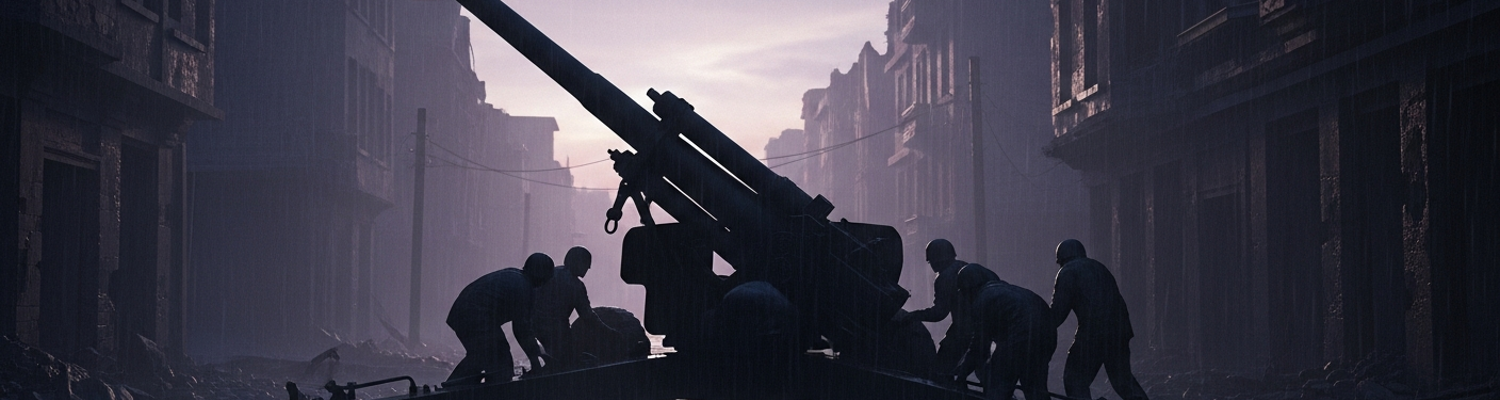
A new approach was required. The failure of indirect fire forced a radical, dangerous improvisation. Instead of lobbing shells from miles away, single guns were brought into the city’s narrow streets to engage fortified buildings at point-blank range. Units began calling for the 155mm M12 Gun Motor Carriage, a self-propelled gun nicknamed the “Doorknocker,” to be brought forward. These vehicles, along with towed 155mm “Long Tom” howitzers, were laboriously maneuvered by their fourteen-man crews down rubble-choked streets, often under direct enemy fire, to blast individual machine-gun nests and command posts. This was a role for which the weapons were never designed; their crews lacked the appropriate sights and firing tables for such close-range engagements. They aimed visually, treating the 13,880 kg cannon as a massive sniper rifle, firing shell after shell to systematically dismantle a single building floor by floor. This shift marked a critical moment where frontline necessity completely overrode established doctrine, turning artillerymen into urban demolition teams.
After-action reports from the 26th Infantry Regiment confirm that infantry commanders, stalled by fortified German positions, began calling for single guns to be brought forward. This led to the deployment of both standard 105mm howitzers and the heavy 155mm guns. Self-propelled 155mm M12 Gun Motor Carriages, vehicles originally designed for assaulting fixed fortifications, were requested by battalion commanders and maneuvered into the city. The artillery battalion was no longer the primary fire unit; the individual gun, assigned to a specific infantry company, became the instrument of urban demolition.
This was a battlefield improvisation of the highest order.
The physical process of moving these weapons into firing positions was a monumental and dangerous task. Towed 155mm guns, weighing nearly 14,000 kilograms, had to be manhandled by their crews down rubble-choked streets under the constant threat of sniper fire and pre-sighted mortars. Photographic evidence from Bismarck Strasse shows artillerymen wrestling their piece into position on a street corner, completely exposed. The self-propelled M12s were slightly more mobile but just as vulnerable, as they lacked significant armor and their open-topped crew compartments offered no protection from overhead shell bursts or fire from upper-story windows. Guns were positioned at street level, sometimes just hundreds of yards from their targets, a direct violation of doctrinal safety distances. Each mission was a high-risk operation, placing the fourteen-man crew of a “Long Tom” in the same peril as the frontline infantrymen they were sent to support.
With the guns in place, crews had to abandon the science of indirect fire for the art of the point-blank shot. The Fire Direction Center, with its observers, maps, and complex calculations, was discarded. Gunners used direct aiming techniques, employing the gun’s telescopic sight, typically reserved for emergency self-defense, or simply looking down the length of the barrel to line up a shot. There were no firing tables for systematically dismantling a four-story stone building from 300 yards away. It was a process of trial and error. A gunner would fire a round, observe the impact, and make manual adjustments for the next shot. The objective was not to suppress, but to obliterate. They fired shell after shell into a single window, doorway, or section of wall until it collapsed, creating a breach for the infantry or burying the defenders inside. The German garrison commander later noted that when the Americans began using 155mm guns as sniper weapons, he knew the battle was lost.
Operational logs from the U.S. First Army in October 1944 reveal a battlefield condition as formidable as any German pillbox: the weather. The autumn of 1944 was unusually cold and wet. A constant, near-freezing rain fell over the Aachen sector, turning fields and unpaved roads into a vast expanse of deep, glutinous mud. This was a tactical obstacle that directly influenced every aspect of the battle. The mud penetrated weapons, causing them to malfunction. For the individual soldier, the combination of cold and wet was a constant source of misery, leading to widespread cases of trench foot and exposure. The poor weather also provided an advantage to the German defenders, as rain clouds and thick fog limited visibility, allowing their artillery to fire without risk of being spotted from the air.
This environment had a severe effect on artillery mobility. A towed 155mm M1 “Long Tom” howitzer weighed nearly 14,000 kilograms and required a powerful prime mover like a Mack NO 6x6 truck or an M4 High Speed Tractor. In the soggy terrain around Aachen, these heavy vehicles lost all traction. Dirt tracks dissolved into quagmires, bogging down prime movers and their multi-ton guns. Photographic evidence from the campaign shows artillery pieces and their transport vehicles sunk axle-deep in mud, completely immobilized. Repositioning a single heavy gun from a rear battery position to a forward street-fighting role became a day-long engineering project, demanding immense physical labor from crews who had to wrestle their pieces through the muck.
The weather’s most crippling impact was on the overstretched American supply lines. The rapid Allied advance across France had already pushed logistics to the breaking point. The autumn rains and mud were the final blow. The primary workhorse of the supply chain was the GMC CCKW 2.5-ton truck. These trucks were overwhelmed by roads that had been turned into impassable swamps. Convoys from supply depots in Belgium slowed to a crawl. Entire truckloads of desperately needed 105mm and 155mm shells became stuck miles from the front. This breakdown in transportation created a severe ammunition shortage at the gun line, forcing commanders to ration their fire. During some periods of the fight for Aachen, First Army artillery was limited to just a handful of rounds per gun per day. The shortage grew so acute that it directly delayed operations, forcing a reliance on the dangerous, improvised direct-fire missions because there were not enough shells to sustain the massive, doctrinally-sound barrages that planners preferred.