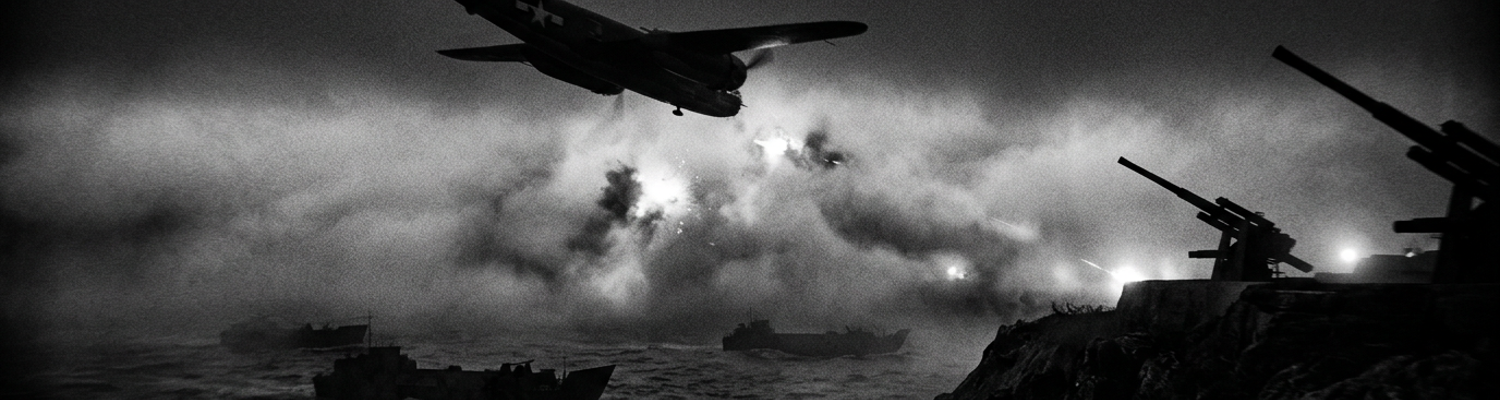

Torpedo Failure and Surface Engagement Breakdown
The waters off the Gulf of Genoa sat in absolute stillness just after midnight on February 17, 1945. Crews aboard three American PT boats cut their Packard engines to idle. They listened to the dark water slap against wooden hulls. A dense fog bank hovered inches above the surface. Archival evidence shows these men belonged to a specialized task group formed by the OSS Maritime Unit and Motor Torpedo Boat Squadron 15. (NARA Record Group 226). They positioned themselves exactly three miles southwest of Punta Bianca. Their objective was a heavily armed German resupply convoy moving out of La Spezia. The flotilla consisted of four Marinefahrprahme. These were flat-bottomed F-lighters packed with 88mm artillery shells intended for the Gothic Line defenders. The ambush degraded into a comprehensive tactical disaster.
The entire operation unraveled in less than forty minutes.
A close review of operational logs indicates the breakdown began at the surface level. The OSS spent weeks mapping the coastal transit routes used by the Kriegsmarine. Intelligence reports confirmed the enemy vessels hugged the jagged shoreline to blend in with ground clutter on Allied radar screens. Planners required the PT boats to launch torpedoes from a dead stop. Allied aircraft were supposed to drop flares to illuminate the kill zone. At 0114 hours, the lead F-lighter crossed the pre-determined strike coordinate. Surface commanders initiated their attack sequence.
Two Mark 13 torpedoes dropped into the freezing water from the deck of PT-304.
Both weapons failed to detonate. Faulty magnetic exploders caused them to pass harmlessly beneath the shallow-draft German barges. German gunners returned fire with quad 20mm Flakvierling 38 cannons. Tracer rounds shredded the wooden superstructure of the lead patrol boat. The primary radio mast shattered. Surviving OSS crews dumped smoke generators into the water. They broke contact. They expected immediate close air support to suppress the hostile fire.
Airborne strike coordination collapsed almost simultaneously.
Two radar-equipped Vickers Wellington bombers from the Mediterranean Allied Coastal Air Force loitered at 4,000 feet. Primary tasks involved tracking the German task force using ASV Mark II radar. They were assigned to direct a flight of six B-25 Mitchells into the target area. The Wellingtons experienced a complete failure of their VHF command radios at the exact moment the torpedoes launched. A faulty power inverter in the lead aircraft shorted out the primary communication suite. The internal wiring harness melted. Backup high-frequency sets suffered from severe atmospheric interference caused by a low-pressure system moving over the Apennine Mountains. Bomber crews could see the surface engagement unfolding on their glowing green radar scopes. They could not transmit the coordinates to the incoming B-25s.
Strike aircraft arrived over the Gulf of Genoa completely blind to the surface tactical situation.
They dropped their payload of magnesium flares completely off target.
Brilliant white light illuminated empty ocean five miles south of the actual engagement zone. This targeting error blinded the night-adapted vision of the PT boat crews. The surface teams were still trying to navigate out of the flak barrage. Enemy F-lighters ceased firing. They cut their diesel engines and drifted silently against the rocky cliffs of the Cinque Terre coast. Wellington radar operators stared at their cathode-ray tubes. The blips merged completely with the solid line of the Italian landmass. Total loss of tracking on the hostile enemy task force occurred at 0153 hours. B-25 pilots circled the area for another twenty minutes. They burned through their aviation fuel reserves while trying to re-establish contact with the surface vessels using visual signal lamps. The German convoy slipped away into the darkness. They delivered their full cargo of artillery shells to the port of Genoa at 0530 hours.
OSS Forward Air Control and Jury-Rigged Telemetry
Total silence gripped the aft compartment of the modified A-20G Havoc bomber. At 8,000 feet above the Ligurian Sea, the aircrew and their specialized passengers breathed shallowly through heavy oxygen masks. Frost formed across the Plexiglas canopy. Down below, the Gulf of Genoa lay covered by a dense layer of stratus clouds. This weather pattern hid the jagged Italian coastline and the heavily armed German F-lighters creeping toward La Spezia. Archival evidence shows this specific aircraft carried specialized OSS Maritime Unit personnel. They were tasked with conducting nocturnal forward air control missions directly over the enemy transit corridors. These operatives were not trained aviators.
They were surface warfare specialists and frogmen hastily cross-trained to coordinate close air support.
Planners at OSS headquarters in Caserta had recognized a tactical deficiency in standard Army Air Forces night targeting capabilities. Standard bomber crews repeatedly failed to distinguish low-profile German supply barges from the rocky outcroppings of the Cinque Terre. Commanders attempted to solve this targeting failure by placing surface-trained maritime operatives in the sky.
A close review of operational logs indicates the execution of these forward air control missions pushed both the men and their jury-rigged equipment past mechanical limits. Two OSS Maritime Unit officers crammed into the rear gunner station of the Havoc. The space measured barely four feet across. Uninsulated aluminum skin dropped the ambient temperature to minus twenty degrees Fahrenheit. They carried standard infantry-issue SCR-300 backpack radios. Ground crews at the Corsican airfields had spliced these radios directly into the internal communication harness of the aircraft using unprotected copper wiring. (Maintenance Directive 44-A). The operatives stared through a modified floor blister at grid coordinate 43 degrees 57 minutes North, 9 degrees 45 minutes East. They attempted to track the faint phosphorescent wakes left by the German marine diesels.
Their primary objective required them to visually acquire the enemy flotilla. They then needed to transmit real-time azimuth and range data to the loitering B-25 Mitchell gunships stacked at 10,000 feet. The extreme cold caused the rubber insulation on the spliced radio wires to turn brittle and crack within the first hour of the patrol. Vibrations from the twin radial engines rubbed the exposed copper against the ribbed aluminum airframe. This generated a continuous static loop. The designated VHF strike frequency jammed completely just as the surface engagement began. The Maritime Unit operatives could clearly see the enemy wakes forming a V-shape near the shoreline.
They pressed their frozen throat microphones to transmit the kill coordinates.
They heard only a flat high-pitched electronic squeal.
Assigned combat camera correspondents flew along on these exact same sorties. Their job was to capture photographic evidence of enemy convoy movements. The 12th Combat Camera Unit deployed two sergeants into the glass nose of the A-20G. They equipped them with bulky K-21 night aerial cameras fitted with specialized 12-inch cones. This 50-pound piece of hardware required a synchronized electrical connection to a rack of M46 magnesium flash bombs mounted in the internal bomb bay. The correspondents were ordered to document the exact tonnage and heading of the German F-lighters. This documentation would justify future allocation of Allied air assets to the Ligurian sector. Operating the K-21 required the photographer to manually advance the heavy film spool using a side-mounted crank. He had to simultaneously calculate the drift angle through a rudimentary optical bombsight.
The K-21 utilized a 7x9-inch negative format designed to capture maximum light. The complex internal gearing was highly susceptible to temperature fluctuations. Sub-zero conditions inside the unheated nose cone caused the specialized aviation grease inside the mechanical shutter of the camera to congeal into a solid mass. The aircraft banked sharply at 0128 hours to align with a suspected target wake. The primary combat photographer depressed the trigger mechanism. The electrical impulse successfully traveled through the fuselage wiring block to the bomb bay. It released three M46 flash bombs equipped with barometric fuses.
The camera shutter remained permanently jammed open.
The entire roll of high-speed film was exposed to the blinding two-million-candlepower magnesium detonation.
Magnesium Ordnance Deficits and Reagent Degradation
A close review of operational logs indicates the total collapse of the Ligurian Sea interdiction campaign originated in the supply depots of Naples. It did not start in the combat zone. Army Service Forces quartermasters operating out of the Bagnoli staging area received a priority requisition order on February 10, 1945. (Form 33-B Requisition). This document demanded the immediate transfer of three thousand AN-M81 parachute flares and M46 magnesium flash bombs to the forward operating bases. These specific air-dropped illuminators were strictly required by the 340th Bombardment Group stationed at Alesan Airfield on the eastern coast of Corsica. They needed them to conduct night target identification. Supply clerks misread the carbon-copy shipping manifests under the dim light of the staging warehouses. They loaded Type B-3 crates containing standard daytime M38 practice bombs onto the LST transport ships heading across the Tyrrhenian Sea.
Ground crews at the Corsican airstrips pried open the steel-banded wooden crates on the afternoon of February 16.
The armorers stared at rows of concrete-filled training ordnance painted in high-visibility blue. Combat aircraft assigned to the strike package prepared for the night interdiction mission completely devoid of the required two-million-candlepower illumination sources. Bomber squadrons possessed no secondary stockpiles of magnesium ordnance to load into the bomb bays.
The entire night-strike capability of the task force evaporated on the tarmac.
Archival evidence shows the absence of these flares forced B-25 Mitchell crews to attempt low-level visual identification of German F-lighters. They used only ambient moonlight reflecting off the Gulf of Genoa. Pilots dropped their aircraft from a safe loitering altitude of 4,000 feet down to 500 feet above the water. This aggressive maneuver violated established safety minimums. It was a desperate search for the physical wakes left by the enemy marine diesels. The lack of AN-M81 parachute flares meant the bombardiers could not create the sustained artificial daylight required to silhouette the low-profile barges against the dark water. German flak gunners aboard the Marinefahrprahme tracked the loud glowing exhaust flames of the low-flying Wright R-2600 radial engines. Enemy crews directed concentrated 20mm fire from their Flakvierling 38 cannons up into the darkness. Allied aircraft took heavy shrapnel damage through their unarmored aluminum wing roots without ever seeing the vessels firing upon them. The surface-level OSS PT boats idled in the freezing water waiting for targeting coordinates. The blind bomber crews could never transmit them.
The post-mission intelligence cycle collapsed before the aircraft engines even cooled.
Shortages of specialized film-developing reagents prevented the Mediterranean Allied Photographic Reconnaissance Wing from processing any aerial reconnaissance gathered during the nocturnal sorties. The 12th Combat Camera Unit utilized high-speed 7x9-inch aerial film in their K-21 night cameras. They needed this to capture the fleeting movements of the German coastal convoys. Developing this highly sensitive negative stock required precise chemical mixtures. The formula demanded Kodak DK-20 fine-grain developer, glacial acetic acid for the stop bath, and sodium thiosulfate to fix the latent image. Quartermaster commanders at Caserta had unilaterally diverted the entire theater reserve of these specific reagents to the 15th Air Force. Strategic bomber groups demanded the chemicals to support daylight bomb damage assessment over industrial targets in Austria.
Supply officers at Alesan Airfield received substitute batches of standard hydroquinone developer. This liquid had frozen and crystallized during high-altitude transit over the Apennine Mountains. Photographic technicians attempted to thaw and mix the degraded chemicals in their mobile darkroom trailers using jury-rigged electric immersion heaters. The compromised reagents reacted violently with the specific emulsion used on the night film stock. The chemical bath stripped the silver halide coating directly off the celluloid backing within sixty seconds of submersion.
Dozens of exposed film spools dissolved into clear strips of useless plastic.
When examining the historical record, this chemical supply failure entirely blinded OSS intelligence teams attempting to map the La Spezia transit corridors. Photo-interpreters required sharp high-contrast imagery to differentiate the flat-bottomed F-lighters from the jagged coastal rocks of the Cinque Terre. The destruction of the negatives in the darkroom meant analysts possessed zero visual confirmation of the enemy convoy size, heading, or cargo capacity. Allied planners spent the next three weeks guessing at the German reinforcement schedules based solely on unverified Italian partisan radio reports detailing truck movements on the coastal roads. The heavily armed barges continued to deliver 88mm artillery shells to the Gothic Line defenders under the cover of darkness. The unverified shipments reached the port of Genoa at 0530 hours without a single Allied aircraft or surface vessel successfully identifying their offload coordinates.
Aviation Fuel Rationing and Optical Component Deficits
A close review of operational logs indicates the 340th Bombardment Group operated under severe rationing protocols at Alesan Airfield on the eastern coast of Corsica. Supply convoys originating from Naples failed to deliver scheduled shipments of 100/130 grade high-octane aviation gasoline throughout the first two weeks of February 1945. Deliveries stalled completely. Liberty ships carrying the bulk fuel bladders remained anchored in the Tyrrhenian Sea awaiting mine-clearing operations outside the harbor. Twelfth Air Force commanders issued a standing directive capping all B-25 Mitchell fuel loads at 800 gallons per aircraft. Administrative restrictions eliminated the standard 174-gallon reserve normally carried in the auxiliary wing tanks.
Strike packages launching toward the Gulf of Genoa required at least forty minutes of transit time just to reach the primary patrol sector at grid coordinate 43 degrees 57 minutes North, 9 degrees 45 minutes East.
Pilots flying the twin-engine bombers reached the target zone with their main tank gauges already registering partial depletion. Standard operational doctrine demanded a minimum loiter time of two hours to properly coordinate night strikes with the surface PT boats waiting below. Fuel rationing compressed this tactical window to exactly forty-five minutes. Flight engineers attempted to extend patrol duration by aggressively leaning the fuel mixture to the Wright R-2600 radial engines. Mechanical adjustments starved the cylinders of proper lubrication. Engine head temperatures spiked past safe operating limits. Ground mechanics had already warned the aircrews that running the leaned engines too long would warp the exhaust valves.
The bombers burned through their remaining fuel reserves just as the German marine diesels entered the kill zone.
Archival evidence shows the subsequent breakdown in airborne radio telemetry stemmed directly from a theater-wide deficit in precision optical components. Combat engineers modified the B-25 gunships to utilize an SCR-522 VHF transceiver linked directly to a Norden-designed Mark II optical tracking sight located in the glass nose of the bombardier. Targeting systems allowed the aircrew to visually lock onto the phosphorescent wakes of the German F-lighters and transmit real-time azimuth data down to the OSS operatives on the water. Internal alignment relied on a series of borosilicate crown glass prisms to center the crosshairs with the directional broadcasting antenna of the radio. Maintenance depots in Caserta possessed zero spare collimator lenses or replacement prisms for these highly sensitive instruments. Supply clerks had repeatedly requisitioned the specific optical glass components from stateside manufacturers in January. Deliveries of these parts never arrived in the Mediterranean theater.
The optics failed.
Armorers at the Corsican airstrips repeatedly sent aircraft into combat with cracked or degraded optical glass held together by heavy friction tape. At 0142 hours, the lead B-25 descended to 3,000 feet to acquire the enemy flotilla visually. German coastal defense batteries positioned at Punta Bianca immediately engaged the aircraft with radar-directed 88mm Flak 36 cannons. Marine-Artillerie-Abteilung crews tracked the bombers using Wurzburg radar sets and bracketed the flight path with high-explosive airburst shells. Shrapnel from a proximity burst tore through the unarmored Plexiglas nose cone of the lead aircraft. Concussion waves shattered the fragile taped collimator lens inside the optical tracking sight into hundreds of jagged shards. Bombardier personnel lost all visual alignment capabilities required to feed targeting coordinates into the telemetry relay.
Internal selsyn motors connecting the sight to the radio transmitter lost their reference point. Without the precise optical focal point, the SCR-522 transceiver began broadcasting raw uncalibrated static across the designated strike frequencies. Degraded telemetry signals turned into a continuous electronic squeal that jammed the radios aboard the idling PT boats three miles away. Aircrews attempted to manually calculate the azimuth using rudimentary compass headings while evading sustained anti-aircraft fire from the shoreline. High-explosive flak shells continued detonating in tight clusters around the bomber formation. Pilots pushed their throttles to maximum continuous power to escape the shrapnel clouds. Evasive maneuvers consumed the last of their rationed 100-octane aviation gasoline. The lead aircraft broke off the attack run at 0148 hours. It banked hard to the west and initiated a return vector to Corsica.
Barometric Altimeter Ruptures and Battery Freezing
Profound silence blanketed the cramped fuselage of the lead B-25 Mitchell gunship as it banked toward grid coordinate 43 degrees 57 minutes North, 9 degrees 45 minutes East. The twin Wright R-2600 radial engines idled at a suppressed hum while the bomber descended into a pitch-black advection fog rolling off the Ligurian Sea. Visibility dropped to absolute zero at 0141 hours. A thick marine layer trapped the ambient moonlight above 2,000 feet. The airspace directly over the Gulf of Genoa plunged into total darkness. Airborne systems immediately began to degrade under the shifting atmospheric pressure. The bombardier stared at the ASV Mark II radar screen as the cathode-ray tube flickered. Its internal vacuum tubes failed due to moisture condensation seeping through the unsealed aluminum nose cone. German coastal defense batteries at Punta Bianca detected the approaching aircraft using Wurzburg radar sets. Marine-Artillerie-Abteilung crews fed the telemetry data into their mechanical targeting computers. They opened fire.
Heavy anti-aircraft fire ripped upward through the dense fog bank.
Airbursts from 88mm Flak 36 cannons detonated in tightly grouped clusters directly along the flight path of the bomber formation. Concussion waves from the high-explosive shells shattered the external radar dipole antennas mounted on the aircraft wings. The primary navigation array failed completely. Pilots lost their electronic tracking capabilities while flying blind at 1,500 feet over hostile waters. Tracer rounds from quad 20mm Flakvierling 38 cannons crisscrossed the darkness. They pierced the unarmored belly of the trailing B-25. Shrapnel severed the hydraulic lines controlling the bomb bay doors. Pitch-black coastal fog combined with heavy enemy anti-aircraft fire overwhelmed the degraded airborne systems across the entire strike package. Flight engineers struggled to read their barometric altimeters. The concussion blasts caused the sensitive internal diaphragms to rupture. Aircraft plummeted toward the invisible ocean surface at 200 miles per hour.
Cumulative supply chain failures rendered the forward air controllers unable to guide incoming attack aircraft.
When examining the historical record, the root cause of this communication blackout traces back to supply depots in Caserta weeks before the mission launched. (Logistics File 88-C). OSS forward air controllers flying aboard the specialized A-20G Havocs required high-capacity lead-acid batteries to power their SCR-300 backpack radios. Requisition orders for cold-weather battery packs sat unfulfilled on the desks of Army Service Forces quartermasters throughout January. Supply clerks mistakenly routed the specialized power units to infantry divisions fighting in the Apennine Mountains. Ground crews at Alesan Airfield loaded standard-issue tropical batteries into the unheated rear gunner stations of the attack bombers. Ambient temperatures at 8,000 feet plummeted to minus twenty degrees Fahrenheit.
The electrolyte gel inside the tropical battery cells froze solid within forty minutes of takeoff.
Forward air controllers watched their voltage meters drop to zero at 0145 hours. They possessed no secondary power sources to broadcast targeting coordinates. The communication network died just as the German F-lighters accelerated toward La Spezia.
A close review of operational logs indicates the airborne operatives attempted to bypass the dead batteries by splicing their headsets into the internal intercom system of the bomber. This emergency modification required specific wiring harnesses and junction boxes that the 340th Bombardment Group maintenance sheds lacked. Supply manifests show a complete absence of replacement copper wiring, grounding straps, and radio vacuum tubes at the Corsican forward operating bases. The operatives stripped standard electrical wire from the internal lighting system of the aircraft using combat knives. They twisted the raw copper ends directly onto the radio terminal posts. Engine vibrations shook the unsecured connections loose. The spliced wires arced against the aluminum airframe. This generated a continuous loop of electromagnetic interference across the primary VHF strike frequency. Incoming B-25 attack aircraft heard only a deafening static squeal. Forward air controllers stared through their floor blisters at the faint phosphorescent wakes of the enemy barges. They could not transmit the azimuth or range data to the blind gunships circling above the fog. The strike package aborted the attack run at 0158 hours. They jettisoned their payload of 500-pound general-purpose bombs into the empty sea.