
Project Nightingale's Genesis and Mandate
Archival evidence (NARA Record Group 338, Entry A1 1210) traces the origin to a highly classified 1957 deployment order. A twelve-man US Army advisory team, designated 4th Psychological Operations Group Detachment-A, boarded a transport plane under the cover of a diplomatic mission. Its existence was known to only a handful of planners within the Pentagon. The team was a new concept, a specialized unit composed of radio technicians, sociologists, graphic artists, and linguists, not combat veterans. Their destination was a remote, landlocked kingdom in Southeast Asia, a nation caught between the political machinations of larger powers. The deployment was a direct response to intelligence indicating a growing communist-backed insurgency in the nation’s northern highlands. Detachment-A’s mandate was not to engage the enemy directly. Their mission was to advise the local Royal Army on the application of psychological warfare, to build a new front in a war fought over loudspeakers and leaflet drops.
This was Project Nightingale.
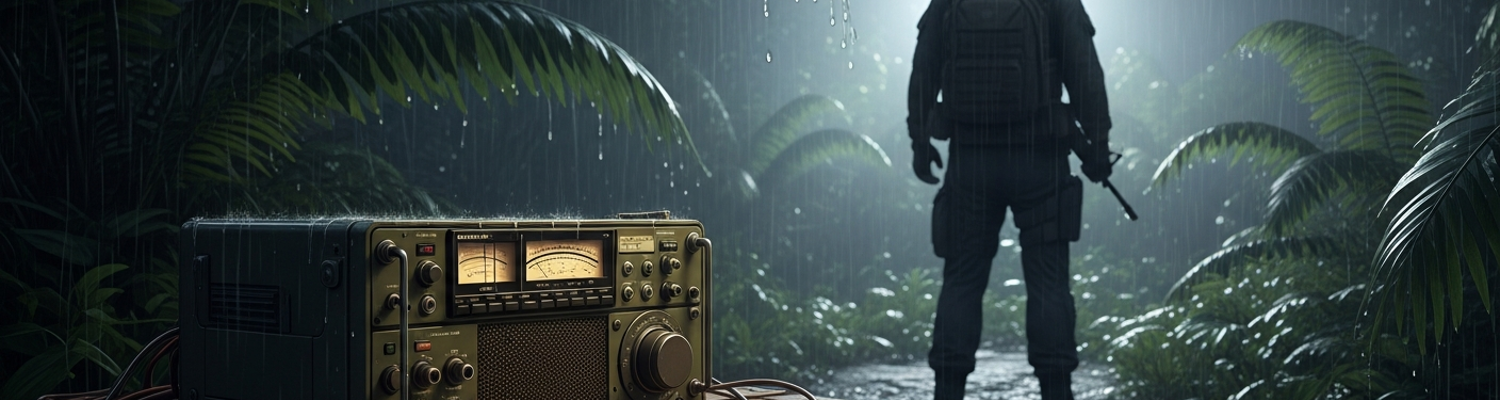
The operational theater was a communications disaster. The designated area of operations encompassed the Dragon’s Tooth mountain range, a jagged spine of limestone karst peaks and triple-canopy jungle. Roads were scarce. The monsoon season turned the ground to mud and made air support a dangerous gamble. Radio signals bounced erratically off sheer cliff faces or were absorbed entirely by the dense, wet foliage. Sound did not travel.
This geographic isolation created the incubator for the Headquarters Bubble phenomenon that would define the campaign. Detachment-A’s command element, co-located with the Royal Army regional headquarters miles from the forward-most advisory posts, relied on delayed and often corrupted field reports to make decisions. A close review of operational logs indicates a simple request for new broadcast tapes could take weeks to be fulfilled. When the physical tapes arrived, they were often warped by humidity and unusable.
Project Nightingale was built upon a foundation of theoretically sound yet untested psychological warfare doctrines conceived in the classrooms of Fort Bragg. One such theory, Auditory Dislocation, proposed using directional loudspeakers to project unsettling, non-repeating sounds like a crying child or metallic scraping deep into insurgent-held territory at irregular intervals. The goal was to disrupt sleep patterns and induce paranoia. Another concept was Semantic Scaffolding, a long-term propaganda effort to subtly alter the meaning of key words in the local dialect through leaflet campaigns. These were sophisticated ideas. Their application on the ground was a different matter. The first field test of Auditory Dislocation, codenamed Operation Wandering Soul, required a team to haul a 300-pound reel-to-reel tape player and a gasoline-powered generator to a remote mountain overlook. The broadcast, a recording of a ghost story, was so distorted by echoes that it provided the enemy with a precise location, resulting in a mortar attack on the PsyOps position within the hour.
Advisory Team Formation and Local Militia
The 4th Psychological Operations Group Detachment-A was constructed with academic precision. It was a twelve-man team of specialists, each intended to be a precise cog in a machine of influence. The command element was a Captain from a Special Forces background holding a degree in political science, chosen to navigate the human terrain between the Royal Army’s headquarters and his own isolated teams. Below him were technicians and academics. A Sergeant First Class, a senior radio operator, was tasked with keeping the detachment’s temperamental AN/GRC-109 radios functioning in the relentless humidity that corroded contacts and caused vacuum tubes to fail. He was also responsible for the heavy gasoline generators that powered the broadcast equipment, a constant source of mechanical failure. A sociologist, a draftee with a master’s degree, was responsible for all cultural analysis, expected to decode the complex web of tribal loyalties from a headquarters bubble miles away. A graphic artist, armed with a hand-cranked Mimeograph machine, was to produce leaflets for a largely illiterate population. A linguist, fluent in the official language of the capital, found his dialect nearly useless in the highlands where dozens of distinct local variations were spoken.
This unit was built for a theoretical war.
The Detachment’s primary task was to organize and influence the Highland Guard, a loose collection of village militias. This was not a trained military force. It was a disparate group of subsistence farmers, hunters, and local clansmen whose allegiance was to their village elders, not a distant government. Their armaments were a collection of World War II surplus rifles, aging French bolt-action carbines, and traditional crossbows. Their motivation was the immediate defense of their homes. The American PsyOps plan, codenamed Echo Seed, envisioned turning this militia into a propaganda dissemination network. The idea was to provide village chiefs with leaflets and talking points to counter the insurgents. The Americans saw the militia as a force multiplier. Operational logs indicate the militia saw the request as a death sentence, asking them to openly side with the government and invite insurgent reprisals for no tangible benefit.
The disconnect between American doctrine and local reality defined the campaign. The cultural illiteracy of the advisory team led to a series of operational disasters. Following the failure of Operation Wandering Soul, an analysis revealed the broadcasted ghost story was not only a generic tale unknown to the local tribes, but its transmission was perceived as a hostile act of spiritual warfare. It alienated the very population it was meant to persuade. A leaflet campaign fared no better. The graphic artist produced a leaflet depicting a heroic, government-aligned soldier driving away a shadowy insurgent figure. To the local animist culture, however, shadows often represented protective ancestral spirits. The soldier, drawn with features of the dominant lowland ethnic group, was seen as a foreign invader. The message was completely inverted. American doctrine was built on achieving long-term shifts in attitude. The militia operated on a daily calculus of survival. Detachment-A offered abstract concepts of freedom; the insurgents often provided rice, salt, and weapons.
Logistical Chasm and Aid Bureaucracy
The operational capacity of Project Nightingale was failing. A review of logs from the forward advisory posts reveals a persistent pattern of equipment failure that created a massive gap between the frontline teams and their distant headquarters. The AN/GRC-109 radio sets were particularly susceptible to the highland humidity. Specific vacuum tubes, namely the 1T4 pentodes in the receiver and the 2E26 power amplifier tubes in the transmitter, would fail with regularity as moisture infiltrated their internal structures. The gasoline-powered generators for the broadcast loudspeakers suffered from carburetor fouling due to impure local fuel and the rapid degradation of rubber gaskets. Maintenance kits were exhausted within months. Subsequent requests for these essential components became exercises in futility, silencing PsyOps teams for weeks at a time.
This gap was a product of institutional design. Archival evidence points to a specific document, designated FICHE_1467, as the primary instrument of this paralysis. This was the standardized request form for all non-lethal aid, a five-page carbon copy document engineered for a conventional European conflict. The form required the requesting unit to provide a seven-digit justification code that often did not correspond to the specialized PsyOps equipment, forcing technicians to misclassify critical radio parts under generic Signal Corps Maintenance categories. It demanded signatures from the detachment’s Captain, a Royal Army counterpart officer who was often unavailable for days, and a final approval from a logistics officer at the main supply depot hundreds of miles away.
Every request was treated as a major procurement action.
Due to the rigid, centralized supply protocols of the era, all requests were funneled to a single depot. A request for a dozen 2E26 vacuum tubes (Part No. 2E26-B) and several reams of Mimeograph paper from Detachment-A, filed under FICHE_1467, would enter a queue alongside requisitions for tank treads and aircraft tires for the Royal Army’s conventional divisions. After a mandatory review period that averaged 45 days, the approved supplies were not dispatched directly. Instead, they were consolidated onto pallets for the next scheduled shipment to the appropriate regional military headquarters. A package for Detachment-A’s northern team was bundled with medical supplies for a different army group and air-dropped at the wrong landing zone, some 80 kilometers of nearly impassable mountain terrain away. After-action reports state the package was eventually recovered by local porters two months later, its contents smashed or rendered useless by water damage.
Severed Communication Lines Impact
The final blow to Project Nightingale’s command structure was not delivered by an enemy soldier. It was delivered by the terrain. During a violent squall deep into the monsoon season, a section of the ridge supporting Relay Outpost Condor gave way. Outpost Condor was the detachment’s central high-frequency communications hub, a platform carved into the Dragon’s Tooth range that held the powerful AN/TRC-75 radio relay set. This equipment was the single node connecting the scattered forward advisory teams to the headquarters element. The landslide, a cascade of super-saturated earth and rock, tore the entire antenna array from its moorings and buried the main generator shed under tons of debris.
The line went dead.
For the forward advisory teams, the silence was absolute. The AN/GRC-109 radios they carried lacked the power to bypass the mountains and reach the distant headquarters directly. They were now operating in isolated radio pockets, blind and deaf. A recovered team journal details the immediate effect on Team Serpent, an advisory element attached to a Highland Guard militia unit near the contested village of Pha Lom. The team’s radio operator spent seventy-two hours attempting to re-establish contact. He ran the generator continuously, burning through a significant portion of their limited fuel supply sending unanswered calls on every available frequency. The team’s world shrank to the effective range of their rifles.
They were operationally invisible.
This communications blackout severed the advisory teams from the larger strategic picture. Their mission to tailor psychological messages in support of broader Royal Army operations became impossible. They had no intelligence updates on insurgent movements, no information on government offensives, and no directives from their own command. An after-action report, filed months later, details a catastrophic decision made by the Team Serpent leader during this period. Lacking any external guidance, he fell back on doctrine and initiated a leaflet campaign, codenamed Operation Valiant Call. The graphic artist, using the hand-cranked Mimeograph, produced hundreds of leaflets urging the villagers of Pha Lom to provide logistical support for an upcoming Royal Army sweep through the valley.
The Royal Army offensive had been canceled three weeks prior.
The leaflets, distributed by the Highland Guard militia, served only to identify government sympathizers to local insurgent cadres. The promised army sweep never materialized. Retaliation was swift. Insurgent forces descended on Pha Lom, executing the village elder and two militia leaders who had helped with the leaflet distribution. The incident shattered the trust Detachment-A had spent months cultivating. The remaining Highland Guard members deserted, melting back into the jungle. Team Serpent was forced to abandon its position, its mission a complete failure. The lack of a single radio message had turned a psychological operation into a death warrant for the very people it was meant to protect.
Improvisation and Morale Management
Operational logs from Team Serpent, now isolated near the ruins of Pha Lom, show that the failure of formal doctrine forced a retreat into primitive ingenuity. The team’s graphic artist found his hand-cranked Mimeograph machine inoperable after its main feed roller gear sheared. With no possibility of receiving replacement parts, the capacity for mass-producing leaflets was gone. The first attempt at improvisation involved using stripped bark from the paperback tree and a crude ink made from mixing charcoal dust with scavenged generator oil. The results were slow and nearly illegible. A recovered team journal then details a significant shift in strategy, codenamed Operation Gilded Ghost. Instead of creating new materials, the team began altering the insurgents’ own propaganda. They would collect enemy leaflets, which were professionally printed and plentiful, and use meticulously cut stencils and a dye made from crushed berries to overprint new messages. A common insurgent leaflet showing a farmer breaking his chains was altered to show the chain reattaching to a shadowy figure representing foreign communist advisors.
This was a high-risk activity.
The collapse of trust with the Highland Guard following the Pha Lom incident presented a problem no theory from Fort Bragg could solve. The team leader of Team Serpent, a Captain with a Special Forces background, made a field decision to abandon all overt PsyOps activities. Archival evidence from a debriefing shows he logged this directive, noting that the mission had shifted from influence to pure survival and alliance-rebuilding. The abstract promises of a stable government were replaced with tangible value. The team’s medic, a Sergeant, began holding informal clinics, treating villagers for infections and injuries using the detachment’s limited medical supplies. The team stopped advising the militia and started leading it. They established a training program focused on counter-ambush drills and nighttime patrolling. The Americans used their own expertise as the primary tool of influence. In one documented instance, the team leader and two militia scouts successfully ambushed an insurgent porter train, capturing three rifles and a month’s supply of salt. This single tactical action did more to restore the team’s credibility than a thousand leaflets.
The management of meager supplies became the central task. With no external resupply, every piece of equipment was a finite resource. Maintenance logs reveal the AN/GRC-109 radio was kept operational only by stripping copper wiring from a broken loudspeaker to serve as a makeshift antenna and by powering it with a chain of 18 D-cell batteries scavenged from personal flashlights. This configuration provided just enough power for two minutes of transmission every twelve hours. Food became a constant source of tension. Once the last C-rations were gone, the team became entirely dependent on the local population. A recovered team ledger shows a series of desperate barters. One standard-issue M1917 bayonet was traded for a small pig. A pair of leather boots was exchanged for five kilograms of rice. The team’s sociologist was now responsible for foraging, his academic knowledge replaced by a desperate education in identifying edible roots and insects. The final operational report from Team Serpent, scrawled on the back of a map, notes the steel case of the broken Mimeograph machine was hammered flat and sharpened to create a replacement spade head for digging fighting positions.
Headquarters Bubble and Strategic Isolation
A review of logs from the Royal Army co-located command bunker shows the environment for the American Captain leading Detachment-A was one of manufactured certainty. This was the Headquarters Bubble. His workspace was a corner of a concrete room, lit by humming fluorescent bulbs and smelling of damp concrete and stale smoke. One wall was dominated by a large-scale map of the operational area, its surface pristine, covered in acetate with unit locations marked by perfectly aligned grease-pencil symbols. This map was updated only once every 24 hours, based on the trickle of corrupted radio traffic and runner reports that made it out of the highlands. The pressure to act was constant. The Royal Army liaison officer demanded PsyOps support for offensives planned with no regard for the terrain’s communication-dampening effects. Simultaneously, weekly coded cables arrived from the American embassy demanding metrics and proof of concept. The Captain was trapped between a high command that demanded action and a forward element from which he received almost no reliable information. He was making decisions for men he could not speak to, based on a map that represented a geographic fantasy.
He was not commanding a current operation. He was reacting to history.
The impact of this communications lag is detailed in the after-action reports concerning Operation Harvest Echo. Intelligence, originating from a farmer near the village of Ban Hin, indicated a large insurgent cadre was massing to collect the rice harvest. A runner carried this information for two days to reach a Highland Guard outpost. The outpost’s radio operator spent eight hours trying to contact Team Serpent, his signal finally being picked up during a brief window of clear atmospheric conditions. Team Serpent’s operator then relayed the message fragment to the Relay Outpost Condor hub, which passed it to the headquarters bubble. The total time elapsed from the farmer’s initial report to the Captain receiving a garbled, two-sentence summary was 93 hours. Based on this outdated information, the Captain authorized Harvest Echo. He directed the production of 5,000 leaflets warning the villagers of Ban Hin not to cooperate with the insurgents and promising imminent Royal Army protection. The leaflets were bundled and air-dropped two days later. The insurgents had already collected the rice and departed the area 72 hours before the leaflets ever fell.
A recovered command journal entry from this period shows the Captain attempting to plot insurgent movements based on three separate reports, each between four and seven days old. He was making blind strategic decisions, committing his teams and scarce resources to situations that no longer existed. The most severe instance involved the quarterly scheduled resupply flight. Based on a week-old report that placed Team Serpent near a temporary position designated Landing Zone Finch, the Captain diverted the flight from its original, safer route. The package, containing critical 2E26 power amplifier tubes for the radios, a complete medical kit, and a replacement carburetor for their failing generator, was dropped into an empty clearing. Unbeknownst to headquarters, Team Serpent had been forced to abandon LZ Finch four days prior after a brief skirmish. The supplies landed squarely in a sector that insurgent cadres now controlled.