
The Desert Lens Arms Package
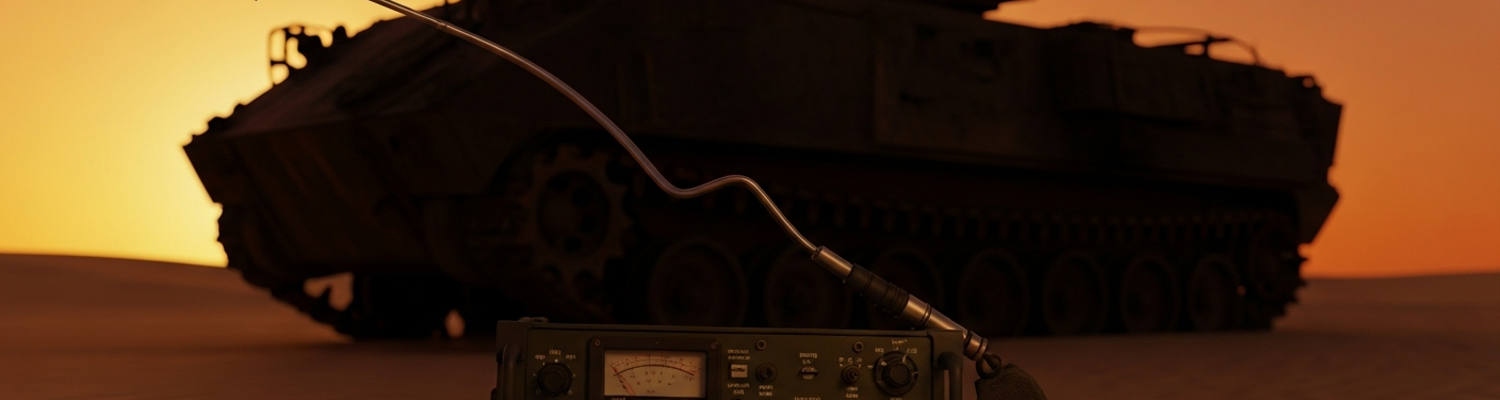
The frequency knob of the AN/PRC-77 radio set was stiff under Private Hamid’s fingers. Dust, finer than sand, had already worked its way past the seals of the green metal box. He sat in the shadow of a Hino truck tire at the edge of an airstrip in North Khajir province, ignoring the heat that distorted the distant mountains. His platoon sergeant wanted a communications check with Battalion HQ. The English lettering on the dial was an unfamiliar map. He twisted the knob, heard only a hiss, and twisted it back. The radio’s weight, a full 23.5 pounds with its BA-5598/U battery, was a dense, foreign presence against his spine. It was a feeling that would soon become common to the entire 4th Royal Guard Brigade.
American equipment arrived in the summer of 1980. The transaction, filed under Foreign Military Sales Case ZR-B-UDS, was intended to arm a key regional ally for a brewing counter-insurgency. Shipping manifests confirm the delivery of 2,500 M16A1 rifles and 50 M60 machine guns. The weapons were a significant technological shift for the Zafiri Royal Guard, whose arms lockers were filled with aging Soviet AKM and RPD variants. The M16A1 was lighter than the AKM, and its 5.56x45mm cartridge offered a flatter trajectory. Its direct impingement gas system, which vented hot propellant gas directly onto the bolt carrier group, was a mechanism demanding constant, intensive maintenance.
The fine, abrasive dust of North Khajir was not the mud of Vietnam. It coated the bolt with a microscopic grinding paste. This led to failures to extract and double-feed malfunctions. Zafiri armorers, trained on the forgiving long-stroke piston of the Kalashnikov, were unprepared to service these issues in the field. The M60 general-purpose machine gun, firing the heavier 7.62x51mm round, offered a major increase in suppressive firepower over the squad’s existing RPDs. Its operational weight exceeded 23 pounds, and the standard 100-round belts of ammunition were cumbersome. The weapon required a dedicated gunner and assistant gunner to be employed effectively, a tactical adjustment from the more mobile fire support Zafiri doctrine had previously emphasized.
This new arsenal was given to the 4th Royal Guard Brigade. Archival evidence shows the 4th was a unit more practiced in parade-ground drills in the capital than in the hard realities of asymmetric warfare. It was selected for its political loyalty to the monarchy, not its combat record. Their deployment to North Khajir placed them in a geography perfectly suited to their insurgent adversaries, the Al-Hurr. The terrain was a complex network of deep, narrow wadis and jagged ridgelines that broke up lines of sight and channeled advancing formations into natural kill zones. The Al-Hurr insurgents, local to the region, used this landscape to their full advantage. They initiated ambushes from high ground at close quarters and disappeared before the Brigade’s heavier assets could be brought to bear.
Initial operations proved the American arms were not a simple solution. The AN/PRC-77 radio sets became a point of systemic failure. The radios consumed batteries at a high rate. The Zafiri logistical chain, unaccustomed to supplying such items in bulk to dispersed frontline units, quickly broke down. Operational logs from the 4th Brigade’s first major offensive, Operation Asad’s Claw, document multiple instances of platoons losing contact with their company command posts after just a few hours of patrolling. During one engagement near the Tangi pass, two companies of the 4th Brigade were unable to coordinate a pincer movement because one of their radio operators could not establish a connection in the narrow canyon. Reports of weapon stoppages on the M16A1s flooded the command net. Soldiers, frustrated by the unfamiliar cleaning requirements, found their rifles jamming after firing only a few magazines in the dusty conditions, forcing them to attempt to clear complex malfunctions while under effective enemy fire.
Reconnaissance Failures in North Khajir
Intelligence summaries from the first quarter of 1981 revealed the initial, flawed signals. Imagery from KH-11 KENNEN reconnaissance satellites, on their orbital passes over North Khajir province, captured sporadic nighttime thermal blooms. These infrared signatures were consistent with small convoys, typically two or three Hino or Soviet-era ZIL-130 trucks, moving along secondary tracks in the Tangi Valley. The resolution was sufficient to identify the vehicles but not their cargo or exact personnel count. Zafiri G2 intelligence officers also received a handful of disparate HUMINT reports from local assets. One report, filed as Z-G2-RPT-81-034, documented a meeting between known Al-Hurr sub-commanders in a village near the provincial border. Another spoke of small arms being cached in a series of caves twenty kilometers to the west. Each piece of information, viewed in isolation, appeared minor.
The data was presented by Zafiri intelligence staff to their American counterparts in the Technical Assistance Field Team (TAFT) assigned to the 4th Royal Guard Brigade. The TAFT’s primary mission was equipment integration and tactical training, not strategic intelligence analysis. Their assessment, recorded in weekly operational logs, reflected a doctrinal interpretation rooted in recent American counter-insurgency experience. US advisors viewed the scattered truck movements and weapons caching as standard insurgent activity. This was the background noise of a low-intensity conflict. From their perspective, Al-Hurr was a fractured organization incapable of large-unit actions. These activities were simply the logistical effort required to sustain small, dispersed guerrilla bands. The recommendation passed to the Zafiri brigade commander was to maintain focus on small-unit patrol actions and perfecting proficiency with the new equipment. Re-tasking limited aerial reconnaissance assets or diverting ground patrols to investigate these minor events was deemed an inefficient use of force.
A critical blind spot was created. The Al-Hurr movements were not random. They were the visible component of a sophisticated deception. While Zafiri and American attention was fixed on the vehicle convoys, the bulk of the insurgent force was consolidating on foot. A force of 1,500 fighters drawn from three separate Al-Hurr factions moved in groups of 20 to 50 men. They traveled at night. They used ancient smuggling paths and dry riverbeds invisible to satellite observation and far from the roads patrolled by the 4th Brigade. These groups converged on a pre-selected assembly area known as the Sar-i-Sang basin, a natural depression shielded by a series of low ridgelines approximately eight kilometers southwest of a Zafiri outpost designated Point 703. Over a ten-day period, this force gathered undetected. They brought with them not just rifles but consolidated heavy weapons platoons equipped with DShK heavy machine guns, 82mm mortars, and dozens of RPG-7s. The entire intelligence apparatus was oriented to detect patterns of a small-scale insurgency, while a conventional infantry assault force was gathering nearby.
Collapse of Command at Point 703
02:00 hours, April 12, 1981. The attack on Point 703 began with precision. The first 82mm mortar rounds fired by Al-Hurr detachments impacted directly onto the 4th Royal Guard Brigade’s command post. Post-action analysis of the impact craters indicates the insurgents had previously registered the exact coordinates of the headquarters element and its primary radio antenna array. Within seconds, the command tent was shredded. The brigade’s main link to its higher headquarters was severed. Immediately following the mortar barrage, pre-sited DShK heavy machine guns opened fire from the high ground to the north and east. Their 12.7x108mm rounds created interlocking fields of fire that swept across the exposed perimeter defenses. RPG-7 teams, having crept forward under the cover of darkness, began a systematic reduction of the Zafiri machine gun nests and mortar pits. The Al-Hurr assault was not a wave of fighters but a coordinated, multi-layered siege designed to dismantle the position’s command, communication, and heavy weapon capabilities in the opening moments.
The Zafiri response was paralyzed. Operational logs from adjacent units paint a picture of complete electronic silence from the outpost. The initial mortar strike had not just destroyed the command post; it had obliterated the brigade’s primary and secondary AN/GRC-160 radio sets. It also destroyed the frequency card listing the alternate battalion nets. This forced the surviving platoon leaders to fall back on their platoon-level AN/PRC-77 radios. The operators, undertrained and panicked, defaulted to their last known company-level frequency. No one answered. The company command net had ceased to exist the moment the command post was hit. Without a pre-designated alternate frequency or a clear chain of command, each platoon was an isolated pocket of resistance, blind and deaf to the units fighting just meters away. One surviving non-commissioned officer later recounted that his platoon leader spent nearly ten minutes frantically cycling through the PRC-77’s frequency knobs, receiving only static while RPGs impacted his sector.
With the command structure gone and communications nonexistent, tactical cohesion evaporated. The psychological impact of the precise and overwhelming enemy fire shattered unit morale. Soldiers, pinned down by the DShKs, found their M16A1 rifles jamming with dust and fouling, a direct result of the maintenance failures noted in earlier after-action reports. The weapon stoppages, often requiring complex clearing procedures, occurred at the worst possible moment. Archival evidence shows that Zafiri soldiers began abandoning their defensive positions in small, uncoordinated groups, seeking any available cover. The Al-Hurr forces, anticipating this, had positioned blocking forces along the likely escape routes and wadis leading away from Point 703. The brigade ceased to function as a military formation. It was reduced to pockets of panicked men who were systematically hunted and destroyed over the next two hours.
Sensory Overload and Human Erosion
The breaking point was reached weeks before the attack on Point 703. After-action reports and declassified personnel files from the Technical Assistance Field Team reveal a pattern of escalating stress within the advisory contingent and their Zafiri counterparts. The most detailed account comes from the informal field log and subsequent formal debriefing of Staff Sergeant David Miller, a US Army Special Forces weapons sergeant from 5th Special Forces Group embedded with the 4th Royal Guard Brigade. Miller’s role was to provide technical advice on the newly issued M60 machine guns and M16A1 rifles. This placed him in daily, direct contact with the Zafiri soldiers. His documentation (filed under report series AAR-7B-SFG) provides a granular view of the psychological erosion that preceded the tactical collapse. He recorded the growing listlessness of the Zafiri troops, their disregard for complex weapon maintenance procedures, and a pervasive fatigue that no amount of sleep seemed to cure.
Miller’s own condition, detailed in a mandatory post-deployment psychological screening, became a case study in sensory overload. He described the operational environment as an unending assault on the senses. For weeks, he spent up to eighteen hours a day either on patrol or inside the cramped, stifling hull of a Zafiri M113 armored personnel carrier being used as a mobile command post. He documented the constant, high-decibel engine noise, the metallic shriek of the tracks, and the incessant, overlapping chatter from three separate AN/PRC-77 radios tuned to different nets. His report itemized the physical symptoms. A persistent low-grade headache. An inability to focus on written reports. A state of hyper-vigilance so acute that the sudden engagement of the vehicle’s cooling fan could trigger a combat reaction. Hours spent observing the world through the narrow, green-hued field of view of an AN/PVS-5 night vision device induced a sense of detachment and distorted depth perception. His report concluded that his functional capacity was degraded not by a single traumatic event, but by the cumulative weight of non-stop, low-level sensory inputs that overwhelmed the brain’s ability to filter information.
This internal breakdown mirrored the external chaos Miller witnessed during the brigade’s final hours. His logs from the night of the attack on Point 703 offer a chronicle of command cohesion dissolving under pressure. Positioned at the brigade command post, he documented the Zafiri brigade commander’s paralysis following the initial mortar barrage that destroyed the primary radio antennas. The commander and his staff, products of a rigid, top-down military culture, were institutionally incapable of adapting to a decentralized fight. Miller recorded his own frantic attempts to convince his Zafiri counterpart to authorize platoon leaders to act independently and to use pre-arranged secondary frequencies. The request was met with a vacant stare. The command net was a cacophony of panicked, overlapping transmissions from isolated units, none of whom could hear each other. A key entry in Miller’s log notes a Zafiri company commander, located less than 400 meters away, calling for fire support on a frequency that no longer existed, his voice growing hoarse over the static.
Miller documented watching a Zafiri lieutenant grab a radio handset, scream contradictory orders to two different platoons, and then abandon the radio entirely to take cover. Soldiers, seeing their leadership frozen or absent, reverted to individual survival instincts. Fire discipline evaporated. Entire sections began firing their M16A1s on full-auto, leading to widespread weapon jams that the fatigued and panicked soldiers were unable to clear. Miller’s final log entry, written hours later from a temporary casualty collection point, noted the abandonment of functioning M60 machine guns and mortars as their crews fled.
Doctrinal Lessons from the FMS Failure
Post-action investigations by both Zafiri and American personnel produced a grim autopsy of the preceding intelligence collapse. A review of these reports indicates the core problem was a failure of imagination, rooted in established Cold War counter-insurgency doctrine. The American advisory team and their Zafiri counterparts had access to satellite imagery and signals intelligence that showed Al-Hurr logistical movements. They interpreted this data through a doctrinal lens that viewed their adversary as a collection of small, disconnected guerrilla bands incapable of coordinated, large-unit action. The Al-Hurr fighters were stereotyped into tactical insignificance. This led directly to the misallocation of reconnaissance assets. Patrols and aerial surveillance focused on interdicting minor supply routes while a conventional assault force of over a thousand fighters gathered undetected just kilometers away.
The disaster at Point 703 exposed the weakness of the Foreign Military Sales program as a tool for building resilient partner forces. The program successfully delivered advanced hardware. It failed to transfer the deep institutional knowledge required to sustain it under combat conditions. The Zafiri 4th Royal Guard Brigade possessed M16A1 rifles, M60 machine guns, and modern PRC-77 radios, creating a superficial image of a modernized fighting force. Archival evidence from the advisory team, however, details a near-total breakdown in the logistical and maintenance chains required to support this technology. Spare parts for the M16A1’s gas system were scarce. Zafiri armorers trained on the simple mechanics of Kalashnikov-pattern rifles were unprepared for the maintenance-intensive nature of the American weapons in a fine dust environment. The PRC-77 radios consumed batteries at a rate the Zafiri supply corps could not match, rendering them useless for extended operations.
This technological dependency, without the corresponding logistical self-sufficiency, created a brittle force. It was a unit equipped to fight a short, conventional engagement with full American support, not a prolonged counter-insurgency on its own. When the initial, sophisticated Al-Hurr attack severed command and control, the technological advantage of the Zafiri brigade evaporated.
The long-term implications for American counter-insurgency strategy were substantial. The belief that technological overmatch, delivered through FMS programs, could serve as a shortcut to victory was challenged. Point 703 demonstrated that a thinking adversary could and would identify the seams in a technologically-dependent force. Al-Hurr did not try to defeat the M16A1 in a direct firefight; they attacked the logistical and command structures that enabled it, knowing the weapon systems would then fail on their own. Military strategists began to re-evaluate the emphasis on hardware-centric aid packages. A shift in thinking emerged, one that would slowly influence doctrine over the following decade. This new approach argued for building host nation capabilities from the ground up, focusing on fundamentals like independent logistics, small-unit leadership, and doctrinal flexibility. The final recommendation in Miller's AAR-7B-SFG report was a single line: 'Logistics and leadership training must precede hardware delivery.'