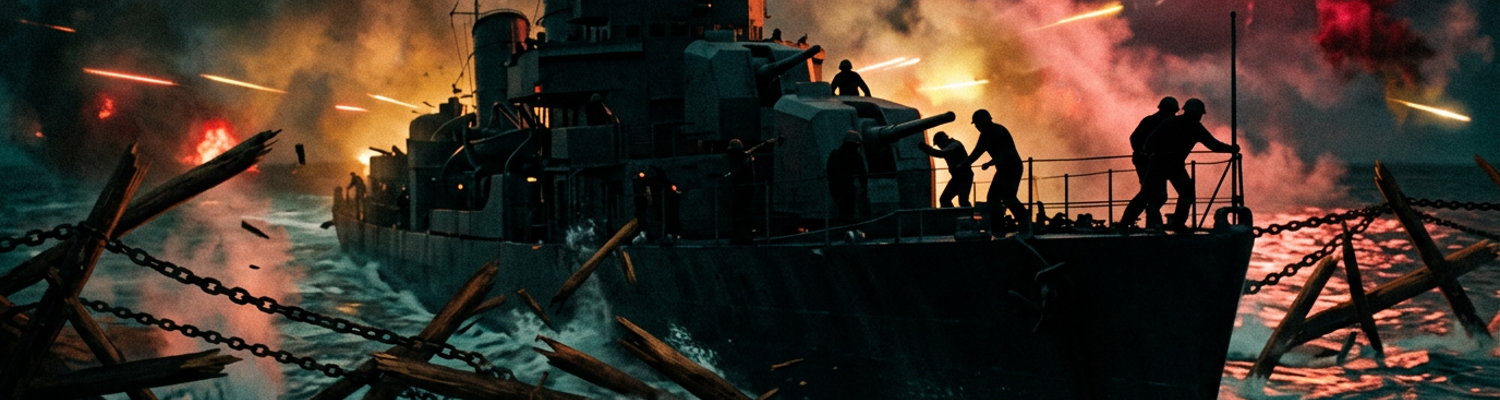

Combat Operations of the Northern Attack Group
Radioman Third Class Thomas Evans adjusted the brass tuning knob on his receiver inside the radio room as the first coded distress calls crackled through his headphones. His fingers scribbled fragmented coordinates onto a paper pad while electrical static hissed over the naval channel. He handed each slip of paper through the small bulkhead slot to the plotting officers on the flag bridge. Heavy Atlantic swells battered the scout boats and transport ships ten miles off the Moroccan shoreline, pitching small craft into deep troughs and throwing landing schedules into disarray. Navigators in the lead Higgins boats lost sight of coastal landmarks after French authorities extinguished the harbor beacons, causing assault waves to drift miles away from their assigned beach sectors. Evans listened as incoming voice transmissions broke up into noise, leaving officers above him to guess where the first American soldiers were touching land.
Charts on the plotting table reflected that confusion as staff officers scrambled to track scattered landing craft in the darkness. Rear Admiral Monroe Kelly commanded Task Group 34.8 aboard the flagship USS Texas off the Moroccan coast on November 8, 1942. His naval staff shared cramped quarters with Army Brigadier General Lucian Truscott and his ground division planners, isolating both leaders inside an armored command space cut off from direct contact with the beaches. Radio transmitters remained shut down under strict operational silence orders to prevent French shore batteries from detecting the American task force before daybreak. That silence forced Kelly to rely on blinker lights from scout vessels and handwritten dispatches brought by small motor launches across choppy water. Every message took over forty minutes to cross the sea from the breaking surf back to the flagship, keeping commanders ignorant of the heavy gunfire pinning down the assault troops on the sand.
Bullets from French machine guns swept the surf and pinned down those landing waves at Mehdia, threatening the entire invasion timetable. General Truscott needed his infantry battalions ashore without delay because the Northern Attack Group carried an urgent mission for the wider African campaign. The primary strategic prize was the all-weather concrete runway at the Port Lyautey airfield, designated for P-40 Warhawk fighter squadrons. Seventy-seven of those American fighters waited on the flight deck of the auxiliary carrier USS Chenango, unable to take off until ground troops captured the field intact and cleared enemy artillery positions from the surrounding hills. Seasonal autumn rainstorms turned dirt airstrips across Morocco into thick mud, making that single concrete strip five miles up the Sebou River the only surface capable of launching and recovering land-based fighter planes.
Steel cables and sunken barges blocked the river channel leading inland toward that airfield, creating an impassable barrier known as the Sebou boom. Kelly studied outdated navigational charts under dimmed red battle lamps while messengers brought news that French 138-millimeter coastal guns at the Kasbah fortress were pounding American beach positions. Heavy surf continued to smash landing boats onto sandbars, destroying portable radios and severing communication between beach masters and headquarters. Kelly and Truscott decided that infantry units advancing over marshy ground could not reach the airfield quickly enough on foot to prevent French forces from blowing up the runway. Kelly issued orders to prepare a specialized naval raiding party on a shallow-draft destroyer to ram the river mouth, cut through the steel barrier, and secure the waterway under direct shellfire.
Landing Craft and Surf Conditions
Destroyer crews aboard the lightened warship could not begin their run toward the Sebou boom until the infantry waves secured the coastline and suppressed the heavy guns overlooking the water. Heavy Atlantic swell exceeding fifteen feet scattered landing craft and delayed assault waves across five designated landing beaches. Massive ocean breakers slammed wooden Higgins craft against hidden offshore sandbars, flipping multiple hulls upside down and pitching heavily burdened soldiers into deep water hundreds of yards short of dry ground. Soldiers weighted down with sixty-pound packs, ammunition bandoliers, and steel helmets fought against the strong undertow to keep their heads above water. Coxswains struggled with sticking rudders and flooded diesel engines in the ocean darkness, but violent currents carried entire boat sections miles to the north and south of their intended touchdown points. Soldiers who survived the violent undertow pulled themselves onto strange sand dunes under steady machine gun fire, separated from their proper companies and lacking their heavy mortar support.
Sand jammed rifle bolts and fouled machine gun tripods as isolated clusters of infantry tried to organize improvised firing positions along the edge of the breakers. Radio sets soaked by saltwater failed, creating an immediate communications blackout between landing parties and offshore command ships. Battalion signalmen tried cranking hand generators and wiping down wet wiring on their SCR-284 field sets, but salt crust and blown vacuum tubes prevented any outgoing signal from reaching the task force. Beachmasters had no way to notify the fleet where individual platoons had touched shore, whether the coastal batteries were under attack, or how many assault craft lay smashed on the sandbars. Company messengers sent inland to locate neighboring units disappeared into the coastal brush under rifle fire, preventing ground officers from coordinating their movements or directing naval gunfire support.
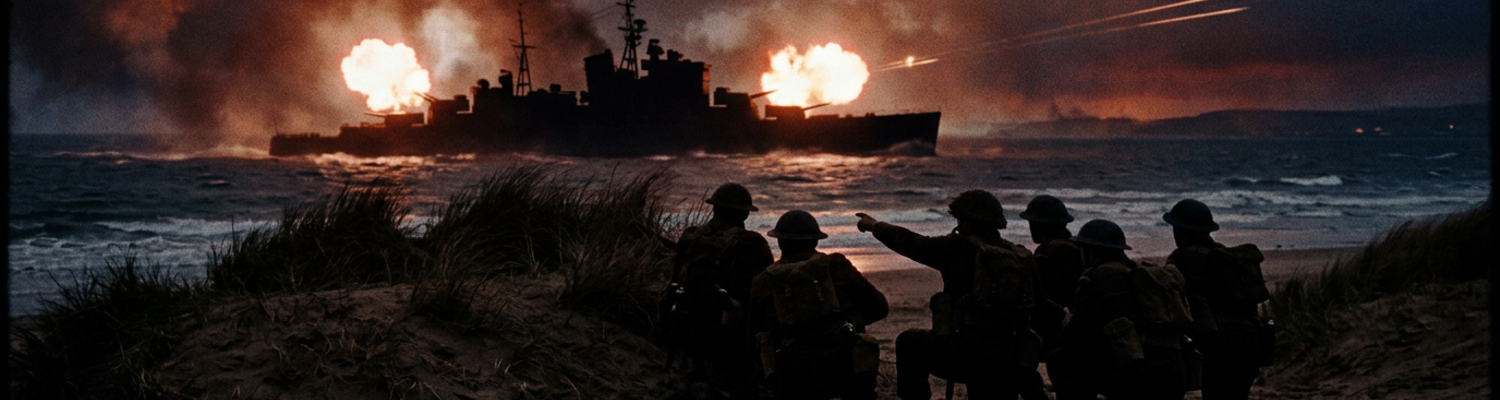
Spotters in the stone observation posts of the Kasbah fortress easily tracked the stranded groups on the open sand and directed rapid 75-millimeter shrapnel salvos onto the beaches. Shrapnel tore through abandoned supply crates and punctured rubber life rafts, pinning the surviving infantry behind low dunes without fresh ammunition or medical supplies. Artillery flashes blooming against the Moroccan bluffs showed the commanders aboard USS Texas that heavy ground combat was underway, but no tactical details pierced the armored isolation of the flag plot. General Lucian Truscott paced the narrow compartment beside Rear Admiral Monroe Kelly while staff officers received blank status forms from the radio shack every fifteen minutes. Outdated coastal maps pinned to the planning table offered no help because the staff had no coordinates for the scattered assault waves or the surviving Higgins boats. Kelly refused to launch the destroyer raid into the narrow Sebou River channel while French coastal batteries continued to fire uninterrupted salvos across the beachhead.
Salvos forced both commanders to make critical tactical decisions without knowing whether American troops controlled any beach exits or if the assault was collapsing. Truscott directed his operations staff to ready an armed scout boat to cross the heavy surf line directly so a staff officer could walk the sand on foot and bring back verified operational reports to the flagship. Coxswains lowered the thirty-six-foot scout boat into the surging Atlantic swells beside the armored hull of USS Texas, but violent breakers swamped the craft and stalled the courier mission before it could reach the shore. Offshore flag officers aboard USS Texas operated in near-total informational isolation, relying on vague visual signals and conflicting fragmentary reports from scattered vessels across the horizon. Lookout binoculars swung constantly across the dark coastline, yet watchstanders deciphered only brief flashes of colored signal lamps that contradicted reports arriving over damaged radio channels. Red blinker flashes from one coastal scout suggested that assault troops held the high ground north of the river, while a green flare from a Navy patrol craft indicated that the beaches were under heavy counterattack.
Command Isolation and Kasbah Artillery
Admiral Monroe Kelly and General Lucian Truscott stood over blank plotting boards in the flag plot, unable to verify where their frontline troops had stalled or whether the assault battalions still possessed heavy weapons. Messengers sprinted between the radio shack and the bridge carrying contradictory scraps of paper, while the two commanders remained confined inside their armored compartment without clear information about the fighting on shore. Riflemen from the 60th Infantry Regiment endured the deadly fire of that unseen battle as they crawled across the damp dunes below the Sebou River bluffs. Vichy French forces inside the seventeenth-century Kasbah fortress directed heavy 75-millimeter artillery and machine gun fire against advancing infantry battalions as the Americans struggled across open marshland. Ancient stone battlements and thick masonry walls provided the French defenders with elevated firing platforms overlooking every natural approach along the river bluffs. French spotters on the fortress parapets easily sighted their rapid-firing field guns onto the exposed gullies, detonating air-burst shrapnel rounds directly over the shallow rifle pits American soldiers had scooped out by hand.
Machine guns hidden in the masonry embrasures poured crossfire across the barbed-wire barriers guarding the lower slopes, cutting down platoon leaders and destroying hand-carried field telephones. Shrapnel and bullets shredded radio antennas and killed company runners, completely stopping the forward battalions from sending coordinates back to the naval guns offshore. Officers aboard USS Texas kept their fourteen-inch gun turrets trained on the horizon but refused to pull the firing triggers without confirmed coordinates from those silenced ground units. Rear Admiral Kelly knew that a single misdirected heavy naval shell could hit friendly infantry companies clustered on the slopes below the stone battlements. General Truscott paced the flag plot and refused to let his staff guess at artillery targets, demanding visual confirmation of the French positions even as fragmentary messages claimed that enemy cavalry and armored cars were counterattacking toward the beachhead. Intelligence staff plotted contradictory grease-pencil marks across the plastic map overlays, erasing and redrawing troop boundaries whenever lookouts spotted a new smoke column rising from the distant hills.
Smoke from the burning landing craft delayed the operational timetable, leaving the seventy-seven P-40 fighters on USS Chenango idle on their flight deck while French artillery continued to pound the landing zones below. Truscott refused to accept that tactical delay while French shells detonated across his assault waves on the beaches. Staff officers immediately radioed the light cruiser USS Savannah to catapult Curtiss Seagull observation floatplanes into the sky to locate the hidden French batteries. Naval aviators flew low through bursts of antiaircraft fire directly over the stone battlements, finally radioing accurate grid coordinates of the French 75-millimeter guns back to the fleet. Those incoming flight reports confirmed that the pinned-down infantry battalions could not storm the Kasbah fortress from the beaches without an immediate breakthrough along the river itself. Kelly summoned the commander of the naval raiding detachment to the flag bridge, ordering his team to finalize their assault plans for breaching the boom across the Sebou channel.
Demolition Preparations at the River Mouth
Lieutenant Mark Starkweather assembled an improvised naval combat demolition unit from Navy and Army volunteer personnel after stepping into the glare of the battle lamps on the flag bridge. Kelly needed a specialized squad capable of breaching the river obstruction by stealth, forcing Starkweather to recruit combat engineers from shore parties and seasoned seamen from transport crews within mere hours. Staff officers aboard USS Texas could provide no clear intelligence regarding the construction of the boom, handing Starkweather only prewar river sketches that omitted water depths and current speeds. Command isolation deepened as radio traffic from the shore remained silent, leaving the raiding team to organize their mission entirely on guesswork and makeshift equipment. Starkweather gathered demolition specialists, mechanical tools, and field rations on the wet decks of the transport fleet, preparing his men to breach the fortified waterway without direct artillery support.
Boatswains swung the landing craft over the side into the dark ocean swells as the unit deployed in an exposed Higgins boat equipped with heavy cable cutters and explosive charges to breach the river mouth barrier. Plywood hull plating offered no real ballistic protection against fortress artillery or machine guns, leaving the volunteers exposed as they arranged heavy manual shears, hacksaws, and waterproofed demolition blocks across the deck boards. Saltwater spray drenched the crew and coated the cutting tools as the coxswain navigated through fifteen-foot Atlantic breakers toward the submerged sandbars guarding the Sebou River entrance. Starkweather checked the primer cords and friction igniters by touch in the total darkness, knowing that a single damp detonator would doom their attempt to clear a passage for the following warship. French searchlights from the Kasbah fortress swept the ocean horizon north of their position, forcing the crew to throttle their diesel engine to a low hum and slip unseen into the mouth of the river.
Kelly monitored the empty dispatch boards inside the flag plot of USS Texas, completely cut off from the small boat as it crossed into enemy-held waters. Stifling heat, stale cigarette smoke, and nervous silence filled the armored compartment where senior commanders waited for operational updates that never arrived. General Truscott paced between the charting tables, unable to determine whether the demolition party had made landfall, whether French gunners had sunk the craft, or whether American infantry had taken the fortress bluffs. Radio silence protected the raiding boat from direction-finders along the coast, but it locked the task force command inside an agonizing information vacuum where every strategic calculation had to be made blind. Flag officers debated whether to send the old destroyer USS Dallas forward on schedule or hold the warship in deep water, knowing that driving an unarmored ship into a blocked channel would result in catastrophe if the barrier remained intact.
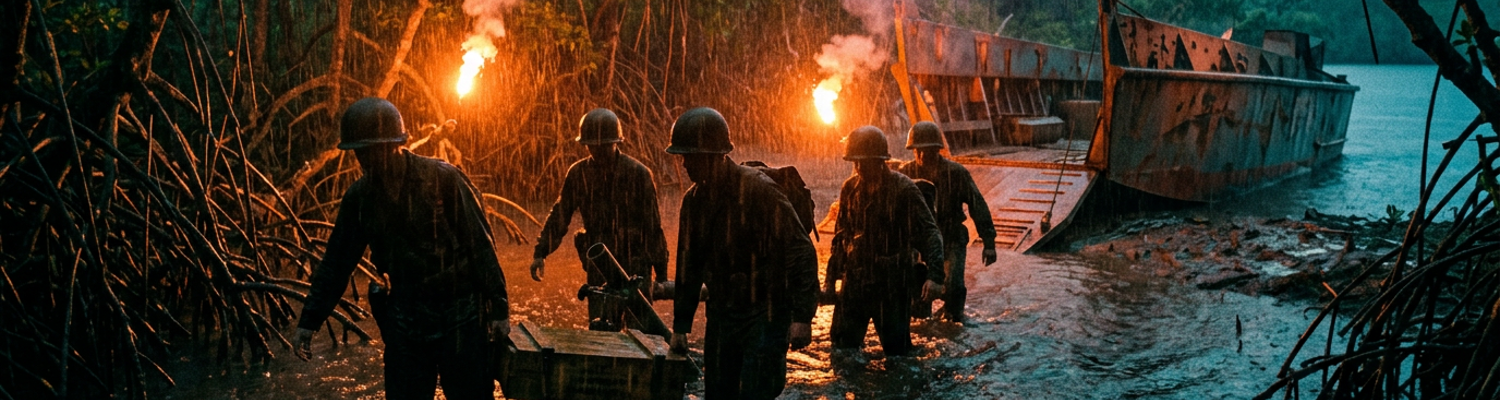
Steel cables stretched between anchored buoys and sunken river barges loomed out of the gloom as the Higgins boat nudged against the floating Sebou barrier. Engineers leaned over the wooden bow with heavy mechanical cutters, gripping the thick wire rope and putting their entire weight onto the long tool handles to shear the braided strands. Volunteers lashed packs of high explosives to the submerged anchor chains and set waterproof delay fuses, working with bare hands in the freezing current while water slapped against the hull. Cutter jaws sliced through the heavy tension lines with sharp metallic snaps, allowing the severed halves of the main hawser to recoil and sink beneath the river surface. French sentries along the stone parapets of the Kasbah suddenly opened fire with rifles and machine guns, kicking up water geysers around the wooden Higgins boat as Starkweather ordered his coxswain to pull away into the dark channel.
Execution of the Sebou Boom Breach
Bullets punctured the wooden hull below the waterline, but the lieutenant countermanded his retreat when he saw that the main cable obstruction remained uncleared. French coastal batteries and snipers focused fire on the wooden craft as crewmen manually cut through the heavy steel cable and net boom. Two volunteer seamen balanced on the slippery bow with three-foot hand shears, bracing their bodies against the river current while chopping away the thick wire mesh strand by strand. Splintered oak flew from the gunwales and shrapnel tore through the equipment bags while the engine mechanic worked in the bilge to patch leaks with wooden plugs and grease-soaked rags. Heavy anchor chains still held the central boom buoys to sunken barges beneath the surface, resisting the mechanical cutters and holding the barrier rigid across the channel. Starkweather hauled waterproof demolition packs onto the forward deck and ordered his demolition specialist to prime the pressure fuses.
Starkweather clamped the explosive blocks directly onto the submerged steel couplings before diving flat into the bilge with his crew. Demolition charges successfully severed the remaining barrier links under point-blank fire, opening a narrow channel into the Sebou River estuary. Columns of black mud and severed metal collapsed back into the churning river, revealing a passage barely wide enough for a single warship to squeeze through. Starkweather raised his signal lamp toward the river entrance, but heavy French rifle fire shattered the glass lens before the crew could transmit the clearance code. Saltwater flooded the portable radio transmitter on the engine housing, leaving the raiding team with no working equipment to contact the waiting task force offshore. Starkweather steered his riddled craft toward the northern riverbank to seek cover among the reeds while the coastal guns continued their steady bombardment.
Kelly stared at the silent plotting board inside the flag plot of USS Texas, completely unaware that the river boom had been breached. Staff officers clustered around the tactical map in the stifling heat of the armored compartment, unable to confirm whether Starkweather had succeeded or died under the guns of the Kasbah. Thick steel bulkheads blocked out the Atlantic wind but trapped the bitter smell of burning paper and stale sweat as the hours slipped past the planned invasion timetable. General Lucian Truscott demanded immediate answers from the communications team, yet radiomen could intercept only French distress signals and fragmented static from the Moroccan shore. Kelly knew that committing an unarmored four-stack destroyer into the narrow estuary without guaranteed river clearance would invite the total destruction of the vessel. Staff navigators updated the tide charts under the red battle lamps, calculating that falling water levels over the river bar would soon trap the entire naval assault outside the harbor.
Truscott broke the agonizing silence in the plotting room by insisting that the task force could wait no longer for visual confirmation from the scout party. Kelly concurred with the ground commander and released an encrypted signal authorizing USS Dallas to begin her run toward the river mouth under the cover of offshore naval guns. Blinker lamps flashed the attack order through the predawn haze to the old destroyer, directing Lieutenant Commander Robert Brodie to ram any remaining river obstructions. Brodie ordered his engineering crews to build maximum steam pressure in the boilers while René Malavergne, a civilian French harbor pilot who supported the Allies, took the helm to navigate the treacherous sandbars. Texas swung her massive fourteen-inch gun turrets toward the Kasbah to bombard the French artillery positions that still dominated the entrance. Sailors aboard the speeding destroyer watched the distant shoreline erupt with shell explosions as their vessel surged forward toward the newly opened gap in the Sebou estuary.
River Shoals and Estuary Navigation
Spray from breaking ocean swells doused the open bridge of USS Dallas as Lieutenant Commander Robert Brodie checked the helm indicators beside René Malavergne. Escaped French civilian pilot René Malavergne boarded the flush-deck destroyer USS Dallas to serve as primary navigational pilot across treacherous sandbars. Malavergne knew every hidden shelf of silt because he had guided commercial cargo vessels through the Sebou estuary for years before his arrest and escape from Vichy authorities. His eyes scanned the brown surf line where shifting river shoals constantly reshaped the navigable passage beneath the water. Brodie relied on the local pilot because standard naval charts gave no warning about the dynamic sand ridges that accumulated across the river entrance after autumn storms. Sounding leads plunged into the churning surf as seamen called out diminishing depth readings from the forward deck, warning of the shallow shoals ahead.
USS Dallas stripped off topweight gear, munitions, and non-essential fuel to reduce draft for navigating the shallow Sebou bar at high tide. Shipyard crews and sailors dismantled the heavy torpedo mounts, searchlights, spare anchors, and boat davits of the vessel prior to the assault. Engineers pumped out boiler reserve tanks and drained tons of fuel oil, leaving only the bare minimum needed for the sprint into the estuary. Artillerymen lowered crates of naval ammunition and depth charges into transport hulls offshore to lighten the old destroyer by several critical inches. These structural alterations reduced the ship draft from over thirteen feet down to barely nine feet, matching the predicted depth of the cresting ocean swell. Massive Atlantic breakers lifted the lightened hull upward, then dropped the keel toward the hidden sandbar with a violent impact.
Rudder commands passed down the voice pipes as Malavergne signaled the helmsman to steer toward the turbulent water over the submerged bar. Malavergne watched the movement of the coastal undertow, identifying the narrow channel through slight shifts in the color of the river current. Mud scraped against the steel bottom plates with a grinding vibration that shook the entire hull from stem to stern. Twin propeller screws churned through thick silt, throwing clouds of gray mud to the surface as the warship pushed past the resistance of the sandbar. Brodie maintained forward speed until the destroyer cleared the barrier bar and entered the deeper river channel leading inland. French riflemen on the bluffs above immediately opened fire, striking the bridge shields with copper-jacketed bullets as Dallas steadied her course.
Smoke from those coastal rifle flashes drifted out to sea, obscuring the river mouth from Admiral Monroe Kelly and the command staff aboard USS Texas. Kelly and General Lucian Truscott stood over silent status boards, isolated from operational news as the high tide began to recede. Neither commander knew whether the stripped destroyer was moving through the river channel or stuck hard aground under French artillery. Radiomen monitored silent radio channels in the hot compartment, passing blank paper pads between plotting officers while the staff waited for verified messages. Kelly refused to divert naval gunfire support without exact target coordinates, fearing that unspotted naval shells would hit Dallas in the confined waterway. Truscott checked his pocket watch against the invasion timeline, calculating the remaining minutes of daylight before the assault on the airfield collapsed.
Destroyer Dash and Airfield Capture
Lieutenant Commander Robert J. Brodie Jr. forced USS Dallas through the severed boom and ten miles up the winding Sebou River under hostile fire to prevent the airfield assault from collapsing. Steel cable fragments dragged against the hull of the destroyer as the ship shoved past the shattered floats and entered the brown river water. French riflemen and machine gunners concealed in the shoreline brush immediately fired on the exposed bridge, chipping paint and denting the armor shields around the crew. Sailors on Dallas answered with their three-inch deck guns and heavy machine guns, firing directly into the reeds along the banks while Malavergne guided the helmsman through the shallow channel. Artillery shells from French 75-millimeter batteries on the bluffs threw mud and water over the decks as the warship pushed steadily against the river current.
River bends grew tighter and shallower as the warship advanced farther inland against the heavy current. Malavergne watched the color of the muddy water from the open bridge, calling out rudder orders to keep the ship from running hard aground on shifting sandbars. Bullets repeatedly struck the bridge and deckhouses, wounding several sailors but failing to slow the forward progress of the ship. Silt sucked into the engine condenser intakes threatened to overheat the machinery, forcing boiler crews to adjust pumps and clear strainers in the stifling heat below decks. French soldiers on the bluffs fired down on the decks with rifles and automatic weapons, but Dallas maintained its speed through the narrow waterway. Dense riverbanks and rising hills soon hid the fighting destroyer from the view of the Atlantic task force waiting miles behind.
Admiral Monroe Kelly waited beside the plotting board in the flag plot of USS Texas, completely unable to see the river fighting through the coastal haze. General Lucian Truscott stood next to him in the hot, unventilated compartment while communications staff passed along blank report sheets from the radio room. Thick armor walls kept the commanders safe from enemy fire, but the lack of radio signals isolated them from their assault forces at the most critical moment of the invasion. Kelly refused to order naval artillery strikes or air attacks near the river because unspotted explosions could easily destroy Dallas instead of the French gun positions. Staff officers updated the tide charts under dim red lamps, knowing that falling water would soon trap the ship if it ran aground. Radio receivers produced only loud static, leaving the senior leaders to wait in silence while the invasion timetable depended entirely on a ship they could not contact.
Dallas bypassed a scuttled vessel before debarking Company K of the 60th Infantry Regiment directly onto the Port Lyautey airfield perimeter, achieving the breakthrough the flagship could not see. Brodie spotted the sunken obstruction lying directly across the channel and squeezed his ship through a narrow gap between the rusted hull and the muddy shore with only inches of clearance. Enemy machine guns opened fire from nearby trenches as the destroyer cleared the wreck and reached the river bend bordering the airfield. Brodie ordered the helmsman to drive the bow of Dallas straight into the soft riverbank, grounding the warship firmly beneath the runway embankments. Soldiers of Company K scrambled over the railings, dropped into the mud, and charged across the open ground to assault French defensive positions. American infantry rapidly cleared the runway and eliminated the remaining snipers, securing the strategic airfield intact for incoming Allied fighter squadrons.