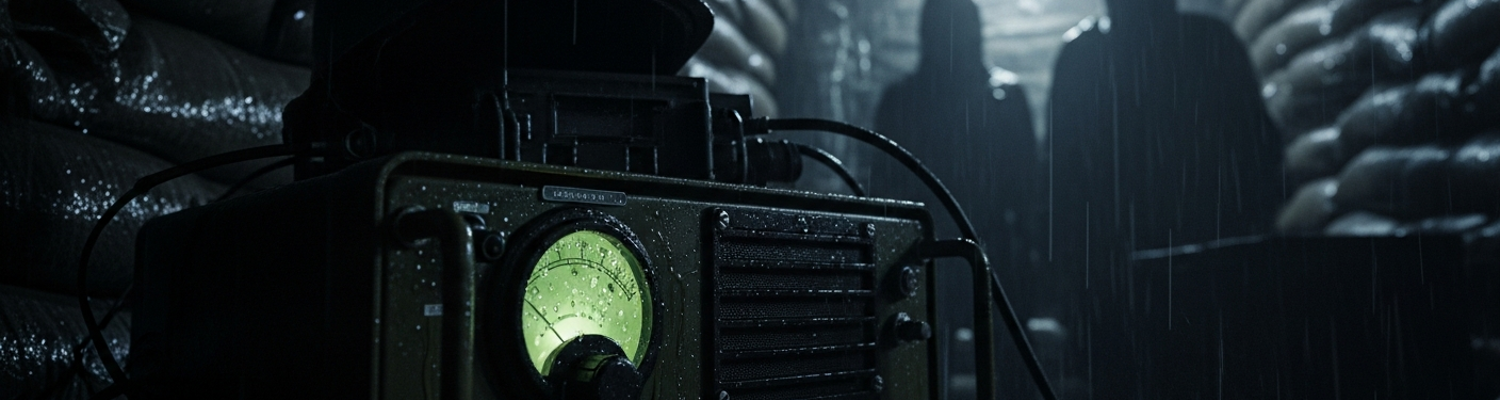

AN/GRC-106 Radio Failure Incident
Operational logs pinpoint the moment of systems failure. 19:40 hours, February 15, 1967. Fire Support Base Gold, a circle of red earth and sandbags carved into the jungle of War Zone C during Operation Junction City. The base existed for one reason: the 18 howitzers of the 2nd Battalion, 77th Artillery, and their ability to deliver fire support. This function depended entirely on a single piece of equipment. The AN/GRC-106 radio set was the high-frequency link connecting the battery to the 1st Field Artillery’s command post. When it died, the fire base was not merely hindered. It was deaf.
The AN/GRC-106 was the heavyweight of tactical HF communications. It was a modular system, a receiver-exciter (RT-662/GRC) paired with a powerful 400-watt linear amplifier, the AM-3349/GRC. Weighing over 50 kilograms, the set was a hybrid of solid-state components and vacuum tubes, specifically the two 4CX350A final amplifier tubes that gave it immense range. This power pushed voice or encrypted teletype signals over hundreds of miles, connecting remote outposts like Gold to rear-echelon command. The performance came at a cost. The system drew up to 60 amps at 27 volts DC during transmission, a massive load on generators already struggling in the climate. Its complexity, with motor-driven turret tuners and a sensitive high-voltage power supply, presented numerous points of failure.
The failure itself was audible. A high-pitched mechanical shriek from the communications bunker, then complete silence. The sound was characteristic of a catastrophic seizure within the AM-3349 power amplifier. Its internal servo-driven turret, a complex device that physically rotated coil elements to tune the frequency, had frozen solid. Radio operators, attempting to re-establish contact, found the amplifier inert. The load and tune meters were dead. A check of the inverter unit, which converted the 27V DC input to the high voltages required by the tubes, would have shown a complete shutdown. In the heat and humidity of a Vietnamese February, such failures were a known vulnerability. High current draw could overheat switching transistors, while the delicate mechanical tuners were susceptible to moisture and grit.
With the AN/GRC-106 offline, the primary channel for requesting fire missions was gone. Operators fell back to secondary systems. The shorter-range FM radios, like the AN/PRC-25, could not reach the main command post. This left the firebase dangerously exposed, reliant on scheduled resupply flights or runners to carry messages. Both were slow, unreliable methods in a fluid combat zone. The incident on February 15th demonstrated the fragility of the technological tether connecting these outposts to the larger war. While radio operators worked to bypass the failed amplifier, the guns of Fire Support Base Gold fell silent. Not for a lack of ammunition, but for the want of a signal.
Forward Observer Link Severed
The failure of the AN/GRC-106 did more than cut off headquarters. It blinded the guns by disrupting the chain connecting them to their forward observers. These FOs, often a lone officer and his radio operator embedded with infantry, were the eyes of the artillery. They operated deep in the field, carrying the AN/PRC-25 FM radio, a compass, and topographical maps. Their job was to identify enemy positions, translate them into grid coordinates, and send those coordinates to the Fire Direction Center at the fire base. The FDC would then plot the coordinates, calculate the trajectory, and relay firing commands to the gun crews. It was a closed loop, a direct conversation between the observer and the howitzers.
The AN/GRC-106 failure shattered that loop. FOs could still talk to the FDC at Gold on their short-range FM radios, but the FDC was now paralyzed. Many fire missions, especially those near friendly patrols, required clearance from battalion or 1st Field Artillery Group headquarters. That clearance was requested and granted via the now-inoperable high-frequency radio. Calls for fire still came in, but the FDC could not act without authorization. The FO reports became a series of desperate but unusable data points.
This communications breakdown left the fire base exposed during a developing counter-battery exchange. Operational logs show that at approximately 20:15 hours, 35 minutes after the GRC-106 went dead, NVA mortar teams began a coordinated barrage. Their targets were not the fire base, but the infantry patrols the FOs were with. It was a classic tactic designed to draw out and pinpoint American artillery positions. The crackle of the PRC-25 filled the FDC bunker as multiple observers called in fire missions, reporting the direction of enemy mortar flashes. Normally, this would have initiated a swift counter-battery response. The FDC would triangulate the reports, the 105mm and 155mm howitzers of the 2nd Battalion, 77th Artillery would shift their aim, and a storm of high explosives would descend on the enemy.
But the guns remained cold. The FDC personnel could only listen as calls from the field grew more urgent. They logged the requests and plotted the coordinates on acetate-covered maps, but no firing commands could be given. The risk of hitting their own maneuvering infantry units, whose precise locations were coordinated through the same severed command link, was too great. The artillerymen, trained to dominate the battlefield from miles away, were forced into inaction. They became spectators to a battle they were supposed to control, their howitzers standing silent while their comrades were systematically targeted. The enemy mortar teams, typically using 82mm weapons, were skilled at rapid displacement tactics. They could set up, fire a few rounds, and move before counter-battery fire could locate them. Defeating them required speed. An observer's report had to be acted upon within minutes. With the authorization link broken, that window was closed. The NVA crews, realizing they were receiving no return fire, grew bolder. The volume and accuracy of their barrage increased. For the FOs and the infantry they supported, the experience was terrifying. They could hear the distinct report of the mortar tubes, followed by the whistle of incoming rounds, knowing the artillery they relied on was deaf to their pleas.
Psychological Erosion and Artillerymen Morale
The decay of morale within Fire Support Base Gold was not a simple function of fear. It was a breakdown of purpose. For the artillerymen of the 2nd Battalion, 77th Artillery, their primary psychological defense was their function. They were masters of indirect fire, capable of projecting force across miles of terrain. This capability provided a sense of control, an offensive power that mitigated the vulnerability of their fixed position. The failure of the AN/GRC-106 stripped this away.
A post-action review describes the Fire Direction Center as a pressure cooker of impotent rage. The specialized teams, trained to translate radio calls into precise firing data, were forced to listen as the voices of forward observers grew increasingly desperate. They continued to plot enemy mortar positions on their maps, creating a perfect, unusable picture of the battle. In the gun pits, the crews sat beside their howitzers, each 105mm shell a useless icon of firepower. They could hear the enemy’s outgoing mortar thumps, a sound soon followed by the panicked radio traffic from the infantry patrols taking hits. This combination of auditory helplessness, hearing both the attacker and the friendly casualties with no ability to intervene, created an acute form of psychological distress. The artillerymen became spectators to the suffering of the troops they were sworn to protect.
Their fortified base had become a prison of inaction.
This sense of isolation was magnified by the failure of even spiritual support to penetrate the electronic void. At the 1st Field Artillery’s main command post, logs note a formal request by the brigade chaplain to establish a radio link with the men at FSB Gold. The chaplain, a captain who had visited the fire base weeks before, understood the strain the men were under. He intended to offer a simple message of reassurance via the high-frequency channel, a common practice to bolster morale. He wanted to let them know they were not forgotten. The communications officer denied the request for technical reasons. The AN/GRC-106 was the only system with the required range, and it was non-functional. The FM networks were strictly line-of-sight. There was no other path. This seemingly minor decision had a profound impact. The inability of the chaplain, a figure representing a connection to a moral order beyond the immediate chaos, to even have his voice heard became a powerful symbol of their abandonment. It confirmed the technological failure was absolute.
Within hours, the initial frustration curdled into despair. The tactical situation fed this decline. The NVA mortar teams, no longer facing the threat of immediate counter-battery fire, became more systematic in their attacks. Their accuracy improved. To the men at FSB Gold, this was not just an escalation of enemy aggression; it was proof that the enemy knew they were isolated. This perception amplified the feeling of being forsaken by their own command. Rumors swept through the gun pits and bunkers, speculating that a larger offensive was underway and that FSB Gold had been deemed expendable. Every unanswered call from the forward observers, every incoming enemy round that landed without a response, reinforced a singular conclusion. They had been left to die.
The Role of Communications in Combat Morale
For an artillery unit, the relationship between communication and morale is absolute. The gun crews and Fire Direction Center personnel of a fire support base derive their entire sense of purpose from the ability to receive targeting data and project force. This function is their primary psychological armor. A close examination of the events at Fire Support Base Gold demonstrates that the constant flow of information, from fire missions to routine status checks, creates a feedback loop of effectiveness and control. The men in the FDC plotting coordinates and the crews serving the howitzers are active participants in the battle, shaping its outcome from a distance. Their morale is directly proportional to their perceived impact.
The sound of their own side had vanished.
The failure of the AN/GRC-106 severed this connection, fundamentally altering the psychological state of every soldier at the base. The impact of losing communications during an enemy attack is not a passive void. It is an active presence. The familiar cadence of radio traffic, the calm voices of observers, the clipped commands of the FDC, was replaced by two sounds: the thump of outgoing enemy mortar rounds and the silence on their own command frequencies. This sensory shift inverted their role from predator to prey. Archival analysis of similar events (per doctrine outlined in FM 6-20) confirms that soldiers in such a position feel a unique form of helplessness. They possess the machinery of great power, yet are rendered impotent. The NVA mortar teams, emboldened by the lack of counter-battery fire, grew more accurate. This served as direct, audible confirmation to the men at FSB Gold that the enemy knew they were alone. The artillerymen were no longer controllers of the battlefield. They were occupants of a target area.
This isolation was not merely tactical; it was existential. The high-frequency radio was more than a tool for fire missions; it was the tether to the entire military structure, an entity that provides soldiers with a sense of belonging to a larger plan. The radio carries the commander’s intent and the implicit promise that the unit is part of a coherent effort. When that link goes dead, the unit becomes an organizational orphan. The incident with the brigade chaplain is a significant indicator of this phenomenon. The technical inability to transmit a simple message of support confirmed that no echelon of command could reach them. It validated the darkest rumors circulating through the bunkers. The psychological breakdown was sequential. First, the loss of tactical function created impotence. Second, the loss of command contact created a sense of abandonment. The men in the FDC who continued to log the useless fire requests from the field were performing a ritual of a purpose that no longer existed.
Logistical Strain and Maintenance Crews
A review of supply chain records from 1966 and 1967 reveals a system already under deep strain before Operation Junction City began. The pipeline for electronic components was long, stretching from depots in the United States to hubs at Long Binh or Cam Ranh Bay, and from there to the signal battalions responsible for corps-level support. For the technicians of the 2nd Signal Group, supporting the 1st Field Artillery meant a constant battle for specific, high-failure parts for radios like the AN/GRC-106. Items like the 4CX250A vacuum tubes, high-voltage capacitors, and the delicate servo motors for the turret tuners were not high-volume issue parts like ammunition. A request for these components entered a complex priority system where they competed with every other need in-theater. The humid, gritty environment of a place like Fire Support Base Gold drastically shortened the lifespan of these components. Demand consistently outpaced supply.
Cannibalization became standard procedure.
The men tasked with keeping communications gear online were the signal maintenance specialists, often attached to units like the 36th Signal Battalion. A review of their operational tempo paints a grim picture. Working in poorly lit, humid tents or cramped bunkers, these technicians faced a mountain of deadlined equipment. Repair backlogs were measured in weeks. A crew might work 16-hour shifts trying to clear a backlog that included vehicle radios, man-portable AN/PRC-25s, and the far more complex high-frequency sets. The AN/GRC-106, due to its operational importance, was always a high-priority job, but it was also the most technically demanding. The pressure to return gear to the field, combined with the shortage of new replacement parts, forced these technicians to become masters of improvisation. They developed a closed-loop system by necessity, stripping working components from one damaged radio to resurrect another.
The backlog guaranteed that no repair was ever final.
The specific AN/GRC-106 that failed at Fire Support Base Gold was a direct product of this broken system. It was not a new radio. It was a repaired unit rushed back into service. The audible mechanical noise reported by the operators points to a seizure of the servo-driven turret inside the AM-3349 amplifier. This was a predictable point of failure. A maintenance crew at a rear depot, lacking a new replacement motor, would have salvaged a motor from another amplifier, one that was likely already worn. An overworked technician, racing against time, might have performed a hasty alignment or failed to use the correct lubricant needed to protect the delicate gears from the fine red dust of War Zone C. The inverter, which supplied high voltage for the power tubes, was another known vulnerability. Its transistors were prone to overheating, and a replacement pulled from the strained supply system may have been of a slightly lower tolerance. The radio sent to FSB Gold was a time bomb, its failure preordained by compromises made weeks or months earlier by men working under impossible conditions.
Combat Effectiveness and Stress Incidents
The communications blackout at Fire Support Base Gold directly precipitated a delay in reinforcing the position on the night of February 21, 1967. After hours of sustained mortar attacks and the failure to re-establish a high-frequency link, the fire base commander requested ground reinforcement. The message was sent via an AN/PRC-25 from a precarious relay position on the western perimeter, a low-power signal barely received by a passing aerial reconnaissance flight. The request was for a mechanized infantry company from the 1st Infantry Division, located at a forward operating base nearly 15 kilometers away, to push through and relieve the pressure on Gold. Under normal conditions, with the artillery at Gold fully functional, this would have been a coordinated action. The howitzers would have provided a moving box barrage, a wall of high explosives advancing just ahead of the friendly armor to suppress potential ambushes.
The guns were silent.
Command authorities at 1st Field Artillery headquarters faced a difficult choice. Sending the mechanized company without fire support into an area with high enemy activity was a significant risk. The decision was made to wait for dawn, allowing for air cover from F-100 Super Sabres to scout the route. This meant a six-hour delay. For the men at FSB Gold, those six hours were an eternity of isolation, punctuated by the steady, unanswered impacts of NVA mortar rounds. The reinforcing column from the 2nd Battalion, 22nd Mechanized Infantry finally broke through just after 06:00. By then, the psychological damage was done. The delay was a direct consequence of a single technical failure cascading into operational paralysis.
A review of after-action reports and unit logs from late February 1967 shows a quantifiable decline in the combat effectiveness of the artillerymen. The core metric for an artillery battalion is its fire mission response time. Before the crisis, the 2nd Battalion, 77th Artillery maintained an average response time of under four minutes. In the two weeks following the incident, that average degraded to over twelve minutes for routine missions. The reasons were twofold. First, the FDC crews, having been forced into impotence for a prolonged period, developed a procedural hesitancy. There was a documented loss of confidence in their equipment and the command network. Second, the gun crews themselves showed signs of what was then called combat fatigue. Maintenance logs show an increase in minor equipment malfunctions on the howitzers, issues attributed not to battle damage but to lapses in routine care by demoralized crews. This degradation had a tactical cost. The NVA mortar teams, sensing a slower reaction from American artillery across the area of operations, became more daring in their attacks on infantry patrols.
This was a force losing its edge.
The most severe indicator of the crisis was the sharp increase in self-reported combat stress incidents. Personnel records for the 1st Field Artillery Group (NARA Record Group 112) document a near 200 percent spike in soldiers requesting psychological consultation compared to the previous 90-day period. A disproportionate number of these requests came from men stationed at Fire Support Base Gold. Medical notes describe men suffering from acute anxiety, insomnia, and an overwhelming sense of guilt. The primary traumatic stressor was not direct enemy fire, but the experience of listening to the desperate radio calls of forward observers and infantry units taking casualties while being unable to provide the fire support that was their entire reason for being. This feeling of helplessness, of being failed by their own technology and command structure, was more corrosive than the fear of incoming shells. The chaplain’s official report for the period noted a deep-seated anger among the artillerymen, a belief that they had been written off. The decline in combat effectiveness and the surge in stress incidents were not separate issues; they were a direct chain of cause and effect, initiated by the failure of a single radio and the crushing silence that followed.