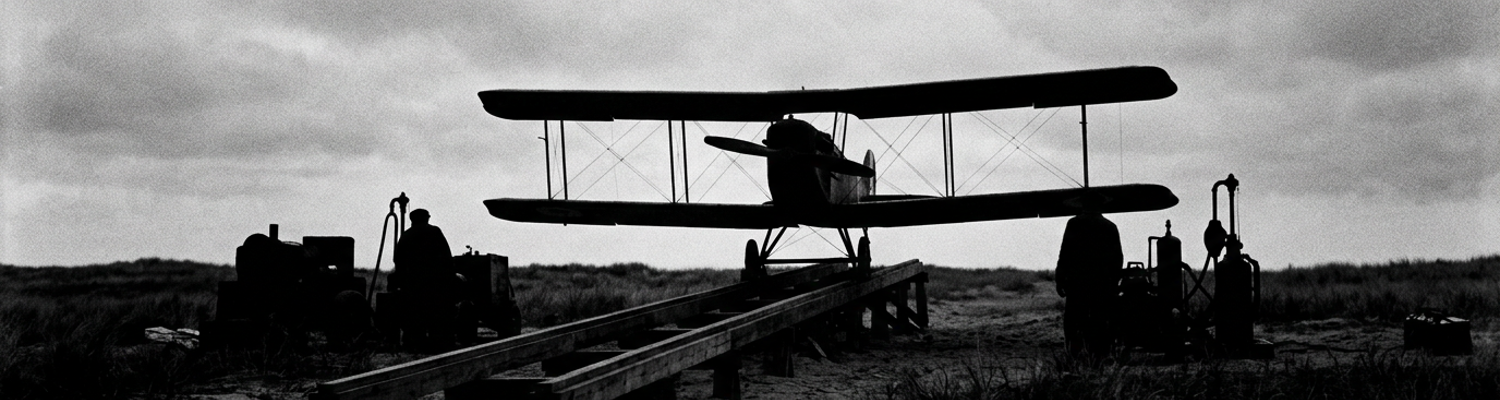

Post-Armistice Cancellation of the Kettering Bug
At an isolated sandy airstrip near Carlstrom Field, Florida, an army technician in grease-caked dungarees knelt beside a track-mounted launch dolly. He carefully tightened a brass retaining nut on an eight-inch pneumatic gyroscope. His spanner slipped twice against the stripped threading of the cast-aluminum casing. The rubber vacuum line finally seated against the intake valve. Beside him, an instrument officer checked the mechanical gear teeth on an automatic revolution counter. This counter was calibrated to cut the ignition circuit after a specific number of flight revolutions. Seconds later, the forty-horsepower De Palma engine ran at full throttle. The four-cylinder power plant rattled the wooden airframe. The craft surged down a sixty-foot wooden trestle into a stiff Atlantic headwind.
It did not climb into level cruise toward the designated offshore grid.
The wood-and-papier-mâché biplane pitched forty-five degrees to port. It skipped across a scrub oak thicket. The airframe overturned in the dirt. Dry-cell batteries and ripped linen scattered across the sand.
Not a single Dayton-Wright aerial torpedo ever saw operational combat service.
War Department procurement records reveal the financial scope of the secret Dayton-Wright aerial torpedo project. The program consumed more than two hundred and seventy-five thousand dollars in direct wartime appropriations. Substantial auxiliary funding was drawn from Army Ordnance accounts (NARA Record Group 338). Charles Kettering and the Dayton-Wright Airplane Company had promised a low-cost pilotless craft. They claimed it would deliver a hundred and eighty pounds of high explosive deep behind enemy lines. The projected range exceeded fifty miles. Assembly facilities in Dayton fabricated fuselages out of laminated wood framing and pressed paper. Subcontracted workshops machined intricate pneumatic gyroscopes designed by Elmer Sperry.
War Department officials originally ordered hundreds of units in anticipation of the 1919 spring offensives on the Western Front.
The signing of the Armistice on November 11, 1918, permanently halted shipping schedules. Not a single operational squadron stood up in France. Subsequent post-war accounting revealed hidden operational expenses. The munition required specialized launching rails. It required portable air compressors. It required trained mechanical teams. These requirements erased all projected cost savings. Formal cancellation directives issued by the War Department in early 1920 terminated funding. Remaining prototypes were locked in McCook Field hangars.
Archival evidence shows that weapon accuracy degraded with every mile flown away from the launch rails.
A close review of operational logs indicates that post-war tactical review boards viewed the munition as a threat to friendly forces. The vehicle lacked inflight radio telemetry. It lacked a command-guidance link. The craft depended entirely on crude mechanical dead reckoning. An internal reduction gear counted propeller revolutions to measure elapsed distance. This mechanism activated a trip cam. The cam cut the engine ignition and popped the wing-attachment pins. The fuselage then dropped straight down onto the calculated target coordinates.
Changing barometric pressure routinely jammed the bellows regulating altitude.
Sudden thermal updrafts caused the unguided craft to oscillate vertically. Reviewing officers emphasized that crosswinds pushed the lightweight biplane miles off its intended flight path over moderate distances. The payload consisted of nearly two hundred pounds of cast amatol. The system lacked an abort circuit. Erratic flights placed friendly artillery batteries and rear supply depots directly in the strike zone. Allied front lines were equally vulnerable. Tactical review boards formally concluded that releasing thousands of blind explosive airframes into contested airspace presented unacceptable risks to ground operations.
Army Air Service testing at the Aberdeen Proving Ground officially ceased in 1920. Ground crews were ordered to expend leftover test fuselages as static ballistic targets.
Authorization and Strategic Mandate of Newton D. Baker
War Department routing slips establish that the initial push began inside the Munitions Building in Washington. Executive transmittals received by Secretary of War Newton D. Baker in October 1917 formally authorized the secret project. Colonel Edward Deeds headed the Equipment Division of the Signal Corps. He hand-carried the early technical proposals directly to Baker's desk. This maneuver bypassed standard procurement committees. Deeds had worked directly with Charles Kettering at the Dayton Engineering Laboratories Company before the war. This prior relationship gave Deeds unvetted access to civilian engineering files.
Baker reviewed memorandum drafts requesting an immediate allocation of two hundred thousand dollars.
The funds were intended to build twenty-five operational test fuselages. These documents argued that human flight crews were too expensive to waste on fortified positions. Baker initialed the confidential procurement directive on November 24, 1917. The funding transferred directly to the Dayton-Wright Airplane Company under an experimental Signal Corps contract code (Contract SC-10492).
Baker authorized full-scale development before Kettering built a single functional airframe.
Archival evidence shows that Baker acted on promises of rapid factory output. The Dayton-Wright plant in Moraine, Ohio, was cleared to establish segregated assembly lines. Civilian woodworkers manufactured components behind armed guards. Kettering established the engineering shop at McCook Field. He pulled in Orville Wright as an aerodynamic consultant. Elmer Sperry joined for mechanical control instrumentation. Civilian sub-contractors received blueprints for internal fuel tanks and linen-wrapped biplane wings. They did not know the intended assembly sequence. Deeds assured Baker that five hundred aerial torpedoes could ship to France every month by the summer of 1918.
Internal War Department correspondence bypassed General John J. Pershing's headquarters at Chaumont during these early weeks.
Operational planning remained confined entirely to civilian administrators and Signal Corps equipment managers in Washington. The strategic plan abandoned conventional bombing doctrine entirely. Allied ground offensives had stalled across the Western Front. Infantrymen were consumed against fixed defenses. The War Department designed the program to field autonomous loitering flying bombs. These weapons were intended to overwhelm German rear-echelon command headquarters. Planning files detailed operations against Crown Prince Wilhelm's Fifth Army command post at Stenay. Targets included high-level communications nodes at Charleville-Mézières and Montmédy.
Baker and his military advisers calculated that swarms of cheap biplanes could penetrate deep beyond the fortified Hindenburg Line.
German anti-aircraft flak and pursuit squadrons routinely mauled standard American DH-4 bombers in this sector. Ground crews planned to launch waves of fifty to one hundred airframes from hidden rail spurs twenty miles behind the trench lines. These unmanned craft would fly straight compass headings into the German rear sector. They would loiter over railway choke points and divisional field offices. Trip cams would then release their two-hundred-pound amatol payloads directly onto command bunkers. Staff officers intended to blind the German military apparatus before ground troops assaulted the barbed wire.
Planners at the War College drafted operational charts assigning specific rail-launch coordinates throughout the Meuse-Argonne sector. Launch rail arrays were planned for construction near railhead supply dumps outside Souilly. Natural ravines and heavy camouflage netting would screen these sites from German artillery spotters. Each launch site required dedicated chemical production shacks. Technicians needed these shacks to mix liquid sulfuric acid for dry-cell batteries. High-pressure hand pumps were required to charge the internal gyroscopes. Track switches were designed to cycle unguided biplanes onto the launching cradles at thirty-second intervals. Field specifications dictated that the flight control systems must maintain a uniform altitude of two thousand feet. Reduction gears would count out precisely sixty-five miles of elapsed distance.
Manufacturing Deficiencies at McCook and South Fields
Maintenance logs from December 1917 document severe disruptions across experimental testing grounds in the Miami Valley. Supply personnel and mechanics at McCook and South Fields faced continuous supply failures during the winter mobilization. Temperatures dropped to fifteen degrees below zero Fahrenheit along the frozen mudflats of the Great Miami River. Regional rail transport stalled. Essential coal deliveries stopped.
The Baltimore and Ohio Railroad system collapsed under blizzard conditions.
Freight cars loaded with raw materials sat immobilized in classification yards near Cincinnati. Mechanics attached to the Signal Corps Aviation Section lacked basic replacement parts. They lacked spark plugs. They lacked copper wiring needed to assemble the experimental forty-horsepower engines. Civilian workers at the South Field facility burned scrap lumber and packing crates in iron drums. They needed the heat to keep their hands warm enough to handle steel wrenches. Motor oils thickened into unpumpable paste inside cold storage barrels. Compressed air cylinders lost pressure. Valves froze solid in uninsulated sheds.
Colonel Deeds and the Equipment Division failed to establish priority freight routing for the classified project.
Local station agents diverted rolling stock toward frontline fuel contracts. The freeze paralyzed the industrial corridor. Assembly schedules slipped by months as regional transport broke down. Mechanics at McCook Field spent days clearing snowdrifts from the rudimentary dirt runway. They did not have time to fit pneumatic valves or balance engine crankshafts. Solder would not adhere to chilly wiring looms. This caused ground-test electrical shorts. Dozens of dry-cell batteries were destroyed before technicians identified the fault. Replacement fuel petcocks and brass fittings ordered from machine shops in Cleveland failed to arrive. Field expedients introduced irregular pipe diameters into the fuel lines.
Airframe assembly teams in unheated Ohio hangars struggled with warped papier-mâché components.
Environmental conditions inside the drafty corrugated-iron structures of South Field ruined the structural integrity of Kettering's airframes. The design relied heavily on thin basswood stringers and spruce bulkheads. Skin panels were fabricated from pressed papier-mâché pulp to reduce unit costs. Factory workers applied hot animal-hide glue to secure the multi-ply paper layers to the wooden ribs. The organic adhesive chilled and hardened in the sub-freezing hangar air before it could saturate the wood grain. This created brittle bond lines. The chalky joints shattered under minor torsion tests.
Internal moisture within the wet papier-mâché panels froze into microscopic ice crystals.
This ruptured the compressed paper fibers. Deep structural blistering appeared across the exterior skins. The thawing paper warped inward once the ambient temperature rose slightly. This distorted the biplane's aerodynamic contours. The warping bound the internal pushrods connecting the pneumatic bellows to the elevator control horns. Technicians rejected nearly half of all fabricated fuselage shells.
Dimensional checks conducted by Dayton-Wright inspection teams revealed severe geometric twists. Sub-zero exposure threw the fuselage alignment off by more than three-eighths of an inch across the longitudinal axis. These twists threw the mechanical mounting plates for Elmer Sperry's gyroscopic stabilization units out of true level with the airframe horizontal datum. Woodworkers attempted to clamp the distorted fuselage halves together. The brittle spruce longerons snapped under the applied pressure. Splinters tore through the paper skins. Days of manual labor were ruined. Production supervisors refused to modify the hangar facilities. They refused to wait for warm weather. Assembly workers were ordered to scrape frozen glue off warped components with hand rasps. They patched structural fissures with linen dope. They forced misaligned frames into assembly jigs using iron turnbuckles.
Pneumatic Gyroscope and De Palma Pump Failures
Maintenance dockets from the McCook Field experimental hangar expose a persistent flaw within the torpedo guidance bay. The internal guidance layout relied on erratic pneumatic gyroscopes. These units were prone to sudden air pressure losses during pre-flight spooling. Elmer Sperry had adapted these directional brass rotors to run off an external compressed air feed. Ground crews had to charge the casing via rubber hoses directly before ignition. Technicians pumped pressurized air into the tiny turbines. They needed to spin the brass mass up to ten thousand revolutions per minute.
Hand-operated shop pumps could not deliver sustained volume through the narrow intake ports.
Condensation pooled