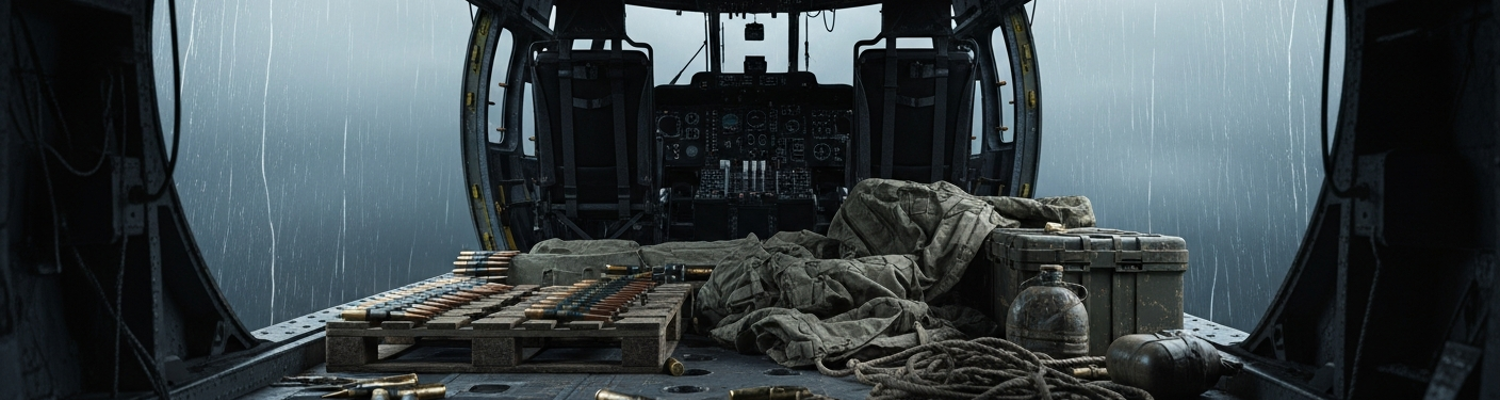

Operational logs for Special Landing Force Alpha show the assembly of what became Task Force X-Ray on Okinawa, dated March 1, 1967. Colonel James A. Gallo, Jr. assumed command. The core of this formation was Battalion Landing Team 1/3 (BLT 1/3), led by Lieutenant Colonel Peter A. Wickwire, supported by the helicopter assets of HMM-263 under Lieutenant Colonel Edward K. Kirby. Both units had just completed full rehabilitation cycles. On paper, they were at peak strength.
The deployment order arrived quickly. After specialized training on Okinawa, the Amphibious Ready Group departed for Vietnam on April 10, 1967. The designated target area was a coastal sector in I Corps, specifically the Que Son Valley, located approximately 25 miles south of Da Nang. The operation, codenamed Beaver Cage, began with a heliborne assault at 07:00 on April 28, 1967. The compressed timeline reflected a significant increase in operational tempo for the Special Landing Force. Its average combat days per month jumped from 12 to over 16 in April alone.
The mission was simple on paper.
Archival evidence (NARA Record Group 127) indicates the Que Son Valley was a known, established transit area for enemy forces and materiel. It formed a natural infiltration corridor from the mountains to the populous coastal plains, serving as a primary source of food and manpower for Viet Cong units. The stated objective for Task Force X-Ray was to conduct search and destroy operations. This meant disrupting supply lines, engaging Viet Cong and People’s Army of Vietnam (PAVN) units, and destroying their base areas. The operation was part of a wider strategy in I Corps to counter the buildup of regular enemy divisions, such as the PAVN 2nd Division, which were increasingly active in the region. By inserting a mobile, heliborne force directly into these sanctuary areas, commanders intended to keep the enemy off-balance. The operation was designed as a swift, violent intrusion into an area the enemy considered its own.
Intelligence promised one thing. The ground delivered another. The initial helicopter landings on April 28th immediately revealed a severe disconnect between aerial reconnaissance and the physical environment. The CH-46 Sea Knight helicopters of HMM-263, already known for being maintenance-intensive and susceptible to engine damage from ground debris, struggled to find suitable landing zones. Declassified command chronologies show that the first four days of Operation Beaver Cage produced more heat casualties than combat-related ones. Over 100 personnel were evacuated due to the oppressive conditions. The terrain of the Que Son Valley was not the flat, accessible plain suggested by maps. Instead, Marines from BLT 1/3 disembarked into a landscape of steep, jungle-clad hills, semi-liquid rice paddies, and nearly impenetrable thickets of bamboo and razor-sharp elephant grass. This topography immediately slowed the battalion’s advance, turning a planned rapid sweep into a grueling, foot-slogging effort. It exposed units to the constant threat of ambush from an enemy that knew the ground intimately. The unexpected terrain nullified the speed advantage of the helicopter insertion and forced the Marines into a close-quarters fight where the environment itself became a primary adversary.
Operational plans for Beaver Cage reveal a logistical framework that was fundamentally sound in theory but brittle in its assumptions. Planners for Battalion Landing Team 1/3 anticipated a dry, hot environment, standard for the Que Son Valley in late April. Their models were shattered by the unseasonably early and intense onset of the southwest monsoon in early May 1967. The weather did not just complicate the mission; it actively attacked the operational framework. Landing zones meticulously selected from aerial photographs transformed into waterlogged, unusable quagmires. The red clay soil of the valley floor and surrounding hills became a viscous, boot-sucking mud that exhausted troops and rendered foot patrols agonizingly slow. This torrential rain did more than just soak the Marines. It effectively blinded them. Helicopter resupply missions by HMM-263, the lifeline for the dispersed rifle companies, were frequently grounded by low cloud ceilings and violent squalls, severing the link between the troops and their support.
Water was the first system to fail.
Under the extreme heat and humidity that preceded the rains, a Marine rifleman required a massive water intake to avoid heat casualties. Command chronologies confirm that in the first four days of the operation, before the monsoon’s full arrival, over 100 personnel were evacuated for heat-related injuries. This was more than from enemy action. The standard resupply method involved delivering five-gallon water cans and bladder bags via helicopter. But the CH-46 Sea Knight helicopters were already plagued with technical issues. Their engines were highly susceptible to foreign object damage from debris ingested while hovering, and the fleet had been grounded previously for mechanical failures. The sudden weather change made these difficult flights nearly impossible. When a patrol was pinned down or a landing zone was too hot, water resupply simply stopped. A close reading of after-action reports shows that Marines, burdened with ammunition, were forced to discard rations to carry extra canteens. When that ran out, they resorted to drinking from bomb craters and rice paddies, often using Kool-Aid packets from their C-rations to mask the taste of purification tablets. This practice led to widespread dysentery. The failure to provide this most basic element of sustenance became a direct vulnerability, impacting the combat effectiveness of BLT 1/3.
Ammunition followed a similar, perilous path. Water was a constant need, but ammunition was a spike demand, required in massive quantities during intense firefights. The logistical system was designed to push ammunition pallets forward via helicopter, either sling-loaded beneath the aircraft or kicked out onto landing zones. The fighting on May 10th saw Companies B and C heavily engaged with a large Viet Cong force for hours. An emergency resupply of ammunition was called. A command chronology from the operation details one incident on May 5th where, under constant enemy fire and in gathering darkness, helicopters from HMM-263 successfully extracted 200 men and 3,000 pounds of ammunition from a compromised landing zone. This success, however, highlights the extreme risk. The monsoon conditions made sling-load operations, already dangerous, a near-suicidal prospect for aircrews. Low visibility, treacherous winds, and the constant threat of enemy ground fire meant that units running low on ammunition during a firefight faced the very real possibility of being completely cut off. For the rifle companies of BLT 1/3, spread across the valley, the sound of approaching helicopters was not a guarantee of support, but a desperate hope against the rain and the enemy.
Operational logs for Operation Beaver Cage expose a command and control system fractured by incompatible communication protocols. The very architecture of the Special Landing Force (SLF) created this division. Marine units, as components of III Marine Amphibious Force, operated under one doctrine. The ships of the Amphibious Ready Group they deployed from belonged to the U.S. Navy’s Seventh Fleet, a separate command with its own procedures. This was not a theoretical problem. It was a mechanical and procedural chasm that opened on the battlefield. A Marine rifle company commander from BLT 1/3, pinned down in the Que Son Valley, used an AN/PRC-25 radio to speak to his battalion headquarters. That battalion headquarters, in turn, had to relay urgent requests for naval gunfire support or logistical aid through a series of radio operators, traversing the divide between Marine and Navy frequencies, call signs, and terminology.
The system was built on layers of translation. Each was a potential point of failure.
The physical hardware itself was a source of constant struggle. The AN/PRC-25, a revolutionary piece of solid-state technology for its time, had vulnerabilities in the environment of the Que Son Valley. Its effective range was drastically reduced by the steep, jungle-covered hills, turning a theoretical 3-5 mile transmission distance into a desperate search for high ground. More to the point, the radio’s handset was notoriously susceptible to moisture. In the torrential downpours of the early monsoon, radio telephone operators (RTOs) were often seen desperately trying to shield their handsets with plastic bags, knowing that one drop in the wrong place could sever their link to supporting arms. Archival evidence shows that during the initial amphibious landing of Operation Beaver Cage, two M48 tanks attached to Company D came ashore with their radios rendered inoperable by water damage. This reduced them to uncoordinated pillboxes that could only communicate by voice. This single incident, occurring at the very start of the operation, was a direct preview of the systemic communication failures that would plague the entire force.
This fragile network was completely overwhelmed during periods of heavy combat. A single radio frequency often had to carry the traffic for artillery adjustments, calls for helicopter medevac, logistical requests, and the minute-by-minute tactical direction of the firefight. The result was a chaotic and often-fatal competition for airtime. A company commander’s urgent plea for more ammunition could be interrupted by a forward observer adjusting a naval gunfire mission from a destroyer miles offshore. The aural record of these battles, had one been kept, would be a confusing overlap of conflicting directives. The inherent friction between services was amplified by the sheer volume of radio traffic. A Marine commander on the ground thought in terms of grid squares and tactical objectives. A Navy supply officer aboard the USS Okinawa (LPH-3) thought in terms of cargo manifests and stock numbers. A request for ammunition for the M60s from a desperate platoon had to be translated up the Marine chain of command, leap across the service divide to the afloat command group, and then be re-translated into a specific requisition order that a Navy quartermaster could understand and fill. Each step in this process added time and introduced the possibility of error, a delay measured in the lives of Marines running low on ammunition and water.
A close examination of Seventh Fleet operational directives from 1967 reveals the strain placed upon its logistical apparatus, particularly the process of underway replenishment (UNREP). For the Amphibious Ready Group (ARG) supporting Task Force X-Ray, this was a constant, ticking clock that governed their ability to remain on station off the Que Son Valley. The core of the issue was scheduling. The ARG's primary vessels, including the helicopter carrier USS Okinawa (LPH-3) and its escorting destroyers, had to periodically break away from combat support operations to rendezvous with replenishment ships. These were oilers (AOs), ammunition ships (AEs), and refrigerated stores ships (AFs). These UNREP ships were themselves part of a larger, theater-wide logistical chain stretching across the Pacific, and delays were endemic. A typhoon in the South China Sea or a shift in operational priorities for carrier groups on Yankee Station could push a scheduled rendezvous back by 24 to 48 hours, creating a cascade of consequences. For the ARG commander, this meant an impossible choice. Remain on station and risk running dangerously low on aviation fuel for HMM-263’s helicopters and 5-inch shells for naval gunfire support, or depart for the rendezvous and leave the Marines of BLT 1/3 with a dangerously thin support umbrella.
The sea itself became a bureaucratic obstacle.
This fragile scheduling was compounded by a deep-seated communication disconnect between naval supply officers and Marine logisticians. The problem was not of garbled radio transmissions, but of incompatible systems and languages. A Marine company commander’s urgent request for more M60 ammunition or spare parts for the PRC-25 was filtered through multiple layers of command, eventually arriving at a Navy supply desk aboard the USS Okinawa. That Navy quartermaster, however, operated within a completely different inventory system, with its own stock numbers and nomenclature. A 1973 GAO report on 7th Fleet logistics noted that even years after Operation Beaver Cage, there were systemic issues with materiel shortages and incompatible parts management. A request from the field had to be translated from a tactical need into a specific Navy Stock Number. If the item was not in the ARG’s limited onboard stores, a new request had to be generated and sent to the wider Seventh Fleet supply command, potentially to be filled by a replenishment ship days away. This process was a breeding ground for error. After-action reports contain numerous anecdotes of helicopter sorties burning precious fuel to deliver the wrong type of ammunition or an incompatible radio battery, all due to errors in this multi-stage translation process.
The operational readiness of Task Force X-Ray directly suffered from these systemic failures. The consequences were tangible. A destroyer low on fuel and munitions would be forced to conserve, potentially denying a fire mission requested by a hard-pressed Marine platoon. Archival data shows a constant struggle to balance resource allocation, with priority often going to larger carrier strike groups, leaving amphibious forces with reduced support. The most severe impact was on the air assets of HMM-263. The chronic maintenance issues of the CH-46 Sea Knight helicopters were amplified by the inconsistent supply of spare parts. The difficulty in sourcing and delivering specific components, from engine filters susceptible to sand and dust to delicate rotor assemblies, meant that the number of operational aircraft dwindled. For the Marines of BLT 1/3, this translated into fewer medevac flights for their wounded, longer waits for water and ammunition, and a crippling reduction in the mobility that was supposed to be their greatest advantage. The inability of the offshore naval support to seamlessly provide for the force ashore meant that the operational tempo was dictated not by the tactical situation on the ground, but by the stuttering, unpredictable rhythm of the Seventh Fleet's supply chain.
Command chronologies for Operation Beaver Cage reveal a persistent disconnect between battalion-level intent and platoon-level action. This gap proved fatal in early May 1967. The high operational tempo, with combat days for the Special Landing Force increasing from an average of 12 per month to over 22 in May, stretched command and control to its breaking point. It was in this environment of exhaustion and fractured communication that a rifle platoon from Company C of BLT 1/3 was dispatched on a local reconnaissance patrol. The patrol’s objective was not part of a coordinated battalion-level maneuver. It was initiated at the company level, based on a fragment of intelligence suggesting enemy movement. This decision, made in isolation, meant the patrol’s route and purpose were not fully integrated into the battalion’s operational picture or deconflicted with adjacent units. The platoon stepped off from its defensive perimeter without the benefit of wider situational awareness. It was a ghost element moving through a battlespace where other friendly forces were blind to its existence. This lack of coordination was a direct symptom of the communication failures plaguing the task force. The AN/PRC-25 radios, while functional, were often over-tasked and their range was severely hampered by the terrain, creating isolated pockets of command. The patrol was, in effect, alone before it even made contact.
The unit proceeded without a full understanding of the battlespace.
The platoon’s route took it toward a prominent terrain feature common in the Que Son Valley: a wide, sandy riverbed, left dry by the seasonal weather. From a tactical standpoint, such features were natural channels for movement but also textbook kill zones. Viet Cong and PAVN doctrine, refined over years of fighting in this specific region, specialized in utilizing such terrain for devastating ambushes. An analysis of their methods shows a preference for L-shaped attacks, where machine guns would be sited to fire down the long axis of the kill zone, while a second element of riflemen would engage the target’s flank, pinning them in a crossfire. Mortars were often pre-sighted on the anticipated route of advance. As the Marines from Company C entered the open expanse of the riverbed, they presented a perfect target. The attack was initiated with a single, coordinated volley of automatic weapons fire from concealed positions on the riverbanks. The volume of fire from RPD machine guns and AK-47s was designed to achieve immediate shock and suppress any organized response. Simultaneously, 60mm mortar rounds began to fall within the riverbed, their impacts throwing up plumes of sand and shrapnel, forcing the scattered Marines to seek cover in the open. The ambush was not a haphazard engagement; it was a professionally executed trap.
The assault was a direct consequence of a systemic failure in situational awareness. Prior to entering the riverbed, the platoon had no intelligence indicating the presence of a significant enemy force. The patrol was moving with standard tactical discipline, but they were blind. The very nature of their uncoordinated mission meant they were not a priority for the limited aerial reconnaissance assets, and the communication breakdown prevented any last-minute intelligence from battalion from reaching them. They were unaware that elements of a Viet Cong Main Force unit had been observed in the broader sector. The initial burst of fire inflicted casualties and shattered the platoon’s command structure. The platoon commander and his radio operator were hit in the opening moments, severing any chance of immediate communication with higher headquarters or supporting arms. Without a functioning radio, the platoon was incapable of calling for artillery support, helicopter gunships, or medical evacuation. The surviving Marines were pinned down by the interlocking fields of fire. Their own M60 machine guns struggled to gain fire superiority against multiple, well-concealed enemy positions. The engagement devolved from a firefight into a desperate struggle for survival, with small groups of Marines fighting in isolation within the kill zone. The lack of coordination that defined the patrol’s launch now guaranteed its destruction, as no one at the battalion or task force level was initially aware that the platoon was in contact.
Operational logs from the engagement on May 10, 1967, detail the mechanical and tactical realities of an ammunition supply system collapsing under combat pressure. For the pinned-down elements of Companies B and C, BLT 1/3, the volume of fire required to prevent being overrun by a large Viet Cong force was immense. A single M60 machine gun, firing at a sustained rate of 100 rounds per minute to suppress enemy positions, could exhaust its initial 100-round bandolier in 60 seconds of controlled, effective fire. With multiple M60s and dozens of M16 rifles engaging the enemy, often at ranges under 50 meters, the platoon’s basic combat load of ammunition evaporated. The standard load for a rifleman, around 200 rounds for his M16, was predicated on maneuver and planned resupply, not a prolonged, static defense against a prepared ambush. The initial moments of the firefight, which wounded or killed key leaders and radio operators, severed the unit’s ability to formally request an emergency aerial resupply. The system was not built for this. Surviving Marines resorted to a desperate, internal logistical effort: low-crawling under heavy fire from one fighting position to another, redistributing single magazines and belts of M60 ammunition from the dead and wounded to keep the remaining automatic weapons firing. This was the logistical breakdown in its most granular form, a failure that forced individual Marines to become the entire supply chain.
This same matrix of failure crippled medical evacuation efforts.
For the 88 Marines wounded on May 10th alone, the logistical paralysis became a direct threat to their survival. A MEDEVAC request followed the same tortured path as a resupply call, but with a far greater urgency. A wounded Marine was categorized, typically as Routine, Priority, or Urgent. The casualties from the ambush, men with chest wounds, massive bleeding, or head injuries, were all Urgent. They required evacuation within the hour to have a chance at survival. On the ground, Navy Corpsmen, with only the supplies in their medical bags, worked to stabilize the wounded, applying tourniquets and battle dressings while the firefight raged around them. Their efforts were a stopgap measure, buying time that the broken supply chain could not redeem. The CH-46s of HMM-263 and other available 1st MAW helicopter assets were the only way out. Yet, the same conditions that halted ammunition flights, heavy enemy fire on any potential landing zone, poor visibility from rain and low clouds, and the mechanical unreliability of the helicopters themselves, also grounded the MEDEVACs. Command chronologies note that it was only by evening, after the enemy attack had been broken by sustained ground combat and air strikes, that helicopters were finally able to reach the beleaguered companies to extract the wounded and dead. For many, this support came hours too late.
A review of press credentials issued by the Military Assistance Command, Vietnam (MACV) in early 1967 shows that a freelance photojournalist, a French national named Henri Huet working on assignment for the Associated Press, was attached to Battalion Landing Team 1/3. He joined Company C just days before the May 10th engagement, equipped with two Nikon F camera bodies, one loaded with black and white film, the other with color slide film, and a selection of prime lenses. His stated purpose was to document the operational tempo of the Special Landing Force, capturing the daily reality for Marines plucked from ships and thrown into the inland valleys. Huet was a veteran correspondent, known for his proximity to the fighting. More than 60 journalists would be killed over the course of the war.
His presence with the platoon was unremarkable at first. He was another figure burdened by gear, moving with the patrol as it departed its perimeter into the Que Son Valley.
The film he shot in the hours before the ambush would become an unnerving record of the moments before catastrophe. One sequence of photographs, later analyzed from his contact sheets, documents the calm as the platoon entered the wide, sandy riverbed. The images show Marines, their faces etched with a mixture of boredom and tension, taking a brief halt. One frame captures a Marine using a P-38 can opener on a tin of C-Rations. Another shows a radioman sitting against a sparse clump of vegetation, his AN/PRC-25 radio silent beside him. Huet’s technical choices, dictated by the midday sun, resulted in deep, sharp shadows that seemed to claw at the edges of the frame. The photographs are notable for their composition, which often isolates individual Marines against the vast, exposed, and seemingly empty landscape of the riverbed, visually telegraphing the tactical vulnerability of the unit. These images provide no overt indication of the professionally executed trap that was about to be sprung.
The subsequent photographic record captured by Huet provides a visceral, ground-level perspective on the logistical collapse detailed in official after-action reports. As the ambush was initiated, his focus shifted from portraiture to documenting the mechanics of the firefight. One image shows the platoon’s radio operator slumped over his AN/PRC-25, the radio’s handset shattered by shrapnel, a perfect illustration of the severed communications link to battalion headquarters. Another photograph, taken from a low angle, depicts a Marine desperately feeding the last belt of M60 ammunition, passed to him by a comrade, into his machine gun. This single frame visually confirms the ammunition shortage that had crippled the platoon’s ability to return effective fire. Huet’s lens also found the Navy Corpsman, documenting his frantic efforts to apply a battle dressing to a casualty, the scene devoid of the hoped-for sound of inbound MEDEVAC helicopters. This collection of images bypassed the sanitized language of official reports and provided unassailable proof of the systemic failures. The film canisters containing these records were eventually removed from the battlefield hours later, tucked into the pocket of a wounded Marine being loaded onto one of the first helicopters able to land after the fighting subsided.