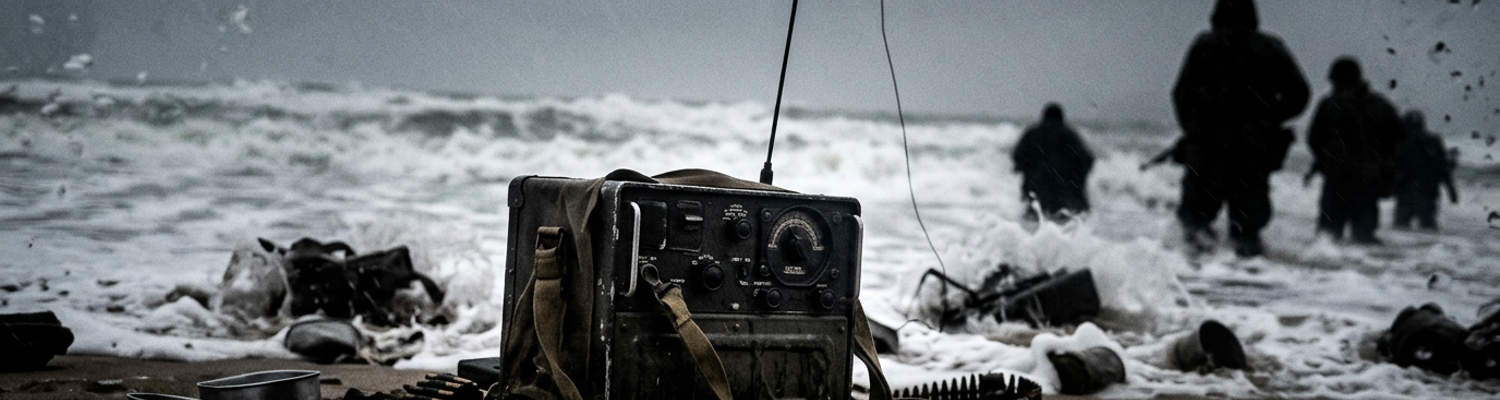

Origins of the Galvin SCR 300 Radio
In a dimly lit workshop at the Galvin Manufacturing Corporation facility on Augusta Boulevard in Chicago. Mid-1940. An electronics technician dressed the frayed lead wire of a vacuum tube socket. He used a hot soldering iron to mend a continuous wave transmitter circuit. High frequency bench tests had just failed under simulated field vibration. The United States Army Signal Corps confronted a severe problem along its tactical command networks at that exact moment. Existing battalion communications relied on amplitude modulated radios like the SCR-194 and SCR-195 sets. These units collapsed into static whenever nearby truck engines ignited. Thunderstorm fronts rolling across combat zones caused total signal loss.
Advancing infantry squads lost all contact with artillery support.
When examining the historical record, War Department procurement officers recognized that traditional AM field radio sets suffered from electrical interference. Frequency drift and line of sight limitations crippled combat management. The Signal Corps issued a development contract in late 1940 to Galvin Manufacturing Corporation. The directive required the Chicago firm to engineer a rugged radio transceiver. It needed to maintain clear line communications under heavy combat conditions. A specialized engineering team took charge of the project under Daniel E. Noble. He brought along chief RF specialist Henryk Magnuski, Marion Bond, Lloyd Morris, and Bill Vogel. Noble recognized that amplitude modulation was fundamentally unsuitable for infantry frontline combat due to atmospheric noise. He forced a radical shift toward frequency modulation. The team engineered an 18-tube double superheterodyne circuit. This system operated continuously across the 40.0 to 48.0 megacycle band. It locked receiver and transmitter tuning into a single unified control knob.
Archival evidence shows the physical envelope of the new unit was engineered to strict weight parameters. The military designated the BC-1000 transmitter receiver inside the SCR-300 assembly. The entire radio apparatus weighed exactly 35 pounds when fully equipped with its dry cell BA-70 battery block. The load included a canvas carrying harness, protective metal casing, handset, and flexible whip antennas. Engineering the unit down to a 35-pound payload required Galvin designers to fit an automatic frequency control system and an adjustable squelch circuit into a compact aluminum chassis. This prevented background receiver roar without overloading the foot soldier. Generating 0.3 watts of radio frequency output, the battery powered FM voice transceiver maintained unbroken voice contact over a distance of three to five miles. Rain, humidity, or ground noise did not degrade the signal. Infantrymen no longer needed to halt and unroll long spool lines of field wire.
They stopped setting up ground stakes to establish voice contact with forward observers.
A close review of operational logs indicates the United States War Department formally standardized the device as the primary backpack transceiver. The military documented its battlefield usage under Technical Manual TM 11-242. Successful spring 1942 field trials occurred at Fort Knox, Kentucky. Prototype units maintained clear FM transmissions through heavy tank engine interference and dense foliage. Galvin Manufacturing began mass production immediately after these tests. The term walkie talkie entered official military parlance specifically to describe this backpack mounted set. This distinguished it from the smaller five pound hand held SCR-536 unit known as the handie talkie. Carrying the 35-pound radio strapped to canvas back harnesses allowed radio operators to walk or crouch in foxholes. They spoke directly into the TS-15 handset or wore a specialized throat microphone. Nearly 50,000 units rolled off Galvin assembly lines during World War II.
The backpack transceiver became the primary combat net radio across European and Pacific operational areas.
Early Pacific Exercises and Signal Attenuation
Initial Pacific trial deployments of the SCR-300 walkie talkie in early March 1943 revealed deep physical vulnerabilities. Exposure to tropical marine environments caused immediate hardware failures. Landing rehearsals conducted by the 27th Infantry Division took place at Kahuku Point on the northern tip of Oahu. Ambient relative humidity exceeding ninety percent combined with high temperatures to breach the BC-1000 transmitter receiver outer housing. Moisture seeped past standard rubber compression gaskets. Water pooled inside the lower chassis. The liquid rapidly corroded the brass leaf springs of the internal BA-70 dry cell battery compartment.
Bakelite band selector rotary switches shattered under thermal stress.
Archival evidence shows internal wiring harness insulation softened. This bled short circuit currents directly to the aluminum chassis ground. V Amphibious Corps signal officers logged reports showing that over forty percent of deployed sets suffered total power failure within seventy two hours of shore exposure (NARA Record Group 338). Supply depots at Espiritu Santo and Guadalcanal recorded massive write offs of unserviceable radio chassis. This occurred before full scale combat operations had even begun in the Solomon Islands. Infantry company commanders found their primary voice communication link dead in the mud before reaching designated staging lines.
Large scale amphibious assault exercises off Maui in June 1943 exposed further design flaws. Salt fog generated across the surf zone caused severe signal attenuation. This crippled long range tactical communications. Fine marine mist suspended heavy concentrations of microscopic sodium chloride particles in the low lying air layer. This layer sat directly between ship to shore control craft and advancing assault waves of the 4th Marine Division. Airborne sea salt deposited a thin conductive liquid glaze across the AN-130 and AN-131 whip antenna mounting bases. Radio frequency energy leaked away from the output stage directly into the wet metal frame of the backpack casing. Signal strength dropped by as much as twenty decibels over open ocean paths.
Voice transmissions that previously reached five miles on Kentucky test ranges abruptly faded into loud static at distances under eight hundred yards across the reef.
Command personnel aboard attack transports lost continuous contact with lead wave battalion commanders. Landing craft drivers had to rely on signal flags and signal lamps amidst heavy sea spray. Naval gunfire liaison officers were left completely unable to adjust simulated shore bombardment barrages onto target grids.
Signal Corps technicians struggled continuously with high frequency performance drops under sustained tropical humidity throughout the late summer of 1943. Trapped water vapor altered the dielectric properties of open air gaps inside the radio chassis within the 40.0 to 48.0 megacycle frequency band. This shifted the precise capacitance values of variable tuning assemblies. Tuning drift plagued the double superheterodyne receiver circuits. The transmitter and receiver alignment desynchronized under heavy equatorial heat. Miniature 3A5 vacuum tube sockets accumulated heavy condensation. This created stray capacitance paths that pulled local oscillator circuits far off their assigned operational channels.
Field maintenance technicians attached to the 754th Tank Battalion signal detachment attempted to halt radio frequency performance drops. They applied dipped paraffin wax coatings to variable ceramic capacitors and sealed handset connectors with flexible rubber sheaths. Marine Corps and Army Signal Officers mandated that repair teams perform complete alignment re calibrations every morning at 0500 hours. They used bench testing gear inside improvised canvas drying tents. Moisture continually re entered the chassis during mid day jungle patrols.
The January 1944 Kwajalein Atoll Assault
Major General Charles H. Corlett launched Operation Flintlock against Japanese positions across Kwajalein Atoll on January 31, 1944. The 7th Infantry Division led the amphibious campaign targeting the Marshall Islands. The objective was to crack the inner defense perimeter of Imperial Japan. Operations began at pre dawn hours near coordinates 8 degrees 43 minutes North 167 degrees 44 minutes East. The 7th Cavalry Reconnaissance Troop alongside Company B of the 111th Infantry Regiment paddled ashore in small rubber craft. Securing the outlying islets of Carlson, Carlos, Carter, and Cecil granted Allied forces control over Carlos Pass. This opened a protected deep water entry into the central lagoon.
Extensive preliminary naval bombardment from battleships and cruisers preceded the main assault.
The 32nd and 184th Regimental Combat Teams staged their main assault landings at 0930 hours on February 1. Battalions surged onto Red Beach 1 and Red Beach 2 at the western end of Kwajalein Island. Veterans who had endured frostbite and arctic gales during the Attu campaign months earlier stepped directly into warm tropical breakers. They faced heavy machine gun and mortar fire from Japanese defensive pillboxes. Dense salt spray and heavy surf immediately threatened essential beachhead communications. Hydrodynamic churning across the shallow coral reef generated heavy ocean foam that washed over the low gunwales of tracked LVT landing craft. Airborne sea salt coated the flexible AN-130 and AN-131 whip antenna bases carried by infantry radiomen.
The conductive liquid glaze leaked radio frequency power directly into the wet metal frames.
Wire spools unreeled by trailing signal teams snapped under the force of breaking waves. Others sank deep into jagged coral crevices. This rendered standard field telephone lines useless. Salt water seeped past rubber sealing gaskets along the seams of the CS-128 lower battery cases. The dry cell BA-70 power blocks flooded instantly. Internal short circuits destroyed vacuum tube wiring harnesses. Rapid sodium oxidation corroded silver plated socket contacts and brass leaf spring connectors inside the BC-1000 chassis. Company commanders lost hardwired wire links to their assault platoons within minutes of touching shore. Wireless radio frequency transmission became the sole remaining voice channel on the beachhead.
Continuous short range FM nets were required for coordinating supporting artillery fire across the narrow coral spit. Five Army field artillery battalions established temporary fire bases on nearby Carlson island. These included the 31st, 48th, 49th, and 57th Field Artillery Battalions equipped with 105mm and 155mm howitzers. SCR-300 backpack transceivers provided the direct tactical link connecting forward observers on Kwajalein Island with gun batteries positioned two miles across the open water. The sets operated across the designated 40.0 to 48.0 megacycle frequency band. Frequency modulated signals penetrated thick clouds of cordite smoke. The FM band ignored the electrical spark interference generated by nearby naval gun mounts.
Forward artillery observers pressed the press to talk switches on their TS-15 handsets. They called down and adjusted over 29,000 rounds of high explosive ordnance during the initial twenty four hours of combat. Forward observers could not walk creeping shell barrages within fifty yards of advancing infantry platoons without continuous short range FM communication. Signal Corps technicians improvised field fixes directly on the beach. They wrapped rubber tape around antenna bases and elevated receiver units on wooden ammunition crates above wet sand. Battery dry cells were dried manually over portable stoves inside landing craft engine spaces. Battalion signal officers maintained four active FM nets by late afternoon on February 2.
Field Modifications and Latex Waterproofing
Signalmen attached to the 7th Infantry Division Signal Company improvised latex waterproofing techniques in late January 1944. They sealed the BC-1000 radio chassis directly aboard attack transports before approaching Kwajalein Atoll. Electronics maintenance personnel coated the exposed aluminum chassis joints with liquid rubber vulcanizing compound. They stretched flexible latex sheaths over the primary structural seams. Signal troops wrapped heavy strips of raw rubber latex sheeting around the CS-128 battery case latches. This closed the vulnerable gap where ocean water routinely flooded the BA-70 dry cell power supply.
These field fabrications blocked liquid sodium chloride from breaching the main chassis enclosure.
Technicians applied rubber cement to secure thin latex membranes over the carbon microphone elements inside TS-15 handsets. This prevented heavy ocean spray from grounding out primary voice coils during early assault waves across Red Beach 1 and Red Beach 2. Custom rubberized coverings protected delicate internal components from salt corrosion across the harsh maritime climate of Kwajalein Atoll. Battalion repair detachments crafted fitted rubber boots using cut vehicle inner tubes and medical latex sleeves. These encased the vulnerable AN-130 and AN-131 whip antenna mounting bases. Airborne salt spray routinely gathered at the exposed base terminals. This created a conductive path that bled radio frequency output power directly into the grounded metal frame.
Technicians painted thick coats of melted paraffin wax onto the 3A5 vacuum tube socket pins and variable air tuning capacitors housed inside the double superheterodyne receiver circuit. This moisture barrier prevented destructive sodium oxidation on silver plated terminal pins. It kept local oscillator circuits from drifting off assigned frequency channels under tropical heat. Specialized rubber washers were hand punched from synthetic material and installed beneath top panel control dials. These guarded the rotary band selector switches from fine saltwater mist that seeped through standard panel bushings. Field technicians built customized canvas harness covers lined with vulcanized rubber to shelter the entire backpack assembly from splash impact.
These field modifications allowed operators to maintain functional radio nets in landing surf throughout the amphibious assault. Radio operators assigned to the 32nd and 184th Regimental Combat Teams waded through four foot breaking waves off Kwajalein Island. They held latex protected SCR-300 transceivers above the foam line. Heavy sea spray washed over the rubberized outer covers without penetrating the battery compartments. High voltage plate supply lines inside the BC-1000 transmitter chassis remained dry. Continuous 40.0 to 48.0 megacycle FM voice channels connected beachhead landing teams with fire direction centers of the 31st, 48th, and 49th Field Artillery Battalions stationed on nearby Carlson Island.
Submerged wire reels failed in deep coral crevices. These modified wireless transceivers became the sole channel for adjusting 105mm and 155mm howitzer barrages against Japanese pillboxes. Radiomen crouched in active surf zones with water splashing over receiver controls. They maintained uninterrupted tactical net control across the entire Western sector.
Flexible Wire Antennas and Fire Direction Nets
Standard AN-131 sectional whip antennas presented severe tactical hazards for 7th Infantry Division signalmen during the opening hours of Operation Flintlock. Infantry squads advanced across the 800 yard wide strip of Kwajalein Island. Radiomen carrying thirty five pound BC-1000 transceivers extended the ten foot flexible steel rod to maintain signal range. Extended steel whips swayed conspicuously above low coconut palms and shell craters. Hidden Japanese snipers lashed into palm tree crowns used the vertical poles as targeting markers. They directed heavy small arms fire directly at radio operators. Physical impact from enemy shrapnel and rifle rounds shattered thin antenna tubing.
Operators repeatedly caught the long metal rods on low hanging branches and wire obstacles while crawling through jagged coral.
This snapped the threaded brass connectors at the AN-130 base mounting stud. Base spring couplings failed under continuous mechanical strain. The top mounted antenna jack became unusable. Division signal technicians immediately devised improvised flexible wire antennas to preserve hardware durability and maintain concealment. Signalmen detached the broken rigid whips from top panel jacks. They replaced them with hand fashioned flexible leads cut from standard rubber insulated W-110 copper field telephone wire. Radiomen stripped eight to ten feet of copper conductor. They soldered the exposed strands to thread adapters and secured the flexible wires along canvas backpack straps.
Some operators draped the wires behind them while crawling. Keeping antenna profiles flat against the ground eliminated the vertical silhouette that drew sniper fire. It prevented mechanical shear against concrete rubble and palm logs. Flexible wire antennas absorbed heavy physical impacts without snapping or bending out of shape. Receiver sensitivity remained stable across the 40.0 to 48.0 megacycle band. Operators remained prone inside shell craters while keeping their transceivers fully operational. Field maintenance sections distributed spare spools of field wire directly to front line company teams to enable rapid antenna replacement.
These modified SCR-300 transceivers effectively maintained short range FM fire direction nets during infantry advances across the island. Forward observers from the 32nd and 184th Regimental Combat Teams used modified sets to communicate with fire direction centers. Frequency modulated voice links allowed artillery observers to call down direct 105mm and 155mm howitzer barrages onto Japanese pillboxes. They walked high explosive shells within seventy five yards of advancing American rifle platoons. Wire equipped transceivers bypassed broken field telephone cables. They transmitted target adjustments without signal fade despite heavy cordite smoke and continuous beachhead explosions. Division artillery command posts processed over three hundred target fire missions over these short range FM nets on February 2 alone. Tactical fire direction centers relied on this unbroken voice contact to coordinate joint mortar and howitzer strikes.
Salt Spray and Rapid Battery Degradation
Sustained exposure to ocean spray turned the high voltage battery supply into an unreliable power cell within hours of hitting the Kwajalein beaches. Airborne sodium chloride particles suspended in the heavy shoreline surf coated the exterior chassis of the BC-1000 transceiver. Salt spray deposited a thin film of saline solution directly across the bottom latch assemblies and the seven prong battery connector plugs. Electrical current leaked continuously across this liquid bridge. This drained power from the radio even when operators flipped the main power switch to the off position. Radiomen assigned to the 32nd Infantry Regiment on Red Beach 2 observed receiver signal strength dropping rapidly within thirty minutes of wading ashore.
High ambient heat reaching ninety degrees Fahrenheit accelerated the electrochemical reaction.
Stray surface currents bled off the reserve charge before infantry squads could advance past the seawall. Radios that normally maintained active continuous voice operations for up to twenty five hours suffered severe terminal voltage collapse in less than four hours. Moisture intrusion directly destroyed the internal dry cell chemistry of the fifteen pound BA-70 battery supply packs. Standard rubber gaskets sealing the lower CS-128 battery case failed under the hydrodynamic pressure of ocean breakers. Saltwater flooded the internal power compartment. Three distinct cell groups comprised the power system inside the assembly. A 4.5 volt circuit powered vacuum tube filaments. A 90 volt group drove the double superheterodyne receiver plate. A supplementary 60 volt cell series combined to supply 150 volts for the transmitter output stage.
Water entering the card stock paper separators caused immediate short circuits between adjacent zinc carbon cells. Chemical degradation inside the flooded cells caused individual cell voltages to plummet rapidly below operational limits. The eighteen vacuum tubes inside the BC-1000 chassis could not maintain thermionic emission without a stable 4.5 volt filament supply. Incoming signals vanished into weak static. Logistical personnel faced severe hazards while transporting dry replacement BA-70 batteries across the fire swept beachhead. Japanese 75mm artillery batteries and heavy machine guns positioned near the airfield swept the narrow coral shelf. They knocked out amphibious tracked LVT vehicles carrying reserve supply crates.
Quartermaster detachments from the 7th Infantry Division Signal Company had to hand carry thirty eight pound wooden battery cases through three hundred yards of open surf. They moved under continuous mortar barrages. Heavy ocean waves regularly soaked replacement dry cells before runners reached frontline company command posts. Radiomen with dead SCR-300 sets remained pinned down inside shell craters at coordinate grid 8 degrees 43 minutes North 167 degrees 44 minutes East. They were unable to call for defensive artillery fire while awaiting fresh power packs. Supply teams suffered thirty percent casualties during the initial eighteen hours of landing operations while delivering dry BA-70 units to frontline rifle companies. Over two hundred waterlogged BA-70 power blocks lay abandoned along the high tide line of Kwajalein Island by nightfall on February 2.
Post War Shifts to Crystal Tuned Channels
Army Ground Forces commanders analyzing combat reports from Pacific island landings concluded that the single band SCR-300 was architecturally obsolete for post war combined arms operations by late 1945. Tactical doctrine demanded complete interoperability between advancing rifle companies, heavy armor units, and ground attack aircraft. This required transceivers to bridge broad frequency spectra rather than remaining locked within a narrow 40.0 to 48.0 megacycle band. War Department equipment boards at Fort Monroe issued revised operational requirements. They directed Signal Corps procurement to establish multi channel versatility across all infantry, armor, and artillery nets. Command decisions formalized the Old Family radio lineup. This divided the tactical spectrum into distinct branches.
The AN/PRC-8 served armor from 20.0 to 27.9 megacycles.
The AN/PRC-9 served artillery from 27.0 to 38.9 megacycles. The AN/PRC-10 served infantry from 38.0 to 54.9 megacycles. Single knob tuning assemblies were no longer acceptable. Neighboring artillery batteries and armor columns accidentally jammed voice networks during complex combined maneuvers. Tight channel spacing mandated precise frequency control to prevent adjacent channel interference. This ensured separate voice links for company command posts, forward artillery observers, and battalion headquarters. The manually tuned Variable Frequency Oscillator circuit inside the BC-1000 chassis was systematically superseded by crystal controlled oscillator networks. Operators using the SCR-300 rotated a mechanical tuning dial to adjust variable air capacitors. These altered their physical gap spacing whenever tropical heat expansion or heavy weapon recoil hit the aluminum casing.
This mechanical instability dragged local oscillator circuits off assigned target frequencies. Radiomen had to execute manual re alignments in combat. Replacing continuously variable VFO knobs with quartz crystal units like the CR-18/U guaranteed fixed channel locking regardless of ambient temperatures or nearby detonation shockwaves. Next generation transceivers like the single channel AN/PRC-6 handie talkie and detent tuned AN/PRC-10 manpack utilized crystal calibrated reference circuits to eliminate open air tuning drift. Signal Corps engineers replaced fragile ceramic air trimmers with hermetically sealed quartz crystal resonators. They locked local oscillator circuits onto exact center frequencies within tolerances under five kilocycles.
Test bench evaluations at the Signal Corps Engineering Laboratories in Fort Monmouth confirmed that crystal controlled sets maintained channel alignment under sustained vibration. This eliminated manual zero beating on the battle line. Emerging military communication standards enforced drastic reductions in hardware weight alongside massive improvements in structural stability. Infantry officers in European and Pacific theaters reported that the thirty five pound SCR-300 payload severely restricted foot mobility during fire and maneuver tactics. War Department specifications for replacement transceivers established a strict twenty four pound upper weight limit. This included the battery pack and accessories. Electronics designers achieved this reduction by replacing bulky WWII octal vacuum tubes with subminiature seven pin miniature glass tubes like the 1U4 and 3A4.
This reduced receiver circuit volume by forty percent.
Retirement and Legacy of the AN PRC 8
War Department procurement officers systematically phased out the SCR-300 as lighter Cold War tactical transceivers entered active military service in the late 1940s. Signal Corps evaluators at Fort Monmouth documented how the aging BC-1000 transmitter receiver placed physical strain on foot soldiers. Troops were forced to carry thirty five pounds of deadweight while maneuvering under fire. Emerging tactical doctrines required smaller combat net radios capable of operating across wider frequency bands without manual frequency drift. Infantry units transitioning into early Cold War operational footing needed transceivers utilizing subminiature seven pin vacuum tubes and cast magnesium alloy casings. These dropped overall backpack weights down to twenty four pounds.
The bulky BA-70 dry cell battery block gave way to modern BA-279/U power packs.
Operators ran continuous communications for extended field shifts without experiencing rapid voltage collapse. Production of the legacy Galvin assembly ceased entirely. Thousands of surplus WWII units were transferred to national reserve armories or stripped for component salvage. The AN/PRC-8 replaced the legacy SCR-300 in frontline Army infantry formations during the early 1950s. Operating across the 20.0 to 27.9 megacycle frequency spectrum, the AN/PRC-8 introduced detent tuned crystal calibration and modular circuit construction. Combat companies maintained immediate voice contact with supporting armor units and command elements. Formations like the 24th Infantry Division and the 2nd Infantry Division deployed to the Korean Peninsula with these replacement sets. They issued them down to rifle platoon leaders and forward observation parties.
The new radio used pre set channels to lock local oscillator circuits into exact frequency alignments despite heavy artillery vibrations or rapid shifts in ambient humidity. Receiver sensitivity jumped while internal power consumption dropped. This eliminated the constant frequency drift that had plagued WWII operators in tropical heat. Signal Corps maintenance detachments no longer needed canvas alignment tents or daily zero beating recalibration routines. The AN/PRC-8 held its frequency lock under direct mortar bombardments. Ad hoc modifications tested at Kwajalein influenced future waterproof radio designs across all branches of the United States Armed Forces. Signal Corps engineers at the Fort Monmouth laboratories systematically analyzed field reports from the 7th Infantry Division Signal Company.
They focused on how technicians had applied raw latex sheathing, vulcanized rubber cement, and cut vehicle inner tubes to prevent saltwater intrusion during Operation Flintlock. These emergency beachhead fabrications proved that standard paper gaskets and exposed chassis joints were completely inadequate for amphibious combat. Designers integrated these lessons directly into military specification MIL-R-10552. This mandated that future transceivers feature factory molded neoprene O-rings, hermetically sealed panel rotary bushings, and quick clamping waterproof battery compartments capable of withstanding complete immersion in salt water down to a depth of four feet. Antenna mountings were redesigned with heavy molded synthetic rubber boots. This directly copied the inner tube sleeves fabricated by infantry radiomen on Kwajalein Island to prevent RF signal leakage across wet ocean spray. Submerged pressure tests inside environmental test chambers at Fort Monmouth became a mandatory manufacturing requirement before any new tactical transceiver entered mass production.