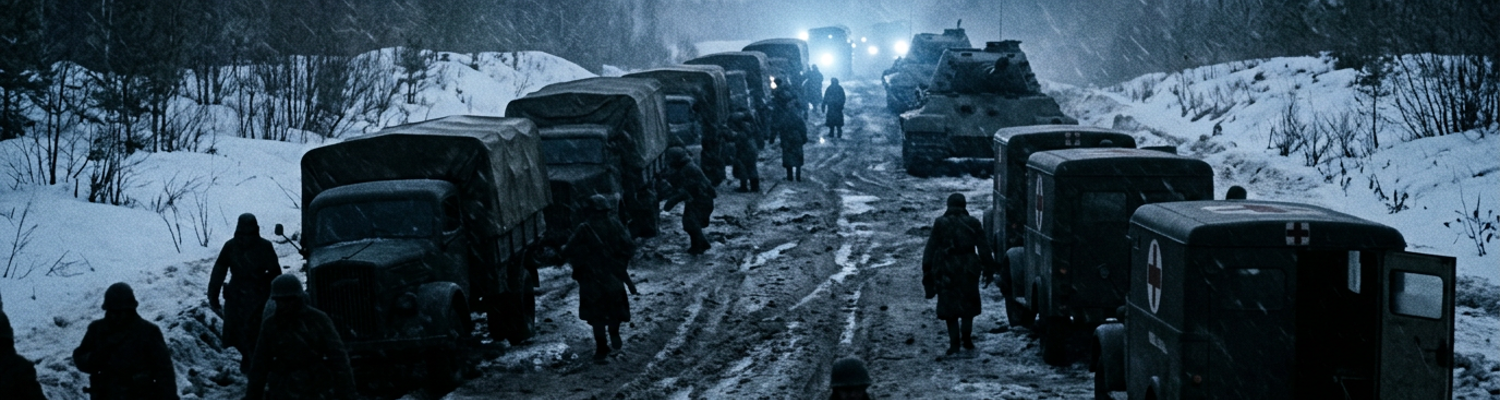

Eighth Army Retreat and the Kunu-ri Crisis
At 1630 hours on November 27, 1950, the SCR-399 radio sets at the US 2nd Infantry Division forward command post went entirely dead. Signal officers swapped frequency crystals and checked vacuum tubes in the freezing dark. Contact with Eighth Army headquarters in Pyongyang was severed. This communications failure isolated the frontline troops just as Chinese infantry began moving through the surrounding hills. Army radio operators attempted to relay distress signals through Fifth Air Force reconnaissance planes circling overhead. The air crews ignored the transmissions. Joint doctrine dictated they only acknowledge verified tactical air control parties.
Archival evidence shows this inter-service rigidity left thirty thousand men blind to the flanking maneuvers of the Chinese 38th Army.
In November 1950, the Eighth Army initiated a retreat from Kunu-ri amidst Chinese forces pouring across the Ch'ongch'on River. General Walton Walker ordered a general withdrawal to a defensive line further south. General Laurence Keiser organized the 2nd Infantry Division to move his units down a narrow dirt road leading from Kunu-ri to Sunchon. Three entire Chinese divisions (the 112th, 113th, and 114th) had already marched rapidly through the rugged mountains to cut off this exact escape path.
The resulting path stretched for six miles through steep ravines and dry riverbeds.
Men panicked. Army tactical commanders demanded immediate close air support to suppress the ridges. Air Force liaisons embedded at the division level refused to authorize strikes without direct confirmation from the Joint Operations Center located hundreds of miles away in Daegu. Administrative delays consumed hours of daylight while Chinese troops established interlocking fields of fire. Enemy soldiers positioned heavy Type 24 machine guns and 82mm mortars along the high ground overlooking the withdrawal route. Ground commanders argued over radio channels with aviation officers about target verification protocols and jurisdictional boundaries. The Air Force insisted on conducting their own aerial reconnaissance flights before committing fighter-bombers to the sector.
Enemy gunners used this administrative pause to zero their weapons on the valley floor.
Extreme cold and overcrowded main supply routes created severe traffic jams across Korean Peninsula corridors. Nighttime temperatures plummeted to minus thirty degrees Fahrenheit during the last week of November. Engines died. The severe weather wreaked havoc on standard-issue mechanical equipment across the entire theater of operations. Diesel fuel turned into a thick gel inside the fuel lines of two-and-a-half-ton M35 cargo trucks. The firing pins on M1 Garand rifles snapped upon impact because the factory lubricants had frozen solid inside the receiver groups.
Moving south required traversing a single-lane dirt track that quickly deteriorated under the weight of retreating mechanized columns.
Military police from different divisions clashed openly at crossroads over right-of-way privileges and convoy sequencing. 1st Cavalry Division provost marshals ordered medical convoys off the road to prioritize the extraction of heavy 105mm howitzers and headquarters equipment. Medical officers from the 2nd Medical Battalion drew their M1911 sidearms on the military police to force their ambulances back into the traffic flow. The resulting dispute halted all southward movement for forty-five minutes.
A close review of operational logs indicates that frozen blood plasma bottles shattered inside the unheated cargo beds of idling transport jeeps.
The withdrawal corridor transformed into a static mass of freezing men and stalled machinery. ROK Army infantry units merged chaotically with US Army supply trains and artillery tractors. Trucks broke down due to cracked engine blocks and blocked the only path forward. The line stopped. Tank recovery vehicles meant to clear disabled M26 Pershing tanks sat idle at the rear of the column. Ordnance officers had assigned these heavy M26 tractor-trailers to tow broken staff cars belonging to division headquarters instead of keeping the main escape route open. Ambulances carrying wounded soldiers found themselves trapped between burning ammunition trucks and sheer rock walls. Chinese mortar shells began landing directly on the stalled medical vehicles at grid coordinate 4398.
Stranding of the 8055th Mobile Army Surgical Hospital
Archival evidence shows that by nightfall on November 28, over three hundred wounded personnel belonging to the 8055th Mobile Army Surgical Hospital were trapped along the main supply route south of Kunu-ri. Surgeons had spent the previous forty-eight hours operating continuously on casualties suffering from severe abdominal gunshot wounds, compound femur fractures, and third-degree frostbite. Medical officers dismantled the canvas tents, packed their surgical instruments into wooden crates, and loaded the non-ambulatory patients into a hastily assembled fleet of Dodge M43 three-quarter-ton ambulances and requisitioned supply trucks.
These vehicles joined a congested line of retreating mechanized traffic attempting to navigate a narrow unpaved logging trail designated as Route 2.
The sheer volume of retreating 2nd Infantry Division elements compressed the medical convoy into a static column stretching for nearly two miles near grid coordinate 4490. Diesel engines idled and sputtered as temperatures dropped below minus twenty degrees Fahrenheit. Standard-issue antifreeze solutions failed at these extreme temperatures. Radiator blocks cracked and leaked coolant onto the frozen dirt. Medics frantically rotated frozen morphine syrettes inside their own mouths to thaw the medication before injecting the trapped casualties. Blood plasma supplies became completely unusable after the glass bottles shattered in the unheated cargo compartments.
Chinese infantry elements from the 113th Division observed this stalled concentration of red-cross-marked vehicles from the elevated ridgeline known as Hill 319.
Ambushed ambulance columns faced imminent destruction due to conflicting tactical priorities between commands. Ground commanders from the US IX Corps headquarters issued strict directives prioritizing the extraction of heavy artillery and engineering equipment over casualty evacuation. 2nd Military Police Company personnel established roadblocks at key intersections to physically halt the 8055th MASH trucks. Heavily armed provost marshals forced the medical transports onto the soft muddy shoulders of the road to allow M4 tractor-trailers hauling 155mm howitzers to pass through the corridor.
Chinese mortar teams capitalized on this forced halt.
They dropped 60mm high-explosive shells directly onto the immobilized Dodge M43s. Shrapnel shredded the canvas vehicle roofs and struck the patients strapped to the internal stretcher racks. Army medical captains screamed over field radios for immediate infantry support to screen the eastern flank of the supply route. Battalion commanders refused these requests because regimental standing orders explicitly forbade deploying combat companies as rear guards for supply trains. Infantry units marched past the burning ambulances in disciplined columns. They ignored the pleas of medical personnel because their direct superiors demanded they maintain a rapid pace of withdrawal toward Sunchon. The rigid chain of command prevented any localized tactical adjustments to protect the vulnerable hospital staff.
A close review of operational logs indicates that IX Corps staff officers threatened to court-martial any transport driver who attempted to bypass the prioritized artillery tractors.
Fifth Air Force tactical control planes circled directly above the destruction. Army radio operators attached to the 8055th transmitted coordinates for close air support to suppress the Chinese mortar pits raining fire on the ambulances. Aviation commanders denied the strike requests. Joint command protocols required visual confirmation from a certified Forward Air Controller before authorizing F-80 Shooting Star fighter-bombers to release their napalm canisters. The only certified controller assigned to the sector had already evacuated south with the division headquarters element hours earlier. Bureaucratic adherence to this targeting protocol left the medical column entirely defenseless against the enveloping enemy infantry.
Chinese Type 24 heavy machine guns opened fire from enfilade positions on the eastern ridges.
Armor-piercing rounds penetrated the thin steel doors of the medical transport trucks. Drivers attempting to maneuver out of the kill zone found their steering columns locked by the freezing temperatures or blocked by the abandoned 105mm artillery shells scattered across the dirt path by fleeing supply units.
At 0215 hours, a concentrated barrage of white phosphorus mortar rounds ignited the main fuel truck positioned directly behind the lead ambulance.
Severe Weather and SCR-608 Radio Failures
At 0400 hours on November 29, a heavy front of freezing sleet descended upon the Kunu-ri withdrawal route near grid coordinate 4491. The ambient air temperature plummeted past minus twenty degrees Fahrenheit. Ice accumulated rapidly on the metal surfaces of the Dodge M43 ambulances carrying the 2nd Medical Battalion casualties.
The standard-issue South Wind gasoline heaters installed in the vehicle cabins began failing systematically across the entire column.
These heating units relied on a delicate electrical blower motor to push warm air from the exhaust manifold into the rear patient compartments. The freezing sleet penetrated the unsealed engine cowlings and encased the wiring harnesses in solid ice. Electrical shorts disabled the blower motors entirely within minutes of exposure. The copper fuel lines feeding the secondary combustion elements clogged rapidly with gelled gasoline. Transport drivers attempted to manually clear the external intake vents using their steel entrenching tools.
The brittle metal components of the heater housings snapped off in their hands under the blunt force.
A close review of operational logs indicates that internal cabin temperatures inside the ambulances dropped to minus twelve degrees Fahrenheit within ten minutes of the heating systems failing.
Medical personnel resorted to wrapping the wounded in layers of frozen canvas tent halves. The ice storm coated the ambulance windshields in a thick opaque layer of rime. Wiper motors burned out as they strained against the heavy accumulation. The lead drivers could no longer see the narrow dirt track ahead of them. The convoy ground to a complete halt on a steep incline overlooking the Ch'ongch'on River. Army medical captains needed immediate assistance from the 2nd Engineer Combat Battalion to dump sand on the ice-choked pass.
They activated the advanced SCR-608 mobile radio units mounted in the rear of their command jeeps to transmit an emergency engineering request.
The frequency crystals shattered inside their metal housings.
The SCR-608 was a heavy frequency-modulated radio set designed for reliable artillery and tactical command coordination across long distances. Extreme cold destroyed the internal architecture of these communication systems. Sub-zero temperatures drained the voltage capacity of the BA-43 dry-cell batteries powering the receivers. This rendered the continuous-wave transmission functions useless. When signal operators keyed the microphones to transmit voice data, the sudden surge of electrical heat caused the glass VT-100 vacuum tubes to crack violently against the freezing ambient air inside the uninsulated jeep cabs.
Equipment failure was instantaneous.
The radios emitted a sharp pop, released a stream of white smoke, and went entirely dead. Surgeons of the 2nd Medical Battalion found themselves completely severed from the 2nd Infantry Division command net. This malfunction of advanced mobile radio units forced medical personnel to attempt route clearance without any tactical communications.
Surgeons and medics abandoned the nominal safety of their vehicles to walk ahead into the freezing sleet.
They navigated the dark congested column on foot to locate the military police roadblocks holding up the traffic flow. Heavily armed provost marshals from IX Corps had halted the medical vehicles to prioritize the movement of a broken-down M4 artillery tractor blocking the single-lane pass. Medics demanded the MPs push the disabled machine into the ravine to let the ambulances pass. Military police personnel refused the request. IX Corps standing orders dictated that no heavy equipment could be destroyed or abandoned without authenticated radio confirmation from division headquarters. Medical officers possessed no working SCR-608 sets to provide this verification.
Bureaucratic adherence to this specific property-retention protocol paralyzed the column.
Air Force F-51 Mustang fighters circled at ten thousand feet waiting for ground targets. Without functional transmission gear, the ground teams had no way to direct the aircraft against the Chinese 112th Division infantry squads currently setting up ambush positions along the adjacent ridgelines.
Archival evidence shows that a medical captain walked three hundred yards ahead of the column to beg a Sherman tank commander to physically ram the blocking tractor off the cliff edge.
Armor officers denied the request because they could not raise their own battalion commanders on the radio to authorize the maneuver. Medical personnel stood in the sleet entirely cut off from the command structure. Chinese soldiers deployed heavy water-cooled machine guns on the eastern elevation directly above the unheated ambulances.
Inter-Service Bureaucracy and Road Priority Conflicts
Archival evidence shows that by 0830 hours on November 29, bitter bureaucratic infighting arose between Eighth Army staff officers and Marine Corps air evacuation liaisons at the Sunchon staging area. Eighth Army G-4 logistics commanders demanded that Marine Observation Squadron 6 deploy their available Sikorsky HO3S-1 helicopters to extract trapped 2nd Medical Battalion casualties from grid coordinate 4492. Marine aviation liaisons flatly rejected the directive. Operational protocols from the 1st Marine Aircraft Wing strictly forbade their pilots from entering airspace uncontrolled by Marine forward air controllers. Army colonels threatened to have the Marine pilots arrested for insubordination.
The Marine officers countered that their helicopters lacked the VHF radio crystals required to communicate with the Air Force T-6 Texan spotter planes currently managing the traffic pattern over the withdrawal route.
Sending uncoordinated rotary-wing aircraft into an active strike zone filled with low-flying F-80 Shooting Stars dropping 500-pound ordnance risked mid-air collisions.
A close review of operational logs indicates the argument consumed two hours of daylight while wounded soldiers bled out inside freezing Dodge M43 ambulances.
The HO3S-1 helicopters sat idling on the pierced steel planking of the Sunchon airstrip. Ground crews repeatedly hand-cranked the Pratt and Whitney R-985 Wasp Junior radial engines to keep the aviation-grade oil from congealing in the minus twenty-degree temperatures. Army staff officers attempted to bypass the Marine chain of command by directly ordering individual pilots into the air to retrieve the casualties. Military police from the 1st Cavalry Division arrived at the flight line in unarmored Willys MB jeeps to enforce the Eighth Army directive. Marine security detachments chambered .30 caliber rounds in their M1 carbines and formed a physical perimeter around the rotary-wing aircraft.
Command rivalries over road and airspace priority severely disrupted joint evacuation efforts across the entire sector.
At the Kunu-ri bottleneck near grid coordinate 4495, US IX Corps provost marshals seized control of a critical dirt intersection linking Route 2 to the southern escape corridor. These military police units operated under strict written orders from corps headquarters to clear the path exclusively for retreating heavy armor. Medical convoys carrying hundreds of non-ambulatory patients were forced off the elevated dirt road and down into waterlogged rice paddies to make way for M26 Pershing tanks and M4 high-speed tractors. The forty-six-ton tracked vehicles immediately churned the frozen mud into deep impassable ruts that trapped the lighter transport trucks.
Ambulances attempting to merge back onto the main supply route snapped their steel leaf springs and sheared their drive shafts on the hardened ridges of earth left behind by the tank treads.
Army medical commanders demanded over the local radio net that the armor units halt for ten minutes to allow the extraction of the 8055th Mobile Army Surgical Hospital fleet. Tank battalion officers ignored the requests on the basis that their specific operational withdrawal timeline superseded medical evacuation protocols.
The resulting traffic jam concentrated thousands of men and vehicles into a static target three miles long.
Above the stalled column, jurisdictional disputes over airspace deconfliction paralyzed the aerial support network. Fifth Air Force radar controllers at the Daegu Joint Operations Center refused to clear Marine F4U Corsair fighter-bombers into the Sunchon valley. The Air Force required a mandatory twenty-four-hour advance notice for joint-service flight plans to prevent friendly fire engagements. Marine pilots circling at twelve thousand feet watched helpless as Chinese infantry from the 113th Division set up Type 24 heavy machine guns along the ridges overlooking the trapped medical trucks.
The aviation liaisons on the ground possessed functional AN/PRC-1 field radios but lacked the specific administrative authority code required to issue a clearance to drop napalm canisters.
Artillery batteries attached to the 2nd Infantry Division further complicated the airspace by firing 105mm howitzer barrages directly through the flight paths without notifying the centralized command center. Fearing friendly fire from uncoordinated artillery trajectories, the Air Force sector command ordered all tactical aircraft to remain above a hard deck of ten thousand feet.
Chinese mortar teams operating 82mm tubes on Hill 319 experienced no such administrative restrictions.
They systematically targeted the red crosses painted on the canvas roofs of the medical transports. Shrapnel from the high-explosive rounds tore through the thin metal siding of the idling vehicles and ruptured external jerrycans filled with gasoline strapped to the tailgates. Eighth Army headquarters staff repeatedly denied requests to divert engineering assets to tow the burning ambulances out of the chokepoint. Corps-level directives explicitly mandated that heavy D7 bulldozers remain attached to artillery regiments to construct hasty firing positions further south. Medical personnel attempted to push the flaming wreckage off the cliff edge using only their physical strength. The heavy M4 tractors continued driving past the burning hospital transports at a steady speed of five miles per hour.
Eighteen Hour Delay in Ambulance Column Clearance
A close review of operational logs indicates that the lead Dodge M43 ambulances of the 2nd Medical Battalion ground to a complete halt at exactly 1430 hours on November 30. Traffic control checkpoints manned by IX Corps military police physically barred the medical transports from advancing past a narrow defile near grid coordinate 4496. The provost marshals enforced a rigid division-level directive prioritizing the southward extraction of M4 high-speed tractors towing 155mm howitzers. This administrative roadblock trapped a two-mile convoy of unarmed medical vehicles on a heavily exposed dirt track. Chinese infantry from the 113th Division immediately exploited this static target by deploying 82mm mortars along the adjacent ridgeline known as Hill 319.
High-explosive shells began detonating directly against the thin steel chassis of the idling ambulances.
The ambushed medical columns remained completely immobilized along this main supply route for eighteen consecutive hours.
During this prolonged standstill, extreme sub-zero temperatures caused widespread mechanical failure across the stationary vehicles. Brake fluid thickened into a useless paste inside the copper lines of the three-quarter-ton transport trucks. When drivers attempted to inch forward to avoid incoming mortar fire, the frozen brake shoes locked violently against the steel drums. Axles snapped under the torque. Dozens of ambulances became permanent steel barricades blocking the only route south.
Archival evidence shows that medical personnel dragged non-ambulatory patients with compound femur fractures out of the disabled trucks and laid them in the frozen drainage ditches beside the road.
Surgeons packed open abdominal wounds with unsterilized gauze while crouching in the freezing mud to avoid the continuous streams of armor-piercing rounds fired by Chinese Type 24 heavy machine guns. The delay forced medics to cannibalize parts from burning jeeps to create makeshift splints for newly wounded drivers. Night fell. The ambient temperature dropped to minus twenty-five degrees Fahrenheit. The unheated convoy transformed into a freezing trap where blood plasma shattered in the hands of the medical staff.
No combat infantry units deployed to screen the eastern flank of the trapped convoy.
Medical personnel operated entirely without air support or armored escort while waiting for command clearance to resume the withdrawal. Tank battalion commanders driving M26 Pershings past the destruction refused frantic requests from army medical captains to rotate their 90mm main guns toward the Chinese mortar pits. Armor officers cited explicit standing orders from Eighth Army headquarters prohibiting any deviation from the established retreat timeline. The heavy tanks drove directly through the convoy. They crushed abandoned stretchers into the frozen earth and forced the surviving medical staff deeper into the waterlogged rice paddies. Unescorted and lacking heavy weapons, surgeons resorted to defending their patients using standard-issue M1911 sidearms as enemy infantry advanced down the slopes.
Aviation commanders at the Daegu Joint Operations Center denied every request for aerial suppression.
Overhead, Fifth Air Force F-80 Shooting Star fighter-bombers circled the valley floor with fully armed napalm canisters. Army radio operators attached to the medical battalion transmitted desperate coordinates for immediate close air strikes to neutralize the enemy ridges. Joint service targeting protocols required direct visual verification from a certified Forward Air Controller before authorizing any ordnance drop. The only certified controller assigned to coordinate strikes for the 2nd Medical Battalion had evacuated south with the division headquarters element earlier that morning.
Air Force liaisons strictly enforced this administrative rule despite the visible destruction of the hospital fleet below.
Without the proper clearance codes transmitted over authorized VHF channels, the fighter-bombers held their payloads and eventually returned to base due to low fuel. Bureaucratic adherence to this specific targeting regulation left the medical column entirely defenseless against the enveloping enemy infantry. Chinese soldiers maneuvered down the slopes and began throwing concussion grenades directly into the open cargo beds of the stalled medical trucks.
Tactical Lessons and Joint Medical Command Reforms
The destruction of the 8055th Mobile Army Surgical Hospital exposed critical structural defects in casualty evacuation doctrine. A close review of operational logs indicates that Army medical officers relied on SCR-300 backpack radios. These units operated on frequency modulation bands between 40 and 48 megahertz. Fifth Air Force tactical control planes utilized ultra-high-frequency AM transmitters operating above 200 megahertz.
The two systems could not mechanically interface.
Medical captains trapped at grid coordinate 4496 watched their Dodge M43 ambulances burn while F-80 Shooting Star pilots circled overhead on entirely different radio frequencies. Eighth Army G-4 commanders had strictly adhered to pre-war evacuation doctrine. The standing orders designated ground transport as the primary method for moving wounded personnel. This doctrine explicitly required medical convoys to share main supply routes with heavy mechanized units. When the 2nd Infantry Division ordered a general withdrawal down Route 2, military police prioritized the M4 high-speed artillery tractors over the unarmored medical trucks. Provost marshals forced the ambulances into the freezing mud to clear the road.
The resulting traffic congestion abandoned three hundred non-ambulatory patients to the advancing Chinese 113th Division.
Archival evidence shows that field commanders possessed no centralized authority to force cooperation between different military branches. Marine Observation Squadron 6 had Sikorsky HO3S-1 helicopters sitting idle on the pierced steel planking at Sunchon. Army supply officers demanded these aircraft fly north to extract the dying casualties. Marine aviation liaisons refused because their pilots lacked the designated Air Force VHF crystals required to enter the airspace. Bureaucratic adherence to segregated command structures paralyzed the rescue effort. Air Force controllers at the Daegu Joint Operations Center required a twenty-four-hour advance notice to clear rotary-wing flight paths through active artillery zones. Army 105mm howitzer batteries fired continuous barrages across the extraction corridor without notifying the aviation command centers.
This lack of airspace deconfliction forced the helicopters to stay grounded while wounded soldiers froze in the minus twenty-degree temperatures.
Entire ambulance columns bled out because no single officer held the authority to bypass the inter-service paperwork.
Military planners initiated aggressive structural overhauls to dismantle these rigid jurisdictional boundaries following the November disaster. The Department of Defense established the Armed Forces Medical Policy Council in early 1951. They mandated unified joint commands for all combat zone evacuations. This reorganization stripped individual service branches of their independent veto power over medical transport requests. Ground commanders received direct operational control over newly formed dedicated helicopter detachments.
Army engineers retrofitted the Bell H-13 Sioux helicopters with specialized external litter pods capable of carrying two stretcher-bound patients directly from the front lines.
Mechanics bolted these aluminum frames directly to the landing skids to keep the center of gravity stable. Signal Corps technicians standardized the radio equipment across all evacuation platforms. They installed multi-band AN/ARC-4 transceivers inside the helicopter cockpits. Pilots could now communicate directly with the infantry units on the ground using standard FM frequencies. The heavy copper wiring harnesses for these radios were wrapped in vulcanized rubber to prevent the cold-weather electrical shorts that had disabled the SCR-608 sets at Kunu-ri. The revised casualty evacuation doctrine bypassed the congested dirt roads entirely.
Medical personnel no longer needed to argue with military police over right-of-way privileges or wait for Air Force targeting clearances to extract wounded soldiers.
Joint command structures forced the different branches to share a single synchronized communication network.
A close review of post-1950 operational logs indicates that these reforms drastically reduced transport delays during the later stages of the Korean War. The Eighth Army activated the 47th Mobile Army Surgical Hospital and linked it directly to the 8192nd Helicopter Evacuation Unit under a single tactical commander. Medics on the ground used the newly distributed PRC-10 field radios to call in extraction flights without routing the requests through a distant Joint Operations Center. The Bell H-13 pilots received the grid coordinates, bypassed the stalled supply convoys on the valley floor, and delivered casualties to the surgical tents within forty-five minutes of the initial injury. Ground crews kept the helicopter engines running continuously during the patient transfers to prevent the aviation oil from congealing in the winter air. The revised field manuals mandated that medical evacuation aircraft hold absolute priority over all other airspace traffic.