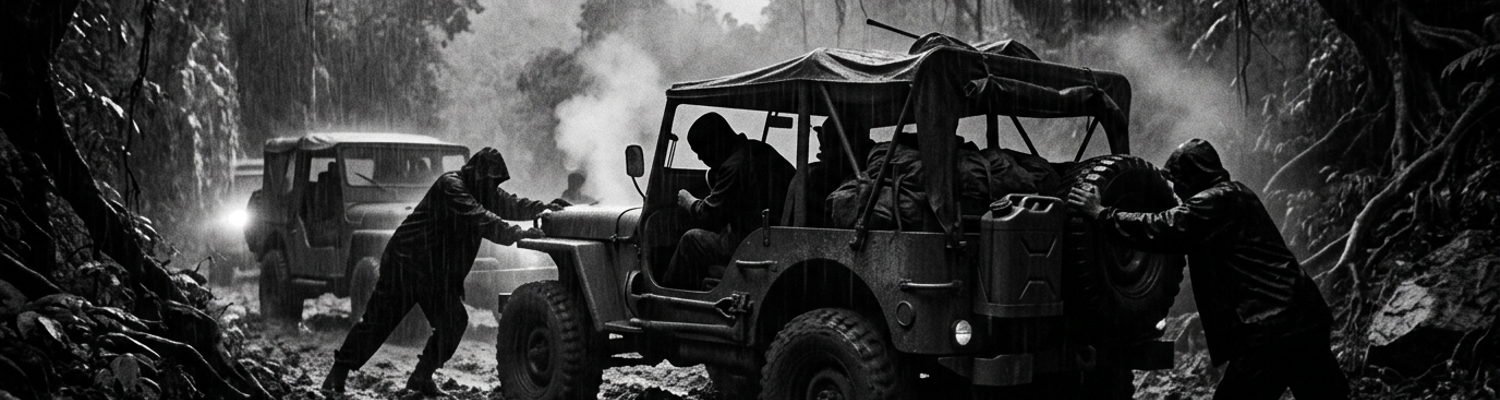

Deployment of the 124th Cavalry Reconnaissance Troop
16 December 1944. Coordinates 24 15 18 N, 97 14 22 E. Dense jungle mist settled over the staging grounds near Bhamo. The 124th Cavalry Regiment completed its transformation into a motorized scout unit. Formed as the last operational horse-mounted cavalry formation of the Texas National Guard, the regiment had spent the initial years of the war patrolling the scrub terrain of the Mexican border from Fort Bliss and Fort Brown. They shipped from San Pedro to Bombay. Upon reaching the Ramgarh Training Center in Bihar, India, General Staff directives stripped the troopers of their mounts. They integrated the formation into the 5332nd Brigade Provisional. Archival evidence shows that this conversion separated cavalrymen from the horses they had cared for over years. Stable duty was replaced with round-the-clock mechanical maintenance. Technicians assigned to the newly constituted reconnaissance troop stripped down their tactical doctrine. They retrained horse cavalry scouts to operate as mechanized reconnaissance teams. These teams were responsible for probing Japanese defensive concentrations along the central axis of northern Burma.
Men trained for saddles absorbed grease, steel, and fuel vapors under tropical rain.
Operational staging along the Ledo-Burma Road trace required immediate field-expedient adaptations of the standard quarter-ton four-by-four truck. Willys MB and Ford GPW scout jeeps faced steep mountain transit. The routes featured twenty-percent gradients, unpaved switchbacks, and deep monsoon slurry. Mechanics in the division ordnance shops welded steel wire-cutters onto front bumper assemblies. This modification was designed to defeat Japanese ambush cables strung across jungle trails at neck height. Pintle-mounted Browning M1919A4 .30-caliber machine guns were bolted directly behind driver seats. Auxiliary racks were fabricated to secure extra five-gallon jerry cans of water and 80-octane gasoline. Operating these light vehicles across the razorback ridgelines between Myitkyina and the Salween River pushed mechanical tolerances beyond factory specifications. Transfer cases overheated during sustained low-range climbs. Gear oil boiled off. Pinion teeth stripped. Heavy mud seized brake drums, rendering friction pads useless on descents. A single locked wheel sent a chassis over a two-thousand-foot precipice.
When examining the historical record of these mountain patrols, the psychological degradation of the scout drivers emerges as a direct consequence of the machinery itself. Eighteen-hour transit shifts over washed-out corduroy roads subjected drivers to non-stop high-frequency chassis vibrations. This caused severe nerve deadening in hands and feet. Monotonous low-gear engine drone stripped away peripheral vigilance. It produced sensory exhaustion that mirrored combat shock long before Japanese 33rd Division outposts opened fire with Type 92 heavy machine guns. Scouts suffered from constant spatial anxiety. Their minds wore raw by the strain of peering through driving rain into blind switchbacks where unseen mudslides had sheared away half the roadbed.
A close review of operational logs indicates that scout sections moving south toward Wanting suffered severe attrition without engaging enemy armor. Lead vehicles negotiated hairpin turns while trailing elements maintained thirty-yard intervals. This spacing prevented mass casualties from concealed Japanese artillery batteries emplaced on dominating high ground. Drivers kept engines running constantly in torrential rain. They feared that saturated distributor caps and drowned ignition coils would fail to restart under fire. Replacement carburetor floats and rear axle half-shafts were flown into rough landing strips at Namhkam by C-47 transport planes. The parts arrived packed in heavy grease alongside emergency shipments of dexedrine tablets. Medical officers distributed these pills to keep drivers conscious through forty-eight-hour continuous road-reconnaissance sweeps.
Ambush Encounters Near Namhkam and Mountain Defiles
Archival evidence shows that on the morning of 17 January 1945, the motorized reconnaissance elements of the 124th Cavalry pushed east from the Shweli River valley. They moved toward the high passes commanding Namhkam. Operating along narrow logging shelves carved into six-hundred-foot canyon walls, the scout sections encountered prepared defensive sectors. Infantry regiments of the Japanese 56th Division manned these positions. Japanese field commanders had converted these narrow mountain defiles into systematic containment zones. They anchored their reverse-slope bunker systems into limestone outcroppings and dense bamboo thickets. Lieutenant Colonel William J. Wood ordered scout sections forward in dispersed echelons. He attempted to locate enemy field works before the main elements of the 5332nd Brigade committed their pack artillery and mule trains to the pass. Moving along single-lane shelf roads with zero lateral clearance, the point jeeps drove directly beneath camouflaged log-and-earth pillboxes. These bunkers were designed to deliver grazing fire down the defile axes. Every hundred yards gained required dismounted scouts to crawl through razorback brush to probe blind curves. This exposed individual point men to interlocking fields of fire from hidden rifle pits.
Entrenched machine gun nests held their fire.
They waited until entire motorized columns were committed to the shelf roads.
A close review of operational logs indicates that the lead Willys MB scout vehicles entered a prepared ambush zone three miles northeast of Namhkam. Japanese gun crews engaged them with Type 1 47mm anti-tank guns and 37mm rapid-fire weapons. These guns were concealed within reinforced cliff hollows. High-explosive and armor-piercing projectiles severed steering linkages. They cracked engine blocks and detonated spare fuel drums lashed to the running boards. Trapped on a five-yard-wide track bordered by an unclimbable rock wall on the left and a vertical cliff on the right, drivers could neither turn their vehicles around nor execute evasive maneuvers. Japanese defensive doctrine paired direct-fire anti-tank weapons with rapid volleys from Type 89 50mm knee mortars. These mortars fired from hidden revetments eighty yards above the road grade. Mortar rounds struck the exposed rear beds of the jeeps. They peppered crew members with fragmentation and ignited canvas gear bags. Cavalrymen dismounted under direct fire. They scrambled into drainage ditches while trying to extract wounded gunners from burning chassis. Secondary ammunition cook-offs shredded the sheet-metal hulls shortly after.
When examining the historical record of these mountain engagements, the psychological breakdown among mechanized cavalry scouts stemmed from the sheer physical helplessness of being pinned inside mechanized columns. Pinned beneath the wheel hubs of their disabled vehicles, scout drivers endured hours of concussive blast pressure. Incoming mortar rounds exploded against sheer granite walls. The noise inside the rocky gorge reached deafening levels. It shattered auditory orientation and prevented platoon leaders from relaying tactical hand signals or shouted withdrawal orders. Mechanics who attempted to hook recovery cables onto shattered lead jeeps were systematically picked off by Japanese snipers. These snipers fired from tree hides wrapped in camouflage netting. Troopers abandoned their immobilized vehicles. They clawed backward through shale scree and red mud while carrying wounded comrades on improvised poncho litters.
Field surgical stations set up outside Namhkam admitted forty-two cavalrymen suffering from concussive head trauma, shrapnel amputations, and profound combat hysteria within thirty-six hours of the initial defile crossing. Drivers repeatedly lost voluntary muscle control in their hands. Their fingers locked in rigid spasms after gripping steering wheels under sustained mortar bombardment. Troop commanders suspended motorized vehicular movement along the Namhkam-Wanting corridor for forty-eight hours. They ordered all remaining reconnaissance sweeps to be conducted entirely on foot by dismounted cavalrymen armed with M1 carbines and hand-carried radios. Ordnance recovery crews later salvaged three burned-out chassis. They discovered eight unexploded Type 89 mortar shells lodged directly in the crushed chassis frames and engine compartments.
Allied Reciprocal Logistics and Theater Fuel Quotas
Archival evidence shows that daily combat mobility for the 124th Cavalry operated under the diplomatic terms of Reverse Lend-Lease agreements. Under State Department Decimal File 841.51/496-582, American and British logistical auditors maintained an exhaustive paper trail. They tracked every drum of motor fuel, crate of replacement tires, and railhead transport wagon exchanged between British Indian Command and the United States Services of Supply. Because the Mars Task Force operated at the far end of a supply line that crossed the Indian Ocean and the Assam railway network, American quartermasters were forced to balance vehicle requisitions against British pool allocations. Joint accounting boards scrutinized daily theater disbursements. They balanced field supplies drawn by Northern Combat Area Command against British Fourteenth Army requirements operating further south along the central front. Motor officers in the 124th Cavalry spent exhausting night hours translating US ordnance nomenclature into British War Office catalog codes. This translation was required to secure authorization for emergency chassis shipments. This bilateral ledger system created administrative choke points. It halted transport convoys at Ledo and Margherita while staff officers verified reciprocal credit transfers.
A close review of operational logs indicates that strict theater fuel quotas dictated scouting operations south of Myitkyina with ruthless mathematical limits. Headquarters allocated each Willys MB reconnaissance jeep an austere operating allowance. The allowance was precisely five gallons of 80-octane gasoline per twenty-four-hour cycle. This forced platoon leaders to plan reconnaissance probes down to the exact odometer mile. Operating in four-wheel drive low-range across muddy shelf tracks consumed gasoline at three times the standard road-consumption rate. Scout drivers confronted the calculation of range versus survival. When lead vehicles became bogged down in riverbeds near the Shweli River, crews routinely shut off their engines during forward halts. They did this to conserve their remaining fuel reserves. They knew that an ambush would find them stationary with cold starter motors. Drivers developed acute psychological dread of fuel starvation. They listened with fixation to the uneven cough of Carter carburetors sputtering on fuel mixed with condensation and monsoon silt. Running empty meant abandoning vehicles to Japanese patrols. The alternative was pushing a quarter-ton steel chassis by hand through exposed defiles while under high-angle mortar fire.
Tire tubes were vulcanized until the degraded rubber separated from the fabric plies.
When examining the historical record, vehicle spare-part requisitions exposed scout mechanics to a prolonged psychological breaking point. Forward maintenance sections attached to the 124th Cavalry submitted priority vouchers to SOS Base Section 1. They requested front axle steering knuckles, universal joints, and suspension leaf springs. These parts were routinely shattered by boulder strikes along unpaved river traces. These requisitions faced systematic denial or backorders. Cargo space on incoming Douglas C-47 sorties from Dinjan was hoarded for artillery ammunition and blood plasma units. Mechanics scavenged parts from stripped chassis in open mud revetments. They cannibalized cracked differential housings under driving rains with hand wrenches. They filed down mismatched British Bedford truck components to fit Willys drive shafts. They dreaded the moment a field-expedient repair would shear apart while a scout section negotiated a one-lane cliff edge under fire. The chronic scarcity transformed basic mechanical maintenance into an agonizing moral burden. Squadron commanders routinely forced motor officers to choose which running scout car would be permanently grounded. They stripped one vehicle to keep two other battered jeeps operational on the road trace to Wanting.
By late January 1945, Base Section 1 logged 412 unfulfilled mechanical work orders for the regiment. Thirty-six scout vehicles were officially struck from operational strength logs. Spare transfer case bearings were unavailable anywhere east of Calcutta.
Continuous Motorized Reconnaissance and Sleep Deprivation
Archival evidence shows that between 22 January and 4 February 1945, motorized reconnaissance detachments of the 124th Cavalry operated under continuous seventy-two-hour patrol cycles. They moved along the mountain spur connecting Namhkam to Ridge 2470. Troop commanders rotated three-vehicle reconnaissance teams along isolated axes without providing relief drivers or scheduled rest pauses. Standard operating procedure required scout sections to negotiate unpaved switchbacks carved into sixty-degree mountain gradients. Japanese forces had concealed Type 93 pressure-plate landmines beneath crushed shale along these routes. Drivers spent three consecutive days behind the steering assemblies of their quarter-ton trucks without sleep. They fought micro-naps while descending muddy grades at five miles per hour. Peering through heavy rain and shattered windshields to identify ground disturbances created persistent optic nerve fatigue. The constant optical strain produced severe ocular headaches and rapid involuntary eyelid fluttering. This caused drivers to mistake tree roots and water puddles for exposed mine fuzes. Field officers denied rest halts because theater directives prioritized continuous pressure against retreating elements of the Japanese 56th Division. Whenever a patrol halted to replace blown radiator hoses or shredded fan belts, dismounted scouts stood guard in drenched drainage ditches rather than sleeping. They were conscious that Japanese infiltrators used blind switchback corners to roll Type 99 magnetic grenades underneath stationary vehicle axles.
Sleeplessness destroyed the ability to calculate braking distances on wet mud.
When examining the historical record, the mechanical design of the Willys MB transmitted raw low-frequency road shocks directly into human bone. Driving over corduroy road logs and shattered rock beds for forty-eight hours straight sent high-amplitude vibrations through the unsprung steering column and cast-iron frame rails. Sustained mechanical agitation caused peripheral neuropathy in the extremities of the drivers. It numbed their palms and forearms until they could no longer feel the clutch pedal or maintain a grip on the steering rim. Mounted behind them, machine gunners standing on the rear floorboards absorbed sharp vertical jolts through their knees and lower lumbar discs. This resulted in acute spinal swelling and debilitating muscle spasms. Operating along unmapped, isolated ridge trails, scout sections lacked friendly artillery cover. Japanese snipers tied into banyan trees regularly targeted these vibrating vehicles. They fired single 6.5mm rounds from Arisaka Type 38 rifles into open driver compartments. Sudden rifle cracks cutting through loud engine noise shattered the nervous systems of exhausted troopers. This triggered sudden muscular lockups where drivers froze on the throttle and drove over cliffs.
Constant engine vibration caused inner ear damage that mimicked severe vertigo.
A close review of operational logs indicates that medical officers with the 5332nd Brigade attempted to offset this physiological breakdown. They distributed five-milligram amphetamine sulfate tablets directly to scout sections before departure from staging bivouacs. Chemical stimulants kept drivers awake for sixty hours. The drugs induced acute paranoia, hyper-fixation, and auditory hallucinations in isolated jungle defiles. Drivers reported hearing approaching tracked vehicles through the steady churn of their own transfer cases. They repeatedly brought columns to screeching halts on narrow ledges to train weapons on empty bamboo stands. Gunners developed twitching trigger reflexes. They discharged M1919A4 machine guns into fog banks after mistaking wind-blown foliage for charging Japanese infantry. By 8 February, squadron sick bays logged twenty-six cases of complete neurological exhaustion. Soldiers exhibited catatonic stupor, persistent tremors in their hands, and a total inability to speak. Brigade command revoked open-ended motorized sweep orders. They enforced mandatory four-hour bivouac rotations under guard at defensible road trace intersections.
Signal Photographic Records of Severe Shell Shock
Archival evidence shows that field documentation units from the 164th and 166th Signal Photographic Companies moved directly with forward elements of the 124th Cavalry during late January 1945. Two-man camera detachments operated alongside point scout sections pushing south toward the Burma-China border. They rode in the rear cargo beds of modified quarter-ton trucks with hand-cranked Bell and Howell Eyemo 35mm cameras and 16mm Cine-Kodak Specials. Theater headquarters had originally assigned these technical crews to film road conditions, blown river spans, and captured Japanese bunker complexes to assist engineering battalions. Instead, the cameramen recorded the direct breakdown of front-line personnel under Japanese mortar barrages and sustained sniper fire along the Namhkam-Wanting trace. High ambient humidity and continuous rains swelled the leather equipment gaskets. Internal optical glass fogged rapidly inside non-waterproof carrying packs. Cameramen used airtight zinc ration tins to protect exposed rolls of black-and-white safety negative film. They loaded fresh magazines while lying flat in roadside drainage ditches under 75mm artillery fire.
Lenses fogged over within minutes of leaving mountain assembly points.
When examining the historical record, surviving reels from these forward patrols contain direct visual evidence of rapid-onset combat fatigue among cavalrymen assigned to lead jeeps. Operating as point scouts meant driving without armor plating or overhead cover down single-lane tracks. These tracks were flanked by concealed Type 98 20mm anti-aircraft positions firing horizontally. Celluloid reels cataloged the physical degradation of these drivers over consecutive forty-eight-hour scouting assignments. Frame-by-frame analysis revealed gross motor tremors in the upper bodies of soldiers. These men had spent hours pinned inside unmovable vehicles under high-explosive concussions. Scanned negatives showed point scouts staring fixedly into the camera with blank, unblinking eyes. They were completely unresponsive to spoken directions from vehicle commanders. Their hands shook violently while attempting basic mechanical tasks. They dropped wrench heads, ammunition belts, and fuel funnels into the mud. Rather than diving for cover when Japanese mortar shells bracketed the roadbed, exhausted troopers sat motionless on running boards. Their nervous systems were unable to initiate basic evasion reflexes.
A close review of operational logs indicates that camera teams documented severe functional conversions and acute shell shock symptoms among soldiers assigned to Ridge 2470. Cameramen recorded instances of drivers experiencing rigid conversion spasms. Their fingers curled inward against their palms in involuntary contractions. Field medics had to pry their hands off steering wheels. Other frames captured scouts displaying pronounced cephalic tics and violent, rhythmic head-jerking. This was caused by acoustic trauma from unspotted Japanese knee-mortar barrages exploding on bare rock faces. Several soldiers sat slouched against the front wheels of disabled Willys chassis. They wept without facial movement while shrapnel cut the brush around them. Medical personnel from the 5332nd Brigade quickly removed these men from the patrol line. They tagged them as acute psychiatric casualties before transporting them toward rear clearing stations at Bhamo. Film rolls labeled with sequence markers from the 164th Signal Photographic Company were packed into moisture-resistant metal canisters. They were marked as restricted technical records and transferred to the Signal Corps film repository at Fort Monmouth under classification file RG 111-SC.
Neuropsychiatric Casualties and Reconnaissance Exhaustion
Archival evidence shows that during the ten days preceding the consolidation of Namhkam on 19 January 1945, the medical detachment of the 124th Cavalry Regiment established strict triage criteria for troopers paralyzed by operational exhaustion. Field surgeons stationed at the Shweli River crossing point, near coordinates 23 53 44 N, 97 41 12 E, instituted a forty-eight-hour frontline holding threshold. Troopers exhibiting acute disorientation, severe tremors, or mutism were not immediately sent to base hospitals. Medical officers administered heavy doses of sodium amytal to induce prolonged sleep inside forward blackout tents. They attempted to return men to their vehicles within two days. Anyone failing to regain motor coordination after seventy-two hours was formally recoded from combat exhaustion to severe psychoneurosis and evacuated down the Ledo road line. Operational casualty registers logged sixty-eight cavalrymen incapacitated purely by non-organic nervous collapse prior to the capture of the town. These tallies accounted for nearly fifteen percent of the regiment forward medical admissions during the clearing of the western approaches. This surpassed casualties caused by shrapnel wounds from Japanese 47mm high-explosive rounds.
Field ambulances carried broken minds through the Shweli gorge.
A close review of operational logs indicates that this mental attrition correlated directly with mechanical breakdowns along the route. When low-range transfer case gears stripped on the steep mountain switchbacks north of Namhkam, point scout drivers spent up to twelve straight hours under intermittent Japanese Type 92 machine gun fire. They wedged themselves underneath chassis to replace fractured universal joints. Platoon commanders in Troop A and Troop B faced severe manpower shortages as drivers refused to take the wheel. They exhibited profound somatic conversions including sudden hysterical blindness and rigid paralytic contractions of the lower limbs. Medical officers at the 5332nd Brigade forward clearing station at Mong Wi noted that physical symptoms worsened whenever replacement vehicle components failed to arrive by air drop. Men assigned to tow disabled jeeps broke down under the stress of mechanical entrapment. They repeatedly abandoned working winches during Japanese counter-battery barrages. Squadron headquarters ordered dismounted patrols to cover vehicle recovery operations. The sudden redeployment forced already exhausted scouts to perform twenty-mile forced marches through swampy defiles with no rest cycles.
When examining the historical record, clinical case studies gathered by theater neuropsychiatrists from the 124th Cavalry shaped postwar doctrine on isolated combat stress. Medical officers serving with the United States Services of Supply cataloged the physiological degeneration of motorized scouts. They drafted detailed diagnostic monographs for the Office of the Surgeon General. These reports documented that prolonged exposure to high-amplitude vehicle vibration accelerated neurological collapse. It lowered the threshold for psychological trauma under enemy bombardment. Neuropsychiatrists observed that cavalrymen isolated in motorized reconnaissance units experienced an acute sense of mechanical vulnerability. They knew a single blown distributor cap or snapped tie rod meant death on a one-lane defile. This documentation directly challenged the prewar assumption that mechanized mobility shielded soldiers from combat fatigue. The data collected along the Burma Road provided primary evidentiary backing for the inclusion of gross stress reaction in the first Diagnostic and Statistical Manual of Mental Disorders in 1952. Army psychiatric consultants used the 5332nd Brigade case files to rewrite field manuals. They established mandatory rotation intervals for motorized reconnaissance personnel across later conflicts.
By 26 January, Base Section 1 medical records at Ledo tracked 142 total psychiatric evacuations from the 124th Cavalry. Chronic cases were routed to the 73rd Evacuation Hospital for permanent boarding and transfer to the United States.