
Outer Island Blackouts and Maritime Observation Isolation
Pre-war naval doctrine promised seamless wireless networks connecting peripheral island lookouts directly to fleet assets through standardized high-frequency radio channels. The actual situation confronting coastal watch standers within hours of the December 7 air raid was complete electromagnetic isolation. Archival evidence shows that Fourteenth Naval District headquarters at Pearl Harbor imposed an emergency ban on outward radio transmissions following a series of Imperial Japanese Navy submarine attacks. Fleet submarine I-75 shelled the harbor town of Kahului on Maui on December 15. Gun crews fired sixteen 140mm rounds into commercial warehouses. Submarines I-1 and I-19 followed weeks later. They bombarded the ports of Hilo and Nawiliwili. Pearl Harbor command deduced that Japanese radio direction-finding units were actively tracking local transmitter signatures to triangulate maritime targets and identify island supply channels. Vice Admiral Claude C. Bloch signed fleet orders directing every coastal station across the Hawaiian Sea Frontier to cut carrier wave transmissions immediately. Station operators received instructions to disable transmitters by pulling vacuum tubes or confiscating quartz crystals. Every forward post became a purely passive receiver.
Radio silence turned the outer islands into static voids.
A close review of operational logs indicates that this total communications blackout immediately severed coastal observation posts along Molokai from offshore patrol craft. Coast Guard personnel manning Kalaupapa Light and visual lookout stations along the sheer cliffs found themselves cut off from naval vessels operating in the Kaiwi and Pailolo channels. Tactical doctrine required stations to rely on Aldis lamps, semaphore, and signal flags to report surface contacts. Heavy rain squalls, low cloud ceilings, and dense sea spray off the northern cliffs repeatedly obscured line-of-sight visual pathways. Night operations offered zero relief. Blackout restrictions across the Hawaiian Islands strictly prohibited the emission of any visible light directed toward the water. Lookouts could not employ searchlights or shutter lamps to verify vessel hulls. Coast Guard cutters and auxiliary offshore patrol craft swept past the peninsula at cruising speed with running lights extinguished. They were deaf to terrestrial warnings and unable to report incoming merchant deliveries or offshore submarine periscopes.
Lookouts watched unidentified hulls slide through the dark without any method to confirm their flag.
When examining the historical record of the Kalaupapa settlement garrison, the loss of transmission capability paralyzed administrative interaction with territorial and military headquarters on Oahu. The isolated peninsula housed a civilian disease facility under the Territorial Board of Health alongside an assigned military security detachment. With unscheduled maritime steamship traffic halted by the Fourteenth Naval District, regular mail runs by the Inter-Island Steam Navigation Company stopped completely. Physical requisitions for basic foodstuffs, diesel fuel for local Fairbanks-Morse generator engines, and specialized medical replacement components accumulated unanswered in mainland offices. Pearl Harbor supply officers had no direct data regarding fuel reserves or food inventory levels on the peninsula. To transmit an urgent status report, settlement personnel had to dispatch an orderly on foot up the three-mile cliff trail. They climbed sixteen hundred feet of switchbacks cut into the basalt rock of the pali to reach an overhead civilian telephone wire in Kaunakakai. Frequent wind damage repeatedly grounded the copper telephone wire on the high mountain pass.
Kalaupapa remained without operational contact for days at a time.
By late January 1942, the garrison generator held sixty-two gallons of fuel oil.
Kaiwi Channel Interdiction and Submarine Threats
Archival evidence shows that throughout the opening months of 1942, the Imperial Japanese Navy Sixth Fleet sustained aggressive patrol corridors across the Kaiwi Channel. Fleet submarines I-9 and I-17 operated under orders from Vice Admiral Mitsumi Shimizu. They targeted the restricted twenty-six-mile strait separating Oahu from Molokai to choke maritime traffic feeding Pearl Harbor. These Type C1 and J1 cruising submarines displaced over two thousand tons surfaced. They mounted 140mm deck guns and carried six 533mm torpedo tubes. Operating in deep water troughs exceeding two thousand feet between Makapuu Point and Ilio Point, Japanese commanders submerged during daylight hours. They surfaced after dusk to charge their lead-acid battery banks with twin diesel engines. Hydrophone stations at Koko Head logged repeated low-frequency engine cavitation signatures drifting between two and four knots in the center of the channel. Imperial Japanese Navy commanders recognized that every inter-island cargo craft leaving Honolulu Harbor for the southern outer islands had to squeeze through this exact oceanic funnel.
Submerged hulls waited directly across the transit route.
When examining the operational records of the Fourteenth Naval District, Coast Guard tenders like the hundred-and-ninety-foot Kukui received orders to maintain maritime supply links without naval surface escorts. Fleet destroyers and subchasers stayed tied to screening aircraft carriers and battleship wreckage inside Oahu. Civilian-crewed tenders traversed the Kaiwi Channel alone. District commanders scheduled departures exclusively between 2200 and 0300 to clear coastal artillery defense sectors around Diamond Head under moonless cover. Shipfitters applied heavy black paint over all bridge glass, portholes, and exterior brass fittings. Watchstanders operated behind canvas light-trap vestibules. They used red-filtered flashlights shielded inside brass cylinders to inspect steam boiler pressure gauges. Engine crews on Kukui ran compound reciprocating steam machinery at reduced revolutions to suppress boiler exhaust sparks and deaden propeller noise. Navigation relied entirely on dead reckoning. Helmsmen tracked compass courses without the aid of Makapuu Light or Molokai Light. They calculated ocean currents through the channel using timed drift estimates and wet-string taffrail logs trailing in the wake.
A single stray spark could bring 140mm high-explosive shells down on the deckhouse.
A close review of operational logs indicates that constant periscope alarms and false acoustic contacts unraveled Kalaupapa resupply timetables. Lookouts routinely mistook breaching tiger sharks, bioluminescent plankton blooms, and floating drift logs for surfaced conning towers or white torpedo wakes during night crossings. Standing fleet orders mandated immediate evasive action upon any suspected contact. Helmsmen spun steering wheels hard over. They executed radical twenty-degree zigzag patterns that threw top-heavy deck cargo across unlashed hold spaces. Five-hundred-pound drums of aviation fuel, barrels of lubricating grease, and crated medical supplies broke their rope tie-downs and smashed against iron bulkheads. These erratic course adjustments burned heavy Bunker C fuel at double the standard consumption rate. This drained limited reserves earmarked for the Kalaupapa settlement powerhouse. When acoustic alarms coincided with heavy squalls south of Ilio Point, ship captains aborted the forty-mile transit entirely. They reversed heading toward Oahu to loiter under the protection of coastal artillery at Fort Ruger.
Resupply runs scheduled for seventy-two-hour turnaround cycles stretched into three-week delays.
Kalaupapa supply depots were stripped of engine lubricants, fresh flour, and replacement pharmaceuticals. On March 3, 1942, the tender Kukui abandoned its third attempt to reach Molokai after three hours of violent evasive turns off Koko Head.
Surfboat Operations at the Kalaupapa Breakwater
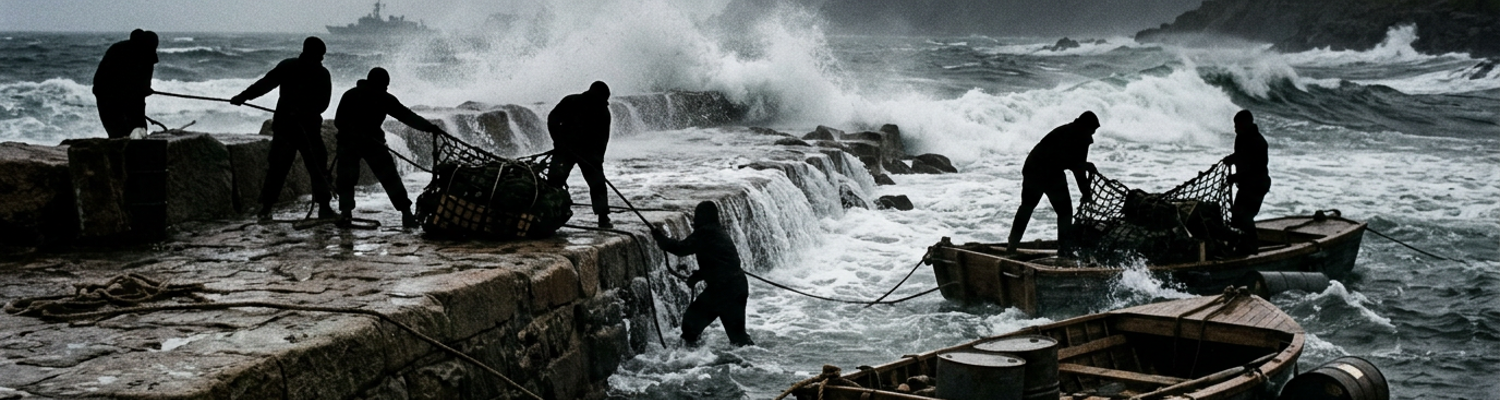
Archival evidence shows that deep Aleutian low-pressure systems generated continuous fifteen-to-twenty-foot ocean swells that struck the northern shore of Molokai throughout February and March of 1942. At the western foot of the Kalaupapa peninsula, the only maritime access point consisted of a three-hundred-foot stone breakwater originally assembled from uncemented basalt field boulders. This primitive barrier had an average crest height barely four feet above mean high tide. The inner boat pocket remained completely exposed to open-ocean energy. Heavy northern swell trains shoaled against the rising sea floor directly offshore. They slammed green water straight over the masonry wall. Waves stripped fifty-pound capstones from the seaward face and deposited them across the narrow, eight-foot dredged channel. Inside the pocket, hydraulic surges pushed the water level up and down six feet every thirty seconds. Moorings torn from iron ringbolts left no stable surface to secure incoming hulls. The designated calm-water transfer basin transformed into a turbulent surge pool.
Green water broke across the rocks day and night.
A close review of operational logs indicates that Fourteenth Naval District lighterage detachments had to run this surf line in standard twenty-six-foot pulling surfboats to offload cargo from the tender Kukui. The tender lay anchored eight hundred yards off the reef. District quartermasters loaded each surfboat to its displacement threshold with sixty-case lots of crated pharmaceutical supplies alongside five to eight standard fifty-five-gallon steel drums of 100-octane aviation fuel. Each filled drum weighed four hundred and twenty pounds. Stowed three abreast across the bottom thwart boards, this dense deadweight lowered freeboard clearance to less than twelve inches at the gunwales. When approaching the cut, cresting rear swells swamped the low-riding wooden boats from the stern quarter. Water rushed over the thwarts. This destabilized the loose barrel lashings. Weight shifted abruptly to the port side. Three surfboats rolled completely upside down in the breaking wash during a single landing sequence on February 14. Rolling fuel drums struck rowers pinned beneath the upturned hulls. Splintered wood crates dumped ampoules of medical morphine, surgical ether, and bandages into the churned seawater.
Free-floating steel drums battered the swimming sailors against the reef.
When examining the historical record of small-boat handling along the northern Molokai coastline, the mechanical weakness of steering sweeps repeatedly compromised surf zone transit. Coxswains operating in heavy breaking seas rejected fixed pintle rudders because airborne sterns lifted rudder blades clean out of the water. They relied instead on twenty-two-foot ash steering oars mounted in stern ring grommets. Entering the ninety-foot gap between the breakwater tip and the outer reef flat demanded precise directional alignment against a four-knot lateral rip current. Cross-seas caught the broadside of incoming surfboats. This exerted high hydraulic torque on the extended sweep. Operating logs record seven separate incidents in late February where ash oar shafts sheared cleanly at the neck under wave pressure. Without oar leverage, the coxswain held no method to correct a yaw. The uncontrolled boats swung perpendicular to the advancing swell faces within seconds.
Every lost oar meant a broach in the surf.
Surf swept the broadsided hulls directly onto the jagged basalt shelf flanking the breakwater entrance. Submerged volcanic pinnacles tore through oak keelsons and shredded three-quarter-inch cedar hull planking. Impact shock shattered structural ribs. Splintered timbers drove upward into the passenger benches. Boat crews scrambled over exposed rock outcrops through breaking foam. They abandoned the wrecked craft to salvage whatever floating fuel drums washed toward the stony beach. By March 8, four of the six Coast Guard surfboats assigned to the Kalaupapa supply detail lay fractured along the lava bench. Sixty tons of mainland flour and bulk sulfur drugs remained stranded offshore inside Kukui cargo holds.
Mechanical Attrition of Deck Winches and Hoisting Tackle
Archival evidence shows that offloading cargo while anchored in the unprotected northern roadstead placed destructive strain on the steam cargo winches of the tender Kukui. Booms swung over the ship side had to suspend two-ton loads directly above twenty-six-foot surfboats that rose and fell on twelve-foot ocean swells. When a rising crest lifted an offloading boat, rope tension dropped instantly to zero. As the wave crest passed, the receiving boat dropped into the trough at fifteen feet per second. This snapped the cable taut with thousands of pounds of kinetic force. This violent cycling reversed mechanical torque into the deck winch drums. Cast-iron spur gears and drive pinions cracked under the sudden shock loads. Winch operators watching the drums could not engage friction clutches quickly enough to counter the erratic vertical wave heave. Teeth sheared directly off the primary drive gears. The hoists locked in mid-cycle. Loaded cargo slings dangled between the rolling ship and the sea.
Cast-iron gear teeth sheared under sudden shock loads.
A close review of operational logs indicates that fiber cordage deterioration accelerated these mechanical failures across the boom tackle. Standard pre-war supply guidelines specified high-grade, long-fiber Manila hemp for all cargo sling nets. Wartime shortages forced district quartermasters to substitute inferior, untreated Mexican sisal. Continuous immersion in Pacific sea brine saturated the fibers during daily loading operations. Saltwater soaked into the rope cores. Trapped moisture and tropical heat bred rapid rot within forty-eight hours. Microscopic salt crystals dried inside the twisted yarns. They acted as abrasives that severed inner fibers every time the tackle flexed under load. Cargo nets rated to hoist four thousand pounds tore apart while lifting loads weighing less than seven hundred pounds. Rations, crated medical bandages, and replacement generator parts spilled into the ocean as net bases split open mid-hoist. Deck crews discarded five to eight ruined nets after every working watch. Settlement resupply operations ran completely out of serviceable cargo webbing by mid-March.
Saturated rope parted without warning.
When examining the historical record of tender maintenance, Fourteenth Naval District supply depots held zero replacement components for auxiliary deck machinery. Pearl Harbor prioritized frontline combatants. They rejected requisitions from Kukui for manufactured boom heel pins, replacement bronze bushings, and wire-rope sheaves. Shipboard machinists operated in the engine-room workshop around the clock to prevent complete hoist failure. Working with a single twenty-four-inch engine lathe, machinists cut scrap mild steel structural beams and salvaged boiler staybolts into crude cylindrical blanks. They turned these rough blanks down by hand to mill unhardened hoist pins. To replace grooved cast-iron sheaves destroyed by wire-rope friction, machinists melted down scrap bronze piping and discarded water pump impellers in an improvised deck crucible. They poured the molten alloy into green-sand molds to cast rough pulley wheels. They bored and faced these wheels without proper tolerances.
These unhardened field components wore down within hours of heavy hoisting.
Softer mild steel pins developed deep shear grooves under cable pressure. Hand-cast bronze sheaves wobbled on their axes as center bores wallowed out. Machinists packed the overheating friction surfaces with heavy graphite chassis grease every twenty minutes to suppress metal-on-metal screeching. They worked four-hour shifts on the rolling deck to drive out scored pins with sixteen-pound sledgehammers. On March 18, 1942, the forward starboard cargo boom failed completely. Its improvised three-inch sheave pin snapped in half during a forty-case lift of tinned kerosene.
Physical Exhaustion and Pali Runoff Hazards
Archival evidence shows that continuous freshwater runoff cascading down the two-thousand-foot northern Molokai pali cliffs turned the Kalaupapa beachhead into a freezing drainage zone throughout late March 1942. Trade wind precipitation averaging over one hundred and fifty inches annually across the upper Kamakou plateau collected in steep hanging valleys before plunging over the vertical basalt escarpment. Free-falling torrents disintegrated into high-velocity cold spray and ground-level sluices. This water struck the Awahua beachhead at fifty-two degrees Fahrenheit. Shore party personnel assigned from Fourteenth Naval District support units worked in knee-deep mixtures of churned red volcanic silt and sharp basalt gravel. Standard-issue cotton utility uniforms and canvas field jackets absorbed the mountain water within minutes. This added fifteen pounds of dead weight to each working seaman. Standing on slick basalt ledges under this vertical deluge, shore working parties found no dry ground to stage cargo. Waves broke against their waists from the seaward side. Cold mountain runoff poured over their shoulders from the landward cliffs.
Cold mountain water poured off the basalt wall without interruption.
A close review of operational logs indicates that prolonged physical immersion in the mixed surf and runoff created rapid medical attrition across boat crews and shore quartermasters. Men spent up to fourteen consecutive hours wading waist-deep in sixty-eight-degree seawater to wrestle twenty-six-foot pulling surfboats against the rocky surge. Wet wool trousers and salt-encrusted dungarees acted as coarse abrasives against saturated skin. They ground volcanic sand into hair follicles until debilitating saltwater boils erupted across inner thighs, groins, and armpits. These bacterial infections appeared in medical logs as sea furunculosis. They developed into open purulent lesions that made basic rowing or walking agonizing. Continuous exposure to cold cliff drainage, wind gusts, and ocean spray drove personnel into progressive hypothermia. Corpsmen logged core body temperatures falling below ninety-five degrees Fahrenheit among men who remained on the rocks for more than four hours. Violent shivering fits stripped sailors of their fine motor control. Numb fingers became incapable of untying swollen manila knotwork or seating hoisting shackles into boat rings.
Salt crust and ground basalt ate through uniform cloth into open flesh.
When examining the historical record of the Kalaupapa supply detachment, thirty-six-hour continuous duty cycles unraveled physical coordination across all cargo-handling details. District supply officers enforced non-stop offloading schedules whenever ocean swells briefly abated. They denied crews restorative sleep between incoming supply lighters. Sleep deprivation degraded motor reflexes to the point where seamen repeatedly miscalculated the speed of incoming surf surges by two to three seconds. Steel drums weighing four hundred and twenty pounds slipped from grease-smeared, water-softened hands. Men attempted to muscle them over gunwales onto wet stone ramps. Uncontrolled barrels rolled backward down the landing incline. They pinned offloaders against basalt boulders and crushed tarsal bones through waterlogged leather service shoes. During the early morning hours of March 22, two exhausted seamen handling a crated Fairbanks-Morse diesel cylinder head dropped the timber casing. An incoming four-foot surge swept their feet from beneath them. Six hundred pounds fell onto the stone landing apron. The oak crate edge struck a shore quartermaster lower leg. This caused an open compound tibia fracture that required immediate emergency splinting under blackout conditions.
By 0400 on March 23, the settlement infirmary held eleven Coast Guard and naval personnel incapacitated by skin ulcerations, hypothermic tremors, and skeletal crush injuries. Twenty-four exhausted men remained to move sixty tons of wet cargo.
Shore Staging and Critical Supply Bottlenecks
Archival evidence shows that the fixed stiff-leg derrick mounted on the stone landing apron at Kalaupapa collapsed under mechanical shock loads on the morning of March 24, 1942. Settlement maintenance crews had built the hoisting apparatus eight years earlier. They used a thirty-foot Douglas fir boom, an ungreased iron mast collar, and a hand-cranked spur-geared winch. Fourteenth Naval District shore parties attempted to use the rig to pluck four-hundred-and-twenty-pound fuel drums directly from surging surfboat gunwales. A seven-foot ocean roller slammed against a grounded lighter while three chained barrels hung suspended mid-air. Shock tension instantly exceeded the derrick two-ton threshold. The cast-iron boom step split diagonally through the center pintle socket. The upper three-quarter-inch wire stay sheared its turnbuckle threads. Timber structural members smashed across the stone apron with explosive force. Nineteen steel drums containing 50-cetane diesel fuel dropped straight into the breaking wash zone. Receding waves dragged the unanchored barrels across jagged basalt ledges. The rocks sliced open six hulls and discharged heavy oil over the narrow boat slipway.
Nineteen steel drums rolled uncontrolled through the breaking surf.
A close review of operational logs indicates that this shoreline wreckage halted the transfer of emergency medical supplies into the settlement. Records kept by the Territorial Board of Health documented that eighty-two patients suffered from concurrent diabetes mellitus requiring uninterrupted daily insulin regimens. Cargo manifests from the tender Kukui listed forty wooden cases holding U-40 and U-80 regular insulin vials. Packers padded them with excelsior shavings inside tin-lined shipping crates. Without active mechanical refrigeration on the open rocks, the suspended peptide compounds risked rapid thermal denaturing once coastal temperatures reached eighty-six degrees Fahrenheit under the midday sun. Saltwater had breached the soldered corners of several crates when landing craft foundered in the breakers. The brine soaked paper labels and coated rubber ampoule stoppers with volcanic silt. Settlement medical director Norman R. Sloan alerted military authorities that dispensary reserves had dropped to three days of usable inventory before uncontrolled ketoacidosis would disable bedridden patients. Two sealed crates carrying sterile hypodermic needles, concentrated chaulmoogra oil, and sulfa tablets lay jammed under splintered derrick beams beneath four feet of surge.
Dispensary reserves dropped to twelve usable vials.
When examining the historical record of settlement staging, Lieutenant Commander Frank A. Erickson coordinated with local overseers to move supplies using pack animals and hand litters along the waterlogged shoreline track. Shore parties conscripted nine draft mules and three pack horses from the settlement dairy to replace disabled motorized equipment. A five-ton commercial flatbed truck sat immobilized half a mile down the track. It was buried to its rear differential housing in churned red mud and volcanic scree. Handlers fashioned improvised wooden pack saddles across the withers of the mules. They secured two fifty-five-gallon fuel drums to each beast with hemp lashing. Saturated clay paths flanking Awahua Bay gave way under the weight. Animals slid down the embankment into salt marshes. To transport fragile pharmaceuticals across the impassable mud, seamen stripped canvas stretchers from aid stations. They mounted them on twenty-two-foot ash oar shafts to form four-man hand litters. Relays of four seamen carried ninety-pound crates on their shoulders. They traded off every sixty yards while wading knee-deep through coastal sludge in driving rain.
By nightfall on March 26, litter teams had dragged twenty-eight pharmaceutical boxes into the clinic. Forty-one damaged fuel drums lay half-buried in the tide line. The survival of the isolated peninsula did not depend on naval surface engagements or grand strategic planning. It rested entirely on unhardened steel pins, rotting sisal rope, and the physical endurance of twenty-four exhausted men working in fifty-two-degree runoff.