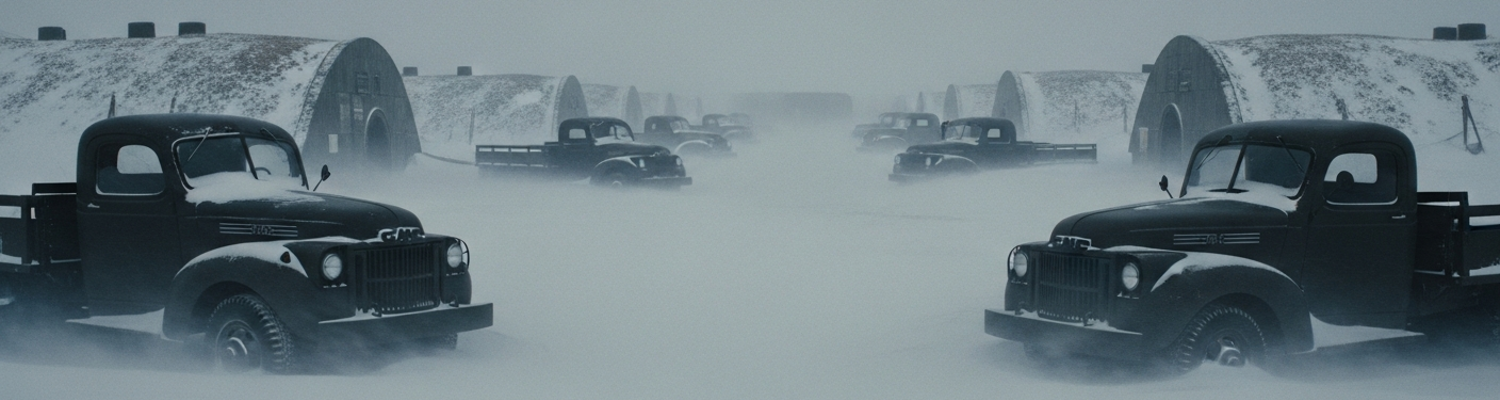

The Strategic Linchpin
Operational records from the U.S. Army Ordnance Department (NARA Record Group 156) detail the selection of Volunteer Prairie, Arizona, in 1942. The location, twelve miles west of Flagstaff, was a deliberate calculation. It was inland, secure from any theoretical coastal attack following Pearl Harbor. The terrain was open and flat, suitable for large-scale construction. Most importantly, it sat directly on the main transcontinental line of the Atchison, Topeka and Santa Fe Railway. This rail line connected eastern factories to the depot and the depot to the ports of California, forming the primary artery for the Pacific war effort. The Navajo Ordnance Depot was designed from the ground up as a remote logistical fortress, chosen for both its isolation and its connectivity.
Construction involved up to 8,000 laborers, who erected nearly 800 specialized storage bunkers across the 28,000-acre site. These were not sheds. They were formidable arch-shaped structures of concrete and steel, known as "igloos," each covered with a thick layer of earth for blast protection and concealment. A network of 227 miles of roads and 38 miles of internal railroad track connected these magazines. The depot's high elevation, approximately 7,100 feet within the Coconino National Forest, was initially seen as an advantage for storing volatile munitions in a cool climate. This assumption would be tested.
The primary mission was the receipt, storage, and shipment of ammunition for the Pacific Theater. The depot functioned as a massive surge tank in the supply pipeline. Munitions arrived, were stored, and then called forward for shipment to debarkation ports. This process ensured a regulated stream of materiel was available for naval and ground forces. A delay at the depot, caused by any number of potential issues, could translate directly into a shortfall for a Marine division preparing for an amphibious assault. The work was a constant, heavy routine of receiving, cataloging, and shipping under immense pressure.
Specialized Ordnance for a Pacific War
The island-hopping campaign demanded a unique arsenal. Field requisitions from late 1944 campaigns on Peleliu and in the Philippines consistently called for ordnance designed to defeat an enemy in caves, reinforced bunkers, and dense jungle. Standard high-explosive artillery was often ineffective against fortifications carved into volcanic rock. In response, supply commands saw a high demand for M2 flamethrowers, napalm bombs, and white phosphorus rounds for mortars and artillery. These were tools for brutal, surgical work.
Napalm, used systematically for the first time in the Pacific, was requested to burn away jungle canopy and create firestorms inside bunker complexes. Marine units developed tactics involving dousing cave openings with unlit flamethrower fuel, allowing vapors to permeate the tunnels, and then igniting the space with a white phosphorus grenade. This created a devastating concussion and consumed all oxygen. White phosphorus, or "Willie Pete," was also fired from 60mm and 81mm mortars not just for smoke screens, but to flush defenders from fortified positions. Handling these incendiary and chemical munitions required specific procedures, adding another layer of complexity for personnel at Navajo managing their storage and shipment in the freezing highlands.
Timely distribution was paramount. The entire two-pronged advance across the Pacific, led by Admiral Nimitz and General MacArthur, was a sequence of interlocking logistical calculations. Planners for major assaults built their timetables around the arrival of supply ships from the West Coast. A single day's delay at a stateside depot like Navajo could cause a transport to miss its convoy. The vast distances involved left no margin for error. A failure to load a boxcar of 105mm artillery shells in Arizona could translate directly into an artillery battery on Leyte being unable to support an infantry advance weeks later.
The Arctic Anomaly of 1944
In the final weeks of 1944, a Siberian airmass descended upon northern Arizona. Regional meteorological archives confirm a period of sustained, record-breaking low temperatures and heavy snowfall. For the personnel at the Navajo Ordnance Depot, the event was a shock. The site was suddenly subjected to conditions more akin to the Eastern Front than the American Southwest. Nightly temperatures plunged below zero, and deep snow overwhelmed the depot's light clearing capabilities. The 28,000-acre facility became a frozen labyrinth.
The depot’s mechanical systems shattered. The extreme cold had an immediate and widespread effect on every piece of equipment. Maintenance records from this period reveal a cascade of failures. Standard-issue lubricants in cargo cranes and transport trucks congealed into a thick, useless sludge. Steel, made brittle by the cold, fractured under normal stress. This was most apparent along the 38 miles of internal railroad track, where frozen switches refused to move and steel rails cracked, halting internal train movements. The fleet of GMC CCKW 2½-ton trucks fared no better. Engines failed to turn over, fuel lines froze, and tires lost traction on the icy service roads connecting the 800 ammunition igloos.
Army planners had selected the site for its rail access and security but had equipped it based on average climatic data. There was no specialized arctic-grade equipment. The clothing issued to soldiers and the large contingent of Navajo and Hopi civilian workers was inadequate for sub-zero temperatures, leading to a rapid decline in manpower efficiency from frostbite and exhaustion. The depot's operational model, dependent on the constant movement of material from dispersed bunkers to a central railhead, was now its greatest vulnerability.
Command Structure Paralysis
Post-action reports reveal a near-total disintegration of the depot’s formal command structure. The Navajo Ordnance Depot operated under a conventional military hierarchy, with an Army Ordnance Corps colonel in command. This centralized model collapsed when the storm hit. The command post was as isolated as any other part of the depot. With 227 miles of internal roads impassable and 38 miles of rail lines frozen, communication beyond line-of-sight became nearly impossible. Orders from the depot commander were theoretical, unable to be physically delivered.
The depot’s design, intended to mitigate explosions by dispersing bunkers, now guaranteed a breakdown in leadership. Individual sector supervisors, responsible for blocks of igloos, were cut off. They were forced to act on their own initiative, becoming autonomous commanders of their frozen domains. Decisions were made based on the immediate needs of a handful of men trying to prevent pipes from bursting or find a single working vehicle. This fragmentation created disconnected, competing efforts.
There was no unified emergency response. The depot’s contingency plans focused on munitions-related disasters like fires or sabotage, not large-scale environmental events. There was no doctrine or pre-assigned crisis management team. The depot commander and his section chiefs, experts in logistics, found themselves leading separate, uncoordinated battles. The chief of motor transport focused on the GMC trucks, while the head of rail operations concentrated on freeing frozen switches. These efforts were not synchronized. No single figure was empowered to triage the catastrophe or establish a depot-wide priority list. The large civilian workforce, including hundreds of essential Navajo and Hopi personnel, lacked a clear chain of command in the chaos.
Collapse of the Internal Transport System
Maintenance logs from late 1944 document a system-wide mechanical failure. The depot’s 38 miles of internal railroad track seized first. Extreme cold caused the steel rails to become brittle, and reports document multiple instances of rail fractures. Just as damaging was the effect of ice on the manually operated switch points. Packed with snow that melted and refroze into solid blocks, they became immovable. Rail crews with pickaxes and blowtorches found that the intense cold often refroze the meltwater as quickly as they could clear it. Spur C-4, servicing igloos with high-priority 500-pound bombs for Army Air Forces B-29 groups, was cut off for more than a week by a fractured rail and three frozen switches.
What the rails could not move, the 227 miles of service roads were supposed to handle. That network also ground to a halt. The depot’s motor transport pool, primarily GMC CCKW 2½-ton trucks, was not equipped for arctic conditions. Standard lubricants congealed, preventing engines from turning over. Diesel fuel lines froze, and the fuel itself began to gel, clogging filters. Tires, their rubber hardened by the cold, lost traction on the icy, unplowed roads. A documented incident on a primary access road saw a three-truck convoy jackknife and slide into a ditch, creating a physical barricade that took recovery crews four days to clear.
This mechanical paralysis directly threatened the war effort. Outbound ordnance shipments ceased. War Department requisitions continued to arrive, but they could not be filled. One high-priority order for 40,000 rounds of white phosphorus for 81mm mortars, requested by Marine Corps units preparing for Iwo Jima, could not be met. Depot command knew the munitions were in Igloos 715 through 725, but they were physically unreachable. In the main classification yard, dozens of empty Atchison, Topeka and Santa Fe Railway boxcars sat idle, waiting for cargo that could not be moved the last thousand yards from its bunker.
Desperate Improvisation by Junior Engineers
With the formal command structure isolated, authority fell to small teams led by junior Army officers and senior NCOs. Lieutenants and sergeants of the U.S. Army Ordnance Corps and the Corps of Engineers became the de facto commanders of their sectors. Trained in routine maintenance, not disaster recovery, they were confronted with systemic failures under conditions no manual had envisioned. Operating with no oversight and few resources, these small teams were forced to devise solutions.
To free frozen rail switch points, engineer teams built makeshift pyres directly on top of the mechanisms, using scavenged railroad ties soaked in diesel fuel. This act, performed yards from igloos containing high explosives, became a standard procedure. To repair fractured rails, welder teams worked in sub-zero temperatures to crudely weld the broken steel back together. These were rough patches intended only to bear the weight of a single, slow-moving train.
Simultaneously, ordnance mechanics attacked the paralysis of the truck fleet. They drained the congealed oil from engines, heated it in 55-gallon drums over open fires to restore viscosity, and then poured the scorching liquid back into the machinery. It was a brutal process, but it worked long enough to get an engine to turn over. For traction, welders crudely attached steel cleats scavenged from scrap metal directly to the tires of trucks. Other crews organized human-powered solutions, with soldiers and civilian workers from the local Navajo and Hopi nations walking ahead of trucks, manually spreading sand from burlap sacks to give the tires a momentary grip.
The Physics of Cold-Weather Failure
Mechanical failures began at a molecular level. Standard-issue lubricants like Army specification 2-106B engine oil and MIL-G-10924 grease were engineered for temperate climates. As temperatures dropped, they did not simply thicken; they congealed into a dense, waxy sludge. This process, known as reaching the pour point, created a bonding agent that fused moving parts together. The engine blocks of the GMC trucks were filled with a substance that prevented pistons from moving. The hydraulic systems of cranes were filled with the same useless jelly.
Attempts to start the trucks resulted in the high-pitched whine of a starter motor straining against a frozen engine, often ending with the battery dying or the starter burning out. For the few engines that could be forced to turn over, the congealed lubricant offered no protection, leading to severe damage as metal ground against unprotected metal. The No. 2 diesel fuel used in heavy vehicles began to gel as paraffin wax precipitated out, forming crystals that clogged fuel lines and injectors. Mechanics, with frostbitten hands, resorted to building small fires under the steel fuel tanks of trucks to liquefy the gelled fuel, risking an explosion with every attempt.
This desperate battle created a unique sensory environment. The air in repair areas was a thick mixture of smells, dominated by the acrid burn of diesel and the sharp, chemical tang of cordite. In the absence of de-icing equipment, teams sometimes detonated small, unconfined charges of smokeless powder scavenged from artillery propellant bags to break ice on mechanisms. The resulting blast of hot gas filled the maintenance bays with the unmistakable odor of burnt propellant. This smell mixed with fumes from diesel-soaked rags used to heat parts and the exhaust from the few engines they managed to keep running. Mechanics worked in this toxic fog, cannibalizing batteries, starters, and fuel pumps to create a handful of functional "Frankenstein" trucks from the wreckage of others.
Volatile Munitions in the Cold
The extreme cold introduced new, unpredictable risks to ammunition handling. Propellant charges, particularly for large-caliber artillery, are manufactured for consistent performance within specific temperature ranges. Sub-zero temperatures could alter the burn rate of the nitrocellulose-based powders, potentially leading to dangerous pressure variations in a gun breach. More immediate was the physical danger. A slick layer of ice coated every bomb casing and artillery shell, making them almost impossible to grip with standard-issue work gloves that offered little insulation against the cold. A dropped 155mm shell, weighing nearly 100 pounds, could easily damage a fuze or crack its casing.
Fuzing mechanisms themselves became a source of concern. The delicate clockwork and chemical components inside point-detonating and time fuzes were not designed for prolonged exposure to such temperatures. Condensation could freeze inside the mechanisms, rendering them inert or, worse, unpredictable. The men tasked with moving this ordnance were often working in near-whiteout conditions, with numb hands, suffering from exhaustion and the early stages of frostbite. The high altitude already reduced physical endurance; the cold magnified it. Under these conditions, loading a single truck, a task that normally took less than an hour with a crane, could consume an entire day and leave a crew physically broken, increasing the chance of a fatal error with every frozen crate they moved.