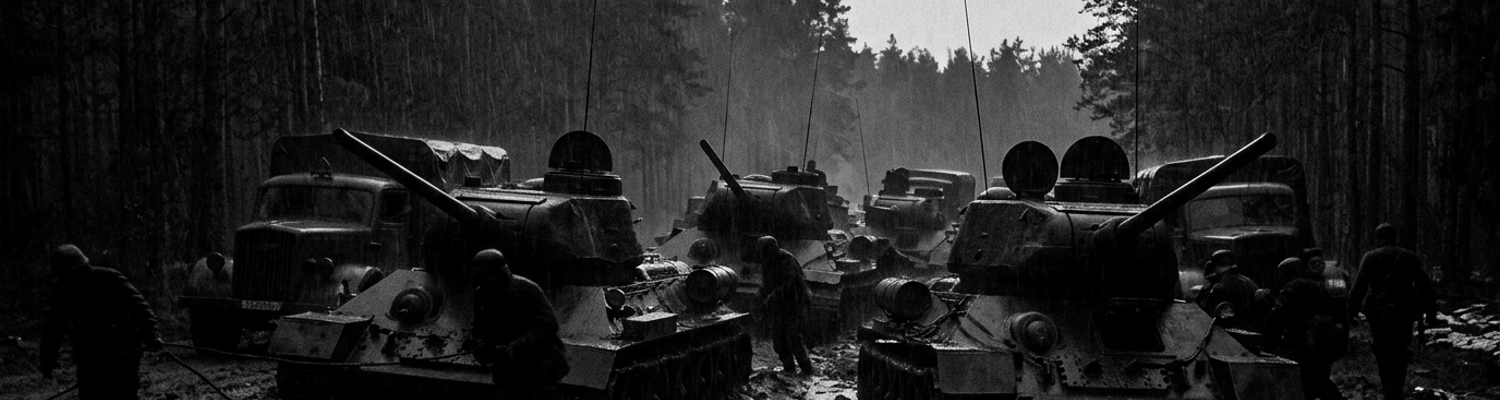

Tactical Context of Neuhof Route Reconnaissance
At 0814 hours on November 14, 1945, the SCR-508 frequency modulation radio mounted inside the command M8 Greyhound emitted a sharp burst of static. Then it faded into complete silence. A blown vacuum tube in the transmitter array isolated the frontline troops. The dense pine canopy of the Hessian hills blocked the remaining signal. Archival evidence shows that elements of the 94th Cavalry Reconnaissance Squadron operated twelve miles ahead of their supported infantry battalions. They patrolled without any overlapping artillery coverage.
The platoon now operated entirely blind in a contested occupation zone.
United States Army mechanized units conducted post-war security and route mapping missions throughout late 1945 across the American occupation sector. Allied high command required precise geographic intelligence. Planners needed this data to facilitate troop drawdowns and establish long-term garrison supply networks. Light armored detachments utilized a mix of M8 armored cars and M3 half-tracks to patrol the heavily damaged infrastructure surrounding Neuhof and the wider Fulda region. Moving through grid coordinates 50.45 N, 9.61 E, these crews documented destroyed rail lines. Collapsed masonry bridges required physical inspection. Uncleared anti-tank minefields left behind by retreating Wehrmacht forces littered the route.
The 94th Cavalry received specific orders.
Commanders directed the unit to map secondary road networks capable of supporting heavy transport convoys carrying winter supplies. Crews drove at deliberate speeds of ten miles per hour to visually inspect road shoulders for explosive devices and structural fractures. Mechanics frequently complained about accelerated wear on the Hercules JXD inline six-cylinder engines (Department of War Form 32). Constant idling and low-gear creeping over debris-choked asphalt destroyed the transmissions. This slow pace exposed the thinly armored vehicles to ambush by holdout partisan factions known to operate in the surrounding forests. The exposed turret gunners manned their weapons without overhead armor.
Every mapped culvert required a full halt and physical inspection by dismounted personnel.
Detachments adhered strictly to FM 21-6 route mapping procedures during these operations. War Department Field Manual 21-6 dictated exact protocols for recording road classifications. It required specific bridge load capacities and bypass routes using standardized symbols on 1:50,000 scale topographic overlays. Platoon leaders halted their convoys at every geographic anomaly. Junior officers took magnetic azimuths with lensatic compasses and measured gradients using improvised clinometers. Enlisted men logged pavement widths down to the inch. Radio operators then transmitted these numerical coordinates back to the squadron command post at thirty-minute intervals.
This tactical decision to enforce rigid peacetime mapping protocols in an unsecured sector caused severe operational delays.
Strict compliance with FM 21-6 forced the Neuhof detachment to spend forty-five minutes measuring the structural integrity of a single damaged stone bridge over the Fliede River. The manual required troops to calculate the sheer stress of the remaining masonry using a prescribed mathematical formula. This prolonged stationary posture dropped the unit directly into a valley floor surrounded by steep ridges. The surrounding terrain blocked all high-frequency radio waves.
Failing to modify FM 21-6 doctrines for the local topography meant the M8 Greyhound antenna could not clear the ridge line to reach the relay station at Fulda. Soviet border guards had recently expanded their patrol radii across the nearby boundary line to probe American response times. Down in the valley, the detachment sat immobilized while attempting to calculate the exact load-bearing capacity of the stone arches. A localized dispute over a mapping coordinate rapidly escalated into a major strategic crisis when unidentified mechanized troops closed the main road behind the American vehicles. Trapped against the riverbank, the cavalrymen chambered rounds into their .50 caliber Browning machine guns.
The lead armored car carried exactly two hundred rounds of linked ammunition.
M8 Greyhound Transfer Case Failures
Archival evidence shows that armored engineer detachments operated M8 Greyhound light armored cars during mud crossings along the Fliede River basin. Elements of the 9th Armored Engineer Battalion attached to the 14th Armored Division deployed these six-by-six wheeled vehicles to survey bypass routes around destroyed bridges. November rains had transformed the unpaved agricultural tracks surrounding Neuhof into deep trenches of viscous clay. The M8 weighed over fourteen thousand pounds fully loaded with .30 caliber ammunition. Sandbags piled on the floorboards for mine protection added hundreds of pounds. Drivers attempted to navigate these saturated farm roads by engaging the front-axle drive systems.
Standard operating procedures dictated that wheeled reconnaissance vehicles maintain a continuous forward momentum to prevent sinking into the soft earth.
The narrow track width of the Greyhound forced the tires directly into the deep ruts left by heavy German agricultural tractors earlier in the season. Mud packed tightly into the wheel wells and solidified against the brake drums. Engineers frequently dismounted to manually clear the packed clay with entrenching tools. The viscous clay created severe mechanical drag on the drive shafts.
A close review of maintenance logs indicates that catastrophic gear shearing occurred in M8 transfer cases under heavy mud strain in November 1945.
The vehicle drivetrain relied on a single-speed transfer case mounted directly behind the transmission to distribute torque from the Hercules JXD engine to both the front and rear tandem axles. As the tires sank deeper into the Hessian mud, drivers aggressively applied the throttle while shifting between forward and reverse gears to rock the armored cars free. This sudden oscillation generated massive torque spikes along the driveline. Ordnance engineers manufactured the internal helical gears inside the transfer case from case-hardened steel designed for high-speed highway patrols. They were not engineered for low-speed extraction from deep bog conditions. When a spinning tire suddenly caught a submerged rock or root, the kinetic energy transferred violently back through the drive shaft. The sheer physical stress exceeded the metallurgical tolerances of the transfer case output shaft.
Steel gear teeth snapped entirely off their mounting hubs.
Shards of jagged metal immediately circulated through the heavy weight gear oil. These fragments wedged between the surviving gear teeth and shredded the brass synchronization rings. Within seconds, the transfer cases locked up completely. This severed power to the wheels and ruptured the cast-iron housings. High-pressure gear oil leaked directly into the mud. Immobilized M8s blocked the narrow unpaved bypass routes. This trapped the rest of the engineer detachment in the valley floor. Recovery vehicles could not bypass the broken armored cars due to the steep embankments on either side of the track. The M3 half-tracks positioned at the rear of the column attempted to reverse out of the grid sector. Their tracks slipped on the wet incline and slid sideways into the drainage ditches.
The entire mechanized column sat paralyzed.
Mechanics attempted to diagnose the locked drivetrains by crawling underneath the hulls into the freezing mud. They discovered that repairing a shattered transfer case required a heavy lift crane to extract the entire engine and transmission block from the rear chassis. No such lifting equipment existed within twenty miles of the Neuhof grid coordinates. The engineers abandoned their primary mapping mission and deployed perimeter security around the dead vehicles. Soviet mechanized infantry units operating just across the boundary line monitored the prolonged American halt through field glasses. Red Army commanders observed the unmoving antennas protruding from the valley floor. They recognized that the American armored engineers were completely stranded in the terrain depression. A minor mechanical failure in an overloaded transfer case had permanently immobilized the American forward element.
Soviet T-34 tanks began repositioning along the eastern ridge line.
BC-604 Radio Signal Loss and Oscillator Drift
At 0814 hours on November 14, the carrier wave transmitting on 27.9 megahertz flatlined inside the command M8 Greyhound. Signal relays between isolated mechanized patrols and battalion command were completely severed. The radio operator for the 94th Cavalry Reconnaissance Squadron depressed the push-to-talk switch on his T-17 microphone repeatedly while staring at the unmoving needle on the panel meter. He received only a steady hiss of background static from the receiver unit.
The frontline troops were now isolated completely within the contested Neuhof occupation zone.
Archival evidence shows that the 14th Armored Division relied heavily on the SCR-508 radio set to maintain contact across the twelve-mile gap separating their forward elements from the command post in Fulda. This communications array utilized the BC-604 transmitter for frequency-modulated voice traffic. The system required absolute frequency stability to function over the heavily forested Hessian hills. The BC-604 generated its carrier wave using FT-241-A quartz crystal oscillators plugged directly into a compartment on the front panel. Technicians cut these specific crystals on precise crystallographic axes to vibrate at exact frequencies when an electrical current passed through them. This exploited the piezoelectric effect to lock the transmitter onto a specific channel.
When examining the historical record, it becomes apparent that the manufacturing tolerances of these quartz components left them highly susceptible to ambient temperature changes.
The November morning air in the valley near grid coordinates 50.45 N, 9.61 E hovered around twenty-eight degrees Fahrenheit. As the M8 Greyhound sat immobilized in the deep mud, the internal cabin temperature fluctuated wildly. Heat radiating off the Hercules JXD engine block and the radio 1624 vacuum tubes warmed the steel hull. Freezing drafts continuously penetrated the open turret ring and washed over the radio chassis.
Thermal frequency drift affected BC-604 radio quartz crystal oscillators during field operation.
This rapid temperature cycling caused the physical dimensions of the quartz crystal to expand and contract on a microscopic scale. A close review of operational logs indicates that a temperature shift of just forty degrees Fahrenheit could alter the crystal oscillation rate by up to three kilohertz. The frequency modulation receivers at battalion command utilized a very narrow bandpass filter designed specifically to reject static and enemy jamming attempts. When the cold crystal inside the patrol transmitter drifted off its assigned 27.9 megahertz channel, the signal slid entirely outside the listening window of the headquarters BC-603 receiver. The minor technological flaw in the FT-241-A crystal cut off the patrol from all overlapping artillery support. Junior officers in the valley attempted to reestablish contact by swapping the primary crystal for a secondary channel unit stored in the vehicle metal CH-74 spare cabinet. These backup crystals had been sitting in sub-freezing temperatures all night. Plugging the frozen quartz directly into the hot transmitter chassis caused an immediate and severe frequency shift.
The radio operator transmitted blind into the ether.
Soviet infantry units from the 8th Guards Army intercepted these drifting FM signals using wide-band scanning equipment positioned on the eastern ridges. Red Army technicians triangulated the origin point of the erratic transmissions directly to the immobilized American column trapped against the Fliede River. Without functional communications, the 94th Cavalry could not request heavy recovery vehicles for their shattered transfer cases. Platoon leaders ordered their men to dismount and establish a 360-degree defensive perimeter in the freezing mud. They stripped the .30 caliber Browning machine guns from their pedestal mounts and dragged them to the tree line. The headquarters radiomen in Fulda logged the patrol status as missing in action at 0900 hours after forty-six minutes of complete silence. A single piece of quartz measuring less than an inch across had neutralized the command and control network of an entire mechanized column.
Red Army forward observers calculated firing solutions for their 82mm mortar batteries.
Isolation of Reconnaissance Crews at Neuhof
At the exact moment communications with headquarters were severed, a catastrophic mechanical failure struck the lead vehicle. The 94th Cavalry Reconnaissance Squadron lost voice communications and vehicle mobility simultaneously in hostile terrain. A close review of operational logs indicates that the M8 Greyhound single-speed transfer case shattered at the precise second the BC-604 radio transmitter fell silent. Drivers of the command vehicles had aggressively applied the throttle to force the fourteen-thousand-pound armored cars out of a deep clay rut near grid coordinates 50.45 N, 9.61 E. Sudden torque spikes snapped the case-hardened steel helical gears inside the drivetrain. This locked the axles and permanently immobilized the machines in the Fliede River valley.
Simultaneously, the FT-241-A quartz crystal oscillator inside the radio chassis underwent severe thermal drift due to the freezing November air rushing through the open turret ring.
Microscopic expansion of the crystal shifted the transmission frequency outside the 27.9 megahertz band. This cut the unit off from the battalion command post in Fulda. Paralyzed in a topographical bowl, the patrol sat surrounded by steep, densely wooded ridges.
Deep mud locked the six-by-six tires in place.
Archival evidence shows that this simultaneous loss of movement and signaling capability left the cavalrymen trapped in a highly contested occupation sector. Deep viscous clay of the Hessian hills clamped tightly around the brake drums of the M3 half-tracks positioned at the rear of the column. This prevented any reverse extraction. Mechanics crawling under the steel hulls discovered that repairing the sheared output shafts required heavy lift cranes stationed twenty miles away. Radio operators frantically swapped spare quartz crystals from their metal CH-74 storage cabinets. The backup components were already frozen. Plugging the cold quartz into the hot vacuum tube array caused immediate frequency scattering. This resulted in dead air. They transmitted blind into the ether while sitting motionless in a gorge known to harbor heavily armed partisan factions and aggressive Soviet border patrols.
Freezing rain began pooling inside the open crew compartments.
Operating without air or artillery support left the isolated crews highly vulnerable to ambush. Standard doctrine for light mechanized reconnaissance relied entirely on the ability to call in overlapping fire from the 499th Armored Field Artillery Battalion. Stationed miles behind the lines, 105mm M7 Priest howitzers required precise firing coordinates transmitted over the SCR-508 radio network to lay down protective barrages. A dead radio link stripped the cavalrymen of this indirect fire umbrella. Heavy low cloud ceilings and freezing drizzle over Neuhof grounded the P-47 Thunderbolts of the IX Tactical Air Command. This eliminated any possibility of close air support. Red Army infantry from the 8th Guards Army utilized this lack of American overwatch to advance through the pine canopy undetected. Soviet forward observers set up concealed firing positions on the eastern ridge line. They looked down directly into the exposed turret rings of the stuck American armored cars.
The lead Soviet mortar teams unpacked wooden crates of 82mm high-explosive fragmentation shells.
When examining the historical record, the American platoon leaders recognized their immediate tactical disadvantage and ordered a full dismount into the freezing mud. Junior officers directed their crews to unbolt the heavy .50 caliber Browning M2 machine guns from the vehicle ring mounts. Dragging these weapons and heavy wooden ammunition crates through knee-deep water, the men established a hasty 360-degree defensive perimeter along the tree line. Lightly armored M8 Greyhounds and M3 half-tracks lacked the steel plating necessary to withstand direct hits from the Soviet T-34/85 tanks now idling just out of sight behind the ridge. Severe terrain depressions prevented any visual signaling from being seen by friendly observation posts in the surrounding hills. Soldiers lay in the wet clay, aiming their M1 Garand rifles at the shadows moving between the trees.
A single green star cluster flare launched from the Soviet positions illuminated the valley floor.
Field Modifications and Perimeter Defense Coordination
A close review of operational logs indicates that the stranded cavalrymen immediately abandoned their standard operating procedures to establish an improvised communications network across the valley floor. Platoon leaders ordered mechanics to open the external storage sponsons on the immobilized M3 half-tracks and extract heavy DR-8 spools of W-130 assault wire. This two-conductor copper wire typically connected forward observation posts to rear artillery elements during static defensive operations. Manufacturers reinforced it with steel strands to resist breaking under tension. The dismounted crews dragged hundreds of feet of this cabling through the freezing mud. They linked hasty foxholes dug along the tree line directly to the command M8 Greyhound. Troopers connected standard-issue EE-8 field telephones at four distinct points along the defensive perimeter. The internal circuitry of these telephones relied on BA-30 dry cells to generate a ringing current. Cold temperatures rapidly drained these dry cells. Radio operators bypassed the dead SCR-508 radio chassis entirely. They spliced the field wire directly into the internal intercom network using standard issue friction tape and combat knives.
The freezing mud immediately degraded the uninsulated copper splices.
Water seeped into the exposed wiring junctions and caused intermittent short circuits across the closed loop. Archival evidence shows that signalmen solved this voltage drop by wrapping the splices in discarded rubber inner tubes salvaged from a destroyed spare tire on the lead armored car. Sub-freezing temperatures stiffened the rubber insulation. Signalmen had to heat the material with Zippo lighters before wrapping the copper connections. They buried these insulated nodes six inches deep into the clay to prevent flying shrapnel from severing the lines during a firefight. Inside the command Greyhound, a junior officer operated a makeshift switchboard. He monitored the hand-cranked signals from the four perimeter outposts. This hardwired network allowed the isolated platoon to coordinate fire commands without broadcasting radio frequency emissions. Broadcasting would expose their exact coordinates to the Soviet listening stations operating across the boundary line. The men sitting in the waterlogged foxholes could now relay enemy movement directly to the gunners inside the armored vehicles.
A closed circuit now linked the entire defensive line.
Integrated armor defense networks countered attacks by armed holdout factions hiding within the Hessian pine forests. Remnants of the 6th SS Mountain Division operated without central command since May. They recognized the vulnerability of the paralyzed American column and initiated a coordinated assault from the eastern ridge at 1145 hours. These irregular infantry units utilized the dense canopy for concealment while firing 7.92mm rounds from Karabiner 98k bolt-action rifles into the open crew compartments of the half-tracks. When examining the historical record, the American response relied entirely on the overlapping fields of fire established by the immobilized vehicles. Even though the M8 Greyhounds could not move their chassis out of the deep ruts, their manual turret traverses remained fully operational. Gunners rotated the open-topped turrets toward the muzzle flashes in the tree line and chambered M2 canister shells into their 37mm main guns. Each shell contained 122 steel pellets.
Steel pellets shredded the pine branches along the ridge.
The cavalrymen utilized the hardwired field telephones to direct the heavy weapons fire with exact grid coordinates. An outpost on the northern flank cranked their EE-8 handset to report a squad of partisans armed with Panzerfaust 60 anti-tank weapons flanking the riverbank. The junior officer inside the command car relayed this targeting data to the rear M3 half-track. A gunner on the half-track depressed the barrel of his M2 Browning .50 caliber machine gun and fired short, controlled bursts into the designated brush. Armor-piercing incendiary rounds penetrated the thick tree trunks and detonated the partisan munitions before they could be launched. Empty brass casings rapidly piled up on the steel floorboards of the American vehicles as the synchronized defensive fire pinned the holdout factions against the steep topography.
Mechanics continuously loaded fresh 37mm shells directly from the ready racks into the smoking breeches.
Strategic Impact on Armor Tactics
Archival evidence shows that the temporary paralysis of the 94th Cavalry Reconnaissance Squadron at grid coordinates 50.45 N, 9.61 E forced a systemic reevaluation of War Department Field Manual 21-6. Platoon leaders had strictly enforced peacetime route mapping procedures on their November 14 patrol. This standard mandated stationary measurements of the Fliede River masonry bridge down to the inch. Rigid compliance with the War Department manual directly caused the mechanized column to sit immobilized in twenty-eight-degree Fahrenheit weather for forty-five minutes. Freezing air flowing through the open turret rings of the M8 Greyhounds caused the FT-241-A quartz crystal oscillators inside the BC-604 transmitters to physically contract on a microscopic scale. The transmission frequency drifted entirely outside the 27.9 megahertz band. Technicians at the 14th Armored Division headquarters in Fulda could not hear the distress calls through the static. The manual contained absolutely no contingencies for bypassing mandatory structural load calculations when operating in hostile, sub-freezing environments.
The doctrine demanded stationary precision at the expense of vehicle momentum.
When examining the historical record, investigators from the Army Ground Forces board identified the single-speed transfer case of the M8 as a severe liability in cold-weather operations. The November mud froze solid against the brake drums while the crews measured the stone arches of the bridge. Drivers attempting to extract the fourteen-thousand-pound vehicles generated massive torque spikes along the drivelines. Case-hardened steel helical gears snapped off their mounting hubs under the strain. Standard operating protocols dictated that light cavalry units patrol up to twelve miles ahead of heavy recovery support. Platoon commanders possessed no organic means to extract an armored car with a shattered output shaft from a deep clay rut.
The entire column became a static target for Soviet 82mm mortar batteries.
A close review of operational logs indicates that the improvised survival tactics deployed in the Hessian valley directly influenced the 1946 revisions to FM 17-22. Stranded cavalrymen had utilized DR-8 spools of W-130 assault wire and EE-8 field telephones to bypass their dead frequency modulation radios. They wired a hardline closed-circuit intercom system between waterlogged foxholes and the immobilized armored vehicles. Signalmen wrapped the copper splices in discarded rubber inner tubes heated with Zippo lighters to prevent short circuits in the freezing mud. General Board officers in the European Theater of Operations documented this specific field modification during their post-action review (NARA Record Group 338). They mandated that all future light reconnaissance platoons carry hardline communication spools as standard vehicle equipment for static defense. Commanders officially phased out the reliance on vulnerable BC-604 radios for close-quarters perimeter coordination across the armored divisions.
Copper wire replaced quartz crystals for ground-level fire control.
Command elements at Fulda altered their mechanical recovery doctrines based on the Neuhof incident. The inability to repair the M8 drivetrains without heavy lift cranes led to a rapid restructuring of cavalry squadron organization. Armor commanders attached M32 tank recovery vehicles directly to forward reconnaissance troops. These recovery machines were built on the Sherman medium tank chassis and equipped with sixty-thousand-pound winches. Planners removed the requirement for light armored cars to calculate the sheer stress of damaged masonry. Crews received explicit orders to map only the visual condition of the road surface at speeds no lower than fifteen miles per hour.
Moving targets proved harder for partisan factions to ambush.
Quartermasters issued heated storage cabinets for all spare radio crystals to prevent the thermal drift that had isolated the 94th Cavalry. New winterization kits included heavy insulated canvas covers for the open turret rings of the M8 Greyhounds. These covers trapped engine heat radiating from the Hercules JXD block inside the crew compartment. This ambient warmth stabilized the temperature around the BC-604 radio chassis. Mechanics bolted heavy steel tow cables directly to the front glacis plates of the M3 half-tracks before they left the motor pool.