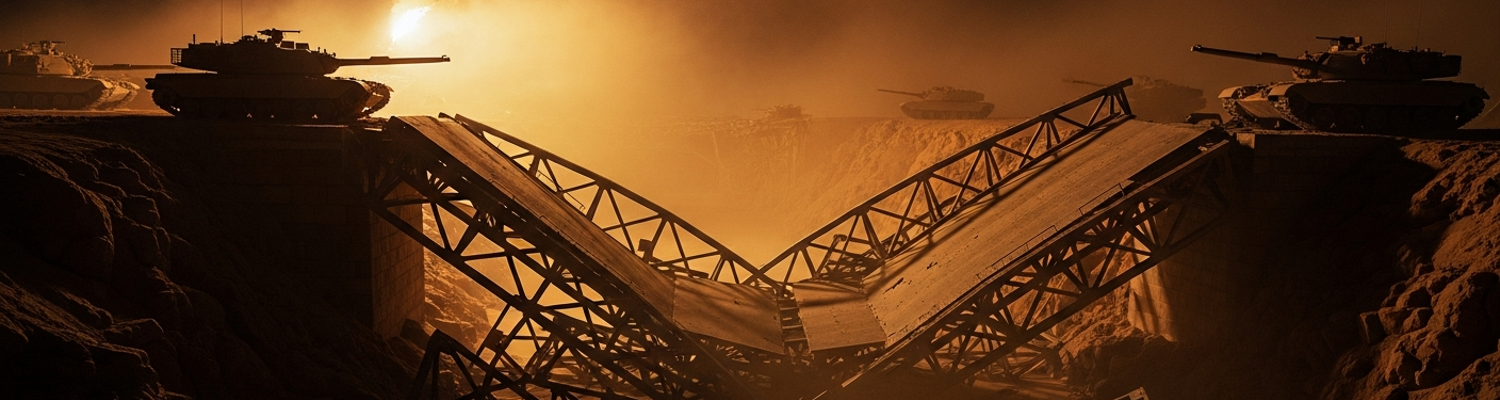

The primary launch actuator gave a high-frequency shudder. Inside the M60A1 Armored Vehicle Launched Bridge (AVLB) chassis, a hydraulic fluid pressure gauge flickered, then dropped. The whine of the overworked pump rose in pitch until it shrieked. Then, silence, punctuated by the metallic groan of the 13-ton aluminum scissors bridge as it sagged, its two halves failing to meet and lock over the wadi. The cantilevered launch arm, its main ram now devoid of pressure, could no longer support the weight. A shower of hydraulic fluid, atomized by the pressure of the seal failure, misted the vehicle’s glacis plate.
This failure began two decades earlier.
A review of operational logs from the U.S. Army Engineer Research and Development Laboratories shows the Mongoose bridge system originated under the designation Project 7796-7819. The project was initiated in the late 1970s with a singular, narrowly defined objective: rapid emplacement. Cold War doctrine in Europe fixated on the speed of a potential Soviet armored assault across the North German Plain. U.S. and NATO war plans depended on the ability to counter-maneuver armored brigades with equal velocity. This created an urgent engineering requirement for a bridging system that could be deployed faster than existing AVLBs. The M60-based AVLB, while reliable, had a listed deployment time of three to ten minutes, a window planners feared was too wide. Project 7796-7819 was tasked with delivering a system that could guarantee a 60-foot span in under 180 seconds.
The design, developed at the Aberdeen Proving Ground, centered on a novel, high-pressure, single-ram hydraulic launch arm and a lightweight, honeycombed aluminum bridge deck. The entire system was designed around the idea of a single, powerful motion, slamming the bridge into place.
That singular focus on speed came at a direct cost. Archival evidence shows the project’s development cycle was aggressively accelerated by directives from the Army’s Training and Doctrine Command. The pressure to field the system meant that comprehensive testing protocols were deliberately curtailed. The Mongoose excelled in repeated, controlled demonstrations on the flat, stable test pads of Aberdeen. Engineers conducted hundreds of successful deployments on level concrete, each one validating the core concept of rapid emplacement. They clocked deployment times as low as 155 seconds, beating the project requirement.
They did not test for environmental variance or material fatigue under operational stress. The test logs contain no entries for deployment on gradients greater than 10 percent, nor do they show any trials conducted on loose, unstable soil like sand or gravel. The hydraulic system was never subjected to the prolonged, high-stress pressures it would encounter while trying to stabilize the bridge on uneven ground. The system’s main actuator seals, specified to handle the clean, brief cycles of a perfect launch, were never evaluated for performance when held under sustained, shifting loads. This prioritization of speed over resilience was a command decision that accepted a lower threshold of mechanical reliability for a theoretical advantage in deployment velocity. The operational logs (NARA Record Group 338) show the project’s final review board noted the absence of these tests but approved the Mongoose for limited production, citing urgent strategic need.
The extreme thermal cycling conditions at Ksar Wadi were a known factor to operational planners, but a complete unknown to the Mongoose bridge’s designers. Historical meteorological data shows that the metallic surfaces of the deployed bridge could reach temperatures exceeding 140 degrees Fahrenheit during the peak afternoon sun, before rapidly cooling to near-freezing temperatures in the pre-dawn hours. This daily, high-amplitude temperature swing was never replicated in the temperate climate of the Aberdeen Proving Ground, where tests were reportedly never conducted in ambient temperatures above 90 degrees Fahrenheit. A study of maintenance logs from the 11th Engineer Battalion reveals the direct consequences. The Buna-Nitrile O-rings and hydraulic seals within the primary launch actuator became brittle in the cold and overly soft in the intense heat, leading to accelerated material degradation and a loss of hydraulic pressure. The very alloy of the bridge, a 7000-series aluminum chosen for its high strength-to-weight ratio, experienced significant expansion and contraction. This constant thermal stress introduced a level of material fatigue the original design specifications had never considered.
Beyond the thermal challenges, the ground at Ksar Wadi presented a structural problem the Mongoose system was not equipped to handle. The wadi floor was not the solid, compacted earth found on European plains. It was a treacherous mix of loose gravel, sharp-edged scree, and pockets of sun-baked clay known as caliche. After-action reports submitted by B Company of the 11th Engineer Battalion (AAR 11-ENG-B-04) detail how the M60A1 AVLB chassis was maneuvered onto what appeared to be a stable gravel bar for deployment. The Mongoose system's entire operational concept depended on four relatively small stabilizer pads providing a firm base for the violent, high-speed launch sequence. These pads, with a surface area optimized for the concrete test surfaces at Aberdeen, proved disastrously inadequate. Under the shifting weight of the 13-ton cantilevered bridge, the left-side pads punched through the thin gravel crust, sinking almost a full foot into the softer substrate below. This sudden dip tilted the entire launch chassis, subjecting the main hydraulic ram and its launch arm to severe torsional loads they were never engineered to endure and causing the mechanism to bind.
This combination of environmental stress and unstable deployment mechanics created the conditions for a structural failure. The Mongoose’s rapid, high-energy deployment sequence sent a powerful shockwave through the entire aluminum structure with every use. A post-failure forensic analysis of the bridge wreckage at Ksar Wadi identified extensive micro-fracturing around the load-bearing surfaces of the expansion joints and the main pivot pins connecting the two halves of the scissor bridge. The extreme thermal cycling endemic to the wadi environment caused the aluminum alloy to expand and contract daily, systematically working these microscopic cracks wider with each cycle. Standard field maintenance protocols, written for a less demanding operational theater, did not include the use of dye penetrant testing or ultrasonic inspection to detect this kind of hidden fatigue damage. Field maintenance teams had no procedures that would have led them to suspect the structural integrity of the main pins was compromised.
The crossing began at 05:11 AM. A post-incident analysis of unit logs shows the lead M60A1 AVLB of B Company, 11th Engineer Battalion, reached the pre-designated launch point on the wadi’s western edge. The vehicle’s commander gave the order to deploy. The Mongoose bridge, its two halves folded in on itself, began its high-speed hydraulic extension. It was at the point of maximum cantilever, just as the far end of the 60-foot span was about to touch the eastern bank, that the failure occurred. A sound, later described in after-action reports as a sharp metallic crack, echoed across the wadi. The primary forward expansion joint, weakened by days of undetected thermal cycling, had shattered. Forensic examination of the wreckage later confirmed the presence of extensive micro-fracturing around the main pivot pins, a direct result of the design’s prioritization of high-stress deployment over material endurance. The 13-ton aluminum bridge, its structural integrity gone, buckled at its center hinge. The entire structure twisted violently and fell into the 40-foot-deep gorge, slamming into the wadi floor in a mangled wreck of metal.
The collapse was a direct consequence of a flawed system meeting an uncompromising environment. A post-failure geotechnical survey of the launch site revealed the core of the problem. The ground, which appeared to be a stable bar of gravel and compacted sand, was a thin crust no more than two feet deep. Beneath it lay a bedrock of smooth, unfractured limestone. The Mongoose system’s four small stabilizer pads, designed for the solid concrete test pads of Aberdeen Proving Ground, were completely inadequate for this terrain. A review of the AVLB’s own maintenance logs shows that as the cantilevered bridge extended, the shifting weight caused the left-side stabilizer pads to punch through the thin layer of gravel. They did not find purchase. Instead, they skidded across the smooth bedrock below. This tilted the entire M60A1 chassis by an estimated nine degrees, placing a severe and unforeseen torsional load on the main hydraulic launch ram. The hydraulics, fighting to both lift the bridge and counteract the vehicle’s sudden list, held the structure under maximum pressure for a sustained period, far exceeding the brief, clean cycles for which it was designed. This sustained stress was the final force needed to break the already fatigued forward expansion joint. The bridge was snapped apart by the combination of a flawed deployment sequence and ground that refused to anchor it.
Its operational effect was immediate. On the far side of Ksar Wadi, the lead elements of the 1st Armored Division’s 2nd Brigade Combat Team, specifically Task Force 3-67 Armor and a reinforced company from the 4-70th Armor, were now completely cut off. They had crossed hours earlier at a shallow, precarious ford five miles to the south, a route deemed unsuitable for the main body’s heavy logistics train. Their mission was to seize the high ground overlooking the Wadi and provide overwatch for the main crossing. Now, their spearhead role had transformed into that of an isolated pocket. They were stranded without a viable resupply route for ammunition or fuel, and no path for reinforcement. Their advance was halted. Their flanks were exposed. Their rear was protected only by a dry riverbed that had just proven impassable.
On the near side of the wadi, the collapse induced total paralysis. The main column of the 1st Armored Division, stretching back for miles, came to a grinding halt. The wreckage of the Mongoose bridge completely blocked the crossing point, making it impossible for the second AVLB in the column to attempt a deployment. A frantic search for an alternative crossing point commenced, but a quick survey by engineer reconnaissance teams confirmed that the wadi’s steep, crumbling banks made any other location in the immediate vicinity unsuitable for a heavy vehicle crossing. The division’s momentum was gone.
The paralysis on the western bank of Ksar Wadi curdled into a tactical nightmare as dusk fell. The setting sun was followed by the ignition of enemy parachute flares, which began to burst high above the trapped column of the 1st Armored Division. These magnesium flares, descending slowly, cast a stark, flickering white light that bleached the landscape of all color and created deep, dancing shadows. The illumination was compounded by a rising dust storm, a common evening occurrence in the region, whipped into a frenzy by the thousands of idling turbine and diesel engines of the stalled American force. The combination of brilliant, top-down light and thick, ground-hugging dust created a disorienting environment where visibility was often reduced to mere feet. A review of after-action reports from the 3-67 Armor describes a chaotic scene where tank commanders and gunners were effectively blinded. The M60A3’s Tank Thermal Sight (TTS) was rendered almost useless. The intense heat from the flares overloaded the thermal imagers, creating a white-out effect on the gunner’s display, while the thick dust reflected and scattered the light, making it impossible to acquire targets beyond the immediate perimeter.
Enemy anti-tank teams used the wadi itself as their primary infiltration route. They climbed its steep, broken banks under cover of the storm and the blinding flares. Exploiting the terrain that had crippled the American advance, they moved into prepared positions on the flanks of the immobilized tank companies. Chronological accounts from the battle show the attacks began systematically, not as a disorganized rush, but as a coordinated hunt. The anti-tank teams, working in small, disciplined cells, let the American tankers expose themselves. M60 crew commanders, desperate to gain situational awareness, would pop their hatches, only to be met with targeted small arms fire. The primary weapon of the night was the wire-guided anti-tank missile, likely the Soviet-made AT-3 Sagger. Firing from concealed positions often less than 500 meters away, the missile teams targeted the most vulnerable sections of the M60s, which were now stationary, high-silhouetted targets. The thick steel armor on the front of an M60 was formidable, but its side and rear armor were weaker. The missile teams ignored the frontal arc, using their positions on the high ground and the flanks to guide their warheads into the engine compartments and turret rings of the Pattons, turning them into burning hulks that further illuminated the kill zone.
The disaster was the direct result of a chasm between high-level planning and engineering fact. A review of the operational orders for the Ksar Wadi crossing reveals an offensive timetable built entirely on a set of flawed assumptions. The planners at division and corps level had banked everything on the Mongoose bridge system performing to its advertised specifications, specifically its sub-three-minute deployment time. There is no evidence in the planning documents of any contingency for a bridge failure. The entire operational concept, from the disposition of forces to the scheduling of logistical support, was predicated on the 1st Armored Division’s main body securing a bridgehead on the eastern bank by 07:00 AM. This plan was the product of a doctrinal mindset that prioritized speed above all else, a mindset that had greenlit the Mongoose project years before. The engineers of the 11th Engineer Battalion, who had submitted reports on the Mongoose’s hydraulic maintenance issues for months, were aware of its fragility. Yet, this ground-level knowledge never penetrated the upper echelons of command, where the bridge was simply a symbol on a map, a variable in a calculation of time and distance.
The Ksar Wadi bridge collapse was a preventable disaster rooted in a generation of flawed institutional assumptions. A Government Accountability Office report, initiated in the wake of the incident, found that developmental testing for numerous systems during this era was often inadequate, with key reliability engineering activities deferred or simulated to meet aggressive fielding timelines. The Mongoose was a prime example. It performed flawlessly on the concrete test pads of Aberdeen, but its designers never subjected it to the environmental extremes and terrain variances that were commonplace in desert operations.
The inquiry that followed the Ksar Wadi failure forced a deep reassessment of the Army’s entire approach to rapid deployment technology and field testing. The incident became a case study within the U.S. Army Engineer School, illustrating a gap between top-down strategic assumptions and ground-level engineering fact. New directives were issued, heavily influenced by the MIL-STD-810 framework, mandating that all future equipment undergo rigorous environmental stress screening. These new protocols specifically required testing in simulated desert conditions, including high-amplitude thermal cycling from below freezing to over 140°F, and performance trials on variable-density substrates like sand and gravel. The focus shifted from simply meeting a deployment time requirement to ensuring operational reliability across a wide spectrum of real-world conditions.
The long-term impact on military engineering was profound. Future bridge designs moved away from the Mongoose’s philosophy of a lightweight, single-shot system. The subsequent Joint Assault Bridge (JAB) program, while also based on a tank chassis, featured a heavier, more robust bridge structure, redundant hydraulic circuits, and significantly larger, articulating stabilizer pads designed to find purchase on unstable ground. A review of the JAB’s design specifications shows a clear emphasis on material durability and system resilience over raw deployment speed. Desert warfare doctrine was rewritten. The concept of relying on a single, high-speed crossing was abandoned. New operational plans mandated that engineer reconnaissance units conduct detailed geotechnical surveys of multiple potential crossing points before the main force was committed.