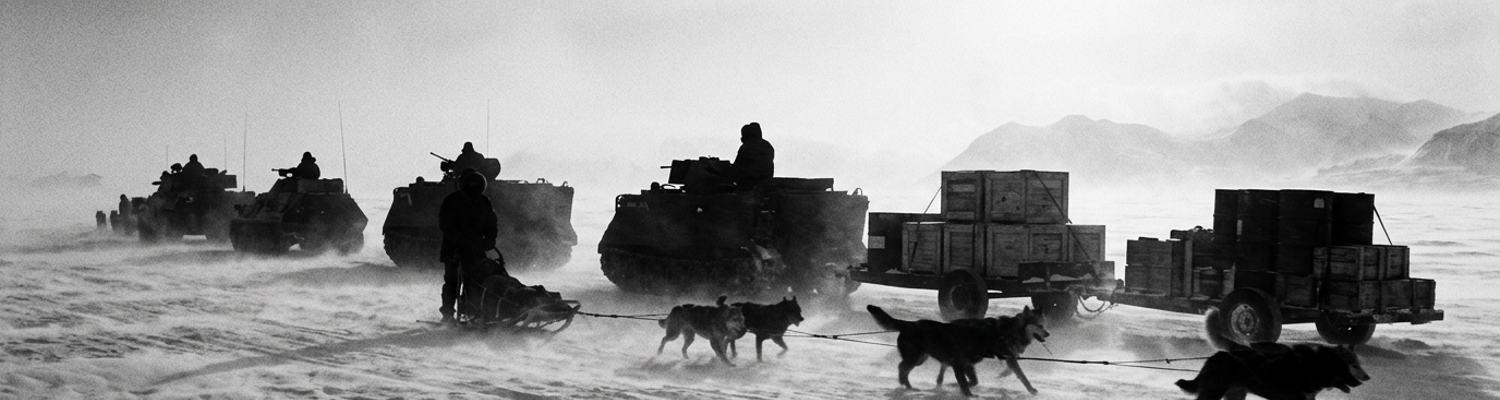

Greenland Sledge Patrols and Early Arctic Strategy
At 0415 hours on March 11, 1942. The high-frequency radio transceiver at the Ella O station emitted a sharp burst of static. The filament in the primary vacuum tube burned out entirely.
The fifteen men of the newly formed North-East Greenland Sledge Patrol were now completely cut off from the United States Coast Guard command center in Narsarsuaq.
Archival evidence shows this radio failure occurred at the exact longitude where German naval intelligence had begun deploying covert meteorological teams. Governor Eske Brun of the Danish colonial administration authorized the formation of these specialized sledge patrols. They surveyed the jagged coastline between 70 and 77 degrees North latitude. The objective was highly specific. Danish hunters and indigenous Greenlandic scouts were tasked with hunting down German Abwehr weather stations concealed within the deep fjord systems.
These enemy outposts utilized synchronized anemometers and automated barographs.
Accurate barometric pressure readings from this arctic zone dictated weather forecasting for the entire North Atlantic theater. U-boat wolfpacks and Luftwaffe bombing squadrons over Britain relied heavily on these daily transmissions. United States military planners wanted direct control over the territory to secure this intelligence. American officers routinely clashed with Danish civilian administrators over patrol jurisdiction and reporting structures. Coast Guard commanders demanded daily operational updates transmitted on fixed schedules. Brun insisted that maintaining strict radio silence and relying on decentralized hunter networks offered the only tactical advantage against heavily armed German landing parties operating near Sabine Island.
Bureaucratic demands from Washington ignored the physical limitations of the environment.
A close review of operational logs indicates that the United States Army Quartermaster Corps attempted to supply these patrols using standard European theater requisition forms. The resulting shipments proved useless for sustained polar operations. Standard issue leather combat boots froze solid within twenty minutes of exposure to the minus 40 degree temperatures along the Clavering O coastline.
Survival required absolute operational dependence on indigenous dog sled transportation and highly specialized polar gear.
Sleds had to be constructed using traditional ash wood lashed together with seal hide thongs rather than rigid iron nails. Metal fasteners would snap under the extreme thermal contraction and violent torque of navigating pack ice. The patrols relied on the Greenlandic fan hitch system to distribute the pulling weight of twelve to fifteen dogs across treacherous glacier systems.
The dogs consumed two pounds of high-fat pemmican daily.
United States supply officers stationed in Iceland frequently refused to authorize funds for purchasing local sled dogs or traditional Inuit kamiks. These sealskin boots were stuffed with dried sennegrass for insulation. American supply commanders viewed the procurement of animal hides and dried grass as a violation of standardized military supply regulations. They shipped heavily insulated rubber overshoes instead. Patrol members documented that the thick rubber cracked at the flex points near the toes after three miles of walking.
The Danish and Greenlandic scouts simply discarded the imported American gear into the snowdrifts.
They chose to rely entirely on local survival expertise to avoid frostbite and trench foot during their three month reconnaissance circuits. An order from the War Department in April mandated the use of heavy canvas military tents. The sledge patrol men ignored the directive and continued constructing traditional snow caves for nightly shelter. A snow cave maintained an internal temperature of 30 degrees Fahrenheit. The canvas tents dropped to match the outside ambient temperature.
Sergeant Marius Jensen submitted a formal requisition for fifty walrus hide whips on May 2.
The quartermaster depot in Boston rejected the request and shipped a crate of standard cavalry riding crops. The rigid leather crops shattered upon impact with the ice during a blizzard near Hochstetter Forland. Jensen had to cannibalize the steering harnesses from three damaged sleds to braid new control lines for his lead dogs.
Bluie East Two and Supply Standardizations
When examining the historical record of the Eastern Defense Command, the rapid mobilization at Ikateq reveals a severe disconnect between strategic planning and ground level execution.
On April 14, 1942. Advance elements of the United States Army Quartermaster Corps disembarked at a barren gravel spit designated as Bluie East Two.
This newly established airfield and supply depot sat at coordinates 65 degrees 56 minutes North 36 degrees 59 minutes West within a narrow mountainous fjord system on the eastern coast of Greenland. Army planners in Washington intended to centralize regional material distribution through this single geographic chokepoint. Liberty ships navigated treacherous ice floes to offload thousands of wooden crates filled with standardized European theater combat equipment onto the frozen beachhead. The Quartermaster detachment immediately began constructing thirty corrugated steel Quonset huts and a 5000 foot dirt runway to handle the influx of cargo planes.
Department of War directives mandated that all scattered Coast Guard units and Danish sledge patrols operating along the eastern seaboard route their supply chains exclusively through this centralized Army hub.
Supply clerks accustomed to stateside procedures expected frontline personnel operating hundreds of miles north to submit formal requisitions via radio before any material could be loaded onto resupply aircraft.
The depot command staff required signed triplicate forms for every issued rifle cartridge.
A close review of operational logs indicates that the attempted distribution of standardized United States military issue gear actively endangered the frontline reconnaissance teams. Army supply officers at Bluie East Two began issuing the M-1941 Parsons field jacket to the deep penetration sledge patrols preparing for northern deployments. This standard issue garment consisted of a lightweight cotton poplin shell over a thin wool flannel lining. At minus 45 degrees Fahrenheit, ambient moisture from human perspiration froze instantly within the cotton fibers.
The fabric turned into a rigid ice caked shell.
This restricted upper body mobility and provided zero thermal insulation against the katabatic winds sweeping off the polar ice cap. Quartermaster personnel also distributed standard M1928 canvas haversacks equipped with cast zinc adjustment buckles. Cast zinc became highly brittle in the extreme cold. When patrolmen attempted to tighten the web straps over their heavy parkas, the metal buckles shattered into jagged fragments. Supply shipments included thousands of M-1935 wool sleeping bags designed for temperate European autumns. Sledge patrol members documented that the brass zipper mechanisms on these bags jammed with crystallized ice condensation after a single night of use in the snow caves.
Army supply officers refused to deviate from the standardized packing manifests.
Archival evidence shows widespread mechanical failures across the issued armaments due to inappropriate winterization protocols enforced at the Bluie East Two depot. The Quartermaster Corps shipped M1 Garand semi automatic rifles packed heavily in Cosmoline. This was a standard rust preventative petroleum grease. Depot commanders ordered the rifles distributed without stripping and replacing the factory lubricant with specialized arctic grade graphite powder.
During a routine coastal patrol near Cape Desolation, a Greenlandic scout attempted to chamber a round after spotting a suspected German landing craft.
Thick layers of Cosmoline inside the receiver had frozen completely solid. Operating rods seized within the gas cylinders. Standard issue weapons were rendered entirely useless in these conditions. Supply clerks at the Ikateq depot also distributed standard leather palm work gloves and M-1938 dismounted canvas leggings. Cotton canvas trapped melting snow against the patrolmen calves during daytime marches. Trapped water subsequently froze into solid blocks of ice around their lower legs when temperatures plummeted at nightfall.
Nine men required immediate emergency medical evacuation for severe frostbite within the first two weeks of the distribution mandate.
The Quartermaster Corps responded by shipping a surplus order of standard zinc oxide foot powder and additional canvas leggings to the forward operating bases. Bureaucratic rigidity at Bluie East Two forced the Danish and Greenlandic scouts to bypass the Army supply chain entirely. Sledge patrol commanders began bartering directly with indigenous hunting parties for essential polar survival gear. They traded heavily rationed coffee and tobacco for caribou skin parkas and seal fat lamps.
Army officers at the centralized depot filed formal disciplinary reports against the patrolmen for discarding standard issue military property on the glacier.
The disciplinary paperwork cited the specific serial numbers of the abandoned M1928 haversacks.
Ammunition Mismatches and Weaponry Incompatibilities
When examining the historical record of the North-East Greenland Sledge Patrol armories, a severe breakdown in supply chain mechanics occurred regarding infantry weapon calibers.
Danish hunters and indigenous scouts operating out of the Eskimonaes station at 73 degrees 05 minutes North 21 degrees 09 minutes West carried the standard Danish military M1889 Krag-Jorgensen bolt action rifle.
This specific firearm featured a unique side loading capsule magazine that required an 8x58mmR rimmed cartridge to function. The projecting rim at the base of the brass casing allowed the heavy steel extractor claw of the rifle to grip and physically eject the spent shell from the breech after firing. United States Army Quartermaster Corps detachments at Bluie East Two began dropping standardized ammunition crates to the forward outposts on May 12, 1942. Supply clerks packed thousands of rounds of standard American .30-06 Springfield cartridges into the cargo holds of C-47 transport planes.
The .30-06 is a rimless cartridge measuring 7.62x63mm in overall length.
The physical dimensions and case design of the American ammunition made it entirely mechanically incompatible with the Danish rifles. A sledge patrolman attempting to load the .30-06 round into the Krag-Jorgensen chamber found that the narrower cartridge slipped too far forward into the barrel. The firing pin could not strike the primer.
The Danish extractor claw possessed no rimmed surface to pull against.
Scouts had to use a steel cleaning rod to manually push unfired American rounds backward out of the muzzle.
Archival evidence shows that field commanders immediately drafted explicit incompatibility reports regarding the useless ammunition shipments. On May 15, patrol leader Ib Poulsen transmitted a detailed encrypted radio message to the supply depot command staff outlining the exact dimensional differences between the 8x58mmR and .30-06 calibers. He requested an emergency airdrop of either the correct Danish cartridges or a complete replacement of their Krag-Jorgensen rifles with American M1903 Springfields that could fire the supplied inventory.
Army supply officers at Bluie East Two received the transmission and officially categorized the request as a non standard theater deviation on their requisition forms.
The depot quartermaster cited War Department Supply Regulation 420. This document mandated that all allied irregular units operating within the Eastern Defense Command receive standard Class V ammunition distributions. Bureaucratic protocols required supply clerks to fulfill packing manifests based strictly on the total number of active personnel listed in the sector rather than their specific issued weapon systems. Officers at the depot drafted a formal administrative rejection of the request from Poulsen. They argued that sourcing foreign 8x58mmR ammunition from neutral Sweden or occupied Denmark violated the established chain of acquisition.
The Quartermaster Corps responded to the detailed mechanical failure report by loading three more cargo planes with an additional 10000 rounds of .30-06 Springfield cartridges.
A close review of operational logs indicates this rigid adherence to standard supply distribution actively disarmed the sledge patrols during peak reconnaissance season. By early June, the Eskimonaes garrison possessed only forty total rounds of usable 8x58mmR ammunition shared among fifteen men patrolling a 400 mile stretch of coastline. The scouts buried the heavy wooden crates of incompatible American ammunition deep in the permafrost behind the main station hut to prevent German landing parties from salvaging the gunpowder.
Supply clerks at Bluie East Two continued generating weekly requisition manifests.
These documents listed the Eskimonaes patrol as fully armed and combat ready based on the sheer tonnage of delivered .30-06 crates. Poulsen submitted a second written report on June 8 explicitly stating his men could not engage armed enemy targets due to the caliber mismatch. Depot commanders filed the June 8 report in a low priority administrative folder and refused to adjust the outgoing cargo loads.
The final June supply drop at the Sabine Island cache coordinates consisted of twelve wooden crates containing M2 armor piercing .30-06 ammunition.
War Department Inventory Vouchers and Administrative Halts
A close review of operational logs indicates that by mid July 1942, the supply chain for the North-East Greenland Sledge Patrol ground to a complete halt due to accounting directives originating from the Munitions Building in Washington.
Army Service Forces auditors mandated that no equipment could leave the Bluie West Eight depot at 67 degrees 00 minutes North 50 degrees 41 minutes West without a fully executed War Department Inventory Voucher.
They specifically required WD AGO Form 446.
Supply clerks at the depot locked down three Quonset huts containing specialized winter gear. These locked structures held 4000 pounds of high fat dog pemmican and eighty replacement ash wood sled runners. Danish patrol leader Kurt Hansen transmitted a request on July 18 for emergency rations after a sudden ice collapse near Young Sund swallowed two of his supply sleds. The Quartermaster detachment at the airbase received the radio signal and drafted the requisition forms. Base accountants refused to authorize the cargo plane loading sequence because Form 446 required the physical signature of a commissioned United States military officer.
Hansen and his indigenous scouts held civilian contractor status under the Danish colonial administration.
The base quartermaster filed the unsigned paperwork in a pending tray and ordered the C-47 transport pilots to shut down their engines.
Archival evidence shows this single administrative requirement initiated a complete bureaucratic freeze of polar operations across the eastern seaboard of Greenland. State side accounting demands dictated that every ounce of issued material had to match the centralized ledger in Washington before the end of the fiscal quarter. Depot clerks at Bluie West Eight physically padlocked the heavy steel doors to Warehouse 4 on July 22. Inside sat 500 crates of replacement firing pins and 2000 pounds of dried sennegrass.
Hansen and his patrol were stranded at coordinates 74 degrees 18 minutes North 20 degrees 14 minutes West.
They had twelve starving sledge dogs and a cracked primary sled chassis. The men attempted to bypass the local depot by radioing the Coast Guard command center in Narsarsuaq for a direct airdrop. Coast Guard officers approved the drop but were blocked by Army supply commanders citing War Department Supply Regulation 114. This regulation strictly prohibited transfers of Class II supplies between different branches without a countersigned inventory voucher processed through the primary regional hub.
The Munitions Building categorized the stranded sled dogs as unverified assets.
When examining the historical record of this freeze, the physical toll on the sledge patrols becomes highly apparent by early August. The accounting department in Washington rejected a batch of thirty vouchers submitted by the Bluie West Eight commander because they featured the stamped signature of a Danish liaison officer rather than a handwritten signature from an American lieutenant. The rejection letter arrived via courier on August 5. Depot supply clerks immediately halted all outgoing flights to the Eskimonaes station.
Sledge patrol teams operating near Sabine Island exhausted their remaining pemmican reserves on August 9.
Scouts resorted to feeding their dogs a mixture of boiled seal blubber and shredded canvas from their ruined American tents. The lack of replacement ash wood forced patrol members to repair their broken sled runners using scavenged driftwood and animal bone. These materials splintered rapidly over the jagged pack ice. A patrol unit led by Marius Jensen abandoned their primary sled entirely on August 12 after the makeshift runners shattered into useless fragments.
Jensen and his three scouts marched forty miles back to their snow caves carrying eighty pounds of salvaged gear on their shoulders.
Army supply officers at the depot continued to demand the physical vouchers. They transmitted a message to Hansen instructing him to travel to the nearest American airbase to sign the documents in person. The nearest airbase was located 600 miles south across an impassable glacier heavily crevassed by the summer melt. Hansen ignored the transmission. He ordered his men to construct makeshift kayaks from seal skins and drift timber to hunt walrus for survival.
The crates of pemmican and ash wood sat locked inside Warehouse 4 at Bluie West Eight until the spring thaw of 1943.
Polar Survival Threats and Ration Shortages
A close review of operational logs indicates that on October 24, 1942, Patrol Unit Two halted their advance across the frozen sound near Shannon Island at coordinates 75 degrees 09 minutes North 19 degrees 48 minutes West.
The surface temperature dropped to minus 52 degrees Fahrenheit.
Twelve Greenlandic sled dogs sat motionless on the pack ice. The animals required a daily intake of high fat pemmican to generate body heat. The depot at Bluie East Two had suspended all airdrops of this specific ration three weeks prior. Supply clerks in Narsarsuaq refused to release the stored cargo without a countersigned Form 446. Danish commander Eli Knudsen ordered his men to pitch their snow caves and wait for the bureaucratic hold to clear. The team carried three brass Primus stoves for melting glacial ice into drinking water.
The Quartermaster Corps had replaced the requested aviation grade kerosene with standard low grade motor oil on the October packing manifest.
This heavy fluid congealed into a thick sludge inside the brass fuel lines. The internal pressure pumps failed to atomize the liquid. Standard motor oil simply pooled at the base of the burner plates and refused to ignite.
The men could not generate fire to hydrate themselves or their animals.
Archival evidence shows the immediate physical deterioration of the stranded dog teams along the northeastern coastline. Without the 4000 pounds of pemmican locked in Warehouse 4 at Bluie West Eight, the animals began consuming their own leather traces. Sled dogs lost an average of two pounds of muscle mass every forty eight hours. Knudsen transmitted a blind radio broadcast on October 28 requesting authorization to abandon the Shannon Island reconnaissance grid to hunt local game. The United States Coast Guard command center denied the request. Officers cited a directive requiring the patrol to maintain a static observation post to monitor suspected German U-boat surface activity near Cape Philip Broke.
The fifteen men sat immobilized in their snow caves as their sled dogs collapsed from caloric deficit.
One lead dog died of hypothermia on November 2.
The scouts fed the carcass to the surviving eleven animals.
When examining the historical record of these severe supply clearance delays, the required field improvisations reveal the extreme physical measures taken to survive. The lack of functional kerosene forced the scouts to hunt ringed seals purely for their subcutaneous fat. Knudsen and a Greenlandic hunter named Mikael crawled across the jagged sea ice for six hours to spear a surfacing seal at an open breathing hole. They dragged the 150 pound carcass back to the snow cave and harvested the blubber using bone handled knives. Patrol members modified their jammed Primus stoves by removing the brass pressure valves and fuel reservoirs entirely.
Scouts carved shallow bowls from local soapstone deposits found along the coastal cliffs.
These men filled the stone bowls with the raw rendered seal fat. Braided strands of dried sennegrass pulled from their discarded stateside boots served as makeshift wicks. This primitive lamp system produced a heavy greasy black smoke that coated the interior of the snow cave in thick soot. Handlers held aluminum canteens over the open flame to slowly melt chunks of multi year sea ice.
The soot triggered severe respiratory infections among the patrol personnel within days.
The men still lacked the necessary pemmican to move the heavy ash wood sleds. They began dismantling their secondary sled chassis to build deadfall traps for arctic foxes. The Quartermaster depot continued demanding signed triplicate forms before authorizing the release of the stored rations. Knudsen ordered his men to cut up their ruined M-1941 Parsons field jackets. Handlers wrapped the frozen cotton poplin fabric around the paws of the weakest dogs to prevent further tissue necrosis from the cold.
The entire unit spent three weeks subsisting on boiled seal meat and melted snow.
Wooden crates of kerosene and pemmican sat untouched on the gravel runway at Bluie East Two.
The ambient temperature reached minus 60 degrees Fahrenheit on November 14.
Inter Agency Friction and Radio Communication Gaps
When examining the historical record of the Eastern Defense Command during the winter of 1942, a severe mechanical disconnect between naval vessels and shore based personnel becomes highly apparent.
United States Coast Guard cutters operated entirely separate communication networks from the United States Army ground handling units stationed at Bluie East Two. The USCGC Northland WPG-49 patrolled the ice choked waters near 73 degrees 15 minutes North 21 degrees 00 minutes West. Coast Guard radio operators relied on standard maritime medium frequency transmitters broadcasting at 500 kilohertz for fleet coordination. These shipboard systems utilized heavy copper wire antennas strung between the steel masts of the vessel.
Army Quartermaster detachments on the gravel beaches utilized the SCR-284 field radio system.
This specific piece of hardware functioned strictly on high frequency amplitude modulation bands between 3800 and 5800 kilocycles. The two branches physically lacked the hardware capability to tune into the frequencies of one another. Shipboard commanders attempting to coordinate incoming supply shipments of ash wood and pemmican broadcasted their cargo manifests into the ether. Army handlers sitting inside corrugated steel Quonset huts thirty miles inland heard nothing but static on their receivers.
A close review of operational logs indicates that the SCR-284 units suffered massive component failures in the minus 40 degree ambient temperatures.
The BC-654 transmitter required a hand cranked GN-45 generator to produce the necessary voltage. Ground handlers discovered that the internal copper wiring of the generator became so brittle in the cold that the rotation of the crank snapped the connections instantly.
The Quartermaster detachment possessed zero replacement copper spools to repair the severed lines.
Archival evidence shows that command staffs in Washington failed entirely to establish unified communication protocols between the two branches operating along the Greenlandic coastline. Army officers at the centralized depot required all forward reconnaissance units to submit their operational patrol schedules via encrypted radio bursts using the M-209 mechanical cipher machine. This device used a series of six adjustable pin and lug rotors to scramble alphanumeric text into unrecognizable letter groups. Coast Guard commanders rejected this requirement outright. They argued that distributing highly classified cryptographic equipment to civilian Danish hunters and indigenous scouts violated basic naval security directives.
Naval intelligence officers instructed the sledge patrols to use a simplified proprietary substitution cipher based on a 1938 Danish meteorological codebook.
Army radiomen at Bluie East Two intercepted these low level transmissions but lacked the decryption keys to translate the signals. Supply clerks officially categorized the intercepted patrol schedules as unrecognized anomalous broadcasts and discarded the paper transcripts into standard burn bags. The lack of shared scheduling data meant Army personnel possessed no accurate coordinates for the deep penetration sledge teams navigating the glacier systems north of Clavering O.
Army supply planes flew blind over the jagged fjord systems.
A C-47 transport pilot assigned to drop three thousand pounds of winterized gear on November 18 received coordinates that were entirely blank.
The resulting operational blindness directly endangered the frontline scouts relying on timely material support. Coast Guard captains frequently altered the sledge patrol routes on a daily basis to avoid suspected German Abwehr landing zones near Sabine Island. Naval officers never relayed these route deviations to the Army Quartermaster Corps. On November 22, a detachment of ground handlers at Bluie East Two loaded a consolidated shipment of specialized arctic graphite powder and replacement Krag-Jorgensen rifle extractors onto a C-47 cargo aircraft.
Army dispatchers routed the flight to the original Eskimonaes station drop zone at 73 degrees 05 minutes North 21 degrees 09 minutes West based on an outdated logistics ledger from August.
Naval commanders had secretly ordered the sledge patrol to abandon that specific coordinate grid four days prior to investigate a strange radio signal near Hansa Bugt. The Army aircraft arrived over the Eskimonaes coordinates at an altitude of 500 feet and pushed twelve wooden crates attached to canvas parachutes out of the side cargo doors. Downslope katabatic winds blowing at sixty miles per hour immediately caught the deployed parachutes. Violent gales dragged the heavy crates across the frozen surface of the deserted ice shelf.
The entire shipment of graphite powder and rifle parts plunged over a fifty foot ice cliff into the open waters of the Greenland Sea.
The November 1942 Friendly Fire Incident
When examining the historical record of the Eastern Defense Command, the total breakdown of field visibility during late autumn weather patterns directly precipitated armed conflict between allied units.
A massive low pressure system stalled over the coastal settlement of Scoresbysund at coordinates 70 degrees 29 minutes North 21 degrees 57 minutes West on November 24, 1942. The barometric pressure dropped rapidly to 975 millibars. Katabatic winds descending from the Greenland ice sheet accelerated to seventy five miles per hour. Airborne snow pulverized into microscopic ice crystals created a total whiteout that reduced human visibility to under twelve feet.
A United States Army Quartermaster detachment operating a forward observation post on the fjord ice attempted to transmit an emergency weather update.
Their SCR-284 field radio failed completely. The 100 foot copper wire antenna accumulated three inches of heavy rime ice before snapping under the intense wind shear. Sub zero temperatures measuring minus 65 degrees Fahrenheit penetrated the uninsulated BA-43 battery packs. The chemical electrolyte solution inside the batteries froze solid.
Electron flow ceased entirely.
Archival evidence shows an uncommunicated North-East Greenland Sledge Patrol unit was moving through the exact same fjord system during the peak of the blizzard. Danish hunter Jens Moller and two indigenous Greenlandic scouts were driving a team of fourteen sled dogs southward toward the Scoresbysund settlement. They needed to secure replacement ash wood after Army cargo aircraft dropped their scheduled supply crates into the open sea four days prior. The three men wore thick caribou skin parkas and traditional sealskin kamiks. The American soldiers manning the observation post perimeter wore standard M-1941 cotton field jackets and steel M1 helmets.
The rigid steel brims of the helmets forced the sentries to keep their heads lowered against the wind.
The lack of shared radio scheduling data between the Coast Guard and the Army Quartermaster Corps meant the American soldiers possessed no written records indicating allied scouts were operating in their sector. The sledge patrol members assumed the unidentified camp belonged to a covert German Abwehr meteorological team.
Neither group possessed the mechanical hardware required to broadcast a warning signal through the storm.
A close review of operational logs indicates the engagement began at exactly 1545 hours. The lead dog of the patrol caught the scent of unburned motor oil leaking from the American camp and immediately altered course toward the snowpack. An American infantry sentry peered through the blowing ice crystals and spotted three large fur clad silhouettes moving rapidly toward the perimeter wire. He raised his standard issue M1 Garand semi automatic rifle. Depot clerks at Bluie East Two had previously stripped the factory Cosmoline grease from this specific weapon and applied arctic grade graphite powder to the receiver.
The operating rod cycled normally in the extreme cold.
The sentry fired three .30-06 Springfield rounds directly into the whiteout at a range of forty yards. One armor piercing bullet shattered the primary left runner of the sled. The sledge dogs panicked and tangled their heavy seal hide pulling traces. Moller and his two scouts dove into a deep snow drift. They immediately unslung their Danish M1889 Krag-Jorgensen rifles.
The scouts returned fire using their dwindling supply of 8x58mmR rimmed cartridges.
The exchange of gunfire lasted for four uninterrupted minutes. American soldiers emptied three eight round en bloc clips into the snowbank. The Greenlandic scouts fired six rounds in response. The thick blizzard conditions and flying ice prevented any direct bullet impacts on human targets. An American corporal pulled the pin on a standard M2 fragmentation grenade and threw it toward the entangled dog team.
The fuse mechanism failed to detonate.
The internal striker spring had contracted severely in the sub zero temperature, preventing the firing pin from striking the primer cup. Moller recognized the distinct metallic ping of the empty M1 Garand clips ejecting from the American rifles. He ordered his men to cease fire and initiated a series of long sustained whistles commonly used by local indigenous dog handlers. The American detachment commander recognized the civilian whistling pattern and ordered his men to lower their weapons.
The Army sentry walked forward and found two dead sledge dogs bleeding into the snow.
Base commanders at Bluie East Two received the casualty report via courier three days later. The depot quartermaster immediately drafted a formal disciplinary citation against the American sentry for expending twenty four rounds of .30-06 ammunition without prior written authorization. The citation required a signed WD AGO Form 446 to replace the expended cartridges. The sentry submitted the paperwork on November 28. Supply clerks rejected the form because the listed targets were allied dogs rather than verified enemy combatants. The twenty four rounds were permanently deducted from the observation post inventory. The two dead dogs were left on the ice.