
Early OSS Morale Operations Doctrine
The Office of Strategic Services’ Morale Operations (MO) branch was formally established on March 3, 1943, under William J. Donovan. He believed psychological warfare was an essential component of the American war effort, having observed the effectiveness of Nazi propaganda. The MO branch mission was to conduct subversive activities to create confusion, incite division, and collapse the morale of enemy forces and populations. This was not overt propaganda, a function of the Office of War Information, but “black” propaganda, material designed to appear as if it came from an enemy or internal dissident source. The branch was built for unconventional warfare, using persuasion and intimidation as modern siegecraft. Its mandate covered rumors, forged documents, poison-pen letters, and clandestine radio broadcasts to attack the psychological underpinnings of the Axis war machine. A review of declassified OSS charters (NARA Record Group 226) shows the branch was structured to insert these weapons directly into enemy territory, creating the appearance of internal decay.
The European theater was its laboratory.
A series of successes in Europe and North Africa formed the bedrock of MO doctrine. Planners viewed the German and Italian soldier as a rational actor who could be persuaded by appeals to self-preservation. Operations in Italy were particularly influential. Operation Sauerkraut, initiated in July 1944, used German prisoners of war who volunteered for re-infiltration behind their own lines. These agents, equipped with authentic Wehrmacht uniforms and forged papers, distributed leaflets and spread rumors that appeared to originate from a German resistance group. One effort created a fictitious organization, the League of Lonely War Women, which spread literature implying that soldiers' wives and girlfriends were having affairs. Another leaflet falsely announced that Commanding General Albert Kesselring believed the war was lost and was resigning, forcing Kesselring to issue a formal denial. These campaigns assumed enemy soldiers, when faced with evidence of their leaders' failures, would choose to surrender. This model, which treated surrender as a logical outcome, was deemed a universal template.
This confidence was transposed directly onto the Pacific theater with few adjustments. A close review of operational logs from early 1944 reveals a profound misunderstanding of the Japanese military psyche. OSS planners, some influenced by pre-war academic studies, operated under the assumption that the Japanese soldier’s devotion was a brittle construct. They believed concepts of Bushido and the Emperor's divine nature were state-enforced propaganda that could be fractured. The pre-Saipan assumption was that beneath the layers of indoctrination was the same rational actor found in Europe. The MO branch intended to exploit perceived weaknesses, such as resentment over the forced mobilization of local women, to provoke anti-government sentiment. The Japanese belief that surrender was a complete forfeiture of honor was not seen as an insurmountable cultural barrier, but as a psychological position that could be eroded. The initial MO leaflet drops on Saipan in June 1944 carried messages promising humane treatment and safe conduct, directly mirroring language effective against German forces.
Saipan Psychological Warfare Deployment
Operational logs show the Office of Strategic Services’ Morale Operations contingent for Operation Forager was a small, specialized element from the OSS Honolulu field office. Archival evidence points to a team of fewer than two dozen specialists. The unit was formally designated as part of the Navy’s Central Pacific command structure, a concession required to operate within Admiral Nimitz’s theater. Key personnel included language specialists, propaganda artists, and technicians trained in portable printing presses and loudspeaker systems. They carried with them the doctrinal assumptions forged in Europe: that enemy morale was a quantifiable target. Their equipment reflected this, including mobile RCA sound trucks and Navy bullhorns intended to project surrender appeals into fortified positions. The MO team was attached to the military intelligence (G-2) sections of the landing forces, tasked with supporting combat by reducing Japanese holdouts.
The pre-invasion assessments provided to the MO teams by the Office of Naval Intelligence and Army G-2 were disastrously inaccurate. These intelligence packages, shaped by a European-theater mindset, portrayed the Japanese civilian population on Saipan, numbering over 20,000, as potentially neutral or pliable. Analysts believed the civilians were primarily Okinawan and Korean laborers with little loyalty to mainland Japan, drastically underestimating the effects of years of imperial propaganda. The assessment of the Japanese soldier was equally flawed, viewing the resistance on other islands as a command-driven policy, not a deeply ingrained cultural and spiritual conviction. The working assumption was that the Japanese soldier, when faced with overwhelming force and severed supply lines, would behave like his German counterpart and rationally choose survival. The possibility that soldiers and civilians would choose death over surrender was not a significant factor in the planning.
Saipan was the first battle where American forces encountered a large, settled Japanese civilian population, a scenario for which no effective doctrine existed.
The initial MO campaign was a direct application of European methods. Starting just before the main landings on June 15, 1944, B-29s and carrier aircraft dropped millions of leaflets. A review of preserved leaflets, such as OWI Series 508 and 509, shows their logical approach. One detailed the exact number of Japanese soldiers who had surrendered on other islands, assuring humane treatment under the Geneva Convention. Another, addressed to civilians, promised food, water, and medical care, urging them to gather in safe areas with white flags. As Marines advanced, loudspeaker teams moved up. From jeeps and amtracs positioned near cave complexes, Nisei interpreters from the Military Intelligence Service broadcast surrender appeals. The messages echoed the leaflets, announcing the battle was lost and resistance was futile. Some broadcasts used captured Japanese soldiers to call out to their comrades, a tactic that had proven effective in Italy. The entire effort was a textbook execution of established OSS MO doctrine.
Japanese Resistance Fanaticism Underestimated
American intelligence organizations entered the Marianas campaign with a crippling deficit of understanding. A review of pre-invasion intelligence packages provided to V Amphibious Corps reveals a consistent misreading of the enemy. Estimates placed the Japanese garrison on Saipan at approximately 15,000 to 18,000 men. The actual number was closer to 32,000. This numerical error was secondary to the deeper conceptual failure. Planners at the Office of Naval Intelligence and Army G-2, conditioned by Europe, projected a model of rational self-preservation onto the Japanese soldier. They cataloged the fierce resistance on Tarawa and Kwajalein but interpreted it as a top-down policy of coercion, not a deeply held cultural imperative. This belief was embedded in the structure of the psychological warfare campaign.
The Imperial Japanese Army was not just a military organization; it was the violent expression of a nationalistic ideology. Its operational doctrine was codified in the Senjinkun, a pocket-sized manual issued to every soldier by War Minister Hideki Tojo in 1941. This was a spiritual and ethical directive. A core tenet explicitly forbade surrender, framing capture as an unbearable disgrace to one’s family, nation, and Emperor. The code instructed soldiers to avoid the shame of capture at all costs. This principle was a direct order that shaped battlefield conduct, leading to a near-total absence of prisoners in previous engagements. The doctrine was reinforced by a belief in the spiritual purity of the Japanese fighting man, a conviction that martial spirit could overcome material disadvantages. On Saipan, every defensive position was intended to be a tomb.
This doctrinal rigidity reached its apex in the concept of Gyokusai, the shattering of the jewel. It called for the honorable death of the entire unit as a final act of service. It was not a spontaneous charge, but an ordered, deliberate battle of annihilation. As the American advance pushed remaining Japanese forces into the northern tip of Saipan, Lieutenant General Yoshitsugu Saito, the island’s commander, faced his choice. Wounded and with his command structure shattered, he issued his final order on July 6, 1944. He called for one last attack to exalt true Japanese manhood and leave their bones on Saipan as a bulwark of the Pacific. The order made no distinction between soldiers and civilians, stating it was better for civilians to join the attack with bamboo spears than to be captured. That night, Saito committed ritual suicide. At dawn on July 7, the largest banzai charge of the war began. Over 4,000 Japanese soldiers, many wounded or armed only with spears, charged the lines of the U.S. Army’s 27th Infantry Division. The assault was an act of mass suicide, wiping out two American battalions and resulting in 4,311 Japanese dead.
The horror extended beyond the military. The fusion of the Senjinkun code with propaganda depicting Americans as inhuman created a psychosis among the thousands of Japanese civilians on the island. As the last defenses collapsed, civilians retreated to the island’s northern cliffs. At Marpi Point, hundreds, perhaps thousands, of men, women, and children chose death over capture. Eyewitness accounts from Marines describe families walking to the edge of the 600-foot Banzai Cliff and jumping into the sea. At the nearby Suicide Cliff, others threw themselves onto the rocks. In some instances, Japanese soldiers shot civilians who hesitated. This mass suicide was the ultimate expression of Gyokusai, a final, horrific rejection of the Allied assumption that a promise of safety could overcome a culture that viewed surrender as a fate worse than death.
Saipan's Improvised Explosive Devices
The advance of the 2nd and 4th Marine Divisions across Saipan was systematically broken by an island-wide network of improvised explosives. Japanese forces, lacking dedicated anti-personnel mines in sufficient quantity, demonstrated a chilling ingenuity in weaponizing their own standard ordnance. U.S. Marine Corps after-action reports reveal a landscape seeded with death traps. The most common devices were constructed from Type 97 hand grenades. Japanese soldiers would bury grenades with the pins pulled, leaving only an inch of the fuze head exposed; the weight of a boot was enough to detonate it. More complex arrangements involved tripwires made from camouflaged vines or thin wire, strung low across jungle trails and connected to the pins of multiple grenades. The goal was to maim and demoralize, channeling American units into prepared fields of fire. For heavier targets, large-caliber artillery shells were buried vertically along roads, their noses fitted with crude wooden pressure-plate triggers. Even captured Allied beer was suspect, with intelligence bulletins warning troops to avoid crates often rigged as anti-lifting devices.
The island’s geology, a maze of karstic limestone caves, became the backbone of this improvised defense. The Japanese 31st Army integrated these natural fortifications into a sophisticated system of delay and ambush on a scale never before encountered. A common tactic documented in unit logs involved rigging cave entrances to kill the initial assault teams. A seemingly discarded piece of equipment at a cave’s mouth would be tied to the pin of a grenade. Once Marines entered a cave, they faced daisy-chained explosives. An analysis of these positions showed Japanese soldiers would link multiple Type 89 mortar shells or aerial bombs deep inside the caverns, designed for command detonation once the cave was full of American troops. The Americans learned quickly not to enter the caves. Standard operating procedure for the 2nd Marine Division shifted to using flamethrowers and satchel charges to neutralize a cave from its entrance.
One soldier, one tank.
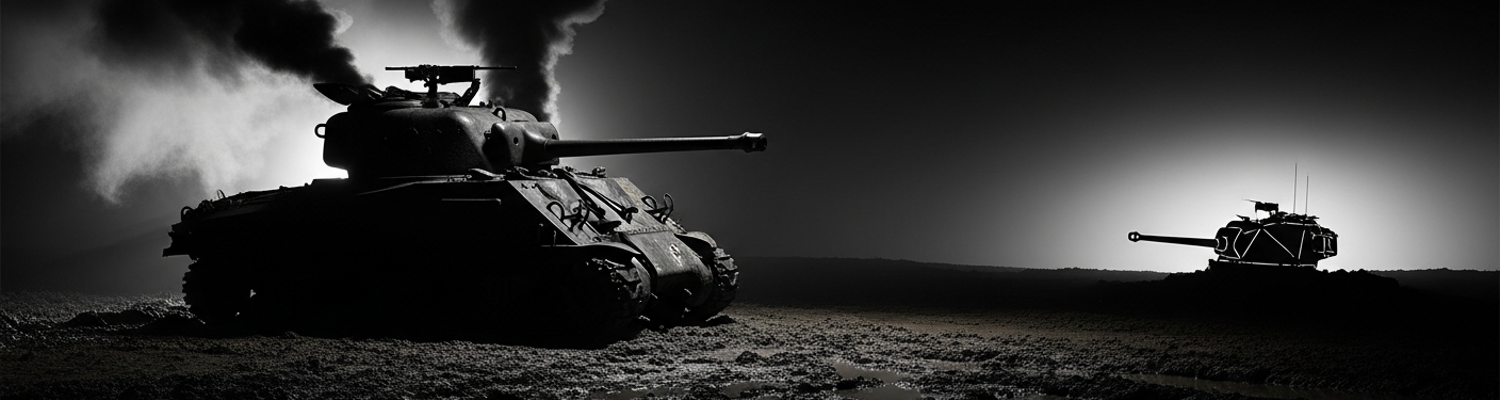
This Japanese doctrine found its ultimate expression in suicidal IED attacks. Lacking effective anti-tank weaponry, individual soldiers became delivery systems for high explosives. The most terrifying was the lunge mine, a conical hollow-charge device mounted on a long pole. A soldier would charge an M4 Sherman tank and manually thrust the mine against its hull, an act that guaranteed his own destruction. Others improvised, strapping Type 99 magnetic mines or satchel charges to their bodies and throwing themselves under the treads of advancing tanks. This tactic was a calculated part of Japanese anti-armor doctrine, intended to separate tanks from their infantry support.
This self-annihilating impulse extended to the civilian population. As American forces secured the island, they were confronted by civilians feigning surrender who would detonate concealed grenades as they approached aid stations. Marine eyewitnesses reported women, sometimes holding infants, approaching their lines before revealing explosives. The fusion of military doctrine with propaganda had created a situation where death was preferable to capture.
Early Bomb Disposal Equipment Limitations
An examination of ordnance logs from the 1944 Saipan campaign reveals an explosive ordnance disposal (EOD) capability straining against its primitive technology. The tools available to Army and Navy bomb disposal technicians were rudimentary, developed to address conventional German aerial bombs in Europe. The standard kit was a collection of hand tools, listening devices, and elementary remote-handling gear. A core component was a set of fuze keys and wrenches, designed to manually unscrew specific, known types of fuzes. Technicians relied on stethoscopes to detect the ticking of a clockwork timer, a method requiring absolute quiet and proximity to a live device. For remote operations, the primary tool was the tape-and-line method: a length of rope taped to a fuze, allowing a technician to attempt extraction from a distance. This technique was massively dependent on the fuze not being damaged, corroded, or fitted with an anti-withdrawal device. For larger ordnance, teams were issued basic block and tackle sets, but these were slow to set up and required several men working in an exposed area.
The inadequacy of this equipment became immediately apparent. Standard tools were designed for open-field or urban environments. They were almost useless against ordnance hidden deep within the island’s karstic limestone cave systems. These caves were complex, multi-chambered networks where bombs and booby traps were placed in shafts or behind tight corners, physically out of reach of any remote-pulling line. The humid, corrosive jungle environment also wreaked havoc on sensitive listening devices. More critically, the Japanese use of improvised devices, often built from their own artillery shells or grenades, meant American EOD teams were encountering fuze systems for which no standard removal procedure existed. After-action reports from the 2nd Marine Division (File A-5-g) repeatedly note that booby traps were the primary cause of EOD work, not the large aerial bombs the teams had trained for. These traps required a delicate, hands-on approach that bypassed the logic of existing remote-handling equipment.
EOD technicians had little choice but to approach and disarm most devices manually. A review of unit logs shows a grim operational rhythm. The process for a suspected booby trap involved a single technician crawling forward, often with only pliers and a knife, to carefully expose the device. He would then have to visually trace tripwires or delicately probe the soil around a pressure-plate trigger to understand the mechanism. This work was painstaking, taking hours for a single device while combat operations stalled. Disarming a device often meant manually cutting wires or attempting to pin a grenade fuze while it was still attached to the trigger. The high casualty rates among EOD personnel in the Pacific were a direct consequence of this shift from remote to manual procedures. For every successful disarming, there was the constant risk of an anti-handling device designed to kill the technician, a tactic the Japanese employed with chilling frequency. The work was physically and psychologically attritional, forcing small teams to confront an endless array of lethal puzzles.
EOD Casualties and Public Shock
The American public’s first visual encounter with the specialized horror of Saipan arrived not through official channels, but through a set of photographs taken by a Marine Corps combat photographer. A review of the original censored contact sheets shows images barred from publication. One photograph, later designated Negative 7-A, became an underground icon within military circles. It depicts a Navy EOD technician, stripped to the waist, his hands deep inside the workings of a buried 250kg aerial bomb converted into a pressure-plate IED. The tools beside him are little more than pliers, a knife, and a stethoscope. The follow-up image, Negative 7-B, shows only a blasted crater and scattered pieces of an M4 Sherman that had been waiting for the road to be cleared.
War correspondents, initially focused on the amphibious assault, soon found their dispatches dominated by this new threat. Press pool reports from journalists embedded with the Army’s 27th Infantry Division show a distinct shift in tone during the last weeks of the battle. Their cables, often delayed and heavily redacted, started detailing the unforeseen nature of the Japanese defense. They wrote of a landscape turned into a single, contiguous weapon. Urgent dispatches described how EOD teams were being systematically targeted. Correspondents detailed the Japanese tactic of rigging their own dead with Type 97 grenades, turning the act of searching a body for intelligence into a lethal gamble. The reports painted a picture of an enemy that had fully integrated improvised explosives into their doctrine of annihilation.
A close examination of declassified casualty logs for U.S. Navy EOD Mobile Unit 5 details the high price of this new battlefield. The unit suffered an almost complete loss of its original experienced personnel within the first three weeks. The case of Petty Officer First Class David Ingram is illustrative. Ingram, a technician with a record of over 40 successful disarmaments, was called to neutralize a large, buried artillery shell blocking a key supply route. He successfully located and disabled the primary pressure-plate trigger. Archival incident reports indicate the Japanese had begun adapting to American EOD procedures. A second, smaller anti-personnel mine had been buried directly beneath the main shell, connected to a pressure-release trigger. When Ingram and his team used a block and tackle to lift the disarmed shell, the secondary device detonated, killing Ingram and two members of his support team.
The psychological attrition on the surviving bomb disposal units was catastrophic. The constant, high-stakes focus required for manual disarming led to rapid burnout. Unit commanders reported a sharp increase in cases of combat fatigue that bore little resemblance to shell shock. It was a quieter, more corrosive strain, born from hours spent in silence, listening for the internal workings of a device that could kill them at any second. The operational tempo offered no relief. As casualties mounted, remaining technicians were forced to work longer hours on an ever-increasing backlog of calls, triaging entire sections of the island as too dangerous to clear. The average operational tour for an EOD technician on Saipan before being killed, wounded, or psychologically incapacitated was less than 20 days.
Washington Reevaluates Psychological Warfare
The initial reports from Saipan arrived in Washington not as operational summaries, but as shocks to the system. A review of declassified communications between Admiral Nimitz’s Pacific headquarters and the War Department in late July 1944 reveals a command structure grappling with events that defied all forecasts. The numbers were one thing: American casualties were horrifically high. The Japanese garrison, estimated at around 19,000, had turned out to be over 30,000. The true crisis was conceptual. Urgent meetings were convened within the offices of the Joint Chiefs of Staff, where Secretary of War Henry Stimson and General George C. Marshall were confronted with field reports describing thousands of Japanese civilians leaping from cliffs and a final, suicidal banzai charge of over 4,000 soldiers. The core assumptions that had guided the American psychological warfare campaign had been proven catastrophically wrong.
The post-mortem inside the Office of Strategic Services was immediate. An analysis of the Morale Operations branch’s activities on Saipan revealed a textbook application of methods that had succeeded in Europe and failed completely in the Pacific. The campaign was built on a fundamental misreading of the enemy. Planners had transposed a European model onto a Japanese military culture animated by the Senjinkun code, which forbade surrender as the ultimate dishonor. Leaflets promising humane treatment under the Geneva Convention (OWI Series 508 and 509) were not seen as offers of salvation but as invitations to disgrace. Loudspeaker broadcasts by Nisei soldiers were met with grenades or silence. The belief that the Japanese soldier was a rational actor who could be persuaded to lay down his arms was shattered. Archival reviews of the MO branch’s planning documents show no significant consideration was given to the possibility that entire communities would choose death over capture.
The lessons learned on Saipan forced a deep and rapid shift in psychological warfare doctrine for the remainder of the war. The European model was discarded. Planners in the War Department and the OSS accepted that appeals for surrender were largely futile against an enemy indoctrinated with a death-before-dishonor creed. A review of directives issued to Pacific theater psychological warfare units in late 1944 and early 1945 shows a distinct hardening of tone. The objective was no longer to coax mass surrenders. The new doctrine focused on magnifying fear, creating confusion, and exploiting the hopelessness of the Japanese tactical situation to induce battlefield errors. The language of leaflets and broadcasts changed. Instead of promising safety, new messages emphasized the betrayal of Japanese soldiers by their leaders and the pointlessness of their deaths. The focus shifted to psychological attrition, aiming to break the enemy’s will to fight effectively rather than his will to fight at all. The mass suicides on Saipan taught American planners that the line between combatant and civilian had been effectively erased. Future operations would proceed with the grim understanding that saving Japanese lives was not a realistic objective of psychological warfare.
Pacific War Strategic Doctrine Changes
The experience on Saipan was a watershed, forcing a complete re-evaluation of American strategic assumptions for the rest of the Pacific War. Planning for the invasions of Iwo Jima and Okinawa was directly altered by the fanaticism encountered in the Marianas. A review of after-action reports from V Amphibious Corps shows that military planners had miscalculated the enemy’s character. The two-day preliminary naval bombardment of Saipan, for example, had been considered adequate. It proved ineffective against the deep defensive systems. Consequently, the pre-invasion bombardment plans for Iwo Jima were expanded exponentially. Planners initially allocated ten days of continuous naval gunfire, a direct admission of the Saipan preparation’s insufficiency. While weather curtailed this to three days, the intent was clear: to systematically pulverize every possible defensive position with overwhelming firepower before the first Marine went ashore. The flat-trajectory naval guns ill-suited for Saipan’s caves led to a greater emphasis on high-angle artillery and aerial bombing.
The ferocity of the Japanese defense on Saipan, from the resilience of the cave networks to the final banzai charge, forced a tactical recalibration. The lessons directly influenced the operational approach to Iwo Jima and Okinawa. Planners now anticipated a defense in depth, designed to bleed American forces white. The expectation was no longer a climactic battle on the shore, but a grinding, attritional fight across the entire island. On Iwo Jima, this led to the understanding that the invasion force would have to destroy, not just bypass, a multi-layered system of underground bunkers. On Okinawa, the scale of the pre-invasion shelling was unprecedented, with over 1,300 ships participating. The use of flamethrowing Sherman tanks became a critical tool for clearing caves. The logistical chaos on Saipan’s beaches also prompted a major organizational change, with the U.S. Navy creating permanent corps shore parties responsible for the efficient movement of supplies, a system refined for the massive undertakings at Iwo Jima and Okinawa.
The most significant change was conceptual. The mass civilian suicides at Marpi Point shattered the American belief that the enemy could be persuaded to surrender. The guiding principle of Japanese soldiers, codified in the Senjinkun manual, was now understood not as propaganda but as an operational reality. The sight of civilians, convinced by Japanese propaganda that Americans were monsters, killing their own children before leaping from cliffs forced a grim realization upon the American command. This experience directly shaped projections for the planned invasion of the Japanese home islands, Operation Downfall. Military planners, using what became known as the “Saipan ratio,” calculated that it cost one American killed and several wounded to kill seven Japanese soldiers. Extrapolating this ratio to the millions of soldiers and fortified civilians expected to defend the home islands produced casualty estimates that were politically and militarily unacceptable, ranging from hundreds of thousands to over a million Allied casualties. The belief that Japanese civilians would fight alongside soldiers with bamboo spears, an idea confirmed by General Saito’s final order on Saipan, became a central feature of this grim calculus. This dark forecast, born from the horrors witnessed on Saipan, heavily influenced the decision-making process that led to the use of the atomic bomb, providing a powerful argument that the bombings might be less costly in total human life than the bloodbath anticipated in Operation Downfall.