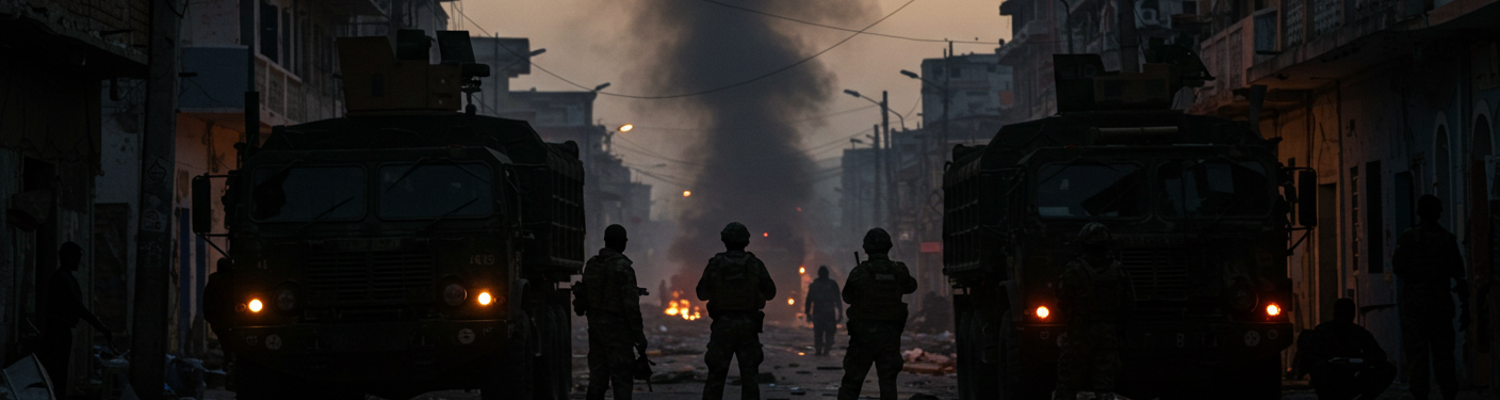

The mission changed while the planes were in the air. For months, United States military planners under OPLAN 2370 had prepared for a forcible-entry assault on Haiti. The 82nd Airborne and 10th Mountain Divisions were geared for combat. Then, on September 18, 1994, a last-minute diplomatic agreement converted the invasion into a permissive landing. This political victory in Washington D.C. triggered operational pandemonium. The National Security Council, having debated the mechanics of an invasion for months, was forced into a frantic, real-time reassessment. The plan for a peaceful occupation was a hastily assembled annex, not a fully developed concept. The meticulously constructed timetables, rules of engagement, and logistical chains for a combat operation were suddenly irrelevant. A crisis-level deliberation consumed the Pentagon. The core question was what, exactly, the 25,000 U.S. troops were now supposed to do. The objective had pivoted from defeating an army to policing a volatile and fractured society. It was a task for which the invasion force was neither equipped nor trained.
Planners in Norfolk and Fort Bragg had prepared for a fight, but their primary adversary was not the Haitian military. It was Haiti itself. The tropical climate was the first shock. Oppressive heat and humidity, consistently near 95 degrees with a 90 percent humidity index, were relentless. For soldiers of the 10th Mountain Division, arriving from the temperate climate of upstate New York, heat stress was an immediate and debilitating factor. Heat-related casualties began to mount before any significant operations were underway. Equipment designed for European or desert climates started to fail. The constant moisture shorted out sensitive electronics in SINCGARS radio sets, while the engines of HMMWVs and M939-series trucks, not optimized for such intense, humid heat, frequently overheated. This left convoys stranded. Makeshift solutions, like constantly running vehicle air conditioners to prevent electronics from failing, put an enormous strain on fuel logistics.
Then there was Port-au-Prince. The city’s infrastructure was not just damaged; it was systematically broken. A close examination of logistical after-action reports (NARA Record Group 338) shows that the primary port could not accommodate the deep drafts of large American naval cargo ships. This forced a chaotic and slow transfer of supplies and vehicles onto smaller landing craft. The bottleneck at the port rippled through the entire deployment. Once ashore, equipment faced a road network that was, in many places, a fiction. Paved roads dissolved into impassable tracks of mud and debris, littered with abandoned vehicles that had to be removed by combat engineers before any movement could occur. For units like the 16th Military Police Brigade, a drive that should have taken 15 minutes across a sector could consume hours. The complete lack of a functioning sanitation system or reliable power grid had immediate tactical consequences. Field sanitation facilities were quickly overwhelmed, leading to outbreaks of food poisoning and other illnesses that degraded force readiness.
Beyond the physical decay lay the human terrain. The primary threats were identified as the 7,000-member Forces Armées d'Haïti (FAd'H) and its thousands of plainclothes paramilitary auxiliaries, most notably the Front for the Advancement and Progress of Haiti (FRAPH). These groups were not a conventional army. They were deeply embedded within the civilian population, particularly in the dense slums of the capital. Archival intelligence summaries from the period show a command structure that was intentionally decentralized and difficult to map. FAd'H soldiers were known to wear civilian clothes under their uniforms, and FRAPH members were indistinguishable from the general populace. This made target identification a severe challenge. A firefight between a U.S. Marine squad and Haitian police in Cap-Haïtien on September 24, 1994, provided a stark example of this problem. The brief but intense exchange demonstrated how quickly a tense standoff could escalate into lethal violence, blurring the lines between police, military, and paramilitary elements.
Operational logs from the 1994 intervention show that the primary arteries of Port-au-Prince were functionally impassable. For units of the 10th Mountain Division and the attached 16th Military Police Brigade, movement through the capital was a constant, non-linear struggle. The city’s road network was choked by a combination of systemic decay and deliberate resistance. FRAPH paramilitaries did not need to construct elaborate military fortifications; they used the urban chaos as a weapon. A typical blockade was not a cleanly defined checkpoint but a sprawling obstacle of burning tires, derelict vehicles, and mounds of debris, often assembled and dispersed by civilian mobs in minutes. Intelligence reports indicate that FAd'H soldiers and FRAPH members would blend into crowds, making it almost impossible to discern hostile intent until an attack was initiated. This forced U.S. patrols and convoys into a state of high alert, slowing movement to a crawl as every intersection became a potential flashpoint.
Movement was a tactical gamble.
The threat of explosive devices, while not the sophisticated IEDs of later conflicts, was a significant factor in operational planning. Archival analysis shows U.S. forces were aware of the prevalence of firearms and ordnance among the population, including rifles, automatic weapons, and grenades. The primary concern was not command-detonated roadside bombs but rudimentary booby traps and the use of hand-thrown explosives in ambushes. One documented incident after the initial deployment involved a grenade thrown into a crowd of pro-democracy demonstrators, an act designed to create chaos. FRAPH and other paramilitary elements specialized in creating no-go zones through terror and the visible presence of armed men. This threat forced a deliberate and cautious pace, fundamentally altering the calculus of every street-level mission.
These obstacles had a direct and crippling effect on the resupply of deployed units. A detailed examination of after-action reports from logistical battalions reveals that convoys departing the Port-au-Prince harbor faced a gauntlet of failure points. The M939-series five-ton trucks were not designed for the tight, debris-strewn streets and suffered frequent mechanical failures. A single stalled vehicle could halt an entire convoy, rendering it a static and vulnerable target. The unpredictable blockades forced constant, ad-hoc rerouting through unmapped and potentially more dangerous areas. The cumulative result was a severe degradation of the supply chain. Shipments of water, MREs, medical supplies, and ammunition were consistently delayed, impacting the readiness and morale of troops at forward positions. Command logs show that some units of the 10th Mountain Division, having deployed from the USS Dwight D. Eisenhower, experienced significant logistical strain as they established a footprint in a city that actively resisted their sustainment.
Analysis of logistical after-action reports reveals a supply chain on the verge of collapse from the moment of landing. The strategic decision to shift from a forcible to a permissive entry created a chaotic scramble for logisticians, but the core problems were deeply embedded in the operational environment. Supplies that made it through the congested Port-au-Prince harbor immediately entered a distribution network that was fundamentally broken. The primary logistical workhorse, the M939-series five-ton truck, proved ill-suited for the tight, debris-clogged streets. Breakdowns were constant. Axles snapped in deep potholes, engines overheated, and tires were shredded by refuse, turning supply routes into static parking lots of disabled vehicles.
This was not a system suffering from friction; it was a system defined by it.
The direct consequence for front-line personnel was a cascade of shortages. For soldiers of the 10th Mountain Division, accustomed to robust logistical support, the realities on the ground were a shock. Water was the most immediate crisis. In the extreme heat, the daily requirement per soldier far exceeded what the strained supply lines could deliver, forcing strict rationing that bordered on medically dangerous. Shipments of Meals, Ready-to-Eat (MREs) were inconsistent, leaving some platoons to subsist on partial rations for days at a time. A review of medical logs shows a spike in heat-related injuries and illnesses like food poisoning, directly attributable to the lack of potable water and poor field sanitation.
These logistical failures had a direct and corrosive impact on operational effectiveness. A close examination of command logs indicates that patrol schedules were frequently altered or curtailed not by enemy action, but by a simple lack of resources. A company commander could not execute a planned multi-hour presence patrol if his soldiers did not have enough water to safely conduct it. Vehicles essential for mobility sat idle for want of fuel or spare parts that were stuck in the gridlock between the port and the front line. The unreliability of resupply forced unit leaders into a conservation mindset, hoarding resources and becoming hesitant to expend them on anything but the most essential tasks. This created a cycle of passivity, undermining the mission’s objective to establish a secure environment through proactive presence.
Medical after-action reports from the 1994 intervention reveal a catastrophic breakdown in the Class VIII supply chain. The logistical gridlock choking Port-au-Prince did not spare medical assets. For the forward aid stations of the 10th Mountain Division, the shortages began with the most fundamental items. Shipments of Lactated Ringer's solution and normal saline, essential for treating shock from dehydration or blood loss, arrived sporadically. Cases were often broken open during the chaotic offloading at the port or damaged in the back of overheating trucks. Archival logs from medical platoons show medics were forced to triage the IV bags themselves, discarding those compromised by the extreme heat. The situation for controlled substances was worse. Stocks of morphine and other analgesics, vital for managing the pain of severe trauma, were insufficient from the outset.
Blood was the most critical failure.
The cold chain required to keep whole blood and packed red blood cells viable was functionally nonexistent between the main storage facilities and the front line. Refrigeration units failed in the constant humidity, and the extended time convoys spent stalled in urban gridlock rendered entire shipments unusable. Medics were left with the tools to stop a bleed but without the fluids or blood products to replace what had been lost. This systemic failure of resupply directly crippled front-line medical triage. A close examination of casualty treatment records shows that medics and battalion surgeons were forced to abandon established treatment protocols. The principles of sorting casualties into Immediate, Delayed, Minimal, and Expectant categories became a theoretical exercise when the resources to support those categories did not exist. A soldier with a survivable gunshot wound to the abdomen, normally tagged as Immediate, required multiple large-bore IVs and immediate fluid resuscitation. Without a reliable supply of IV fluids, that soldier’s chances of surviving long enough for evacuation to a surgical facility plummeted. Medics reported having to make impossible decisions, downgrading the triage category of casualties not based on the severity of their injuries, but on the simple availability of a bag of saline.
This lack of capability meant that injuries which would be survivable in almost any other operational theater became death sentences on the streets of the Haitian capital. The 'golden hour,' the critical window to get a severely wounded soldier to a surgical table, effectively vanished. Without pre-hospital fluid resuscitation to stabilize blood pressure, casualties would go into profound shock, a condition often irreversible by the time they reached a Forward Surgical Team. A soldier suffering from a femoral artery bleed could exsanguinate in minutes. Standard doctrine called for tourniquets and aggressive fluid replacement. In Port-au-Prince, medics often had only the tourniquets.
Diplomatic records and multinational force logs indicate that the operational chaos visible on the streets of Port-au-Prince radiated outward, creating significant friction with international partners. The visible struggle to provide adequate medical support became an early source of diplomatic strain. Medics from partner nations, particularly those from the Caribbean Community (CARICOM) composite battalion, noted the severe shortages of basic supplies like IV fluids and blood products within the dominant U.S. medical system. This created a crisis of confidence. The U.S. was the framework nation, responsible for providing the vast majority of logistical and medical support for the entire 28-nation Multinational Force (MNF). Its inability to sustain its own troops called into question its ability to support anyone else.
Sustained breakdowns in the general supply chain quickly escalated these medical concerns into broader diplomatic grievances. The same port congestion and urban gridlock that starved U.S. infantry platoons of water and MREs also impacted the contingents from nations like Argentina and Bangladesh. These partners, operating under a unified American command structure, found their own operational readiness dictated by the failures of the U.S. logistical system. A close analysis of after-action reports shows that partner nation commanders lodged formal complaints about the lack of reliable support. The CARICOM contingent, a 295-person composite unit from states including Jamaica and Barbados, had been assembled and trained in Puerto Rico with the expectation of being integrated into a functioning support network. Instead, they found themselves at the mercy of a system that could barely function.
These ground-level frustrations were symptomatic of a deeper, high-level diplomatic friction. The entire operation was born from the last-minute diplomatic maneuver which transformed a forcible-entry invasion into a permissive occupation. This sudden shift, made unilaterally by the U.S., sent a shockwave through the coalition. Partners who had committed forces for a combat operation under UN Security Council Resolution 940 were now engaged in a murky peacekeeping mission with unclear rules of engagement. A State Department analysis from the period reveals that this unilateralism was a constant source of tension. The United States provided the command, control, and logistics, which effectively gave it absolute authority over the mission, frustrating partners who felt their role was more symbolic than substantive. Disagreements arose over how to handle the remnants of the FAd'H and the FRAPH paramilitaries, with some partners advocating for more aggressive disarmament, while U.S. commanders, focused on force protection, often opted for a more cautious approach.
The operational mission to restore Haiti’s elected government was immediately superseded by a more complex reality. The core friction point was the restored president himself, Jean-Bertrand Aristide. U.S. and multinational force commanders, operating under the authority of UN Security Council Resolution 940, were focused on maintaining a stable environment. Aristide was focused on consolidating power. This divergence became immediately apparent in the debate over the Haitian armed forces. American commanders, led by Lieutenant General Henry Shelton, favored a gradual vetting and retraining of the FAd'H to serve as the basis for a new national police force. This was a stability-first approach. Aristide viewed it as leaving the fox in charge of the henhouse. He aggressively pushed for the army's complete abolition. Against the advice of U.S. officials, he disbanded the military by executive decree in 1995. This single act created a massive security void, forcing U.S. and UN troops into a day-to-day policing role for which they were ill-equipped and which extended their mission indefinitely.
Internal policy reviews from late 1994 show a command structure in Washington grappling with mission creep. The intervention, sold to the American public and a skeptical Congress as a short, decisive action, was rapidly transforming into a long-term nation-building project. The initial military objectives were achieved almost immediately. What followed was a cascade of non-military tasks. Soldiers found themselves mediating property disputes, directing traffic, and attempting to secure a non-existent justice system. This drift was a source of great concern for military planners, who saw no clear military endpoint. The goal was no longer simply to uphold democracy but to build it from the ground up. The reassessment of the intervention’s feasibility concluded that the problems were not solvable by a military force.
The White House grew anxious over the intervention’s political costs. The operation was deeply unpopular domestically from its inception. The 1994 midterm elections, which saw a massive shift in power in Congress, were fought in part on criticism of the Clinton administration’s foreign policy, with Haiti as a prime example. The financial cost of the operation became a political weapon. Original estimates were quickly exceeded, with the total cost running into the billions. A constant fear in the administration was the risk of a 'Mogadishu moment,' where a firefight resulted in significant American casualties. An incident where U.S. troops initially stood by as Haitian police beat a demonstrator to death was broadcast internationally, causing a political firestorm and forcing a change in the rules of engagement. This combination of domestic political opposition, escalating costs, and the constant risk of casualties created an urgent need for an exit strategy. The decision to transition responsibility to a United Nations mission in March 1995 was driven as much by this political calculus as it was by any objective measure of success on the ground.