
Airborne Command Operations in Operation Just Cause
Sixteen thousand Panamanian Defense Forces personnel occupied heavily fortified positions throughout the dense urban sprawl of Panama City. Archival evidence shows that assault elements of the 75th Ranger Regiment faced a localized force ratio of four-to-one at specific drop zones. Operation Just Cause began in December 1989 to secure strategic infrastructure in Panama. The night sky over Torrijos-Tocumen International Airport immediately erupted with ZPU-4 anti-aircraft fire. Primary objectives included seizing the canal locks, the Madden Dam utility grids, and the Bridge of the Americas. Enlisted paratroopers hooked static lines inside unheated C-141 Starlifters. They inhaled a thick mixture of aviation fuel and cold sweat.
They jumped into the dark at five hundred feet.
Heavy equipment bundles tore through the humid night air. These pallets crashed into the residential neighborhoods surrounding the airfield. Non-combatants huddled under corrugated tin roofs. Tracer rounds of 5.56mm ammunition ignited nearby civilian vehicles. Infantrymen hit the tarmac hard. Intersecting fields of machine-gun fire from PDF Battalion 2000 instantly pinned them down. Dirt and shattered asphalt sprayed across their faces.
The entire assault depended on invisible radio frequencies cutting through the urban static.
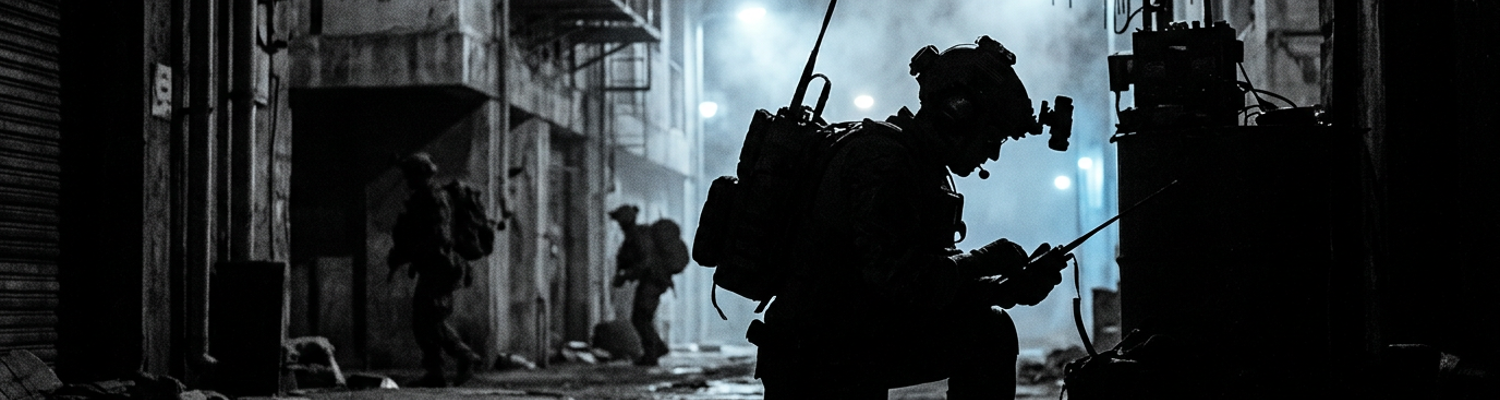
A close review of operational logs indicates that EC-130 airborne command platforms managed real-time troop movement vectors over Panama City. Orbiting at a fixed altitude of twenty thousand feet, the Airborne Battlefield Command and Control Center crews operated banks of AN/USQ-93 radar processing consoles. These modified turboprop aircraft functioned as the primary communications relay between the United States Southern Command and the isolated squads fighting block by block. Inside the pressurized cabin, technicians adjusted UHF and VHF frequency dials. They attempted to pierce the atmospheric interference caused by tropical humidity and burning diesel on the ground. Ground-level radiomen from the 504th Parachute Infantry Regiment crouched behind bullet-pocked concrete walls in the San Miguelito district. They frantically keyed their PRC-77 manpack radios. They squeezed the heavy plastic handsets with bleeding fingers. They shouted grid coordinates into the microphones. Mortar shrapnel impacted the surrounding structures at the same time. The EC-130s received these fragmented transmissions and translated them into actionable flight paths for incoming close air support. Antenna wiring on the aircraft occasionally overheated from the constant transmission load. Communications technicians manually bypassed tripped circuit breakers using insulated pliers to keep the relay active.
Infantry units lost contact for minutes at a time.
Data bank destination surveys were used to coordinate air and ground tactical forces. Planners at Fort Bragg had previously mapped the entire canal zone. They uploaded thousands of pre-verified grid reference points into the EC-130 computer cores via magnetic tape drives. These surveys contained exact geospatial measurements for PDF barracks, utility stations, and civilian residential intersections. When an infantry squad requested fire support, the airborne operators cross-referenced the incoming coordinates against the digital survey files on their glowing green monitors. They then transmitted the verified data directly to orbiting AC-130 Spectre gunships and AH-64 Apache attack helicopters. The system began to fracture when ground troops deviated from the pre-planned routes to avoid high concentrations of non-combatants. Panamanian families fled directly into the crossfire near La Comandancia. Rangers sought cover in unmapped alleyways. The pre-loaded destination surveys did not account for these spontaneous tactical shifts. A radioman from Alpha Company transmitted an urgent request for suppression fire on a PDF sniper position. The EC-130 data bank flagged the location as a civilian hospital. System protocols forced the airborne operator to deny the fire mission. Waiting for manual clearance from higher headquarters, the Ranger squad remained pinned behind a burning garbage truck on 4th of July Avenue. They absorbed continuous sniper fire for forty minutes.
Signal Propagation Issues in Dense Urban Sectors
Over sixteen thousand Panamanian Defense Forces regulars occupied the narrow avenues and commercial districts of the capital. Isolated American squads from the 82nd Airborne Division found themselves trapped in unmapped intersections. Localized adversary force ratios exceeded ten-to-one in these sectors. PDF mechanized units rapidly deployed V-300 Commando armored vehicles to block evacuation routes out of the city center. Infantrymen crouched behind destroyed civilian sedans. Heavy .50 caliber machine gun fire penetrated the engine blocks.
Survival depended entirely on establishing an unbroken radio link with the aircraft circling in the black sky above.
A close review of operational logs indicates that Panama City dense concrete high-rises created severe radio frequency signal reflection. The architectural composition of the banking district and the Punta Paitilla residential zones consisted of thick poured concrete reinforced by heavy steel rebar grids. This construction method inadvertently turned the urban grid into a dense electromagnetic barrier. When an enlisted radioman from Navy SEAL Team 4 keyed his PRC-77 radio near the Paitilla airfield, the 30 to 75 Megahertz Very High Frequency transmission did not travel in a direct line of sight to the orbiting EC-130 platforms. The electromagnetic waves slammed directly into the towering facades of nearby luxury condominiums and commercial structures. The embedded steel rebar acted as a broad radio frequency reflector. It deflected the energy off multiple building faces. The signal scattered into dozens of separate, deflected pathways through the alleys.
The original directional wave fragmented against the concrete.
This physical effect meant that multipath interference degraded transmission accuracy between airborne platforms and ground units. Multipath interference occurs mechanically when a primary radio signal and its reflected copies arrive at a receiving antenna at slightly different microsecond intervals. Up at twenty thousand feet, the AN/ARC-164 UHF transceivers aboard the airborne command platforms captured the initial transmission a fraction of a second before the bounced signals arrived from the city streets below. This slight time delay caused phase cancellation within the radio hardware. The overlapping sine waves collided and flattened each other out inside the circuitry. Airborne communications technicians wearing David Clark headsets heard only a high-pitched oscillating screech instead of human voices.
The digital encryption devices attached to the radios failed to synchronize with the corrupted audio input.
Archival evidence shows that a forward air controller attached to the 1st Battalion, 508th Infantry Regiment attempted to call in a fire mission over the Balboa district. The controller requested immediate 105mm howitzer support from an AC-130 Spectre gunship to suppress a PDF mortar team operating on a nearby rooftop. As he read off the nine-line coordinate grid, multipath distortion scrambled the numerical values. The airborne fire control officer received overlapping, contradictory digits. These digits mapped to three entirely different sectors of the city. The Spectre gunship held its fire to avoid striking civilian non-combatants sheltering in the surrounding apartment blocks. Down on the ground, the controller squeezed the plastic handset with dirt-caked fingers. He desperately repeated the coordinates. Mortar shells of 82mm detonated thirty yards from his position.
He discarded the standard three-foot tape antenna.
To bypass the interference, infantrymen resorted to exposing themselves to direct enemy fire to modify their equipment. Radiomen unthreaded the short antennas and screwed in ten-foot AT-271A whip antennas. They raised them high above the concrete retaining walls. This action immediately drew concentrated sniper fire from PDF sharpshooters positioned in the upper floors of the surrounding structures. In the El Chorrillo neighborhood, paratroopers kicked in the doors of civilian apartments to access higher elevations. They dragged their heavy manpack radios up narrow, unlit stairwells. Terrified Panamanian families huddled in bathtubs and under mattresses. The soldiers smashed out glass windows with the butts of their M16A2 rifles to extend the long antennas out over the street. A specialized technician from the 112th Signal Battalion spliced copper communication wire directly into a civilian television antenna on the roof of a three-story residential complex.
Civilian Radio Interference and Data Corruption
Archival evidence shows that local civilian broadcasting infrastructure actively compromised United States military communications grids during the initial hours of the invasion. Panamanian civilians trapped in the urban sprawl of the capital immediately turned on their commercial radios to gather information about the heavy gunfire outside their windows. High-powered commercial AM and FM transmission towers began broadcasting emergency bulletins. Stations operated by Radio Nacional and various independent broadcasters scattered throughout the San Miguelito district looped salsa music at maximum wattage. The 30 to 75 Megahertz Very High Frequency bands used by the military directly abutted or overlapped with these civilian broadcast frequencies. Infantrymen from the 3rd Battalion, 504th Parachute Infantry Regiment pressed heavy plastic PRC-77 handsets to their ears. They crouched in flooded drainage ditches along the edge of the Torrijos-Tocumen tarmac. Instead of receiving tactical movement vectors from their platoon leaders, these enlisted paratroopers heard blaring commercial advertisements and Spanish-language news anchors over the military tactical nets. The powerful commercial transmitters pushed thousands of watts of radio frequency energy into the night air. This output completely washed out the weaker signals generated by the low-voltage lithium batteries of the infantry manpack radios. Radiomen frantically spun the mechanical frequency selector knobs with mud-slicked hands. They tried to find a clear channel in the saturated spectrum. Rounds of 7.62mm ammunition snapped over their heads.
The civilian radio wave saturation physically blocked the transmission of casualty evacuation coordinates.
Up at twenty thousand feet, the EC-130 Airborne Battlefield Command and Control Center aircraft absorbed this massive influx of overlapping civilian and military radio traffic. The onboard AN/USQ-93 radar processing consoles relied on early digital data links to translate analog voice requests from the ground into formatted targeting packets for the automated fire control systems. These digital feeds required a clean, uninterrupted signal to process geospatial coordinates through the military encryption protocols. The incoming barrage of civilian commercial radio broadcasts bled directly into the tactical command nets. This caused severe data corruption within the EC-130 computer cores. Communications technicians sitting in the unheated, pressurized cabin watched their green cathode-ray tube monitors fill with disjointed alphanumeric characters and hexadecimal sequence errors. Static and distorted music blasted into their David Clark aviation headsets. Operators turned down the volume to avoid permanent hearing damage. The corrupted targeting feeds disrupted the digital data links connecting the command platform to the orbiting close air support elements. When a ground unit transmitted a nine-line fire support request, the overlapping civilian radio waves scrambled the binary translation sequence inside the airborne servers. The data packets arrived at the receiving antennas missing critical strings of positional data.
The automated targeting systems failed to verify the incoming fragmented data packets.
A close review of operational logs indicates that an AH-64 Apache attack helicopter pilot requested a confirmed digital data link update. He needed to engage a Panamanian Defense Forces mortar position operating near the Bridge of the Americas. The airborne operators aboard the EC-130 attempted to push the targeting coordinates through the disrupted network to guide the Apache AGM-114 Hellfire missiles. The corrupted feed transmitted a series of fragmented latitudinal and longitudinal digits. These digits directed the helicopter targeting sensors toward a crowded civilian parking garage three miles away from the actual PDF position. System administrators aboard the command aircraft physically disconnected the heavy coaxial cables from the back of the processing units to force a hard hardware reset. They wiped the magnetic tape drives clean. They reloaded the operating software while wearing thick nomex flight gloves. Their fingers struggled to manipulate the small toggle switches on the server racks. Down in the streets of the El Chorrillo neighborhood, paratroopers took cover behind shattered concrete walls. They waited for air support that could not receive accurate digital targeting information. The ground-level radiomen continued to transmit grid coordinates over the saturated frequencies. The continuous broadcast of civilian radio stations drowned out their voices.
Airborne commanders manually aborted all automated fire missions to prevent accidental civilian casualties.
Misidentification of Dense Tenement Blocks
Archival evidence shows that airborne controllers misread corrupted data streams as enemy staging locations during the intense firefights over the capital. Inside the pressurized, unheated cabin of the EC-130 Airborne Battlefield Command and Control Center, communications technicians stared at banks of AN/USQ-93 radar processing screens. The cathode-ray tube monitors flickered with incoming tactical telemetry from 82nd Airborne Division units fighting on the ground. Overlapping civilian radio broadcasts and severe multipath signal reflection scrambled the digital data links connecting the infantrymen to the aircraft. Hexadecimal sequence errors flooded the airborne computer cores. The displays filled with erratic positional data. Operators wearing heavy Nomex flight gloves tapped frantically on plastic keyboards to filter out the noise. The smell of hot electrical wiring filled the cabin. They watched dense clusters of fragmented alphanumeric characters populate the digital maps of the San Miguelito district. Automated processing systems interpreted the corrupted data packets as massive concentrations of Panamanian Defense Forces personnel moving through the urban grid. Exhausted technicians misread these dense, erratic data returns as active PDF staging areas preparing for coordinated counterattacks against American drop zones. They manually highlighted the corrupted coordinate blocks on their screens. They authorized the transfer of the targeting data.
The digital markers locked directly onto the center of the El Chorrillo neighborhood.
A close review of operational logs indicates that populated residential tenement blocks were incorrectly flagged as hostile military targets. The airborne command platform transmitted the corrupted staging area coordinates to orbiting AC-130 Spectre gunships via secure data bursts. Down on the ground, the physical composition of the targeted zone consisted of three-story concrete housing structures packed with hundreds of non-combatants. Panamanian families huddled on thin wooden floorboards beneath corrugated tin roofs to avoid stray 5.56mm tracer rounds snapping through the humid air. The airborne fire control officers aboard the gunships punched the false grid numbers into their automated weapon systems. Onboard targeting computers immediately designated the crowded civilian apartment buildings as fortified Battalion 2000 strongpoints. Infantrymen from the 1st Battalion, 508th Infantry Regiment crouched behind burning civilian sedans on the street below. They tasted dirt, blood, and cordite. They observed infrared targeting lasers suddenly painting the facades of the civilian structures. Designation beams tracked directly across windows where children were taking cover.
Enlisted radiomen desperately keyed their handsets to abort the firing sequence.
Airborne controllers continued to misread the corrupted data streams. They believed the dense clusters of returning signals represented PDF V-300 Commando armored vehicles hiding between the buildings. Multipath interference bouncing off the structural steel rebar inside the concrete architecture mirrored the specific electromagnetic signature of mechanized infantry units on the airborne radar consoles. The residential tenement blocks were incorrectly flagged as hostile military targets by both the EC-130 command platform and the receiving gunships. The hardware could not differentiate between structural reflections and enemy armor. Technicians aboard the aircraft prepared to authorize immediate 105mm howitzer and 40mm Bofors cannon strikes on the civilian homes to protect the pinned-down paratroopers. Ground-level radiomen squeezed their mud-slicked PRC-77 radios. They shouted abort codes into the heavy plastic microphones. Machine-gun fire impacted the walls around them. Voice transmissions broke apart against the concrete high-rises. They failed to reach the orbiting platforms.
A sergeant ripped the copper wire from his antenna to force a hard signal reset.
The physical disconnection dropped the static load just long enough for an unencrypted manual override code to punch through the atmospheric interference. Airborne operators heard the panicked cancellation order through their David Clark aviation headsets. They physically disconnected the thick coaxial targeting feeds from the main server racks to break the automated link. Flight crews aborted the gunship attack run seconds before the automated cannons initiated their firing sequence. The infrared targeting reticles snapped away from the El Chorrillo tenement balconies.
Ground Forces Advancing Under Corrupted Guidance
Archival evidence shows that dismounted elements of the 2nd Battalion, 75th Ranger Regiment pushed deep into the Rio Abajo district using completely compromised navigation data. Platoon leaders moving through the dense, unmapped alleyways relied directly on erroneous airborne telemetry relayed from orbiting EC-130 command platforms. A cascading hardware fault inside the airborne AN/USQ-93 radar processing consoles injected a continuous 400-meter offset error into the digital coordinate feeds transmitted down to the ground units. Enlisted Rangers carried sixty pounds of combat gear. The heavy canvas straps dug into their collarbones. They advanced block by block down Avenida Santa Elena under the assumption that the route had been cleared by earlier close air support strikes. The corrupted telemetry indicated that Panamanian Defense Forces Battalion 2000 had evacuated the immediate commercial sector. This data was entirely false. Airborne sensors had actually tracked the PDF mechanized units displacing into heavily fortified ambush positions inside the residential concrete structures lining the avenue. The digital offset obscured this localized troop movement from the EC-130 operators. Ground commanders on the street checked their tactical maps against the received telemetry. They marched their squads directly into an active kill zone.
The lead Ranger element walked into an intersecting crossfire of depressed ZPU-4 anti-aircraft guns.
A close review of operational logs indicates that ground personnel lost reliable voice communications almost immediately after the ambush began. Infantrymen dove behind shattered concrete retaining walls and burning civilian sedans to escape the heavy 14.5mm machine-gun fire. Radiomen frantically keyed the mechanical frequency selectors on their PRC-77 manpack systems. Their thumbs slipped on the wet metal as they tried to call for emergency medical extraction. Continuous signal degradation caused by a combination of dense urban architecture and the ongoing EC-130 transmission failures rendered the tactical nets useless. The electromagnetic interference from the overhead high-voltage power lines running along Avenida Santa Elena further scrambled the analog voice frequencies. Platoon sergeants gripped heavy plastic handsets. They shouted grid coordinates into microphones that transmitted nothing but oscillating static bursts. Up at twenty thousand feet, the airborne communications technicians received only fragmented clicks and low-frequency hums. The corrupted telemetry loop had saturated the primary VHF channels. This physically blocked the analog voice signals from pushing through the atmospheric interference.
They were completely cut off from higher headquarters.
Without functional voice links or accurate telemetry, tactical command and control disintegrated into localized, isolated firefights. Squad leaders inside the Rio Abajo sector abandoned their standard operating procedures. They physically detached the ten-foot AT-271A whip antennas from their radios to avoid drawing sniper fire. They resorted to deploying enlisted runners to coordinate movements between pinned-down elements. Just forty-eight hours earlier at Fort Bragg, these same squad leaders had run identical communication failure drills on flat, empty drop zones using perfectly synchronized backup frequencies. Now, a private from Charlie Company sprinted across a four-lane intersection near the Atlapa Convention Center carrying a marked paper map inside his web gear. Heavy PDF rifle fire tracked his movement across the asphalt. He threw himself into a flooded drainage ditch alongside a squad of paratroopers from the 82nd Airborne Division. These paratroopers had also advanced off course due to the faulty airborne telemetry. They had spent forty-five minutes pushing through residential backyards based on a corrupted EC-130 vector. This vector designated a heavily defended PDF barracks as a civilian hospital. Terrified civilian non-combatants screamed from the second-floor windows of the surrounding apartments. Stray 5.56mm rounds shattered their glass storefronts. The erroneous data feeds had directed three separate American platoons into the same dead-end commercial cul-de-sac.
Mechanized PDF units began sealing the exit routes with V-300 Commando armored vehicles.
Ground personnel stripped the unusable PRC-77 radios from their ALICE packs and left them in the mud. Technicians aboard the orbiting EC-130 platforms attempted to re-establish voice contact by broadcasting unencrypted analog signals on emergency civilian frequencies. This localized transmission bypass failed to penetrate the thick poured concrete of the Rio Abajo commercial structures. Down in the cul-de-sac, the isolated infantrymen chambered fresh 5.56mm magazines. They prepared to engage the approaching Panamanian armor with AT4 anti-tank rockets. The airborne command screens continued to display the American squads as holding a secure position four hundred meters away.
Close-Quarters Combat in Populated Residential Zones
Archival evidence shows that elements of Charlie Company, 1st Battalion, 504th Parachute Infantry Regiment breached designated target structures surrounding the La Comandancia military headquarters during the early hours of December 20th. Pre-invasion intelligence briefings conducted at Fort Bragg had categorized these specific three-story concrete and wood tenements along Avenue A as abandoned administrative annexes used exclusively by Panamanian Defense Forces Battalion 2000. This data proved catastrophically false. Enlisted paratroopers kicked through reinforced wooden doors with steel-toed jungle boots. They immediately encountered heavy civilian populations packed into unlit, ten-by-ten-foot living spaces. Multi-generational Panamanian families lay pressed against rotting floorboards. They attempted to avoid the heavy 14.5mm machine-gun fire tearing through the corrugated tin roofs above them. Infantrymen carried sixty pounds of combat gear. Their Nomex flight gloves were soaked in cold sweat. They tripped over foam mattresses and crying infants in the cramped, unlit rooms. The established tactical doctrine for urban clearance required American squads to throw M67 fragmentation grenades into unverified rooms before crossing the threshold to neutralize potential threats. Platoon leaders manually countermanded this standard operating procedure upon seeing grandmothers shielding children in the corners of the designated target structures. Squad radiomen squeezed their plastic PRC-77 handsets. They attempted to relay the severe intelligence failure to higher headquarters. The structural rebar physically blocked the analog signals.
The abrupt shift in the rules of engagement forced paratroopers to clear hostile sectors entirely with direct rifle fire.
A close review of operational logs indicates that Dignity Battalion paramilitaries actively exploited this hesitation to engage American forces. Panamanian fighters wearing civilian clothes embedded themselves directly among the non-combatants inside the tenement blocks to mask their movements. When a fire team from Bravo Company stacked up outside a second-floor apartment along Calle 25, a hidden PDF regular fired an AK-47 assault rifle straight through the interior drywall. The 7.62mm rounds shattered the plaster. They struck an American private in the ceramic strike plate of his body armor. The impact threw him backward down the concrete stairwell. Point-blank firefights erupted inside narrow apartment corridors under extreme chaos as squads returned fire. The architectural layout of the El Chorrillo housing blocks featured unlit hallways barely thirty-six inches wide. These hallways were lined with cheap wooden doors on both sides that offered zero ballistic protection. Paratroopers squeezed their M16A2 triggers in a state of panic. They discharged three-round bursts at muzzle flashes originating just eighteen inches away from their faces. Heavy lead slugs tore through the flimsy interior partitions. They shredded civilian furniture and shattered glass louvers.
Acoustic pressure from rifle fire in the enclosed concrete spaces caused immediate hearing damage to both soldiers and non-combatants.
Doctrinal breakdown accelerated as the firefights devolved into chaotic, room-to-room brawls in the dark. Soldiers tasted pulverized drywall and unburned gunpowder with every breath they took inside the enclosed spaces. Thick clouds of gray plaster dust hung in the stagnant, humid air. This dust completely blinded the passive infrared tubes of the AN/PVS-5 night vision goggles worn by the assault elements. Paratroopers ripped the heavy optical rigs off their faces. Their fingers slipped on the wet plastic. They tossed the useless equipment onto the blood-slicked linoleum floors. Without visual clarity, survival depended entirely on tactile feedback and immediate muscular reflexes. A squad leader from the 82nd Airborne Division pushed through a splintered doorframe. He collided physically with a Panamanian regular attempting to chamber a round in a pump-action shotgun. The two men grappled over the steel barrel in total darkness. Terrified civilians screamed from the adjacent bathroom. The American infantryman resorted to driving the plastic buttstock of his rifle repeatedly into the adversary face until the physical resistance ceased. Empty 5.56mm brass casings ejected from the rifles bounced violently off the narrow corridor walls. They dropped into the collars of the advancing squad members and burned their exposed skin. Standard issue ball ammunition over-penetrated the thin interior walls. The rounds inadvertently struck pressurized water pipes and exposed electrical conduits hidden behind the plaster. Raw sewage and sparks poured directly onto the infantrymen as they crawled over the bodies of fallen combatants to reach the next stairwell.
Isolated fire teams became permanently trapped in the windowless concrete stairwells.
Aftermath of Airborne Relay Doctrinal Breakdown
Archival evidence shows that the complete collapse of the EC-130 communication net forced enlisted infantrymen to abandon established tactical protocols during the heaviest fighting. Elements of Bravo Company, 3rd Battalion, 504th Parachute Infantry Regiment found themselves isolated at the intersection of Avenida Central and Calle 12. Heavy 14.5mm machine-gun fire from Panamanian Defense Forces positions shredded the civilian storefronts around them. The platoon radioman twisted the squelch knob on his PRC-77 manpack radio. His knuckles were scraped and bleeding from crawling across shattered asphalt. The receiver output only static. Up at twenty thousand feet, the airborne command platforms had stopped processing ground telemetry due to overlapping civilian radio interference. Without overhead close air support from AC-130 gunships, the paratroopers lost their primary method for suppressing elevated adversary firing positions. Individual split-second decisions dictated infantry survival during this breakdown of air support. A twenty-two-year-old squad leader realized that waiting for an automated targeting vector would result in his unit being overrun by PDF mechanized infantry. He ordered his men to physically detach the heavy, useless communication gear from their ALICE packs.
They left the twenty-four-pound radios lying in the mud.
The paratroopers initiated unguided, manual assaults to escape the kill zone. Soldiers chambered 5.56mm rounds into their M16A2 rifles and sprinted directly across the fire-swept intersection. They kicked in the reinforced wooden doors of a three-story residential complex to secure a defensible position away from the armored vehicles. Inside the sweltering apartments, a dozen Panamanian non-combatants lay huddled on the floorboards. They covered their ears to block out the deafening rifle reports. The American infantrymen bypassed the standard room-clearing fragmentation grenades to avoid injuring the families. Survival depended entirely on these immediate, decentralized commands rather than the rigid, top-down air support doctrine taught at Fort Bragg. Enlisted men resorted to using colored M18 smoke grenades and hand signals to coordinate movement between the concrete tenement blocks. Squad leaders fired AT4 anti-tank rockets at point-blank range into PDF strongpoints without requesting clearance from higher headquarters. Hot exhaust from the rocket launchers scorched the interior wallpaper of the civilian apartments.
A close review of operational logs indicates that the United States Army Infantry School initiated an exhaustive analysis of these communication failures three months after the invasion. Analysts at the Center for Army Lessons Learned at Fort Leavenworth examined hundreds of physical after-action reports generated by the 82nd Airborne Division. Post-operation reviews highlighted severe vulnerabilities in urban radio relay doctrines. The existing Field Manual 24-1 for combat communications relied heavily on line-of-sight Very High Frequency transmissions bouncing to high-altitude aircraft. Planners had assumed the EC-130 Airborne Battlefield Command and Control Center could maintain a clear data link through any environment. The physical documentation proved that the dense architectural composition of Panama City actively defeated this established doctrine. Structural steel rebar embedded in the Punta Paitilla high-rises had intercepted and scattered the 30 to 75 Megahertz signals before they could reach the sky.
The airborne receivers simply could not process the deflected multipath waves.
Military investigators determined that relying on unencrypted analog radios for close air support in a populated, high-density commercial zone was a fundamental mechanical error. The official reports detailed exact microsecond delays recorded within the airborne AN/USQ-93 radar processing consoles. These specific timing delays directly correlated with the physical distance between the concrete buildings reflecting the signals on the ground down below. To rectify the doctrinal breakdown, the Army signal corps began developing ground-based mobile retransmission stations designed to operate below the rooftop level of urban environments. Technicians drafted new operational requirements for frequency-hopping radios that could automatically bypass civilian broadcasting interference. The final technical evaluation mandated the integration of the Single Channel Ground and Airborne Radio System across all frontline infantry units. The Department of Defense phased out the obsolete PRC-77 manpacks entirely by the end of the 1991 fiscal year.