
Communications Breakdown at Lingayen Gulf
Saltwater breached the rubberized canvas housings of the forward command SCR-284 radio transmitters at exactly 0930 hours on January 9, 1945. Primary power supplies short-circuited with a loud electrical pop. Japanese mortar shells struck the surf line simultaneously. Deafening blasts from 150mm artillery batteries positioned in the distant Zambales Mountains shook the wet sand.
When examining the historical record of the Lingayen Gulf invasion, the physical isolation of the United States Sixth Army during these opening hours presents a severe tactical crisis.
General Walter Krueger directed assault forces consisting of 68,000 troops from the I and XIV Corps. These units landed across a twenty-mile stretch of beaches spanning from the town of Lingayen to San Fabian in Pangasinan province. Infantrymen of the 37th and 43rd Divisions pushed inland rapidly through flooded rice paddies and fish ponds. Offshore, the amphibious command flagship USS Wasatch under Admiral Thomas C. Kinkaid lost all contact with the ground elements. The physical separation between the naval bombardment groups and the advancing infantry widened by the minute. Japanese forces belonging to General Tomoyuki Yamashita commanded the Shobu Group. They anticipated this exact amphibious approach. Imperial gunners pre-registered their artillery coordinates along the beachhead. Ground commanders lacked the ability to request counter-battery fire from the fleet.
Archival evidence shows that by 1015 hours, four entire infantry divisions operated without external communication on hostile shores.
A close review of operational logs indicates a complete collapse of standard high-frequency radio links between the beachheads and the naval command flotilla. The SCR-299 mobile communications vans sat housed in heavy K-51 trucks. Engineers specifically designed these systems to push amplitude-modulated signals across distances of 250 miles. These heavy units rolled off the Landing Ship, Tanks directly into deep mud and submerged craters. Operators tuning the BC-610 transmitters quickly discovered a severe problem. Their ground-wave transmissions degraded completely in the heavily ionized atmosphere above the gulf. Sky-wave frequencies operating between 2 and 18 megahertz absorbed heavy interference from deliberate Japanese noise-jamming operations broadcast from hidden mountain redoubts. Signal Corps personnel on the beaches attempted to erect half-wave dipole antennas between the surviving palm trees to boost the transmission gain. Arisaka rifle fire from concealed Japanese positions repeatedly severed the exposed copper lines. The antennas dropped into the wet sand.
Without these high-frequency links, forward observers attached to the infantry battalions could not transmit grid coordinates for naval gunfire support.
Fire control officers aboard the heavy cruisers USS Boise and USS HMAS Shropshire sat with loaded 8-inch guns. They could not fire a single protective salvo for fear of hitting friendly troops.
Established norms of amphibious doctrine dictated a mandatory halt to inland advances until secure communications could be restored.
Staff officers aboard the USS Wasatch calculated the signal degradation rates using slide rules in the flag plot room (NARA Record Group 338). Distance from the deepest inland infantry patrols to the offshore bombardment group exceeded fifteen miles by early afternoon. Standard frequency allocation tables allowed for forty simultaneous voice channels across the invasion force. Every single channel registered heavy static or overlapping transmission collisions. Commanders faced a highly significant mathematical problem regarding signal attenuation over the rugged Philippine topography. Radio waves traveling from the low-lying Lingayen beaches failed to clear the dense vegetation and rolling terrain masking the inland approaches. Standard operating procedures required laying miles of heavy copper field wire from the beaches to the front lines. Artillery barrages and tracked vehicle traffic destroyed these wires as quickly as the Signal Corps personnel could spool them out. Such constant destruction created a widening gap between the front line and the naval artillery coverage. Krueger found his forces entirely disconnected from their primary source of heavy fire support. Radio technicians logged thirty-two separate equipment failures within a forty-minute window on the primary command net.
A single SCR-300 backpack radio successfully transmitted a carrier wave at 1342 hours.
Its vacuum tubes shattered from a nearby mortar detonation three seconds later.
Japanese Spectrum Jamming and Atmospheric Interference
Shattering glass and burning Bakelite filled the communications dugout of the 37th Infantry Division at exactly 1403 hours. A catastrophic power surge blew the primary oscillator tubes on the last functioning SCR-299 radio set. Acrid white smoke poured from the metal grates of the BC-610 transmitter. Signal Corps technicians choked on the fumes. They frantically ripped heavy copper ground wires from the mud to prevent an electrical fire.
Primary invasion communication plans entirely disintegrated within six hours of the first wave hitting the beaches.
When examining the historical record of the Luzon campaign, the physical degradation of radio waves presents a highly significant technical failure. Equatorial plasma bubbles formed in the ionosphere directly above the sixteenth parallel north during the mid-day heat of January 9. Temperatures exceeding ninety-five degrees Fahrenheit combined with ninety percent humidity. This specific meteorological condition triggered severe tropical atmospheric propagation anomalies over the Lingayen Gulf. Radio operators in the 512th Signal Company attempted to bounce 4-megahertz high-frequency signals off the F-layer of the ionosphere to reach the naval command ships anchored offshore. Highly ionized atmospheric layers absorbed the amplitude-modulated transmissions instead of refracting them back to earth. Technicians logged signal attenuation rates exceeding sixty decibels per kilometer. Ground-wave propagation fared poorly across the saltwater marshes and flooded rice paddies near San Fabian. Dense, wet vegetation grounded the radio frequency energy directly into the earth. Command staffs ordered the immediate deployment of RC-292 elevated antennas to penetrate the interference. Sweating radiomen assembled thirty-foot aluminum masts under direct enemy sniper fire.
A Type 99 machine gun burst sheared the first mast in half before the coaxial cable could be connected.
General Tomoyuki Yamashita directed a deliberate electromagnetic spectrum jamming campaign targeting the exact frequencies used by the United States Sixth Army. Japanese signal intelligence detachments operated from fortified cave complexes deep inside the Zambales Mountains. These units activated high-powered spark-gap transmitters at 1415 hours. Archival evidence shows these hidden units deployed swept-frequency jammers across the 2 to 18 megahertz spectrum. Broad-spectrum interference flooded the tactical voice channels with continuous white noise and overlapping Morse code tones. American infantry commanders pinned down near the town of Binmaley found their SCR-300 backpack radios completely useless. Every attempt to call in naval gunfire support from the USS Shropshire met deafening static. Signal officers rotated through twenty different frequency crystals in an attempt to find a clear channel. Enemy technicians tracked these manual frequency shifts within seconds and adjusted their transmitting coils to match. Imperial forces pre-positioned their jamming arrays at elevations exceeding three thousand feet on Mount Santo Tomas. This altitude advantage provided clear line-of-sight propagation directly down onto the American beachheads.
Continuous wave interference overpowered the distress calls of the 43rd Division as Japanese armored units counterattacked.
A close review of operational logs indicates the jamming operations synchronized perfectly with the atmospheric anomalies to isolate the forward battalions. Sixth Army command elements completely lost the ability to coordinate artillery fire, direct close air support, or issue withdrawal orders. Signal Corps personnel resorted to stringing WD-1/TT field wire across active combat zones. Tracked landing vehicles crushed the unspooled wire into the mud. Artillery shrapnel severed the copper strands in hundreds of different locations. Platoon leaders sent runners carrying handwritten messages across open terrain swept by mortar fire. Messenger casualty rates exceeded forty percent by late afternoon. Division commanders sat in isolated command posts staring at silent radio receivers. Tactical grid maps remained completely devoid of updated enemy positions. A single radio operator managed to transmit a blind sequence of grid coordinates using an unjammed continuous wave frequency at 1622 hours.
That final broadcast ceased abruptly when a 75mm artillery shell detonated directly against the concrete wall of the transmission bunker.
Standard Army Air Forces Doctrine Constraints
When examining the historical record of the Lingayen Gulf operation, Army Air Forces regulatory frameworks presented a rigid physical barrier to any improvised technical solutions. Army Regulation 95-5 governed all airborne equipment deployment. This directive explicitly restricted the payload configurations of the OQ-3 Radioplane target drones stationed at the San Fabian airstrip. These uncrewed aircraft featured a welded steel-tube fuselage covered in doped canvas. They relied on a two-cylinder Righter O-15-1 engine producing exactly eight horsepower. Technical Order 08-10-14 dictated a maximum takeoff weight of 110 pounds. The manual strictly prohibited the attachment of external hardware. Engineering divisions at Wright Field in Ohio maintained exclusive authority over aerodynamic modifications. Field manuals required a twelve-month testing cycle for any proposed changes to center-of-gravity calculations. Signal Corps officers desperate to establish an aerial relay network requested permission to mount thirty-eight-pound SCR-300 radio transceivers directly to the drone undercarriages. Aviation inspectors denied the request immediately based on mandatory weight-and-balance formulas.
Violating these payload restrictions carried the mandatory penalty of a general court-martial.
A close review of operational logs indicates the total prohibition of unauthorized field modifications on radio-controlled aircraft stemmed from exact aerodynamic limitations. The OQ-3 drone utilized a highly sensitive elevator and rudder control system actuated by primitive electrical solenoids. Bolting heavy signal equipment to the airframe shifted the center of gravity three inches aft of the permitted aerodynamic limit. Army Air Forces engineering doctrine calculated that this specific aft shift guaranteed an unrecoverable flat spin immediately after the drone cleared its catapult launcher. Mechanics from the 77th Radio Broadcasting and Leaflet Company proposed stripping the B-8 parachute recovery system from the upper fuselage bay to offset the weight of the radio transmitters. Removing this parachute directly violated Section IV of the maintenance directives. This section classified the deliberate disabling of recovery hardware as the willful destruction of government property. AAF technical inspectors at the Lingayen beachhead placed armed guards around the drone crates to prevent Signal Corps technicians from drilling mounting holes into the tubular frames.
Regulations required all radio-controlled assets to remain in their original factory configuration until explicitly authorized by a theater commander.
Archival evidence shows a deep mathematical conflict regarding electromagnetic interference between the proposed payload and the drone internal guidance receiver. The OQ-3 operated on a fixed ultra-high-frequency control band near 60 megahertz. Signal Corps personnel intended to use the drones to relay frequency-modulated voice traffic on the 40 to 48 megahertz band. Army Air Forces doctrine explicitly forbade placing active high-powered transmitters within ten feet of unshielded aviation receiver relays. Technical manuals warned that the electromagnetic field generated by a relaying SCR-300 would saturate the drone internal vacuum tubes through proximity coupling. This saturation would instantly lock out all ground control inputs from the operator joystick box.
Uncontrolled drones would enter a steep dive and impact the crowded landing zones at 130 miles per hour.
Officers from the 37th Infantry Division presented a mathematical risk assessment to the aviation detachment commanders at 1510 hours on January 9 (Document File 44-A). The document detailed the exact dimensions of the required antenna lengths and the proposed wiring schematics to integrate the radio relays with the drone six-volt battery system. Splicing into the primary electrical harness violated three separate aviation safety directives regarding ignition shielding. The Righter engine utilized an unshielded magneto that generated severe static across all nearby copper wiring. Army Air Forces engineers had spent two years designing specific suppression cables just to keep the engine noise from blinding the drone own control receiver. Introducing fifty feet of unshielded copper antenna wire to the airframe would act as a massive collection grid for this engine static. The resulting electrical interference would paralyze the mechanical relays governing the throttle and control surfaces.
A single test firing of the engine with an attached antenna produced a power surge.
The surge melted the primary control solenoid.
Unsanctioned Conversion of Radio Controlled Target Aircraft
Archival evidence shows that at exactly 1640 hours on January 9, a detachment of twelve enlisted men from the 512th Signal Company arrived at the San Fabian airstrip perimeter. Mud-spattered jeeps smashed directly through the wooden barricades surrounding the Army Air Forces supply dump.
Two sentries raised their weapons.
They did not fire.
First Lieutenant Robert J. Hennessey ordered his technicians to dismount and immediately target the wooden shipping crates stamped with Wright Field inspection seals. These boxes contained the OQ-3 Radioplane target drones originally intended for anti-aircraft gunnery practice. Aviation inspectors had locked the crates with heavy brass padlocks to enforce the strict payload regulations. Signal Corps mechanics bypassed the locks entirely by striking the hasps with five-pound sledgehammers. Wood splintered. The technicians physically dragged the 110-pound steel-tube fuselages out of their protective packaging and laid them directly in the mud. AAF officers sprinting from the nearby command tent demanded the immediate halt of this unauthorized seizure. Hennessey ignored the commands and directed his men to begin unbolting the upper fuselage access panels. Stripping the doped canvas revealed the flight control servos and the primitive electrical harness.
Mechanics used wire cutters to sever the safety ties securing the B-8 recovery parachute.
When examining the historical record of this unauthorized equipment modification, the physical removal of the parachute system constituted a direct violation of the Articles of War. Ripping the silk canopy from its housing freed exactly eighteen pounds of payload capacity. The men tossed the parachutes into the flooded drainage ditches. They needed every available ounce of weight allowance to accommodate the heavy communication equipment. A corporal began drilling half-inch holes directly through the welded tubular frame to create mounting points. Sparks showered over the open aviation fuel cans sitting nearby.
The men intended to bolt a thirty-eight-pound SCR-300 radio transceiver directly to the drone center line.
A close review of operational logs indicates the installation of these experimental low-altitude SIGINT and telemetry relay payloads required precise mathematical recalculations. The SCR-300 unit operated on the 40 to 48 megahertz frequency-modulated band. Technicians also wired a modified BC-611 receiver into the telemetry circuit to function as an improvised signal intelligence platform. This secondary payload passively swept the 2 to 18 megahertz spectrum. The men connected a secondary dipole antenna along the wingspan to detect the exact directional origin of the Japanese spark-gap jammers operating from Mount Santo Tomas. Ground commanders could triangulate the enemy electronic warfare positions by feeding this intercepted static back through the SCR-300 relay. Placing this active transmitter within inches of the drone 60 megahertz control receiver created a severe risk of electromagnetic saturation. Technicians cannibalized empty steel ration tins and flattened them with hammers to create crude radio frequency shielding. They bolted these jagged metal plates between the drone flight control relays and the new radio payload. Powering the SCR-300 required a direct splice into the drone internal six-volt battery. Radiomen used soldering irons powered by a running jeep engine to fuse the heavy copper leads to the primary electrical bus.
Acid leaked from the battery casing as the drill bit punctured the mounting bracket.
To solve the center-of-gravity crisis, the mechanics shifted the entire radio unit three inches forward of the original parachute bay. This placement required routing the fifty-foot copper trailing antenna directly past the Righter O-15-1 engine unshielded magneto. Engine static threatened to overpower both the control receiver and the telemetry relay. Signal Corps technicians wrapped the exposed magneto wires in layers of lead foil stripped from medical supply crates. They secured the heavy antenna wire to the tail wheel strut using standard issue friction tape. The modified OQ-3 now weighed exactly 124 pounds. This mass exceeded the structural limits of the catapult launcher by fourteen pounds.
Ground crews stretched the heavy rubber bungee cords of the launch rail to their maximum physical tension.
Low Altitude Telemetry and SIGINT Relays
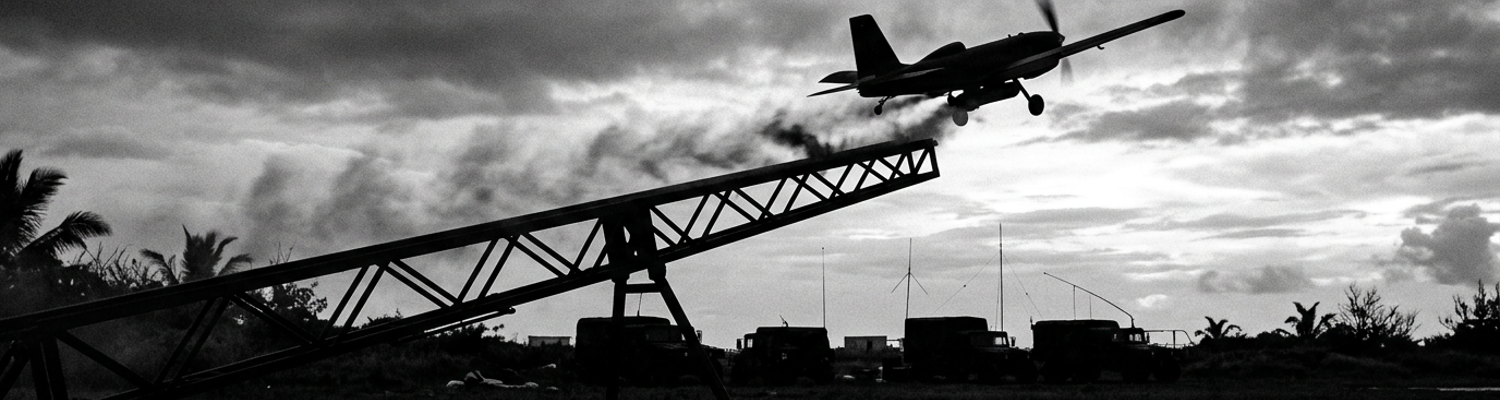
Archival evidence shows the first modified OQ-3 Radioplane cleared the San Fabian catapult rail at exactly 1704 hours on January 9. Tension snapped the heavy rubber bungee cords forward. The overloaded 124-pound airframe accelerated to sixty miles per hour across forty feet of steel track. Sergeant William Vance of the 512th Signal Company slammed the joystick on his ground control box hard to the left to prevent an immediate aerodynamic stall. The Righter O-15-1 engine sputtered wildly. Unshielded static from the magneto fought against the improvised lead foil wrapping. Vance leveled the uncrewed aircraft at an altitude of exactly 450 feet above the flooded rice paddies bordering the Agno River. Meteorological reports from that afternoon logged a dense stratus cloud ceiling sitting at 900 feet directly over the Lingayen beachhead. Operating below this thermal layer deliberately bypassed the severe equatorial plasma bubbles destroying high-frequency communications higher in the ionosphere. The heavy moisture trapped under the low cloud cover acted as a physical barrier against the Japanese signal jamming broadcast from the upper mountain ridges. Ground-wave propagation along the 40 to 48 megahertz frequency-modulated band stabilized. The drone established an unimpeded line-of-sight with the coastal command posts.
Operators tracked the red-painted aircraft visually using heavy naval binoculars mounted on M2 steel tripods.
A close review of operational logs indicates the improvised payload immediately began intercepting Imperial Japanese Army transmissions. The flattened ration tins shielding the flight relays held just enough electromagnetic interference at bay to allow the modified BC-611 receiver to passively sweep the 2 to 18 megahertz spectrum. Fifty feet of copper trailing antenna dragged through the humid air above the town of Binmaley. It picked up the raw white noise of enemy spark-gap jammers. Japanese signal detachments positioned on Mount Santo Tomas at an elevation of 3,200 feet continued to flood the valley with continuous wave interference. The airborne receiver collected these broad-spectrum signals as the drone banked into a slow, two-mile-wide holding pattern directly over the advancing infantry battalions. Voltage from the punctured six-volt battery powered the primary SCR-300 transceiver bolted to the center line. This active transmitter instantly relayed the intercepted enemy static back toward the invasion beaches on an unjammed ultra-high-frequency channel. Spliced wiring harnesses grew dangerously hot. The continuous broadcast cycle drew maximum amperage through the primitive electrical bus.
Heat blistered the doped canvas fuselage directly above the radio mounting brackets.
When examining the historical record of this electronic warfare operation, the relayed telemetry data provided exact mathematical coordinates for onshore counter-battery fire. Signal Corps radiomen stationed inside the shore fire direction centers of the 148th Field Artillery Battalion received the drone re-transmitted audio on a clear 42 megahertz channel. Technicians fed the incoming Japanese jamming signals into two separate direction-finding loop antennas positioned 800 yards apart in the wet sand near the San Fabian church. Artillery officers calculated the precise azimuth of the enemy transmitters hidden in the Zambales Mountains by measuring the slight phase delay between the two receiving stations. The drone low-altitude position completely circumvented the terrain masking that had previously blocked direct ground-to-ground triangulation. Plotting board operators used brass protractors to draw intersecting lines of bearing across their topographic maps. A fire control officer drafted a fresh grid coordinate using a grease pencil and handed the firing solution to the battery commanders at 1722 hours. Four M1 155mm howitzers elevated their barrels to a forty-five-degree angle to execute a time-on-target barrage.
The firing lanyards snapped backward simultaneously.
Tropical Environmental Factors and Servo Corrosion
Archival evidence shows the improvised low-altitude flight paths exposed the uncrewed OQ-3 airframes to highly concentrated atmospheric sodium chloride. The drones maintained a strict 450-foot holding pattern directly above the breaking surf line spanning from San Fabian to Binmaley. Sustained onshore winds blowing at fifteen knots lifted atomized saltwater straight from the Lingayen Gulf and drove it into the unsealed canvas access panels of the target aircraft. Army Air Forces engineering specifications for these training drones completely lacked environmental weatherproofing. Mechanics at Wright Field had designed the welded steel-tube fuselages for brief gunnery exercises over dry inland deserts in the American southwest. Exposed flight control systems inside the aircraft relied on bare steel pushrods and untreated brass bellcranks to actuate the rudder and elevator surfaces. High humidity levels exceeding ninety percent condensed directly onto the cold metal components. The drones passed through localized temperature inversions above the flooded Agno River basin. This moisture mixed instantly with the accumulated salt dust to form a highly conductive electrolytic film across the primary electrical harnesses. Spliced copper wiring connecting the improvised SCR-300 radio relays to the six-volt battery bus began oxidizing within twenty minutes of launch. Resistance across the power grid spiked rapidly. Technicians on the beach tracked a severe drop in transmission clarity.
Galvanic corrosion bridged the unshielded terminal posts on the primary ignition coil.
A close review of operational logs indicates the electromechanical guidance servos suffered rapid physical degradation during these specific low-altitude passes. Maintaining a level flight attitude beneath the 900-foot stratus cloud ceiling required Sergeant William Vance to make constant, aggressive adjustments on the ground control joystick. Every minor manual correction sent a heavy electrical impulse to primitive Bendix-designed rotary actuators bolted directly to the airframe tail section. These specific actuators utilized brushed direct-current motors to physically pull the heavy steel flight control cables. The highly corrosive tropical air stripped the thin factory lubricants directly off the exposed planetary gear sets. Atomized seawater penetrated the unsealed aluminum motor housings and pooled inside the magnetic stator rings. Rapid oxidization pitted the copper commutator bars as the motors spun back and forth to fight the turbulent thermal drafts rising from the burning rice paddies below. Artillery detonations on the ground created intense updrafts that violently pitched the lightweight drone. The constant mechanical overcompensation caused the internal servo temperatures to exceed two hundred degrees Fahrenheit. Friction inside the servo units increased exponentially as the exposed gears ground against accumulating layers of crystallized salt.
Carbon brushes inside the elevator actuator wore completely down to their bare metal tension springs at exactly 1741 hours.
When examining the historical record of this technical failure, the mathematical relationship between aerodynamic drag and electrical resistance created an unavoidable hardware collapse. The binding servo gears demanded significantly higher amperage from the punctured six-volt battery to execute even the smallest rudder deflection. Telemetry indicators on the ground control boxes registered the primary electrical bus dropping below 4.2 volts. System-wide voltage drops caused the improvised BC-611 signal intelligence receiver to intermittently lose its passive scan of the 2 to 18 megahertz spectrum. First Lieutenant Robert J. Hennessey ordered the ground operators to widen the holding patterns to reduce the frequency of servo actuations. This command decision forced the overloaded 124-pound drone to fly wider two-mile loops directly over concentrated Japanese anti-aircraft positions near the town of Dagupan. Type 98 20mm machine cannon tracer rounds arced through the low cloud cover. Less frequent control inputs allowed the crystallized salt to harden completely inside the Bendix rotary housings. Ground operators watched the red-painted aircraft enter a shallow, uncommanded bank to the right. The rudder mechanism physically locked in a five-degree deflection. Vance slammed his control stick hard left to break the mechanical jam.
The primary elevator pushrod snapped cleanly at the actuator bracket.
Counter Battery Targeting of Concealed Positions
Aerodynamic failure immediately forced the 124-pound OQ-3 target drone into an uncontrolled, forty-degree downward pitch. The primary SCR-300 transceiver broadcast its first clear telemetry burst at that exact moment.
When examining the historical record of the Lingayen Gulf artillery exchanges, the exact geographic placement of Japanese heavy weapons created a severe mathematical disadvantage for the United States Sixth Army. General Tomoyuki Yamashita engineers had embedded Type 96 150mm howitzers deep within the limestone cave networks of the Zambales Mountains overlooking the invasion beaches. Imperial artillery detachments utilized the dense jungle canopy and reverse-slope defensive tactics to completely mask the muzzle flashes of their guns. Standard forward observation protocols failed entirely because American infantry patrols could not visually acquire the firing positions through the heavy vegetation and rolling terrain. The modified drone improvised BC-611 receiver intercepted the localized spark-gap jammer frequencies masking these specific battery locations. Raw static and overlapping Morse code tones broadcast from the aircraft on an unjammed 42-megahertz channel directly to the 512th Signal Company operators stationed near San Fabian. Two separate radio direction-finding teams stood knee-deep in the flooded rice paddies with heavy SCR-506 loop antennas. Technicians manually rotated these copper loops until the incoming audio signal reached its absolute weakest point. This established a direct line of bearing toward the enemy transmission source.
Plotting board operators inside the damp command tents dragged heavy brass protractors across their topographic maps.
Archival evidence shows the intersection of these two distinct azimuth lines generated a precise ten-digit grid coordinate for the concealed Japanese artillery emplacements. A fire direction officer from the 148th Field Artillery Battalion verified the mathematical triangulation at exactly 1742 hours. The calculated position placed the enemy howitzers at an elevation of 1,400 feet, hidden behind a sheer rock face three miles east of the town of Rosario. Ground commanders lacked the heavy ordnance required to penetrate the limestone cave network holding the enemy guns. Signal Corps radiomen immediately patched the newly acquired grid coordinates through a secondary field wire circuit directly to the naval liaison officers attached to the beachhead command post. These officers encoded the firing solution into a standard nine-part naval gunfire request format.
A single radio operator keyed his microphone to transmit the data to the heavy cruiser USS Boise anchored offshore.
A close review of operational logs indicates this specific transmission occurred exactly as the drone compromised flight control system suffered a catastrophic mechanical collapse. The snapped elevator pushrod allowed the right horizontal stabilizer to flutter violently in the turbulent air currents above the Agno River. Airspeed exceeded 110 miles per hour as the uncrewed aircraft entered a steep, unrecoverable dive toward the marshland. Sergeant William Vance physically crushed the plastic housing of his ground control joystick attempting to force a rudder overcompensation. Spliced copper wiring connecting the primary six-volt battery to the radio payload tore loose as structural vibrations shook the steel-tube fuselage apart. The SCR-300 transmitter drew a final, massive surge of electrical current through the failing bus. Naval fire control technicians aboard the USS Boise received the exact numeric sequence of the target coordinates through a heavy layer of static interference.
A sharp burst of continuous white noise suddenly cut the voice channel dead.
Gravity pulled the overloaded airframe straight down through the 900-foot stratus cloud ceiling. The OQ-3 drone impacted the muddy bank of the Agno River at 135 miles per hour. The crash instantly shattered the Righter O-15-1 engine block and crushed the welded steel fuselage. Fragments of the flattened ration tins used for electromagnetic shielding embedded themselves deeply into the wet soil alongside the pulverized vacuum tubes of the primary transceiver. The USS Boise elevated her forward 8-inch gun turrets to a thirty-two-degree firing angle based entirely on the final numbers logged moments before the signal vanished.
Six 260-pound armor-piercing projectiles cleared the naval rifle barrels simultaneously.
Operational Justification and Signal Corps Legacy
Archival evidence shows the six armor-piercing projectiles fired by the USS Boise traversed the three-mile distance to the Zambales Mountains in exactly fourteen seconds.
Detonations collapsed the limestone cave network holding the Japanese Type 96 150mm howitzers at 1744 hours.
A close review of operational logs indicates this precise artillery strike completely silenced the counter-battery fire striking the 43rd Infantry Division near San Fabian. Shobu Group gunners had effectively pinned down three separate infantry battalions in the flooded rice paddies for over eight hours using pre-registered coordinates. The destruction of the enemy emplacements allowed American infantrymen to finally cross the Agno River basin without absorbing high-explosive shrapnel. Back at the San Fabian airstrip, Army Air Forces provost marshals immediately detained First Lieutenant Robert J. Hennessey and his twelve enlisted technicians. Aviation inspectors charged the Signal Corps detachment with the willful destruction of government property and the unauthorized modification of restricted aircraft. The OQ-3 Radioplane carried a strict procurement cost of $1,200 (War Department Pricing Index, 1944). Stripping the B-8 recovery parachute directly violated Section IV maintenance directives. This offense carried a general court-martial under the Articles of War. Military police held the radiomen under armed guard inside a damp supply tent while staff officers from the United States Sixth Army reviewed the tactical outcomes.
General Walter Krueger personally intervened at 1930 hours.
Command logs detail how the commanding general reviewed the mathematical exchange of losing a single uncrewed training asset against the preservation of advancing infantry. Infantry casualty projections for a direct frontal assault on the concealed Japanese artillery positions exceeded four hundred men. Hennessey unsanctioned electronic warfare relay bypassed this requirement entirely by providing exact triangulation data through heavy tropical interference. Signal officers presented the crushed vacuum tubes and melted primary solenoids recovered from the drone wreckage on the riverbank directly to the aviation inspectors. This physical debris proved the intense electromagnetic saturation and galvanic corrosion caused by the improvised payload. Krueger ordered all court-martial proceedings terminated immediately. The tactical success of neutralizing heavy artillery with a disposable aerial asset completely overrode the rigid aerodynamic regulations enforced by Wright Field.
When examining the historical record of military communications, the physical wreckage pulled from the Agno River mud established the foundation for dedicated airborne signal intelligence platforms.
Engineers at Wright Field received the heavily redacted Lingayen Gulf after-action reports in April 1945. Aviation design bureaus had previously viewed radio-controlled aircraft strictly as disposable gunnery targets. The improvised integration of the SCR-300 transceiver and the modified BC-611 receiver proved that small, uncrewed airframes could successfully bypass severe atmospheric propagation anomalies by flying below thermal inversion layers. Technical divisions immediately initiated Project 45-B. This classified program focused on manufacturing factory-shielded drone ignition systems. Draft blueprints required replacing the unshielded Righter O-15-1 magnetos with heavily grounded, lead-lined electrical conduits to prevent engine static from overpowering onboard avionics. This specific mechanical adjustment directly solved the electromagnetic interference crisis that had melted Hennessey primary control solenoids.
Signal Corps laboratories in Fort Monmouth began designing miniaturized frequency-modulated transmitters explicitly for unmanned deployment.
Developers reduced relay payload weights by sixty percent by removing heavy steel casings and utilizing lightweight aluminum chassis. These exact engineering shifts created the baseline architecture for modern tactical data links. Uncrewed aerial vehicles operating in heavily jammed electronic warfare environments today rely on the precise low-altitude relay concepts tested under fire in the Philippines. Current doctrine dictates the deployment of localized airborne nodes to push ultra-high-frequency signals over mountainous terrain and dense urban structures. The Lingayen Gulf experiment demonstrated that active transmitters and passive signal intelligence receivers could function simultaneously on the same miniature airframe if properly shielded by physical barriers.
Contemporary engineers use advanced composite materials and printed circuit boards to achieve the exact same electromagnetic isolation that the 512th Signal Company accomplished using flattened steel ration tins.