
Establishment of Naval Air Transport Service at Alameda
Archival evidence shows War Department planners handed the San Francisco naval command a rigid schedule in early October 1942. They demanded a continuous aerial supply route to the South Pacific by December. Supply officers received sixty days to build an infrastructure capable of hauling thousands of tons of freight across 6,000 miles of ocean. The next offensive push in the Solomon Islands depended entirely on this supply line.
The deadline was absolute.
A close review of operational logs indicates staff officers worked eighteen-hour shifts drafting preliminary route maps. Forward bases would exhaust their aviation fuel and replacement parts within seventy-two hours of sustained combat if the supply lines failed to materialize by January. Planners mapped out fuel stops at Johnston Atoll and Palmyra Island. They simultaneously sourced cargo aircraft to fly the routes.
This administrative overhaul rapidly altered existing command structures.
Command 12th Naval District officially assumed total oversight of all transpacific Naval Air Transport Service flights during December 1942. Rear Admiral John W. Greenslade and his staff in San Francisco inherited a fractured system. It previously relied on civilian contracts with Pan American Airways. The transition was chaotic. Naval personnel suddenly scheduled, loaded, and cleared flights for a rapidly expanding fleet of R4D Skytrains, R5D Skymasters, and Martin PBM Mariner flying boats. Officers assigned to the district transport desk struggled daily to merge civilian airline maintenance schedules with strict military cargo manifests. Flight clearances required seven different departmental signatures before a pilot could start their engines.
Transport squadrons VR-2 and VR-3 fell under this new administrative jurisdiction.
This brought hundreds of pilots, navigators, and ground crew into the district direct chain of command. Dispatchers tracked aircraft movements using grease pencils on large plexiglass boards at the headquarters building. Radio operators transmitted encrypted weather data and flight vectors over high-frequency channels to crews navigating the long overwater legs to Naval Air Station Kaneohe Bay. The paperwork backlog frequently delayed priority flights by forty-eight hours during the first three weeks of the month.
The volume of outbound freight immediately overwhelmed the existing storage hangars around the bay.
Naval Air Station Alameda became the primary West Coast hub pushing aviation gear to forward Pacific units. Located at 37.7825 N, 122.3108 W on a man-made peninsula, the facility offered dual utility with deep-water seaplane lagoons and 5,000-foot asphalt runways. Ground crews worked through heavy winter fog. They loaded crated Pratt and Whitney R-1830 Twin Wasp engine cylinders into the bare metal fuselages of waiting transport planes. Forklift shortages meant enlisted men frequently muscled 400-pound crates of Hamilton Standard propeller blades, heavy landing gear struts, and fragile radar magnetrons up wooden ramps by hand.
The labor was punishing.
These shipments were destined for austere repair depots in Noumea, Espiritu Santo, and Henderson Field on Guadalcanal. Mechanics at Alameda conducted final inspections on replacement aircraft before their transit flights. They checked hydraulic lines for micro-leaks. They tested manifold pressures at high revolutions per minute. They calibrated radio compasses against local transmission beacons.
A single faulty spark plug discovered during these checks grounded a priority shipment for an entire day.
Cargo handlers developed new weight-distribution formulas. They packed heavy ammunition boxes alongside lightweight aluminum airframe patches without shifting the center of gravity on the aircraft. Manifest clerks replaced handwritten ledgers with specialized punch-card systems to track inventory moving directly from incoming railcars to the tarmac. The integration of Navy mechanics with civilian technical representatives at the Alameda repair shops gradually reduced engine turnaround times. Efficiency slowly improved.
Freight bottlenecks persisted at the loading docks due to a lack of specialized cargo doors on early transport models.
Ground personnel removed passenger seats and installed reinforced plywood flooring to accommodate heavier payloads. Machinists fabricated custom aluminum tie-down rings to secure fifty-gallon oil drums during turbulent flights over the Pacific. These unglamorous modifications directly increased the payload capacity of each departing flight. Ground crews at Alameda worked under glaring floodlights through the night. They ensured planes departed before dawn to maximize daylight flying hours for the initial leg to Hawaii. The 12th Naval District supply officers continuously revised their loading protocols. They prioritized the exact types of spark plugs and hydraulic fluid requested by frontline maintenance officers.
Transpacific Freight Corridors to Oahu
Transport flights covered a 2,400-mile supply line across open ocean between California and Hawaii. The physical mechanics of this route reveal a grueling endurance test for both machines and crews. Navigators operating out of Alameda plotted vectors toward Naval Air Station Kaneohe Bay using basic celestial fixes and dead reckoning. A standard Consolidated PB2Y Coronado flying boat required fourteen hours to cross this featureless expanse of the Pacific.
Headwinds often dropped ground speeds below 130 knots.
Pilots wrestled with heavy yoke pressures as they flew through unpredicted squall lines. Early R4D Skytrains required the installation of heavy auxiliary fuel tanks bolted directly into the main cabin to make the crossing. This modification consumed maximum floor space. Mechanics routinely bypassed standard maintenance intervals just to keep enough airframes on the flight line. Engine oil consumption became a strict limiting factor. A Twin Wasp radial engine burned up to three gallons of oil per hour during cruise flight.
Flight engineers monitored pressure gauges constantly to prevent catastrophic mid-air seizures.
The distance pushed early airframes to their absolute mechanical limits. A slight miscalculation in fuel mixture settings by the co-pilot easily resulted in fuel starvation two hundred miles short of the Hawaiian coastline. Ditching a heavily loaded transport in the winter swells of the central Pacific guaranteed a total casualty rate. High-priority aircraft spares were continuously delayed by capacity limits on early transpacific air routes.
Archival evidence shows a fully fueled R4D preparing for the 2,400-mile jump to Oahu had a maximum allowable cargo payload of just under 3,000 pounds.
Supply officers at the 12th Naval District transport desk faced impossible mathematical equations every shift. A single replacement wing section for an F4F Wildcat weighed 450 pounds. Three crates of Bendix hydraulic brake assemblies added another 600 pounds. Loadmasters frequently ordered ground crews to pull priority cargo off the aircraft minutes before engine start because the ambient air temperature had risen. Warmer air decreased density altitude. This directly reduced the maximum safe takeoff weight of the plane.
These capacity limits created severe bottlenecks on the Alameda tarmac.
Crates containing fragile SC radar magnetrons and specialized high-altitude oxygen regulators sat under canvas tarps for weeks waiting for available payload slots. Heavy items like landing gear struts were repeatedly bumped down the priority list in favor of lighter, higher-value electronics. Supply clerks watched freight pile up in the hangars. Outgoing planes departed with mostly empty cargo holds filled entirely by the weight of their own aviation gas.
Frontline mechanics on Guadalcanal grounded entire fighter squadrons while these exact components rusted on the California docks.
A close review of operational logs indicates dispatchers attempted to bypass these volume restrictions by stripping all non-essential equipment from the transport planes. Armor plating, life rafts, and co-pilot seating were unbolted and discarded into scrap piles. Even with these extreme weight-saving measures, the sheer distance of the overwater corridor dictated that fuel always took precedence over freight. A PBM Mariner required 1,400 gallons of aviation fuel to safely reach Hawaii with a standard reserve.
That liquid load weighed 8,400 pounds.
Every extra gallon pumped into the wing tanks meant another crate of spark plugs or radio tubes stayed behind in San Francisco. Cargo handlers developed a triage system. They broke open sealed wooden factory crates to extract individual steel ball bearings and aluminum rivets. Loaders packed these loose components into canvas mailbags to fit around the auxiliary fuel cells. Manifest clerks tracked these fragmented shipments using grease pencils on wall charts. They recorded serial numbers for individual magneto coils shipped on Tuesday.
The corresponding engine blocks waited for a heavy-lift flying boat scheduled for Thursday.
Missing a single paper manifest form meant the parts would sit unidentified in a Hawaiian warehouse for months. Naval engineers eventually reinforced the aluminum floorboards of the R5D Skymaster to handle concentrated point loads. This structural change allowed forklift operators to load heavier Pratt and Whitney engine blocks directly over the wing root. This maintained the precise center of gravity required for long-distance flight. Mechanics secured these 1,200-pound engines using half-inch steel chains anchored to the main spar bulkheads.
Loadmasters calculated the exact shear strength of the tie-down rings.
They ensured the heavy blocks would not break loose during severe turbulence over the Pacific. Flight crews verified the tension on every chain link with heavy steel wrenches before sealing the cargo doors.
Modified Transport Aircraft Capabilities and Limitations
Archival evidence shows the 12th Naval District supply chain depended entirely on two distinct airframes. These were the twin-engine Douglas R4D Skytrain and the four-engine Consolidated PB2Y Coronado flying boat. Transport Squadron VR-3 operated the land-based R4Ds from the fog-shrouded asphalt strips at Naval Air Station Alameda. A few hundred yards away at the seaplane lagoons, Transport Squadron VR-2 managed the heavy PB2Y flying boats.
Civilian contractors and Navy machinists subjected them to severe structural modifications before these aircraft could attempt the 2,400-mile great circle route to Hawaii.
The PB2Y originally functioned as a heavily armed patrol bomber. Mechanics stripped out the defensive gun turrets. They removed the bomb bay doors and plated over the openings with raw aluminum sheet metal to reduce aerodynamic drag. Inside the uninsulated fuselage, technicians unbolted the bombardier stations. They installed heavy-duty cargo tie-down rings directly into the aluminum floor ribs.
The R4Ds underwent similar stripping procedures.
Ground crews removed all passenger seating, soundproofing insulation, and cabin heating systems. They installed thick plywood flooring reinforced with steel plating. This distributed the weight of heavy engine crates across the main structural bulkheads. These hasty airframe conversions immediately introduced severe center-of-gravity complications. A close review of operational logs indicates overweight cargo configurations routinely pushed both aircraft types past their designed structural limits.
Loadmasters at Alameda packed the PB2Y Coronados with up to 10,000 pounds of high-priority freight.
This included dense crates of .50-caliber ammunition and replacement Pratt and Whitney R-1830 engine blocks. This extreme payload forced the flying boats to sit dangerously low in the water during taxi operations. Pilots required three full miles of open water in the San Francisco Bay just to achieve takeoff velocity. The extended takeoff runs subjected the hull to violent pounding against the choppy winter swells.
Rivets popped along the lower hull seams.
Saltwater seeped into the lower cargo compartments. This corroded fragile electronic components like SC radar magnetrons before the plane even broke contact with the surface. Once airborne, the Coronado climbed at a sluggish 150 feet per minute. The sheer mass of the cargo forced pilots to operate the four engines at near-maximum continuous power just to maintain a minimal cruising altitude of 4,000 feet. Sustained high-RPM operations rapidly accelerated mechanical wear across the entire engine assembly.
The land-based R4D Skytrains suffered from identical weight-induced mechanical strain during their long ocean hops.
Navy regulations officially capped the R4D maximum takeoff weight at 29,000 pounds. Supply officers regularly ordered ground crews to load the aircraft to 31,000 pounds or more to meet the delivery quotas for the South Pacific. This excess weight directly compromised the structural integrity of the main wing spars. The metal fatigued. During turbulent flights through Pacific weather fronts, the overloaded wings experienced severe flex.
Flight engineers reported visible warping of the interior cabin bulkheads when the aircraft encountered heavy updrafts.
The overweight configurations also drastically reduced the operational range of the twin-engine transports. Drag increased exponentially as the heavy aircraft flew at high angles of attack to generate enough lift. A standard R4D carrying a 4,000-pound payload experienced a fifteen percent reduction in overall fuel efficiency. Headwinds frequently forced crews to consume their mandatory safety fuel reserves halfway through the flight.
The physical toll on the Pratt and Whitney R-1830 Twin Wasp engines becomes apparent when examining the historical record.
The heavy drag profile required pilots to run the engines with rich fuel mixtures to prevent cylinder head temperatures from exceeding 260 degrees Celsius. This rich mixture fouled the spark plugs with lead deposits after just ten hours of flight. Mechanics in Hawaii routinely documented severe oil blow-by in the engine cylinders of arriving aircraft. The pistons cracked. The excess weight placed extreme stress on the main landing gear trunnions upon touchdown at Kaneohe Bay.
The steel struts compressed completely.
This transferred the shock directly into the aluminum wing root. Maintenance logs from December 1942 list thirteen separate incidents of R4D landing gear assemblies fracturing under the load of heavy F4F Wildcat replacement parts. Ground crews had to prop the damaged wings on wooden blocks to unload the cargo.
Celestial Navigation Challenges in Radio-Silent Airspace
Archival evidence shows transpacific flight crews operating out of Naval Air Station Alameda in December 1942 flew across a featureless 2,400-mile corridor to Oahu. Navigators relied almost entirely on primitive dead reckoning and celestial octants to plot courses. Inside the freezing, unpressurized cabin of a Douglas R4D Skytrain, the navigation officer stood on a wooden crate to reach the plexiglass astrodome bolted into the upper fuselage. He used a Pioneer Mark II bubble octant to measure the altitude of specific stars like Sirius or Betelgeuse against a mechanically generated artificial horizon.
The physical mechanics of this process required extreme stability.
Aircraft vibrations from the twin Pratt and Whitney engines forced the officer to average out ten separate optical readings over a two-minute period just to plot a single line of position on his paper chart. Plotting a three-star fix took twenty minutes of continuous calculations using a Weems plotter and heavy nautical almanacs. A sudden shift in winter weather fronts easily obscured the night sky with dense cumulonimbus clouds. Flight logs from these winter crossings reveal crews spent up to eight hours directing the aircraft solely by dead reckoning.
This mechanical process required the aircrew to calculate the true ground speed and wind drift of the aircraft without any external reference points.
Enlisted flight engineers opened small aluminum hatches in the floorboards to deploy Mark 6 drift sights directly over the dark Pacific Ocean. They dropped glass ampoules of aluminum powder into the water. The officer then peered through the optical drift sight. He measured the exact angle at which the glowing aluminum patch slid backward against the heading of the aircraft. This manual calculation provided the only available wind correction data.
The floor hatches had to be sealed if the aircraft entered a heavy squall line.
This prevented saltwater from flooding the lower cargo compartments. The crew then had to guess the wind vectors based on pre-flight meteorological forecasts issued twelve hours earlier in San Francisco. A miscalculated wind shift of just fifteen knots pushed an R4D fifty miles off its intended track. Strict radio-silence protocols prevented direction-finding assistance. This increased the risk of missing oceanic waypoints.
Command 12th Naval District issued absolute orders prohibiting all outbound flights from transmitting on high-frequency radio bands.
Japanese I-class submarines actively patrolled the waters between California and Hawaii during late 1942. Transmitting a simple request for a position update allowed enemy surface vessels to triangulate the exact coordinates of the transport plane. Radio operators sat at their stations with the transmitters physically disconnected from the main power bus. They could listen to encrypted fleet broadcasts. They could not send out a signal to request a high-frequency direction-finding fix from the shore stations at Kaneohe Bay or Point Reyes.
The Bendix automatic radio compasses installed in the R4D and PB2Y aircraft possessed an effective reception range of just 200 miles.
The mechanical needle on the radio compass simply spun in continuous, unresponsive circles for the middle 2,000 miles of the journey. Flight crews crossed the halfway point at longitude 140 degrees West completely isolated from the naval communications grid. A close review of operational logs indicates this communications blackout created severe hazards as aircraft approached the Hawaiian archipelago. Aircrews had to hit a precise geographical window to acquire the low-frequency homing transmitter broadcasting from Makapuu Point.
Missing this narrow oceanic waypoint meant flying past the islands into the deep expanse of the Western Pacific.
The overloaded transport aircraft carried zero excess fuel to conduct search patterns if they missed their landfall. An R4D Skytrain arriving at the 2,300-mile mark typically registered less than forty-five minutes of aviation gas remaining in its auxiliary tanks. Pilots reduced engine revolutions per minute to absolute minimums. They bled off airspeed to stretch their final gallons while the crew desperately searched for a visual reference on the horizon.
The flight engineer initiated emergency ditching procedures if the radio compass failed to pick up the homing signal within a twenty-minute window.
Crew members unbolted the heavy cargo tie-down chains. They began manually pushing 400-pound crates of Hamilton Standard propeller blades out the side cargo doors to reduce the impact weight of the aircraft.
Aircrew Mental Fatigue and Operational Hazards
Archival evidence shows transpacific flight crews operating the Douglas R4D Skytrain endured extreme physical deterioration during fourteen-hour transit flights. Pilots assigned to Transport Squadron VR-3 sat in completely unpressurized cockpits while dragging overloaded airframes across the 2,400-mile Pacific corridor. Standard flight profiles required these transports to climb above 10,000 feet to clear dense winter cumulonimbus formations building near coordinates 30 degrees 15 minutes North, 135 degrees 40 minutes West. Ambient air temperatures inside the uninsulated aluminum fuselage plummeted to minus fifteen degrees Celsius at this altitude.
The Navy issued heavy fleece-lined leather flight suits to combat the freezing conditions.
These bulky garments severely restricted movement inside the cramped cockpit compartment. Flight engineers wedged themselves between the pilot seats just to monitor manifold pressure gauges. Constant, low-frequency vibrations from the twin Pratt and Whitney R-1830 engines transferred directly through the raw metal floorboards into the bones of the aircrew. This mechanical shaking induced severe muscle cramping in the lower extremities after six hours in the air.
A close review of operational logs indicates the lack of cabin pressurization directly degraded mental acuity as the flights pushed deeper into the unlit oceanic airspace.
Transport Command 12th Naval District ordered crews to utilize basic A-8 continuous-flow oxygen masks once the aircraft passed 8,000 feet. The mechanics of these early rubber masks required users to bite down on a hard plastic mouthpiece. Saliva pooled in the lower rubber reservoir. It froze solid. The continuous blast of pure, unhumidified oxygen dried out the mucous membranes of the pilots.
This caused severe nosebleeds that coated their instrument panels in blood.
Prolonged exposure to these high altitudes with imperfect oxygen delivery systems caused mild hypoxia. Co-pilots stared blankly at the artificial horizon indicator for minutes at a time without registering the slow descent of the aircraft. The constant drone of the engines combined with the featureless black sky outside the plexiglass windshield to produce intense auditory hallucinations. Pilots repeatedly reported seeing phantom navigation lights from non-existent aircraft blinking in the distance.
This physical exhaustion directly corrupted the mathematical calculations required for transpacific navigation.
Navigators operating in the rear compartment relied entirely on Weems plotters and heavy nautical almanacs to chart their progress. Fatigue destroyed their ability to perform basic arithmetic by the tenth hour of flight. A navigator attempting to plot a celestial fix with a Pioneer Mark II bubble octant often misread the vernier scale by a single degree due to blurred vision. That one-degree optical error in plotting the altitude of the star Sirius translated immediately to a sixty-mile deviation on the paper chart.
Exhausted flight engineers also miscalculated fuel consumption rates.
They recorded a burn rate of eighty gallons per hour on their clipboards when the engines were actually consuming ninety-five gallons. A sleep-deprived co-pilot frequently left the fuel mixture setting too rich. These compounded human errors forced heavily loaded transport planes far outside their designated approach vectors. Fatigue-induced navigational drifts resulted in a sharp increase in operational losses during late December 1942.
Squadron commanders at Naval Air Station Kaneohe Bay documented multiple instances of incoming R4D and PB2Y aircraft completely missing the Hawaiian archipelago.
An exhausted navigator who incorrectly factored a twenty-knot crosswind into his dead reckoning calculations allowed the aircraft to drift steadily south of the island chain. The crew hit the 2,400-mile mark expecting to see the Makapuu Point lighthouse. They found empty ocean. The overloaded transport aircraft carried zero excess fuel reserves to correct these navigational drifts.
Pilots who missed the islands by just fifty miles ran their auxiliary cabin tanks dry while initiating desperate box-search patterns.
The twin engines sputtered. They seized as the fuel lines sucked in vapor. Aircrews executed forced ditching procedures into the rough twelve-foot swells of the Central Pacific in total darkness. Search and rescue destroyers dispatched from Pearl Harbor routinely found only floating plywood floorboards and slick patches of aviation oil.
Port Infrastructure Bottlenecks at San Francisco Docks
Archival evidence shows the Southern Pacific Railroad deposited an average of 450 loaded boxcars daily into the Mission Bay and Bayshore rail yards by mid-November 1942. This volume of incoming freight immediately overwhelmed the physical capacity of the San Francisco Embarcadero. Dockside staging warehouses at Pier 45 and Pier 60 possessed a combined interior storage footprint of just 120,000 square feet. Trainmasters directed switch engines to park excess rolling stock on emergency sidings stretching three miles down the peninsula along Townsend Street.
Civilian stevedores stacked 400-pound wooden crates containing Hamilton Standard propeller blades and Pratt and Whitney R-1830 engine cylinders up to the ceiling rafters inside the transit sheds.
The sheer density of the cargo eliminated all designated walking paths between the storage bays. The mechanical equipment tasked with moving this heavy freight failed under continuous use. Clark industrial lifting tractors ruptured their hydraulic steering seals after operating for seventy-two consecutive hours. Ground crews lacked replacement hydraulic fluid.
Operations stopped.
Enlisted men resorted to using steel pry bars, wooden rollers, and manila ropes to drag heavy landing gear struts across the splintered wooden planks of the loading docks. Winter rains penetrated the corrugated tin roofs of the older transit sheds. Standing water pooled around unsealed crates of fragile avionics. Saltwater corrosion destroyed sensitive Bendix radio altimeters before they even reached the cargo manifests.
Switchmen operating the Southern Pacific steam locomotives physically uncoupled incoming flatcars and left them exposed on the parallel tracks running along the Embarcadero.
Yardmasters possessed no centralized tracking system to locate specific components within the miles of parked rolling stock. Supply clerks spent up to ten hours walking the tracks when a Naval Air Transport Service dispatcher requested a specific shipment of aluminum airframe patches. They checked individual serial numbers chalked onto the sides of the wooden boxcars in the dark using battery-powered flashlights. A close review of operational logs indicates the physical congestion at the docks worsened due to severe inter-service supply prioritization disputes.
The Munitions Assignments Board in Washington issued conflicting routing directives to both the Army Quartermaster Corps and the 12th Naval District supply desk.
War Department clerks assigned top-tier Class A priority tags to Army Air Forces heavy bomber components bound for the Southwest Pacific Area. Navy supply officers possessed identical Class A priority clearances for F4F Wildcat replacement parts destined for the Solomon Islands. Neither branch held clear statutory authority over the unified loading ramps at the San Francisco port of embarkation. The system broke.
Army supply officers physically ordered their military police detachments to block Navy stevedores from accessing the primary heavy-lift cargo nets.
The cranes sat idle while officers argued over carbon-copy authorization forms. Command decisions at the highest regional levels failed to resolve these daily tarmac standoffs. Rear Admiral John W. Greenslade demanded immediate clearance for air-bound naval freight during morning telephone conferences with Army General John L. DeWitt at the Western Defense Command. DeWitt refused to yield crane access until his B-17 bomber components finished loading onto outbound transports.
These components specifically included bulky Wright R-1820 Cyclone engine blocks.
The backlog expanded. This administrative blockade created severe queues for high-priority Navy cargo. Thousands of pounds of specialized aviation gear sat trapped in the muddy staging areas directly behind Army infantry field rations. Naval manifest clerks watched helplessly as specialized high-altitude oxygen regulators and SC radar magnetrons degraded under canvas tarps.
The paperwork backlog required loadmasters to manually rewrite cargo manifests every time a priority dispute bumped a Navy shipment off the daily flight schedule.
Dispatchers at Alameda headquarters tracked these stranded pallets using red grease pencils on their plexiglass status boards. A single crate of aviation spark plugs often received seven different loading dates before finally moving onto the tarmac. Frontline mechanics on Guadalcanal depleted their entire inventory of hydraulic fluid while fifty-gallon drums of that exact liquid waited behind barbed wire in California. The drums rusted into the damp soil of the Mission Bay rail yard.
Manual Cargo Triage in Freezing Winter Rain
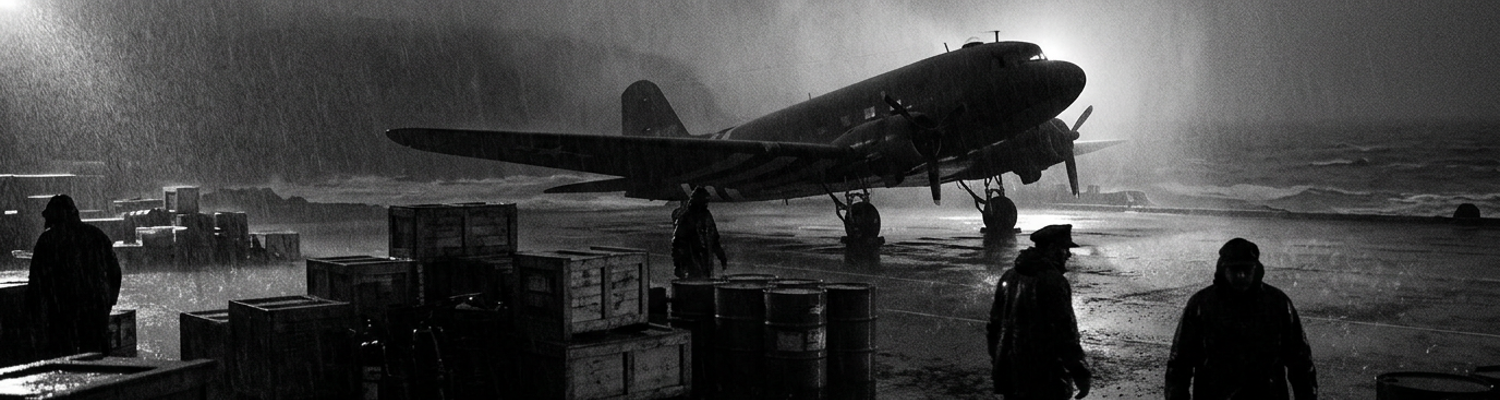
Archival evidence shows a severe shortage of civilian stevedores at Naval Air Station Alameda forced grounded aircrews to act as manual laborers during the second week of December 1942. Flight engineers and co-pilots assigned to Transport Squadron VR-3 found themselves physically sorting mislabeled cargo crates on the exposed asphalt tarmac. The mechanized loading equipment of the facility failed completely under continuous twenty-four-hour operation. Clark industrial tractors blew their primary hydraulic lifting seals after lifting overweight pallets.
Replacement hydraulic fluid was unavailable on the West Coast.
District commanders ordered the flight crews out of the heated ready rooms to manually triage the massive backlog of freight destined for Henderson Field. These men muscled 400-pound wooden crates containing Pratt and Whitney cylinder heads and damp canvas bags of aluminum rivets across the wet concrete using manila ropes. Many of these shipments arrived from the Oakland rail yards bearing incorrect destination tags. Supply clerks at the manufacturing plants frequently mixed up Army Air Forces requisition numbers with Navy inventory codes.
Grounded pilots slated to fly Douglas R4D Skytrains to Hawaii spent up to ten hours a day using heavy steel pry bars.
They separated incorrectly routed F4F Wildcat landing gear struts from piles of unneeded B-17 bomber engine cowlings. The manual labor destroyed their leather flight gloves. The tarmac temperature dropped to two degrees Celsius as the bay winds accelerated past thirty knots. Meteorological data reveals a severe winter storm system stalled directly over the San Francisco Bay for four consecutive days.
Freezing December rain poured across the open loading ramps.
This immediately compromised the structural integrity of the incoming freight packaging. The War Department had not yet standardized water-resistant V-board shipping containers for overseas transit. Civilian contractors packed sensitive electronic components inside standard corrugated paper boxes intended for domestic rail transport. Exposure to the freezing water saturated the untreated cardboard within minutes on the Alameda tarmac.
Wet paper dissolved into thick pulp.
Heavy metal components like Bendix radio compasses and Stromberg carburetors tore through the bottoms of their disintegrated boxes and crashed directly onto the abrasive asphalt. Continuous downpours also destroyed the attached paper shipping manifests. Black typewriter ink smeared across the wet forms. This completely obscured the serial numbers, weight calculations, and destination codes required for military flight clearance.
Dispatchers lost all visibility into the supply chain.
Manifest clerks could not identify which specific radar components belonged to which forward operating base in the Solomon Islands. This total loss of documentation paralyzed the outbound transpacific flight schedule. Supply officers ordered the grounded flight crews to drag the wet, unidentified components into the drafty maintenance hangars for manual identification. Enlisted men used battery-powered flashlights to inspect the stamped metal data plates on individual magneto coils, hydraulic pumps, and radio tubes.
They shouted these raw factory part numbers to manifest clerks standing nearby with thick master inventory ledgers.
Clerks cross-referenced each nine-digit alphanumeric code by hand to determine if the part was intended for a repair depot in Noumea or a fighter squadron in Espiritu Santo. Manual triage required up to forty-five minutes to process a single item. Outbound R4D transport planes sat parked on the flight line with empty cargo holds while the crews slowly rebuilt the ruined shipping manifests from scratch. Mechanics applied thick layers of Cosmoline grease to the exposed metal parts to halt the rapid saltwater corrosion caused by the bay winds.
Squadron personnel repacked the identified components into salvaged wooden ammunition crates.
A priority shipment of fifty high-altitude oxygen regulators sat unidentified in a shallow puddle on the tarmac for nine days.
Long-Term Supply Chain Reforms for Pacific Operations
Archival evidence shows the December 1942 bottleneck on the Alameda tarmac forced the 12th Naval District to completely overhaul its ground operations. Supply officers recognized relying on civilian stevedores and general-purpose military laborers caused unacceptable delays in transpacific flight schedules. The Bureau of Aeronautics authorized the immediate formation of dedicated air-freight handling squadrons. These specialized units consisted of enlisted men trained exclusively in the complex weight-and-balance mathematics required for aircraft loading.
Instructors taught these handlers to calculate the exact shear strength of aluminum floor ribs inside the Douglas R4D Skytrain and the Consolidated PB2Y Coronado.
The crisis of saturated cardboard boxes and smeared typewriter ink simultaneously triggered a complete revision of military packaging regulations. War Department planners mandated the use of standardized water-resistant V-board shipping containers for all overseas aviation components. Supply clerks discarded water-soluble typewriter ribbons. They replaced them with industrial grease pencils and stamped metal identification tags wired directly to the heavy cargo netting.
Handlers painted large, color-coded geometric shapes on the exterior of the waterproof boxes to denote shipping priorities.
This visual system allowed exhausted ground crews working under glaring floodlights to identify high-priority SC radar magnetrons from fifty feet away without reading nine-digit alphanumeric serial numbers. A solid yellow circle stenciled onto a wooden crate dictated immediate loading onto the next outbound flying boat. The streamlined supply protocols engineered from these early Naval Air Transport Service failures directly enabled the high-tempo freight demands of subsequent Pacific island-hopping campaigns. Manifest clerks at the Alameda transit sheds abandoned handwritten ledgers entirely.
They installed heavy mechanical IBM Type 405 alphabetic accounting machines directly inside the drafty staging warehouses.
These machines tracked inventory moving from the Southern Pacific Railroad flatcars to the flight line. This mechanical tracking system eliminated the manual boxcar searches that previously grounded transport flights. Cargo handlers adopted a rigid protocol of pre-weighing and pre-palletizing freight. Enlisted men secured crates of Hamilton Standard propeller blades onto standardized wooden skids while the inbound transport aircraft were still thousands of miles away over the Pacific.
This specific administrative change reduced the ground turnaround time for a four-engine R5D Skymaster from fourteen hours to just under ninety minutes.
During the preparations for Operation Galvanic at Tarawa in late 1943, these exact procedures allowed naval dispatchers to push 6,500 pounds of temperature-sensitive blood plasma and delicate SCR-536 radio crystals across the 2,400-mile oceanic corridor in forty-eight hours. Forklift operators positioned these fragile medical supplies directly over the main wing spar bulkheads to minimize vibration damage during flight. A close review of operational logs indicates this new command structure actively bypassed the jurisdictional disputes that previously paralyzed the San Francisco docks.
The Navy constructed dedicated air-freight terminals at Alameda.
This physically isolated their staging areas from Army Quartermaster control. Heavy lifting cranes and Clark industrial tractors were assigned exclusively to the transport squadrons. Loadmasters stopped arguing with military police detachments over crane access and carbon-copy authorization forms. They simply referenced the daily master punch-card printout and directed ground crews to move pre-staged pallets of Pratt and Whitney R-1830 engine cylinders straight onto the reinforced plywood flooring of the waiting transports.
The centralized tracking system allowed dispatchers to route specific hydraulic brake assemblies to forward repair depots at Kwajalein Atoll during Operation Flintlock within three days of a factory requisition.
Frontline mechanics on the captured Japanese airstrips received the exact Bendix radio altimeters they requested to repair battle-damaged F6F Hellcats. The replacement instruments arrived sealed inside heavy foil moisture barriers packed with silica gel desiccant.