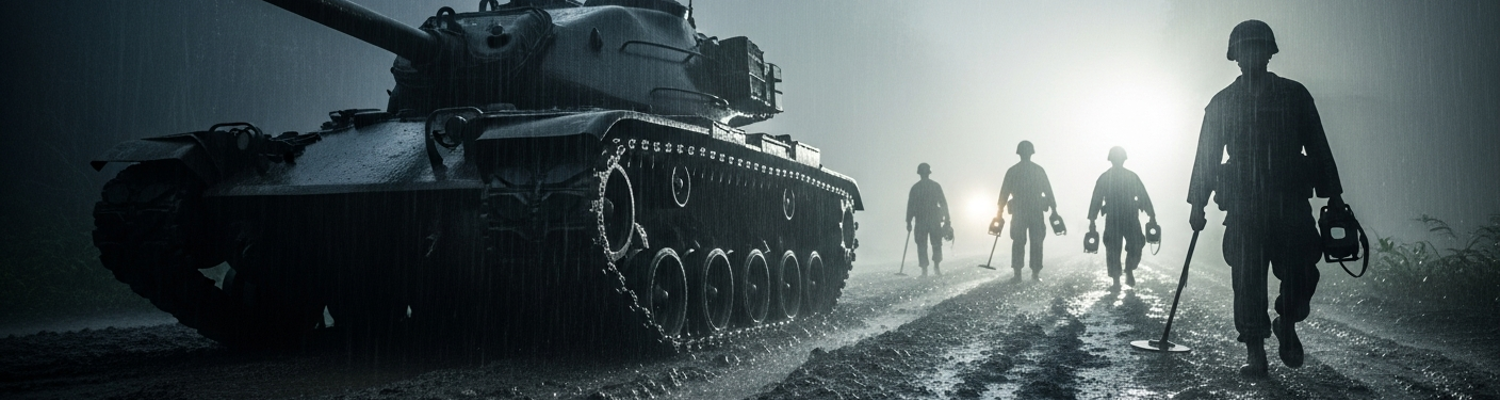

I Corps Operational Environment 1969
I Corps, 1969. The northernmost tactical zone in South Vietnam. Its geography was a collection of extremes, encompassing the five provinces of Quảng Trị, Thừa Thiên, Quảng Nam, Quảng Tín, and Quảng Ngãi, from the Demilitarized Zone (DMZ) down the coast. A close review of operational logs from III Marine Amphibious Force reveals a landscape fractured into hostile regions. The narrow coastal plain, a mix of rice paddies and sand, gave way abruptly to the Annamite Cordillera. These mountains, with peaks over 8,000 feet, were shrouded in multi-layered jungle canopy and sharp limestone karsts that tore at uniforms and skin. The jungle offered near-perfect concealment for North Vietnamese Army (NVA) units infiltrating from staging areas in Laos and across the DMZ, frequently neutralizing American air superiority. For the individual Marine, the environment fostered a deep sense of isolation. A patrol could vanish into the vegetation just a few hundred meters from its base, cut off from sight and sound.
Two roads dictated the tempo of war in I Corps.
National Highway 1, the “Street Without Joy,” was the primary north-south artery connecting major bases like Da Nang, Phu Bai, and Chu Lai. Its strategic importance was absolute, serving as the main conduit for supplies and personnel for the 1st and 3d Marine Divisions. Its vulnerability was equally absolute. The road was flanked by villages of uncertain loyalty and terrain ideal for ambushes. After-action reports from 1969 show a persistent pattern of NVA and Viet Cong activity focused on interdicting this route. Command-detonated mines and rocket-propelled grenade ambushes were a daily threat. Route clearance became a combined-arms battle fought every morning.
To the west, running toward the Laotian border, was National Highway 9. This road supplied the string of combat bases designed to block the Ho Chi Minh Trail, including Camp Carroll, the Rockpile, and Khe Sanh. A former French colonial road, Highway 9 was a treacherous mountain pass and a constant focus of NVA efforts. Operations like Dewey Canyon in early 1969, a major offensive by the 9th Marines, depended entirely on keeping Highway 9 open. The loss of this road meant the isolation of the firebases it supplied. For the engineers and Marines tasked with its security, Highway 9 was a concentrated form of danger, a narrow channel where the enemy could dictate the terms of engagement.
The region’s weather was a tactical and psychological weapon. From September to January, the northeast monsoon brought torrential downpours. The rain turned unpaved roads into impassable mud that could swallow vehicles, halting all ground movement. It grounded helicopters for days, severing the lifeline for medevacs and aerial resupply. The constant dampness caused rampant equipment failure, rusting weapons and shorting out radios. For the individual Marine, it meant being perpetually soaked, leading to immersion foot. The rain, often accompanied by a chilling fog known as “crachin” that reduced visibility to near zero, gave NVA forces cover for major troop movements, a fact they consistently exploited.
Insurgent Booby Traps and Ordnance
The arteries of the American war machine in I Corps were chronically infected with an unseen plague of enemy ordnance. For Marine engineers of the 1st, 7th, and 9th Engineer Battalions, a “secure” road was a fiction. Archival evidence shows the threat was constant, transforming every meter of asphalt and dirt into potentially lethal ground. A review of the 1st Engineer Battalion’s operational logs for 1969 reveals the scale of this effort; in May alone, its teams swept over 1,800 kilometers of road, finding and destroying 91 mines and booby traps. In October, another 2,356,700 meters were swept, locating 23 devices. The daily sweep was a slow, nerve-shredding procession. Engineers with mine detectors moved at a walking pace, senses strained for the faintest signal, while infantry provided a fragile security screen.
The ordnance itself was a mixture of mass-produced foreign munitions and locally improvised devices. Soviet PMN anti-personnel mines and Chinese anti-tank mines could be buried deep beneath the road surface, designed to be initiated by the weight of a heavy supply truck. Viet Cong (VC) and NVA sappers treated route clearance operations as a lethal laboratory. Enemy teams would meticulously observe Marine procedures, identify patterns, and then devise traps to counter them. A common tactic involved a layered methodology of attack. A standard pressure-plate mine might be placed to halt a convoy, but the real objective was often the secondary and tertiary devices placed along the expected paths of approach for security elements and medical personnel. Sappers used command-detonated charges with precision, waiting for a vehicle carrying multiple Marines or a command group to enter the kill zone before triggering the blast. They would then initiate a prepared ambush on the stalled and disorganized survivors, maximizing casualties and amplifying the psychological impact.
The ingenuity behind the explosive traps was extensive. VC forces were masters of improvisation, using scavenged and dud American ordnance to create new weapons. A standard M26 grenade could be placed inside a discarded C-ration can with its pin pulled; disturbing the can would cause the grenade to slip out and detonate. The “cartridge trap” used a bullet, a nail, and a piece of bamboo to create a single-shot firearm buried in the ground, designed to fire into the foot of anyone who stepped on it. More complex were booby-trapped souvenirs, where a captured NVA flag or an enemy helmet would be rigged with an explosive charge. Along the vegetated shoulders of the highways, non-metallic traps were common. The bamboo whip consisted of a long, flexible pole with sharpened spikes, bent back under tension and connected to a tripwire. When triggered, it would scythe across a trail at torso height. Perhaps most infamous were Punji sticks, sharpened bamboo or metal spikes, often coated in filth to cause infection, hidden in pits or undergrowth. Booby traps and mines accounted for an estimated 11% of deaths and 15% of wounds to American forces during the war, a direct reflection of their effectiveness in I Corps.
Monsoon Route Clearance Challenges
The arrival of the northeast monsoon transformed I Corps into a uniformly hostile environment. For the Marine engineers of the 1st Engineer Battalion, the torrential rains systematically dismantled the logistical arteries they were tasked to protect. The sheer volume of water, with monthly precipitation totals exceeding 36 inches, created catastrophic failures in the road infrastructure. After-action reports show a consistent pattern: French-colonial era stone arch culverts and American-installed corrugated metal pipes were overwhelmed. Saturated soil lost its structural integrity, and the hydraulic pressure of the runoff would scour away the earth supporting these structures. The result was a sudden, violent collapse, leaving a deep chasm where a road had been moments before. A bridge swept for mines at dawn could cease to exist by noon, destroyed not by an explosive charge, but by the physics of water and soil. This forced engineers into the perilous task of deploying temporary spans, like the heavy steel Bailey bridge, often while exposed to potential enemy fire.
Beyond the failure of static infrastructure, the monsoon animated the landscape with new threats. The mountainous geography of western Quảng Trị and Thừa Thiên provinces created conditions for devastating flash floods. A dry wash could, in minutes, become a violent, debris-choked torrent several meters deep, moving with enough force to sweep away vehicles and men. A patrol could find itself completely isolated, cut off from its support base by a suddenly impassable river. Engineer heavy equipment, essential for clearing landslides, was often unable to reach the sites of damage, its path blocked by swollen waterways. The NVA exploited this environmental disruption, using the noise of the rain and the chaos of the floods to cover troop movements.
In the jungle, the rain created a different obstacle. The triple-canopy rainforest became a quagmire. The jungle floor, shielded from the sun, never dried, turning into a thick mud that could swallow a Marine up to his knees and bog down heavy machinery. The Caterpillar D7 bulldozers, critical for land-clearing operations, became liabilities, their tracks unable to find purchase in the slick muck. Reports from engineer units detail the efforts required to recover a single bogged-down vehicle, a process that could consume an entire day and leave the recovery team exposed. The monsoon also accelerated vegetation growth; a trail cleared one week would be almost completely overgrown the next. The constant dampness accelerated the decay of sandbags and wooden bunker supports, requiring constant rebuilding, and caused high failure rates in radio equipment, severing communications at critical moments.
Congressional Resource Allocation Shifts
By 1969, the political calculus in Washington D.C. had shifted. A review of federal budgets from the Nixon administration reveals a pivot away from wartime expenditure and toward domestic priorities. National defense, which consumed 44% of federal outlays in fiscal year 1969, was slated to shrink to 37% by fiscal 1971. For the Marine engineer in I Corps, this high-level budgetary struggle manifested in a debilitating scarcity. The competition for federal dollars was the reason the 1st Engineer Battalion’s request for new Caterpillar D7 bulldozer track pads was denied. It was the reason a pallet of replacement radio batteries never arrived at Phu Bai. The operational logs of engineer units during this period show a marked increase in equipment downtime. Awaiting spare parts that were now subject to lower priority requisitions, critical machinery like road graders and five-ton dump trucks sat idle. A single failed hydraulic pump on a bridge-laying vehicle could halt the repair of a vital artery like National Highway 9.
This was a war of diminishing returns.
The policy of “Vietnamization” was the public face of this resource drain. As American troop withdrawals accelerated, the political narrative in Washington suggested a reduced need for robust military funding. This assumption failed to account for the fact that remaining units were often required to cover the same operational areas with less manpower and aging equipment. Analysis of III Marine Amphibious Force records from 1970 shows engineer companies operating at significantly reduced strength. A route clearance team from the 7th Engineer Battalion, tasked with sweeping the treacherous stretch of Highway 1 south of Da Nang, might be forced to operate with a skeleton security element. Where a full rifle squad was doctrine, a single fire team had to suffice. This reduction in flank security made the slow-moving mine-sweep teams vulnerable. NVA and VC sappers, expert at observing American patterns, exploited this weakness with brutal efficiency.
The cuts were not gradual. They were sudden and, from the perspective of field commanders, arbitrary. Directives would arrive from Military Assistance Command, Vietnam (MACV) with little warning, mandating immediate reductions in the consumption of critical supplies. A division-wide order to slash fuel consumption by 25% would cascade through the chain of command. Archival evidence shows these cuts directly impacted route clearance operations. The fuel-intensive M48A3 Patton tanks, often used as heavy escorts, were frequently relegated to static defense positions to conserve diesel. Convoys were forced to proceed with only M151 “Mutt” jeeps and trucks for protection. In some sectors, the frequency of daily road sweeps was reduced to every other day to save fuel, effectively doubling the window of opportunity for enemy sappers to mine the roads. The logistical chain was being deliberately severed, not by enemy action, but by administrative decree.
Marine Engineer Equipment Shortfalls
Vietnamization directly translated into a hollowing out of the mechanical backbone supporting Marine operations in I Corps. A review of maintenance logs for engineer battalions in late 1969 reveals a decline in the operational readiness of heavy equipment. For units like the 1st and 7th Engineer Battalions, this was a daily struggle with failing machinery. Caterpillar D7 and D8 bulldozers, essential for carving firebases out of the jungle and clearing landslides from arteries like Highway 9, were frequently sidelined. The primary cause was a severe shortage of replacement track pads and engine components, items that were now low-priority in a supply chain recalibrating for withdrawal. A common field-expedient solution was cannibalization. A single non-mission-capable bulldozer would be stripped for parts to keep two others running, a practice that steadily eroded the total number of available machines. Operational reports from the 7th Engineer Battalion repeatedly note land-clearing operations being delayed due to equipment failures. This scarcity forced commanders to defer essential road repairs or fortification improvements to prioritize direct combat support.
This was a war fought with worn-out tools.
The deficit was acutely felt in Explosive Ordnance Disposal (EOD). As American forces drew down, the small contingent of EOD technicians was disproportionately affected. At the height of the war in 1969, fewer than 300 EOD personnel were deployed in-country to support over 500,000 U.S. military personnel. The withdrawal of experienced EOD team leaders and technicians, who were often among the first to rotate home without replacement, created a critical skills gap. Personnel records show that the remaining EOD teams were forced to cover larger geographic areas with less manpower. When a route clearance team from the 1st Engineer Battalion located a complex, command-detonated device on Highway 1, the specialized support required to safely neutralize it was often hours away. The alternative was to have less-experienced combat engineers attempt the disposal, a task that fell outside their primary training and added another layer of intense psychological pressure.
The cumulative effect of these shortfalls crippled route clearance capabilities. The daily road sweep became a more perilous and less efficient undertaking. An after-action report from the 7th Engineer Battalion’s Company B details the new operational standard: a mine sweep team moving out onto Highway 1 south of Da Nang with a reduced infantry security element because manpower was stretched thin. The M48 Patton tanks that once provided heavy overwatch were often absent, confined to static positions to conserve fuel. This left the slow-moving engineers protected only by trucks and jeeps, making them an inviting target. A single mine strike could halt traffic for an entire day, as the sweep team waited for the nearest understaffed EOD unit to respond. In October 1969 alone, the 1st Engineer Battalion swept over 2.3 million meters of road, finding 23 mines, a task performed under these increasingly constrained conditions.
Bureaucratic Mandates and Conflicting Directives
MACV directives from 1969 and 1970 reveal a strategic command pulling in two opposing directions. MACV was tasked with executing President Nixon’s policy of “Vietnamization,” a strategy centered on the phased withdrawal of American forces. This policy mandated a quantifiable reduction in the American logistical footprint. At the same time, commanders of field units like III MAF remained responsible for maintaining security in their tactical areas of responsibility. This created a direct and irreconcilable conflict for an engineer battalion commander in I Corps. A MACV directive ordering a 25% reduction in POL (petroleum, oil, and lubricants) consumption to meet withdrawal targets would land on his desk. This order directly contradicted the tactical doctrine for securing roads like National Highway 1. The proven method for protecting slow-moving minesweeping teams was to escort them with M48A3 Patton tanks, whose heavy armor could withstand an ambush and whose 90mm canister rounds could obliterate enemy positions. However, the M48A3 was a fuel-intensive platform, consuming 1.3 gallons of diesel per mile. The fuel rationing mandate forced a choice: either defy the order from Saigon or send the engineers out with inadequate protection, substituting the tanks for M151 jeeps and trucks.
This schism between high-level policy and tactical necessity fostered a deep and corrosive frustration. The men of the 1st and 7th Engineer Battalions were tasked with keeping the vital arteries of I Corps open, yet they were systematically deprived of the tools to do so. The drawdown of not just troops, but also critical material and experienced personnel, created a severe skills gap. An engineer team that located a complex, multi-stage booby trap on the “Street Without Joy” now faced hours of delay waiting for an EOD team from a neighboring, equally overstretched unit. This delay left the entire column of traffic, and the engineers themselves, static and vulnerable. The frustration was compounded by the visible evidence of logistical abandonment. Spare parts for essential equipment were now back-ordered for weeks or months as the entire supply system reoriented toward withdrawal.
For the Marine engineer, the war became a fight against his own failing equipment as much as the enemy. Maintenance logs from engineer units in 1970 paint a grim picture of systemic decay. Cannibalization of vehicles became standard practice. A non-mission-capable Caterpillar D7 bulldozer would be stripped of its hydraulic pumps, engine components, and track pads to keep other machines operational. This created a downward spiral, steadily reducing the battalion’s overall heavy equipment capacity. A single landslide on Highway 9, which in 1968 might have been cleared in a day, could now block the road for a week as engineers waited for a functional bulldozer to become available. This had a direct psychological impact on the men, who possessed the technical expertise to perform their mission but were stymied by bureaucratic neglect. A report from the 7th Engineer Battalion noted that during the improvement of a six-mile stretch of road, the unit suffered 29 wounded and had eight pieces of machinery destroyed by mines, all while contending with these internal logistical failures.
Sustained Combat Fatigue and Psychological Erosion
Operational logs from Marine engineer battalions in I Corps reveal a consistent, grinding operational tempo that induced a unique and corrosive form of psychological erosion. The daily mission was not a singular, high-intensity battle, but a monotonous, repetitive strain of high-stakes labor. For a route clearance team with the 1st or 7th Engineer Battalion, the day began before dawn and involved methodically sweeping the same contested stretches of road they had swept the day before. This unrelenting cycle prevented any psychological recovery. There was no frontline to be relieved from; the war was a permanent condition of their immediate surroundings. This sustained activity led to a predictable pattern of combat fatigue symptoms. Medical records and anecdotal accounts point to widespread sleep disturbance, with Marines unable to rest due to hypervigilance or recurrent nightmares. Irritability and aggression became common, leading to friction within units. A key manifestation was a slowing of thought and reaction time, a dangerous degradation for men whose survival depended on split-second identification of a tripwire or the faint signal from a mine detector.
The constant, unpredictable threat of mines and booby traps was the primary engine of this decay. The danger was invisible and impersonal, turning every meter of road into a source of anxiety. Unlike a firefight, which has a clear beginning and end, the threat of an IED was perpetual. This cultivated a state of hypervigilance that became chronic. Training documents from the period instructed soldiers to be alert for any anomaly: a patch of disturbed soil, a piece of discarded trash, a shadow that seemed out of place. While adaptive in a combat zone, this mindset could not be switched off. It persisted through periods of rest, preventing the mental disengagement necessary for recovery. The psychological impact was amplified by the enemy’s tactics of placing secondary devices to target responders, which meant that the moment of an explosion was not the end of the threat, but the beginning of a new one. The result was a deep-seated fatalism. A Marine on a sweep team understood that survival was not entirely a matter of skill or alertness, but of chance.
As the operational tempo continued unabated through 1969 and 1970, and as equipment and manpower shortages worsened, instances of acute mental breakdown became more frequent. The condition, then often termed “combat fatigue” or “combat neurosis,” presented as a spectrum of behaviors. Some men exhibited the thousand-yard stare, a vacant, unfocused gaze indicating a complete disconnection from their surroundings. Others suffered from uncontrollable tremors, panic attacks, or an inability to perform even routine tasks. In more extreme cases documented in unit diaries, engineers refused to leave the wire or became catatonic in the middle of an operation. These were not signs of weakness but the final stage of a prolonged assault on their psychological endurance. The combination of relentless work, constant fear, lack of sleep, and the growing frustration with failing equipment and contradictory orders from higher command created a situation where a man’s capacity to function was simply expended.
The Pervasive Sense of Logistical Abandonment
MACV directives from the 1969-1970 period created a command structure fundamentally at odds with itself. This fostered a pervasive sense of abandonment among the engineers on the ground. The “Vietnamization” policy demanded a tangible reduction in the American logistical footprint to facilitate troop withdrawals. This translated into top-down directives that crippled the operational capacity of units like the 1st and 7th Engineer Battalions. For the engineer commander, this manifested as an impossible choice: follow new fuel-rationing mandates from Saigon or adhere to established tactical doctrine for protecting his men. The proven method for route clearance security involved escorting slow-moving minesweep teams with M48A3 Patton tanks. The tank’s high fuel consumption, however, made it a primary target of the new austerity measures. The alternative was to send the sweep teams out with only M151 jeeps and trucks, vehicles that provided almost no protection against command-detonated mines or rocket-propelled grenades.
It was a life-or-death calculation made every morning.
This bureaucratic abandonment was made worse by the drawdown of experienced personnel. As the 3d Marine Division began its withdrawal in late 1969, its specialized support units, including seasoned EOD technicians and senior heavy equipment mechanics, were among the first to leave the country without replacement. A close look at personnel records shows the remaining EOD teams were stretched thin, forced to cover vast tactical areas. An engineer team from the 1st Engineer Battalion that discovered a complex booby trap on Highway 1 now had to wait hours for specialized support, leaving the entire column exposed and static on the road. The feeling was one of being deliberately left behind, with the logistical chain being severed not by enemy action, but by administrative decree from a distant headquarters.
The material consequences of these policies directly eroded morale. Maintenance logs from engineer units in I Corps paint a grim picture of systemic decay as the flow of spare parts was choked off by the shift in logistical priorities. The cannibalization of heavy equipment became standard procedure. A non-mission-capable Caterpillar D7 bulldozer would be stripped of its hydraulic pumps and track pads to keep other machines running, a practice that created a downward spiral in equipment readiness. For the individual Marine, this meant having the expertise to do the job but being denied the tools. This frustration was a key component of a unique form of combat fatigue, one rooted in the feeling that their own supply chain had become an adversary. A report from the 7th Engineer Battalion noted that during the improvement of just one six-mile stretch of road, the unit suffered 29 wounded and had eight pieces of machinery destroyed by mines, all while fighting their own deteriorating equipment.