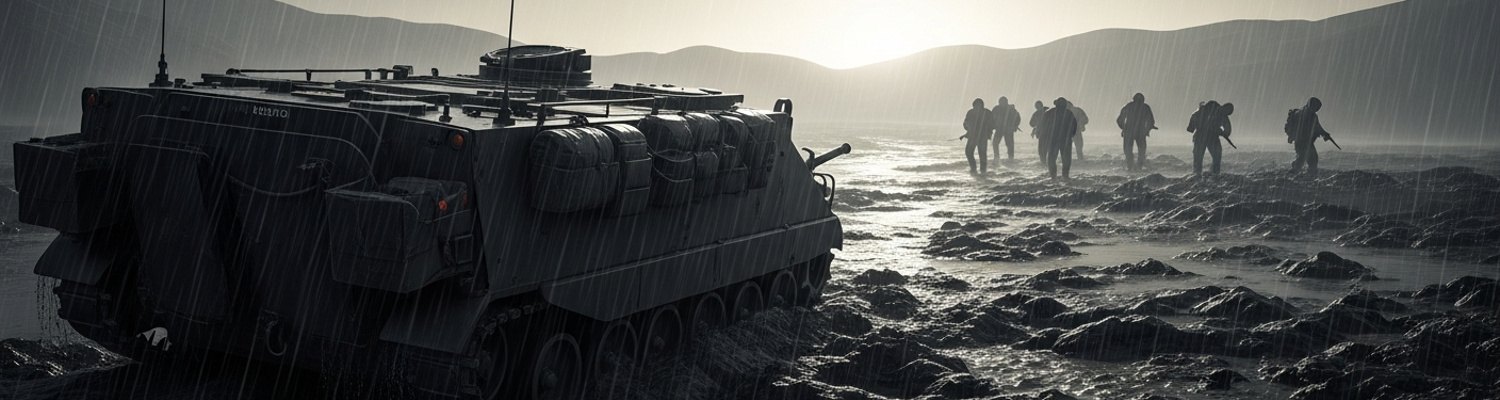

Mindanao Monsoon March 1945
By late April 1945, the operational pause for the U.S. 31st Infantry “Dixie” Division was over. As its units began the push north from Kabacan along the Sayre Highway, the first monsoon rains arrived. This was not a spring shower. It was a daily, torrential downpour that would become the single most dominant factor in the campaign, turning the very ground against the American forces and dictating the pace of the advance.
The Sayre Highway itself was largely a fiction. A thirty-mile stretch of the supposed artery had never been completed. What roadbed did exist quickly dissolved under the constant, hammering rain. After-action reports from the 124th Infantry Regiment, the lead element of the 31st Division’s advance, document a rapid degradation of all wheeled and tracked mobility. The lateritic soil of Mindanao, a product of its volcanic geology, transformed into a thick, viscous, red clay that was meters deep in places. This substance was not an inconvenience; it was a mechanical destroyer.
It clogged the air intakes of jeeps, seized the drive sprockets of M5 Stuart light tanks, and flooded the crankcases of the 2.5-ton CCKW supply trucks that were the division’s lifeline. Axles snapped under the strain of wheels spinning uselessly in the mire. Entire vehicles would slide off the narrow track and become hopelessly bogged down. These vehicle graveyards created chokepoints that paralyzed the columns behind them for hours, sometimes days. The advance slowed from miles per day to mere yards.
Movement itself became the objective.
For the forward infantry patrols of the 124th Infantry, the term “mobile” lost all meaning. The plan for a swift, motorized drive up the highway was abandoned almost immediately. Soldiers were forced to dismount and proceed on foot, their own bodies becoming the prime movers of essential equipment. The rain was incessant, soaking through herringbone twill uniforms and rotting the leather of boots. Jungle rot and other immersion-related foot infections became rampant, creating a steady stream of non-combat casualties documented in NARA Record Group 407. Airdropped supplies became the only method of resupply for the isolated infantrymen. The physical exhaustion was extreme. Men carried not only their personal weapons and ammunition but also components of heavy machine guns and 60mm mortars through mud that could pull a boot clean off a man’s foot. The advance became a grueling slog, with each step a fight against the terrain. This meant that the division’s lead elements were advancing far ahead of their supporting arms, particularly the artillery, which was rendered immobile by the destroyed bridges and impassable roads.
The logistical paralysis reached its peak at the numerous river crossings that transected the Sayre Highway. Retreating Japanese forces had systematically destroyed every bridge along the route. Spans over deep gorges, like the one over the Liutian River, were completely gone, forcing troops to descend 60 feet down lifelines just to cross on foot. The 31st Division’s engineers were faced with an impossible task. The same torrential rains that mired the infantry also swelled the rivers into violent, debris-choked torrents. Banks became unstable mudslides, washing away the footings for temporary pontoon or treadway bridges as fast as they could be emplaced. Winching a few jeeps and light guns across chasms on wire cables was a slow, perilous process. Moving the heavy artillery pieces and the supply trucks was out of the question. This forced a tactical crisis: the 124th Infantry, pushing north, repeatedly made contact with Japanese defenders but lacked the heavy firepower of the artillery battalions stuck miles to their rear. The battle for Mindanao was no longer just a fight against the Japanese 30th Division; it was a battle against the island itself.
Impact of Severed Communication Lines
The electronic sinews of the 31st Infantry Division’s command structure began to decay almost immediately upon leaving Kabacan. Signal Corps maintenance records from late April and early May 1945 indicate a systemic failure of the division’s primary communication tools. The standard backpack radio for platoon and company-level operations, the SCR-300 “walkie-talkie,” proved exceptionally vulnerable to the conditions on Mindanao. Constant, penetrating moisture from the monsoons infiltrated the radio sets, causing corrosion on delicate vacuum tube pins and short-circuiting the dry-cell batteries that powered them. The effective range of these FM radios, nominally three miles, was drastically reduced by the dense, wet jungle, turning them into little more than dead weight for the overburdened infantrymen. The more robust vehicle-mounted sets, like the SCR-508s and SCR-608s, were rendered useless by the simple fact that their host vehicles were hopelessly mired miles to the rear.
The secondary system, hard-wired field telephones, offered no better solution. Signal Corps crews spooling out WD-1/TT wire found their work undone almost as soon as it was completed. The very ground, a soupy, unstable morass, swallowed the thin copper-and-steel strands. Landslides and the sheer weight of the mud created constant breaks in the line. What the environment did not sever, retreating Japanese patrols often did. The result was a near-total communications blackout between the forward-most elements of the 124th Infantry Regiment and their battalion command posts.
With both radio and wire links gone, the lead companies of the 124th Infantry were functionally alone. As platoons pushed ahead through the muck of the Sayre Highway, they became disconnected islands of command, unable to report their positions, the status of their ammunition, or the locations of Japanese strongpoints. The inability to communicate erased the primary advantage of a modern army: the coordination of combined arms. For the riflemen of the 124th, this meant that the 149th Field Artillery Battalion, even when its guns were within range, could not be called upon for support. During one night engagement on the first day of the advance, observers had to adjust artillery fire based on the sound of the exploding shells. Medical evacuation for the wounded became a physical ordeal of carrying men back on improvised stretchers through kilometers of mud, a journey that could take hours or even days. Command was atomized, devolving to individual platoon leaders and squad sergeants who were forced to make decisions with no knowledge of the situation 500 yards to their left or right. The only remaining link to higher command was the most ancient form of communication: human runners, whose desperate sprints through the jungle were both perilous and agonizingly slow.
This breakdown paralyzed tactical decision-making at the regimental and divisional levels. At the 124th Infantry’s command post, Colonel Edward M. Starr and his staff were operating in an information vacuum. Units like the 2nd Battalion under Lt. Col. Robert M. Fowler were known to be in contact with the enemy, but for long stretches, no one knew the exact nature of the engagement, the strength of the opposition, or the friendly casualty count. Attempts to coordinate flanking maneuvers or concentrate forces for a decisive attack became impossible. As the regiment approached the formidable Japanese defenses in what would become known as Colgan Woods in early May, this lack of control proved costly. Planned multi-battalion attacks devolved into a series of disjointed, piecemeal company actions. Units engaged the entrenched Japanese defenders without mutual support, allowing the enemy to focus their fire on one isolated American unit at a time. The command structure, blinded and muted by the technological collapse, could do little more than feed units forward into the grinder and wait for a runner to emerge from the jungle with news.
The M29 Weasel and GMC CCKW Quagmire
The wholesale failure of wheeled and tracked mobility began almost the moment the 31st Infantry Division’s motor pool left the relative security of Kabacan. A deep, pervasive volcanic mud, created by the combination of torrential monsoon rains and the island’s lateritic soil, became the primary obstacle. It was a thick, clinging, abrasive substance with the consistency of wet cement, capable of immobilizing any vehicle unfortunate enough to stray from the hardest-packed sections of the dissolving Sayre Highway. This volcanic slurry, geologically similar to lahar, possesses unique properties; it is exceptionally dense and adhesive, creating a suction effect that could hold a multi-ton vehicle in its grip. The ground itself became a more effective barrier than any Japanese defensive measure, swallowing the division’s mechanical transport and paralyzing the entire logistical apparatus of the northern advance.
The M29 Weasel, a light cargo carrier developed by Studebaker specifically for negotiating difficult terrain like snow and mud, was an immediate and total failure in this environment.
Operational reports from the initial push up the Sayre Highway in late April 1945 reveal a swift disillusionment with the vehicle. The Weasel, with its relatively narrow 20-inch tracks and low ground clearance, was fundamentally mismatched against the specific conditions on Mindanao. While successful in the sands of Iwo Jima and the snows of Europe, the Weasel’s design was defeated by the sheer depth and viscosity of the volcanic mud. The substance would pack into the suspension and track system, locking the bogeys and creating immense friction. The vehicle’s 70-horsepower Studebaker engine was insufficient to overcome the combination of packed tracks and the deep suction of the mire. Weasels would sink until their hulls rested on the mud, their tracks spinning uselessly and digging them deeper into the quagmire. They became immobile roadblocks, forcing subsequent vehicles to attempt to navigate around them and, in turn, become mired themselves, compounding the traffic jams that choked the advance to a standstill.
While the failure of the specialized Weasels was a disappointment, the immobilization of the division’s GMC CCKW 2.5-ton trucks was an operational disaster. These “Deuce and a Half” trucks were the lifeblood of the entire X Corps operation, the prime movers for everything from 105mm howitzers to rations, ammunition, and medical supplies. The 31st Division’s advance was predicated on a functioning supply line stretching back down the highway. The six-wheel-drive configuration of the CCKW was legendary, but it was no match for a roadbed that had ceased to exist. Entire convoys of these trucks, laden with critical materiel, were rendered immobile for weeks. Maintenance logs show a spike in snapped axles and burned-out transmissions as drivers fought to extricate their vehicles. Trucks would slide off the slick, crowned remnants of the road and sink up to their chassis, their cargo unreachable. The result was a miles-long graveyard of half-submerged vehicles, paralyzing the movement of the 155th and 124th Regimental Combat Teams and, most critically, the artillery battalions that were essential for cracking prepared Japanese defenses. This forced the lead infantry elements, who were still able to advance on foot, to fight battles like the one for Colgan Woods in early May without their heavy fire support.
Impassable Supply Routes in Mindanao
Archival evidence from the 31st Infantry Division’s push north along the Sayre Highway in late April and early May 1945 reveals a complete systemic failure of its motorized supply lines. The highway became a one-way artery of defeat for logistics. Convoys could push north into the quagmire, but the combination of destroyed bridges and the bottomless mud made a return trip for resupply impossible. This created a linear, miles-long parking lot of immobilized vehicles. The 149th Field Artillery Battalion, a critical component for overcoming prepared defenses, was left stranded far to the rear, its 105mm howitzers and prime movers unable to traverse the chasms left by demolished bridges. The advance elements of the 124th Infantry Regiment, therefore, moved forward on foot, rapidly outdistancing their heavy firepower and their sources of supply. The road did not simply slow down logistics; it consumed them whole, turning the division’s mechanical advantage into a static junkyard.
This vehicular paralysis translated directly into an ammunition crisis for the forward infantry companies. As the 124th Infantry Regiment engaged Japanese defenders in the approaches to what would become known as Colgan Woods, the riflemen were forced to fight without adequate fire support. Airdrops became the only means of resupply, but these were fraught with their own problems. Low cloud ceilings, torrential rain, and the lack of clear drop zones meant that many supply parachutes drifted away into the dense jungle, delivering their precious cargo to the terrain instead of the troops. Journal entries from the 3rd Battalion, 124th Infantry, note the desperation, with soldiers hoping for cigarette drops as much as ammunition. The inability to replenish stocks of mortar rounds and machine gun belts silenced the infantry’s most effective support weapons. This forced company commanders into costly frontal attacks against fortified Japanese positions that should have been suppressed by artillery. The battle for Colgan Woods from May 6th to May 12th devolved into a close-quarters infantry fight where American units were cut apart, in large part because they lacked the ammunition to effectively return fire and suppress the enemy.
For the soldiers of the 124th Infantry, the inability to deliver rations and medical aid was as dangerous as any Japanese soldier. Men were fighting on reduced K-rations, their physical endurance worn down by malnutrition and the sheer effort of marching through mud. Diseases like dysentery, malaria, and jungle rot were rampant, creating a steady flow of non-combat casualties that the overburdened medical system could not handle. Evacuating a single wounded soldier became a monumental task. There were no ambulances, no functioning jeeps. Medics from the 124th Medical Detachment and riflemen from the line platoons had to hand-carry the wounded on litters, a journey that could take days over miles of treacherous, mud-choked trail. During the intense fighting at Colgan Woods, where the 124th Infantry sustained 69 killed and 177 wounded, this evacuation process collapsed. Men with grievous injuries were forced to wait in the mud at aid stations. The regimental chaplain, Captain Aquinas Colgan, was killed while trying to drag wounded men to safety.
Degraded Combat Effectiveness and Morale
The logistical failures along the Sayre Highway directly resulted in a collapse of combat effectiveness for the forward infantry elements of the 31st Division. After-action reports from the 124th Infantry Regiment in early May show how units that had advanced on foot rapidly outran their capacity to fight. The core tactical doctrine of the U.S. Army relied on the integration of infantry with overwhelming fire support from artillery, mortars, and air power. With the 149th Field Artillery Battalion’s 105mm howitzers stranded miles to the rear, and with radio sets failing in the constant damp, the rifle companies were stripped of this advantage. They were forced to engage fortified Japanese positions with only the weapons they could carry. The battle for the position later named Colgan Woods, from May 6th to May 12th, became the bloody proof of this degradation. Lacking the means to suppress Japanese machine gun nests with artillery, company commanders ordered frontal assaults, which were cut apart. The fighting devolved into a series of disjointed, company-level actions against an entrenched enemy, completely negating the division’s numerical and technological superiority.
For the individual soldier of the 124th Infantry, the breakdown of the supply chain meant a descent into a state of chronic privation that shredded morale. Medical records from the period show a dramatic spike in non-combat casualties. Men were constantly soaked by monsoon rains, living and fighting in filthy, sodden uniforms. Tropical diseases like dysentery, malaria, and debilitating jungle rot were rampant. Journal entries from the 3rd Battalion note that soldiers were subsisting on reduced K-rations, sometimes going days with little food before a successful airdrop. The psychological weight of this was considerable. The inability to evacuate the wounded inflicted a particularly deep wound on morale. Medics from the 124th Medical Detachment and fellow riflemen had to perform grueling, days-long carries of litter-bound casualties through miles of mud. The death of the regimental chaplain, Father Aquinas Colgan, killed by enemy fire while attempting to drag wounded men to safety, underscored the helplessness felt by the troops.
The direct link between logistical failure and diminished fighting capability was demonstrated with clarity in the casualty figures from Colgan Woods. Over six days of intense fighting, the 124th Infantry Regiment sustained 69 killed and 177 wounded to take a small, heavily fortified area. An analysis of these engagements shows that the high casualty rate was a direct consequence of ammunition shortages. Forward observers could not call in artillery, and infantry companies quickly exhausted their own limited supplies of mortar rounds and machine gun ammunition needed to suppress enemy fire during an advance. This forced squads and platoons to rely on rifle fire and grenades in costly close-quarters assaults against prepared bunkers. The supply crisis ensured that the regiment could not bring its full force to bear in a coordinated manner, instead feeding units into the fight piecemeal, allowing the Japanese defenders to concentrate their fire on each isolated attacking element.
Reassessment of Tactical Objectives
Command directives from mid-May 1945 show a definitive halt to the 31st Infantry Division’s aggressive northern push along the Sayre Highway. The initial objective, a rapid, mechanized sweep to the northern coast, was no longer possible due to terrain and attrition. After the close-quarters fighting that secured Colgan Woods between May 6 and May 12, the 124th Infantry Regiment was spent. It had lost approximately 60 men killed and over 120 wounded in just six days of fighting without adequate artillery support.
The advance was not resumed.
Instead, the regiment, and by extension the divisional front, transitioned from a posture of offense to one of static, entrenched defense. The plan for a swift drive on Malaybalay was abandoned. Units were ordered to dig in, establish a defensible perimeter, and hold their ground. This was not a tactical choice so much as an operational necessity. The forward battalions were physically incapable of further offensive action, having outrun their supply lines, exhausted their ammunition, and suffered crippling casualties. The aggressive sweep north had devolved into holding a muddy, isolated line miles from the nearest support.
The new static posture became a battle of attrition that the American forces were ill-equipped to win. Holding a defensive line in the jungle consumed resources at an alarming rate. Japanese forces, primarily elements of the 30th Division under General Gyosaku Morozumi, were not content to allow the Americans to consolidate. They initiated a series of probing attacks, infiltration attempts, and harassing fire against the 124th Infantry’s new perimeter. Although these were not large-scale counter-offensives, each small engagement forced the American soldiers to expend precious ammunition that could not be easily replaced. Airdrops were unreliable in the monsoon weather, and the land route south remained a quagmire. The Japanese defenders, in contrast, were fighting from prepared positions and were not reliant on a collapsing motorized supply chain. The American defensive operations became a resource drain, a constant bleed of rifle ammunition, mortar rounds, and medical supplies into the jungle with no hope of immediate replenishment. The very act of holding ground was hastening the logistical collapse.
By the third week of May, the primary mission of the 31st Division’s forward elements was no longer the seizure of territory but the preservation of the force itself. Tactical objectives were completely subordinated to internal logistics. A significant portion of available manpower from infantry units was re-tasked from combat patrols to form carrying parties. These teams of riflemen became human supply chains, tasked with trekking miles south through the mud to the nearest point accessible by airdrop or vehicle, collecting what they could, and hauling it back to the front on their backs. The focus of command shifted from planning attacks to calculating ration levels and ammunition counts. The successful evacuation of a single wounded soldier, a multi-day ordeal of hand-carrying a litter through the jungle, became a more significant operational achievement than taking a minor terrain feature. The front line of the campaign was no longer facing north toward the enemy, but south, along the ruined, vehicle-choked trail that was the Sayre Highway.
Logistical Imperatives and Troop Disposition
A review of X Corps operational directives from late May 1945 reveals a fundamental shift in the Mindanao campaign, one dictated entirely by logistical failure. The initial strategy, a rapid two-pronged pincer movement with the 24th Infantry Division driving on Davao and the 31st Infantry Division sweeping north up the Sayre Highway, had failed. The 31st Division’s advance was stopped cold, not by Japanese action, but by the complete dissolution of its supply lines in the monsoon mud. This paralysis directly prolonged the campaign in southern Mindanao for months. Instead of a swift offensive to destroy the Japanese 30th Division under General Gyosaku Morozumi, the American effort devolved into a static battle of containment. The objective changed from seizing Malaybalay to simply holding the line and preventing the exhausted forward companies from being overrun.
The strategic decision-making process of Eighth Army command was forced to adapt to the reality that the Sayre Highway was no longer a viable axis of advance. With the 31st Division immobilized, a new plan was required to engage the main Japanese forces. This led to a critical operational pivot: the 24th Infantry Division, having secured Davao, was re-tasked. Instead of consolidating its position, elements were ordered to push north and west, eventually attempting to traverse the torturous, largely imaginary Kibawe-Talomo trail to outflank the Japanese defenders that the 31st Division could no longer reach. This decision was a direct consequence of the logistical collapse on the Sayre Highway. One division’s failure to be supplied necessitated a far more arduous and costly advance by another over even worse terrain. The fight for Mindanao became two separate, disjointed campaigns, one mired in mud and the other hacking its way through dense, mountainous jungle, because the initial, simpler plan was rendered impossible by broken-down trucks and impassable roads.
This logistical paralysis ultimately dictated the final disposition of forces for the Japanese surrender. By August 1945, the American divisions were not poised for a final, decisive assault to annihilate the remaining Japanese forces. Instead, they were positioned in a loose cordon, holding blocking positions along the main roads and trailheads. The 31st Division held the Sayre Highway, its zone of action having barely expanded since May, while elements of the 24th and 40th Divisions blocked other potential escape routes. General Morozumi’s remaining 22,250 troops were not defeated by a climactic battle. They were isolated and contained within the impenetrable mountain redoubts of the island’s interior, left to wither from starvation and disease. The surrender on September 8, 1945, was not accepted by an army on the verge of a final push, but by one whose own logistical constraints had forced it into a protracted siege. The American troop posture was one of containment because an offensive had long since become unsustainable.