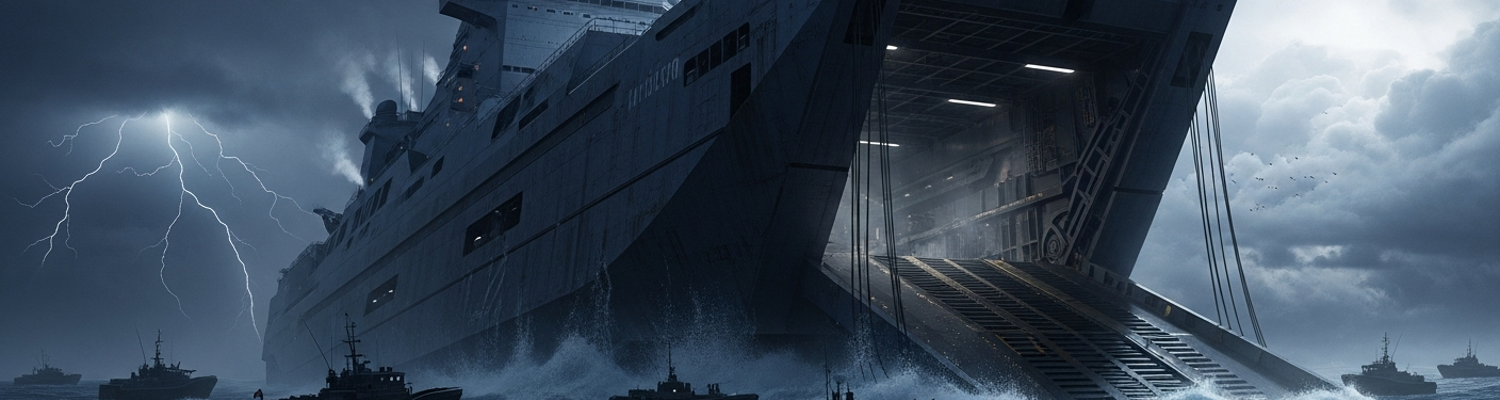

A review of procurement documents after 2009 reveals a fundamental change in how the Pentagon approached amphibious transport. The shift was driven by the logic of transportation finance models. The traditional method of developing bespoke, hardened military vessels over decades was increasingly viewed as an unaffordable practice. Program managers, influenced by the perceived efficiencies of the commercial sector, began to prioritize platforms offering lower upfront acquisition costs. This philosophy favored leasing agreements and the purchase of commercial off-the-shelf hulls. The approach shifted financial risk and blurred the lines between a warship and a chartered ferry. The U.S. Navy’s Expeditionary Fast Transport (EPF) program, previously the Joint High-Speed Vessel (JHSV), was a direct product of this thinking. These ships, based heavily on commercial high-speed catamaran designs, could be acquired for a fraction of the cost of a traditional amphibious warship. This satisfied budget-focused planners but introduced a known risk. The vessels were built to commercial, not military, standards of survivability. To save money on the initial purchase, the fleet would acquire ships with documented limitations.
The financial argument was enabled by a concurrent doctrinal pivot. After years of counter-insurgency campaigns, military thought leaders focused on future conflicts against peer adversaries. This led to the development of concepts like Littoral Operations in a Contested Environment (LOCE) and Expeditionary Advanced Base Operations (EABO). The core of this new doctrine required naval forces to be distributed, agile, and fast, operating within the range of enemy shore-based defenses. A large, slow-moving amphibious ready group was seen as an easy target. The new imperative was to rapidly move smaller units, such as a reinforced Marine company, over vast distances to establish temporary sea-control or strike positions before fading back into the battlespace. This placed a premium on speed and a reduced logistical footprint. A vessel that could sprint at 35 to 40 knots was no longer a luxury. It was a requirement. The ability to operate with less fuel, fewer supplies, and smaller crews was considered essential for survival in a high-intensity fight.
This convergence of cost-cutting finance models and the new doctrine of speed led directly to the adoption of theoretically advanced but operationally unproven transport platforms. The Spearhead-class EPF was the prime example. On paper, its capabilities were impressive. It had a cavernous mission bay for vehicles, a flight deck for helicopters, a shallow draft for accessing austere ports, and a sprint speed exceeding 35 knots. Operational logs from early deployments quickly highlighted severe flaws. The lightweight aluminum catamaran hull, designed for commercial ferry routes, proved vulnerable to damage from high sea states. The USNS Spearhead, the first in its class, suffered significant bow damage during an Atlantic crossing, forcing expensive structural reinforcements across the entire fleet (per DOT&E Report FY2015). The waterjet propulsion systems, necessary for high-speed performance, were found to be susceptible to damage from debris and marine life in the exact shallow, littoral waters they were intended to operate in. Tests revealed that the ships could not meet their key performance parameters for range and speed when fully loaded. The vessel’s ramp, essential for transferring vehicles, was so fragile that it could only be used in nearly calm seas. At-sea transfers with other ships resulted in broken mooring lines and damaged ramp hydraulics. The fleet had acquired its high-speed transport, but it was a fragile instrument unsuited for the chaos of combat.
The entire operational concept of Expeditionary Advanced Base Operations hinged on speed. Planners envisioned reinforced Marine companies establishing temporary sea-denial outposts. The survival of these isolated units was entirely contingent on high-speed logistical support. Spearhead-class Expeditionary Fast Transports were designated as the connecting link, tasked with making rapid, 40-knot dashes from sea-basing ships over the horizon to the newly secured beachheads. Their mission was to deliver first-sustainment packages. These packages contained ammunition, water, medical supplies, and replacement batteries for anti-ship missile systems. They were to be delivered within the first six hours of an insertion, before enemy targeting cycles could react. The logic was that the EPF’s velocity was its primary defense, allowing it to penetrate and exit a contested littoral zone before being effectively engaged. This reliance was absolute. Without this rapid resupply, the forward units would be overrun.
The platforms were a bundle of unproven, complex systems.
A close review of operational logs reveals the intersection of commercial design limitations and the demands of a combat environment. The EPF’s waterjet propulsion system, a key enabler of its high speed, proved sensitive to the very environments it was meant to dominate. In the shallow, debris-filled littoral waters, the intakes for the four MTU 20V8000 M71L diesel engines began to ingest sand, kelp, and sediment. This immediately caused cavitation within the waterjet housing, leading to a drastic loss of thrust and severe vibration throughout the lightweight aluminum hull. Onboard the USNS Choctaw County, engineers watched as engine control monitors flashed with cascading alerts for impeller pressure and intake blockage. These were warnings they had only ever encountered in shore-based simulators. Compounding this failure, the ship’s mission-critical vehicle ramp, designed for the placid conditions of a developed port, was unusable in anything greater than Sea State 3. It could not be deployed to meet the floating pier causeway. This rendered the 20,000-square-foot mission bay, filled with pallets of Javelin missiles and medical kits, completely inaccessible. The ship was not disabled by enemy action, but by its own inherent and fragile complexity.
These failures were not a surprise. They were a documented risk accepted during procurement. Archival evidence from the Director of Operational Test and Evaluation shows that multiple reports had flagged the EPF’s vulnerabilities years before the conflict. During a 2015 transit, the lead ship, USNS Spearhead, suffered significant bow damage in high seas, necessitating structural reinforcements across the class because the Navy had accepted a lighter-weight bow design to save weight. Further tests demonstrated that the ships could not sustain their advertised speeds when fully loaded. The vehicle transfer ramp was only functional in calm, protected waters with wave heights under 0.1 meters. The generators were found to fail at a much higher rate than predicted. These documented deficiencies were overshadowed by the pressing need for a high-speed transport that fit the new EABO doctrine and budget constraints. When the systems failed in combat, the crews were left to enact desperate, improvised repairs. On the Choctaw County, a team of Navy engineers and Marine mechanics attempted to manually clear the waterjet intake grates from a rigid-hull inflatable boat in choppy seas. The perilous effort was ultimately abandoned as the vessel remained dangerously exposed and immobile just off the contested coastline.
The initial phase of the assault on Cape Anvil began not with an explosion, but with a flicker. Operational logs from the Expeditionary Strike Group show that at 04:17 Zulu, the USNS Fall River, an Expeditionary Fast Transport positioned at the fringe of the task force, registered a series of nonsensical data packets across its supposedly secure network backbone. The attack was a textbook execution of the adversary’s documented anti-access/area denial strategy. The strategy prioritized the neutralization of command, control, and logistics over kinetic destruction. Instead of targeting the heavily armed destroyers, enemy electronic warfare units focused their efforts on the flotilla’s softest targets: the commercially derived logistics vessels. The EPF’s integrated bridge system, a suite of commercial-grade Furuno electronics, began to lag. Its GPS plot shifted 1,500 meters inland. On the engineering control console, readouts for the four Wärtsilä waterjets started displaying impossibly perfect, unfluctuating values for fuel flow and turbine RPM. This was a clear sign the diagnostic software was no longer monitoring the actual machinery but was trapped in a loop, feeding the crew a simulated reality.
The systems were not just jammed. They were being actively corrupted.
This electronic assault exploited the very design philosophy that had made the EPF affordable. Unlike a purpose-built warship with physically isolated, redundant controls, the EPF’s functions were networked together for efficiency and a reduced crew size. It used commercial off-the-shelf hardware and software with known cybersecurity vulnerabilities. Pre-war intelligence assessments had explicitly warned that enemy units had acquired and studied these exact commercial systems. The result on the bridge of the Fall River was a breakdown of control. The ship’s autopilot, slaved to the now-compromised GPS and compass data, attempted a series of corrective rudder maneuvers that sent the vessel into a slow, wide turn directly into the path of a following supply ship. The civilian mariners, fighting for control, found the digital commands from their helm station were either ignored or subject to a five-second delay. Down in the engine control room, military engineers received cascading software alerts for faults that did not exist. These alerts buried the one critical message: the central lubrication system for the port-side drivetrain was reporting a catastrophic loss of pressure, a reading that the corrupted main console was masking with its placid, false data.
The failure cascaded from data to mechanics. The quiet troubleshooting began under the immediate threat of enemy coastal defense cruise missiles. Aboard the Fall River, the chief engineer, disregarding the digital interface, dispatched a technician with a wrench and a flashlight to physically check the oil levels on the German-made ZF reduction gear. His attempts to take local control of the machinery were blocked by software protocols that required a digital handshake from the compromised bridge computer. The entire EABO concept depended on these ships making 40-knot sprints into the contested zone. The vessels were now either drifting or moving erratically, their crews locked in a fight with their own operating systems. The enemy’s A2/AD network had achieved a mission kill without firing a shot, turning the high-speed logistical arteries into a cluster of high-value, stationary targets whose last known positions were being fed directly into enemy targeting solutions.
The logistical chain snapped twelve miles off the coast. A close review of the USNS Burlington’s maintenance logs and the after-action reports from its civilian mariner crew details a catastrophic failure. The failure was not the result of enemy fire, but of metal fatigue and flawed design. As the Expeditionary Fast Transport attempted to launch its pre-loaded lighterage, a floating causeway intended to bridge the gap to the shore, a primary hydraulic actuator in the stern vehicle ramp assembly failed. The weight of the ramp, combined with the motion of the vessel in the marginal Sea State 3 conditions, placed a load on the system that its commercial-grade components could not withstand. The result was a complete loss of hydraulic pressure to the port-side support arm. The massive aluminum ramp, carrying a 7-ton truck filled with ammunition, buckled and twisted. It jammed itself in a half-deployed position and rendered the ship’s entire 20,000 square-foot mission bay inaccessible.
The ship was not sunk. It was neutralized.
This single component failure had an immediate tactical consequence. It severed the only planned reinforcement and resupply route to the forces on shore. On the sand of Cape Anvil, the 450 Marines of Company G, 2nd Battalion, 8th Marines, were effectively stranded. Their beachhead, established just six hours prior, was a perilous island, a roughly 800-by-500 meter perimeter of churned-up earth and shattered foliage. The consolidation phase, that period between the initial assault and the establishment of a secure perimeter, was now dangerously extended. Ammunition stocks for their M27 rifles were adequate for the moment, but the heavy weapons that provided their support were starving. The Javelin anti-tank teams were down to their last three command launch unit batteries. Stocks of 40mm grenades for the M320 launchers were nearly exhausted. Without the supplies trapped in the mission bay of the Burlington, their ability to repel a concerted armored counterattack was evaporating with each passing hour.
The enemy’s response was not a massed frontal assault. It was the methodical and precise application of indirect fire. From concealed positions in the hills overlooking Cape Anvil, enemy batteries of 152mm 2A65 Msta-B howitzers began a sustained bombardment. This was not indiscriminate shelling. It was a targeting effort guided by forward observers and counter-battery radar that tracked the Marines’ radio emissions. Each salvo was walked with terrifying accuracy across the small perimeter. One volley struck the company’s makeshift casualty collection point, located in a shallow depression behind a sand dune. Another obliterated their only TRV-150 Tactical Water Purification System. The constant, accurate fire pinned the Marines down, preventing any attempt to improve defensive positions or redistribute dwindling supplies. The shelling made helicopter resupply impossible, turning the sky into a kill zone. The failure of the Burlington’s ramp twelve miles at sea was now being paid for by the isolated Marines at Cape Anvil.
After-action reports from Cape Anvil reveal that the recovery effort began with a series of frantic, cross-channel radio calls. With the USNS Fall River electronically paralyzed and the USNS Burlington mechanically crippled, the standard, segregated repair chains for military hardware and civilian-crewed vessels were instantly obsolete. The Expeditionary Strike Group commander authorized the immediate formation of what were designated Technical Fusion Cells. These were not established units but ad-hoc collections of specialists pulled from any available source. They were dispatched via Rigid Hull Inflatable Boats across the choppy, exposed water between the ships. A typical team thrown together to work on the Burlington consisted of a Marine Corps generator mechanic from the 2nd Maintenance Battalion, two Navy damage controlmen from the USS Mesa Verde, a civilian mariner who served as the ship’s Third Assistant Engineer, and a Navy Information Systems Technician with a specialty in network security. Their assembly was a direct admission that the crisis had exceeded the capacity of any single organization. They arrived on the afflicted vessels with tool bags and diagnostic kits, possessing no shared protocols, no common communications equipment, and no clear hierarchy.
The official maintenance manuals were useless.
On the drifting Fall River, the primary challenge was wrestling control back from the ship’s corrupted software. The team, led by a Navy Chief Warrant Officer specializing in electronics, physically disconnected the main fiber-optic data link between the integrated bridge and the engineering control room. This act violated every peacetime safety regulation. They were attempting to isolate the machinery from the compromised network. Archival evidence shows they used a commercial-grade network analyzer, brought over from the strike group’s flagship, to map the malicious code that had frozen the ship’s brain. Simultaneously, on the Burlington, the team confronting the jammed vehicle ramp discovered that the failed hydraulic actuator was a bespoke German component (part number K-77B-41) for which no spares existed within the entire theater of operations. Their solution was battlefield cannibalism. Using a plasma cutter, they removed a similar, though not identical, hydraulic motor from the ship’s small deck crane. The fittings did not match. The team had to use a portable welding kit and scavenged pipe from the ship’s plumbing system to crudely adapt the salvaged motor to the ramp’s hydraulic lines. The process took four hours of grinding and fabrication on an unstable deck.
This philosophy of manual override defined the entire effort. Aboard the Fall River, engineers abandoned any attempt to reboot the central command software. Instead, they pried open the local control cabinet for the ZF reduction gear and hot-wired the solenoid that governed the clutch, using a simple 24-volt battery pack to force the drivetrain into engagement. To regain control of the Wärtsilä waterjets, the team bypassed the main engine control unit entirely. A close examination of the ship’s logs shows they ran a single shielded ethernet cable, taped across the deck and through open hatches, from a ruggedized laptop directly to the port-side waterjet’s local processor interface. This gave them a crude, text-based command line to manually adjust nozzle direction and engine RPM. They were flying the ship’s propulsion system with keyboard commands, devoid of any safety governors. On the Burlington, the scavenged hydraulic pump lacked the power to lift the massive, buckled ramp. The fix was abandoned. The team instead used the ship’s smaller knuckle-boom crane, the very crane they had just cannibalized, to painstakingly transfer critical supplies. They jury-rigged a lifting harness from cargo straps to hoist individual pallets of ammunition and water from the mission bay and swing them over the side to the waiting lighterage. This agonizingly slow process, moving one pallet every fifteen minutes, became the only lifeline to the Marines trapped on shore.