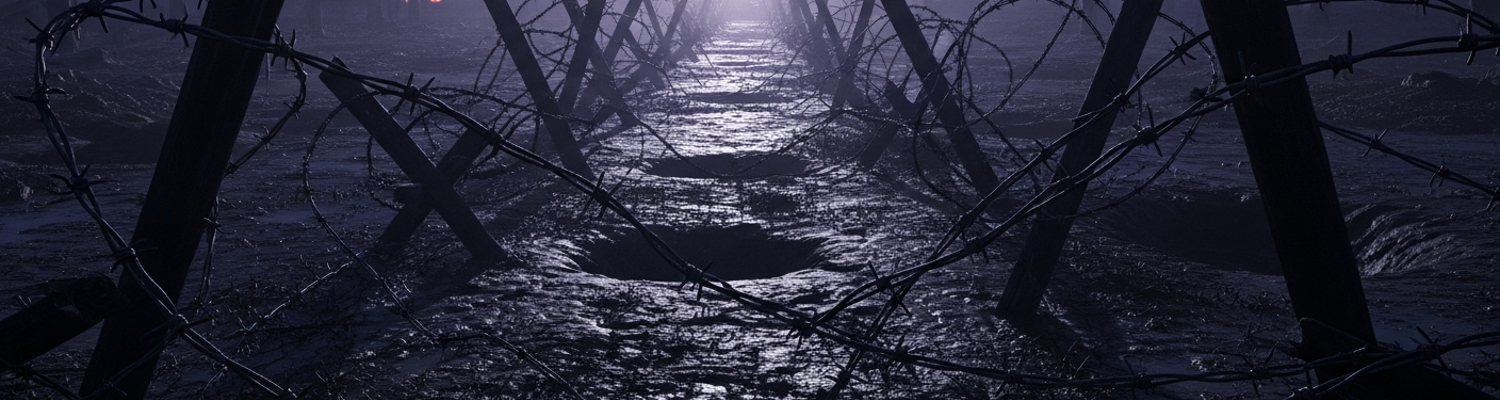

By the autumn of 1918, the American Expeditionary Forces (AEF) command structure faced a static, blood-soaked reality on the Western Front. The prevailing doctrine of massed infantry waves following rolling artillery barrages had proven to be a catastrophic failure against the German army's deeply entrenched positions. The cost in lives for mere yards of terrain was unsustainable.
A close review of operational logs from the St. Mihiel offensive (AEF Document File 2-3.7) shows a dawning awareness within General John J. Pershing’s headquarters that a tactical shift was not just necessary, but essential for survival and victory.
Formal general orders began to circulate, codifying a move away from simple frontal assaults. These directives established specialized platoons within infantry companies, units purpose-built for infiltration and exploitation.
This was not a minor adjustment. It was a calculated break from the entire operational philosophy that had defined the war, a formal admission that manpower and firepower alone could not rupture a prepared defense without bleeding the army white.
The AEF was engineering a new kind of warfare. And a new kind of soldier to wage it.
The primary missions assigned to these new infiltration platoons were deep reconnaissance and the reduction of forward obstacles. In practice, this made them the sharpened tip of the American spear. Trained to move in small, dispersed groups, they were to use the chaos of the initial bombardment to slip through the enemy’s forward defensive crust. Their first objective was to identify and bypass strongpoints, primarily machine-gun nests and concrete pillboxes, leaving them for follow-on forces to neutralize. This demanded an unprecedented level of small-unit initiative. Junior officers and non-commissioned officers were forced to make life-or-death decisions far from any direct command.
The second part of their mission, forward obstacle reduction, was a hands-on affair. Armed with wire cutters, satchel charges, and grenades, these teams had to clear paths through the dense belts of barbed wire that funneled attacking forces into German machine-gun kill zones. They were a fusion of scout and combat engineer, tasked with dissecting the enemy’s defensive network from the inside out.
This tactical framework was a radical departure. The accepted method of attack was a linear, brute-force affair. The AEF’s infiltration doctrine, mirroring concepts developed by German stormtroopers, focused on finding and exploiting the weakest points in a defensive line to achieve a deep breakthrough. It traded mass for speed and precision.
A traditional assault saw entire battalions moving in successive waves. The new orders envisioned a fluid battlefield where these platoons would seep through the cracks in the German line. The risk calculus was fundamentally altered. Instead of distributing risk across thousands of soldiers, it concentrated that risk onto small, highly trained, and heavily armed units. The success of an entire offensive now hinged on the ability of these small groups to penetrate, disrupt, and survive deep within an enemy trench system designed specifically to prevent such incursions.
A review of training manuals from late 1918 (NARA Record Group 120, AEF Training Section) reveals the intensive preparation for these new platoons. The regimen was a direct reaction to the failures of massed assaults and was purpose-built for clandestine operations. Unlike the bulk of the AEF, which often received truncated training, these hand-picked units were subjected to a rigorous curriculum developed with seasoned French and British instructors.
The core of this training focused on close combat. Soldiers drilled relentlessly with the M1918 Browning Automatic Rifle (BAR), learning to use its maneuverable firepower to suppress enemy positions while other squad members advanced. They mastered the use of hand grenades for clearing dugouts and machine-gun nests. Training incorporated the realities of close-quarters fighting, with extensive work on bayonet skills and the use of trench knives for silent neutralization of sentries.
Live-fire exercises simulated penetrating an enemy line, forcing squads to crawl under live machine-gun fire, navigate mock barbed-wire entanglements, and assault concrete pillbox replicas with explosives. This was a significant departure from standard infantry training, which focused on marksmanship and large-unit drill. The emphasis was on aggression, speed, and the individual soldier's ability to function within a small, lethal team.
The new doctrine was as revolutionary as the training. It emphasized independent action and stealth, concepts that ran counter to the top-down command structure of the war. Archival evidence shows a deliberate effort to empower sergeants and corporals to make battlefield decisions. This doctrinal shift was an American adaptation of tactics pioneered by German Stosstruppen, who recognized that small, well-led units could achieve what massed battalions could not.
Platoons learned to move not in waves, but as dispersed, fluid elements, using darkness, fog, and the cratered landscape as cover. Map reading, compass navigation, and movement by bounds became fundamental skills. The doctrine stressed bypassing heavily fortified German strongpoints, leaving them for follow-on waves of regular infantry, while the infiltration units pushed deeper to strike at command posts and artillery batteries. This required a high degree of battlefield awareness and the courage to operate far from the security of the main American line, often with severed communications. It was a tactical model built on trust in the NCO and the individual soldier.
Their primary role was to operate in the pre-assault phase, preceding the main infantry waves by hours. Their missions were high-risk, surgical strikes intended to unhinge German forward defenses.
In the final hours of darkness before a major push, these teams would crawl into no-man's-land. One of their most critical tasks was the silent cutting of barbed wire entanglements. These dense wire belts were designed to funnel attackers into the killing zones of machine guns. Creating gaps was essential for the survival of the main force. The teams used heavy wire cutters and sometimes Bangalore torpedoes to blast paths through the obstacles.
Other pre-assault missions included reconnaissance of enemy forward positions and raids on listening posts to capture prisoners for intelligence. They were the eyes and ears of the commanding generals, confirming enemy dispositions just before an offensive. These actions were exceptionally dangerous, conducted in close proximity to an alert enemy, where a single noise could bring down a devastating artillery barrage.
The operational doctrine for these platoons forced them into the desolate expanse of no-man's-land. Their work began hours before any assault, under the cover of darkness. A primary task was the systematic cutting of German barbed wire. These were not simple fences. German engineers had spent years constructing dense belts of wire, sometimes dozens of feet deep, designed to trap and channel attacking infantry into the interlocking fields of fire from MG-08/15 nests. AEF infiltration teams had to crawl on their stomachs across the mud, carrying heavy insulated wire cutters. The sound of a single metallic snip could carry in the night, drawing machine-gun fire or the glare of a flare, forcing the men to freeze in place. For wider breaches, teams employed Bangalore torpedoes, long pipes packed with explosives that they had to physically push under the wire entanglements before detonating them, an act that erased all stealth.
Simultaneously, other patrol members were engaged in mapping enemy positions. Crawling to the lip of a shell crater, a soldier would painstakingly sketch the layout of the opposing trench, noting the exact location of machine-gun embrasures, listening posts, and mortar positions. This information, relayed back before the main attack, was used to update artillery target maps for the opening barrage. Discovery was a constant threat. The space between the trenches was a sensory minefield. A dislodged rock, a cough, or the glint of metal could trigger a response from the German lines.
After-action reports from the Meuse-Argonne Offensive detail patrols that were systematically hunted by German machine-gunners after their position was compromised. The sound of a German 'egg' grenade clattering nearby in the dark was often the only warning before detonation. Capture was another possibility. More terrifying was the prospect of being cut off. An unexpected German patrol, a sudden friendly artillery barrage falling short, or becoming disoriented in the chaotic landscape could sever a team’s route back to their own lines. The platoon would then be stranded as dawn approached.
The psychological impact was severe. The men selected for these platoons endured long periods of inactivity, lying motionless for hours in a water-logged shell hole, sometimes among the decaying remains of soldiers from previous attacks. This combination of extreme isolation and the need for hyper-vigilance created a unique mental strain. Medical reports from the period document a condition termed 'shell shock,' a range of psychological responses to the trauma of combat. The men on these clandestine missions were especially vulnerable. The prolonged suspense, the quiet terror of the wait, and the intimate proximity to death frayed the nerves of even the most resilient soldiers. The experience of listening to the cries of a wounded man caught in the wire, whom no one could rescue, left lasting psychological scars on the survivors.
The AEF faced its greatest test in the autumn of 1918. On September 26, 1918, the First Army attacked into the Meuse-Argonne sector, northwest of Verdun. This was the largest and most costly military operation in American history, ultimately involving over 1.2 million U.S. soldiers. The strategic objective was to advance northward and sever the Carignan-Sedan-Mézières railroad. This railway was the primary artery supplying the bulk of the German forces in France. Its capture would split the German armies and force a catastrophic retreat.
The terrain itself was a formidable opponent. The battlefield was a narrow corridor, bounded by the Meuse River on the east and the dense Argonne Forest to the west. This landscape of tangled hills, deep ravines, and thick woods had been fought over since 1914. Heavy autumn rains turned the ground to a thick mud that bogged down artillery and supply wagons.
The German Army had four years to turn this ground into a killing zone. A close review of operational logs reveals the depth of the German defensive preparations. The sector was shielded by four distinct defensive belts constructed over a depth of fifteen to twenty-four kilometers. The most formidable of these was the third line, the Kriemhilde Stellung, a core component of the Hindenburg Line. This was not a simple line of trenches but a defense-in-depth system, a four-kilometer deep network of concrete pillboxes, hidden machine-gun nests, pre-sighted artillery positions, and vast entanglements of barbed wire. The wire was a weapon, carefully placed to funnel attacking troops into interlocking fields of machine-gun fire.
Attacking a position like this blindly was suicide. Accurate, timely intelligence on the exact location of enemy strongpoints was an absolute precondition for success. Likewise, the dense wire aprons had to be cut. Without cleared paths, the main body of the infantry assault would be trapped in the open and annihilated.
For the AEF, the stakes could not have been higher. The Meuse-Argonne Offensive was intended to be the decisive American contribution to victory. Allied commanders harbored doubts about the AEF’s staff work and the combat effectiveness of its largely inexperienced divisions. General Pershing was under pressure to prove that his army could function independently. A successful breakthrough would validate the American military effort. A failure would have been catastrophic.
The Germans counted on the AEF’s inexperience and the sheer strength of the Kriemhilde Stellung to halt the offensive. The battle became a frontal assault that pitted the raw determination of the AEF against one of the most hardened defensive networks on the Western Front, resulting in over 120,000 U.S. casualties, with 26,277 killed.
A review of operational logs for the American First Army’s offensive beginning on October 4, 1918, reveals a textbook case of high-risk intelligence facilitating a major advance. The veteran 1st Division was tasked with rupturing the German line east of the Aire Valley, a mission intended to outflank strong German positions in the Argonne Forest. Standing in their way were formidable objectives: the woods of Montrebeau, the ravine of Exermont, and the commanding heights of Hill 240 and Hill 272. These positions formed a key segment of the Kriemhilde Stellung.
The initial days of the offensive had shown that frontal assaults against such positions were calamitous. The 1st Division’s attack, therefore, depended entirely on the success of its infiltration platoons in dissecting this network before the main assault waves were committed.
The breakthrough hinged on the pre-dawn operations of these small units. Armed with wire cutters and sketch maps, teams infiltrated no-man's-land to physically map the enemy’s forward positions. Archival intelligence reports from the First Army (G-2 Section, October 1918) show a stream of information coming from these patrols, identifying the precise coordinates of German MG-08/15 machine-gun emplacements and artillery spotting posts. This was brutally dangerous work. These platoons moved yard by yard through terrain churned by four years of war, crawling under the intermittent glare of German flares.
Their primary task was to cut multiple, wide lanes through the thick barbed wire aprons. Success meant the main assault force could advance without being funneled into killing zones. Failure meant the attack would be stopped cold.
Simultaneously, the intelligence gathered by these teams was being used to update the firing charts of the 1st Division’s artillery brigades. Instead of an indiscriminate barrage, American gunners could now target specific, confirmed German strongpoints with a high degree of precision.
When the 1st Division attacked on October 4th, the value of this intelligence became immediately apparent. The detailed mapping and cleared paths allowed the lead battalions of the 16th and 18th Infantry Regiments to bypass the most dangerous strongpoints and penetrate deep into the German defenses. While other sectors of the front saw advances measured in yards against uncut wire and unsuppressed machine guns, the 1st Division advanced over a mile and a half, creating a significant salient in the German line.
This was not a victory won by manpower, but by precision. The infiltration platoons had identified the seams in the German defenses, allowing the main force to exploit them before the enemy could react. The advance was so successful that it forced the Germans to loosen their grip on the Argonne, achieving the flanking effect that Army command had intended.
This success offered a powerful justification for the infiltration doctrine. General Pershing and his staff had taken a significant risk in deviating from established Allied doctrine, concentrating the potential for failure or success onto small, specialized units. The 1st Division’s breakthrough was a clear vindication of this gamble. It demonstrated that small teams of highly trained soldiers, empowered with initiative and supplied with precise intelligence, could unhinge a defensive system designed to bleed massed infantry formations dry.
The operational success east of the Aire Valley proved that the high casualties of a blind frontal assault could be mitigated through the surgical application of force, guided by clandestine intelligence gathering. The high command saw that the risk was not in using these new tactics, but in failing to adapt to the realities of modern industrial warfare.