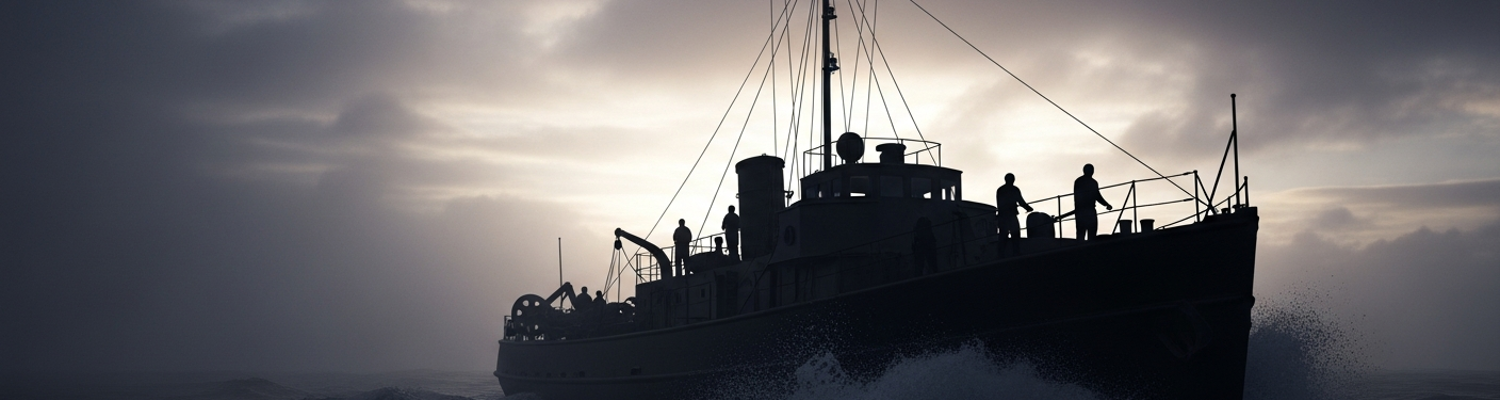

A close review of operational logs from the U.S. Navy’s Tenth Naval District reveals a service unprepared for widespread mine warfare in the Caribbean. Pre-war naval planning had consistently prioritized capital ships over auxiliary vessels. This left the Navy short of modern mine countermeasures when German U-boats began sowing the sea lanes with sophisticated magnetic and acoustic mines. The existing force of aging World War I-era Bird-class minesweepers was too slow. Their equipment, designed for moored contact mines, was largely ineffective against new bottom-laid threats. Archival evidence shows that as the U-boat offensive intensified in early 1942, a state of high tension gripped commands responsible for protecting the flow of bauxite, oil, and other war materials from South America. The response was one of improvisation.
The Navy was forced to form ad-hoc minesweeping groups to shield convoys. The core of this effort was the splinter fleet, a collection of newly constructed but unproven YMS-1 class auxiliary motor minesweepers. These 136-foot vessels were mass-produced by 35 different yacht builders, a testament to the urgent need to bypass larger, overburdened naval shipyards. Their wooden hulls were an intentional design choice to reduce their magnetic signature against German mines, but they were notoriously unsteady craft, tossed around even on calm seas. These were supplemented by even more unlikely vessels: converted civilian fishing trawlers and yachts, designated as YP boats, crewed by reservists and freshly trained sailors with minimal experience. These groups were equipped with often-rudimentary gear, primarily the Oropesa sweep for cutting the cables of moored mines. This offered no defense against the magnetic influence mines being laid by U-boats.
These cobbled-together units were immediately thrown into the defense of the most critical supply routes. A significant concentration of effort was focused off the coast of Puerto Rico. The Mona Passage and the approaches to San Juan were essential choke points for convoys. German long-range submarines, such as the U-508, actively patrolled and mined these waters. A small group of YMS boats, operating under the Tenth Naval District headquartered in San Juan, would be tasked with the duty of sweeping channels ahead of incoming convoys. Operational logs from this period (Tenth Naval District, Weekly Action Report, File 77-B, June 1942) describe the tense, repetitive process. The small wooden ships, engines straining, dragged their limited sweep gear through waters known to be seeded with explosives. The shallow coastal waters around the islands of Vieques and Culebra, while useful for naval training, were also ideal depths for enemy bottom-laid mines. This expanded the patrol area and stretched the limited assets even thinner. For the crews of these small ships, it was a constant battle against an unseen enemy, armed with inadequate tools for an impossible task.
The core of a minesweeper crewman’s existence in the Caribbean was defined by a state of agonizingly slow, repetitive motion. A review of operational logs from the YMS-1 class auxiliary motor minesweepers shows that sweeping operations were conducted at a crawl, often between three to five knots. This was a mechanical necessity. Moving any faster could cause the Oropesa sweep gear to lift out of its prescribed depth or put too much strain on the cables. For the 32-man crew of a 136-foot wooden boat, this meant spending entire days tracing and retracing the same small grid of water, often within sight of the coast of Puerto Rico. The process was a form of tactical purgatory. A typical sweep pattern involved the ship moving in a creeping line, meticulously covering a channel box by box to ensure no patch of seafloor was missed. An entire twelve-hour watch could be spent clearing a single, short approach to a harbor like San Juan, a channel that a convoy would transit in under an hour. Every man on board knew that German U-boats had laid magnetic and acoustic mines in these very waters, yet their only defense was to inch over the suspected danger zone for hours on end.
The entire sensory experience aboard the splinter fleet was a physical assault. The vessel itself was a constant source of oppressive noise. At the heart of the YMS-1 class were two General Motors 8-268A two-stroke diesel engines, powerful but deafening pieces of machinery. Because the ship’s hull was constructed of wood to reduce its magnetic signature, there was little to dampen the deep, resonant drone of the engines. The vibration permeated every compartment, a low-frequency thrum that sailors felt in their bones and teeth, making sleep a challenge.
This was the soundtrack to every moment of the patrol.
Layered over this was the incessant hiss and crackle of the ship’s radios. In an era before secure, crystal-clear communication, the airwaves were a chaotic mix of static, weather interference, and the clipped, formal transmissions of other ships and shore commands. For the radioman, it was a battle to pull coherent orders from the noise. For everyone else, it was another layer of auditory grit, a constant stream of disembodied voices that broke the monotony but heightened the tension.
Outside the hull, the sound of the hunt itself was a sharp, metallic shriek. When the Oropesa sweep gear was deployed, two heavy, torpedo-shaped floats known as paravanes were winched out on either side of the ship. These were hydrodynamic devices, essentially steel kites designed to pull the main sweep wire out to its full width and keep it at a precise depth below the surface. As the minesweeper crawled forward, these paravanes would cut through the water, generating a high-pitched, grating whine that traveled up the thick steel tow cables and into the ship’s frame. It was a sound of friction and tension, the noise of steel fighting against thousands of pounds of hydrodynamic drag.
The sound was a direct announcement that the ship was actively fishing for mine mooring cables. Sailors would become acutely attuned to its pitch and consistency. Any sudden change, a dip in the shriek, a violent shudder in the cable, or the loud bang of the explosive cutters on the sweep wire severing a discovered mooring, would send a jolt of adrenaline through every man on deck. This metallic scream was the most nerve-wracking sound of all, for it was the sound of the weapon itself.
The operational directives handed down to the YMS-1 class minesweeper crews of the Tenth Naval District were defined by a near-total absence of verifiable intelligence. An examination of the tactical situation reveals a command structure in San Juan that was effectively blind. German U-boats, operating alone and under the cover of darkness, laid their minefields with complete stealth. Allied intelligence could not physically track these submarines across the vast Caribbean. The first indication of a new minefield was almost always catastrophic: the sudden, violent destruction of an unescorted merchant vessel. This created an impossible situation for naval command. Lacking precise data, they were forced to issue sweep orders based on inference and probability. The resulting directives were not crisp, actionable grid coordinates. They were often just sprawling, crudely marked boxes on a nautical chart encompassing dozens of square miles of open water, labeled with uncertain notations like 'Suspected Mined Area.' For the sailors on the wooden-hulled sweepers, this meant they were not clearing a known threat. They were simply sent to sail back and forth across a massive ghost footprint, with no knowledge of whether the mines were real, where they were, or if they had already drifted from their initial positions.
The enemy was not a tangible warship or aircraft but an abstraction, a statistical probability of instant annihilation lurking on the seafloor below. Studies of combat stress show that the inability to fight back directly against a threat significantly heightens tension and anxiety. For minesweeper crews, there was no release of tension, only prolonged, agonizing suspense. The men of a YMS boat spent their entire watches, twelve hours at a crawl, within a designated kill zone, knowing their 136-foot wooden vessel was the specific trigger for the weapon they were hunting. The constant state of high alert was physically and mentally draining, leading to what was then termed combat fatigue. Lookouts were not just scanning the horizon for periscopes. They were staring intently at the water directly ahead, searching for the barely visible metallic horns of a moored contact mine. Every snag of the sweep wire on a piece of undersea debris, every unexpected shudder of the tow cable, sent a spike of pure adrenaline through the ship. This was a war of nerves, waged one slow, vibrating nautical mile at a time.
For the enlisted personnel on the deck plates, the struggle was intensely practical. The limited operational intelligence they received was almost useless for the precision their task required. A YMS navigator, working with basic charts and a magnetic compass, was expected to plot a meticulous creeping line sweep pattern over a seafloor he could not see, to find an object whose location was unknown. This forced a reliance on improvisation and, dangerously, on rumor. In the information void left by official channels, scuttlebutt became a primary source of tactical data. A whisper in San Juan about a local fishing boat that failed to return from a particular area, or a report from another patrol of suspicious floating wreckage, would quickly morph into a de facto intelligence report. Archival records show sweep missions being diverted or initiated based on this kind of anecdotal evidence. Crews, desperate for some of sense of agency, would treat these rumors as actionable truths. This created a perilous operational cycle where fear and guesswork, rather than concrete intelligence, dictated the movements of these vulnerable ships, sending them into harm’s way on little more than a hunch.
For the civilian mariners of the Merchant Marine, passage through the Caribbean became a lottery governed by the randomness of survival. A review of operational logs and survivor testimonies reveals that the primary psychological weapon of the German mine was not the explosion, but the sustained, uncertain threat of it. The U-boats sowed their fields of magnetic and acoustic mines under cover of darkness, leaving no visible trace. A convoy of merchant ships, ostensibly protected by a thin screen of overworked naval escorts, could sail into one of these invisible kill zones without any warning. The triggering mechanisms of the mines themselves were the source of the apparent chaos. One vessel, a heavily laden bauxite freighter, might pass over a magnetic mine without incident, its degaussing equipment functioning perfectly. The very next ship in the column, however, perhaps with a slightly different hull configuration or a momentary fluctuation in its own electrical field, would trigger a detonation and vanish. Another ship’s specific propeller acoustics, the unique sound signature generated by its engine RPM and screw design, could be the precise frequency needed to activate a waiting acoustic mine, while dozens of other ships with different sound profiles sailed past unharmed.
Survival felt entirely arbitrary. A ship’s position in the convoy, a last-minute course adjustment, or the simple hydrodynamic pressure of its hull passing over a sensitive trigger could mean the difference between life and a violent, instantaneous death. There was no opponent to fight, no defensive maneuver to execute. The men could only watch the ships around them, waiting to see which one would draw the short straw, knowing their own fate was being decided by physics and chance on the seabed hundreds of feet below.
The experience of a nearby underwater explosion was a full-body assault. It began not with a bang, but with a deep, resonant thump that felt as if the ship had been struck by a colossal, soft hammer. For a merchant vessel sailing near a detonation, the initial shockwave, traveling faster through water than air, would hit the steel hull with sickening force. The entire ship would lurch violently, often sideways, throwing men, equipment, and unsecured cargo across compartments.
A towering column of white and grey water would erupt from the sea surface.
What followed the initial shock was a paralyzing dread. The moments after a near-miss were the most terrifying. The crew, scrambling in the dark amid the new sounds of groaning steel and shouting voices, had to confront a horrifying set of questions. Was that the only mine? Have we sailed into the densest part of the field? Is our own ship, now damaged and possibly leaking, going to trigger the next one? The very act of survival became a potential death sentence. A ship that survived the first blast might have its engines running as the crew fought to maintain power or maneuver away, but the noise of those same engines could be the exact trigger for a nearby acoustic mine. The ship’s steel hull, a massive magnetic object, was now stationary or moving slowly over what was almost certainly a mined area. Every creak of the bulkheads, every shudder of the deck plates, was interpreted as the precursor to the final, ship-breaking detonation. Command decisions were impossible; staying put made the vessel a static target, while attempting to move increased the chances of activating another influence trigger.