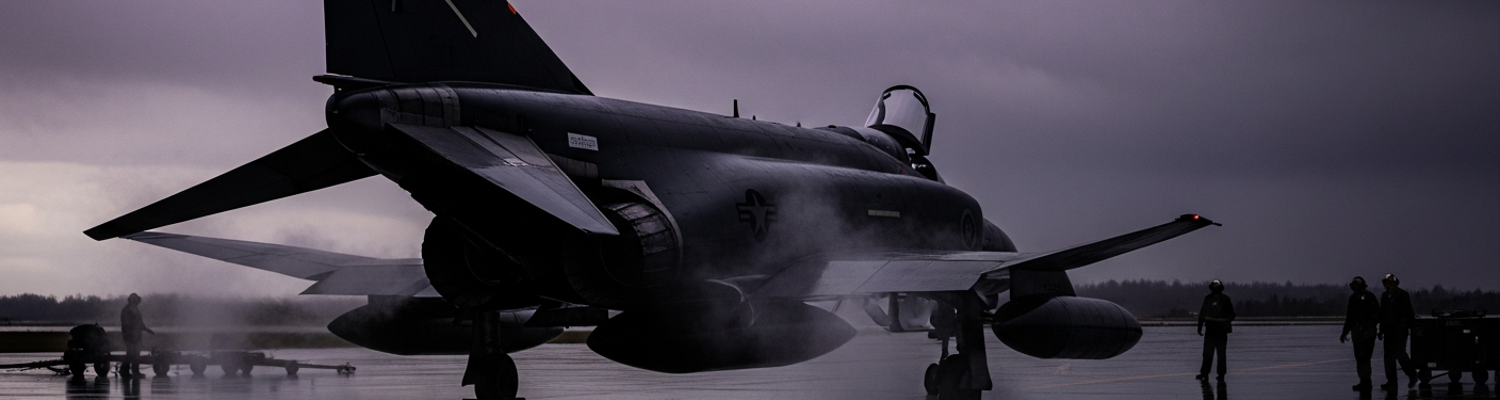

The immediate aftermath of a sortie during the 1967 monsoon fighting around Khe Sanh was a race to record perishable data. Archival evidence from Marine Fighter Attack Squadron 323 (VMFA-323) shows pilots and their Radar Intercept Officers moving from the cockpit of their F-4B Phantoms directly to debriefing rooms. Intelligence officers captured every detail: fuel states, ordnance expenditure, observed enemy anti-aircraft artillery (AAA) locations, and the perceived effectiveness of bomb runs. These sessions were not formalities; they were data-gathering operations conducted under extreme pressure. Every observation, from the color of AAA tracers to secondary explosions in the jungle canopy surrounding Hills 861 and 881, was logged into the squadron’s command chronology (NARA Record Group 127). This process was essential because the monsoon frequently rendered high-altitude reconnaissance ineffective, making the pilot’s-eye view the most reliable source of battlefield intelligence. The data informed the next wave of strikes, often launched within hours, creating a high-tempo cycle of combat, debriefing, and re-armament.
Initial assessments of the F-4 Phantom II’s performance were a mix of respect for its power and frustration with its limitations in the specific environment of Khe Sanh. The Phantom, a twin-engine jet designed as a naval interceptor, proved a rugged platform for ground attack. It could carry up to 16,000 pounds of ordnance, necessary for striking fortified North Vietnamese Army (NVA) positions. Pilots from VMFA-323 noted the effectiveness of napalm and 500-pound general-purpose bombs on enemy bunkers. The aircraft was not purpose-built for low-level, precision close air support. Its high speed, a benefit in interception, became a liability when trying to visually acquire targets in jungle-choked ravines. Early models used in 1967 lacked an internal cannon, a significant drawback when strafing was needed to suppress enemy fire during a Troops-in-Contact situation. The monsoon added another layer of difficulty. Heavy cloud cover forced pilots to rely on radar bombing or guidance from ground controllers, reducing accuracy and increasing the risk of fratricide.
The operational environment around Khe Sanh presented unexpected tactical hurdles that forced continuous adaptation. The NVA’s skill in building concealed and fortified positions was chief among them. Despite heavy aerial bombardment, NVA bunkers, often built with multiple layers of logs and earth, frequently survived direct hits. This forced a re-evaluation of ordnance selection and delivery tactics. Another challenge was the enemy’s increasingly sophisticated use of anti-aircraft weaponry. The concentration of heavy machine guns and smaller caliber AAA around Khe Sanh created a lethal environment for aircraft on attack runs. A review of operational logs indicates the monsoon weather was the most persistent hurdle. The low, thick cloud ceiling often dropped to a few hundred feet, making visual flight impossible and limiting the effectiveness of air support. This weather grounded many sorties and forced others to be led by specialized, radar-equipped aircraft like the A-6 Intruder, which had a superior all-weather and night-attack capability compared to the F-4B. The slick, laterite soil of the Khe Sanh runway itself became a problem, as heavy rains could degrade the aluminum matting, making landings for the heavy Phantoms a hazardous affair.
The operational environment for VMFA-323 during the 1967 monsoon was defined by a debilitating lack of visibility. The seasonal weather, specifically the crachin, created a low, unbroken cloud ceiling with dense fog and drizzling rain. Archival analysis of mission reports indicates this ceiling frequently dropped to 1,000 feet or less, completely obscuring the rugged terrain. For the pilots of the F-4B Phantom II, this was a severe complication. The high-speed interceptor was not an ideal platform for visually acquiring small, concealed targets under the best of conditions; the monsoon made it nearly impossible. The steep slopes of key terrain features like Hills 881 North, 881 South, and 861 became invisible. This forced pilots to rely on instructions from Forward Air Controllers (FACs) on the ground or in slower observation aircraft. This dependence introduced its own delays and risks, as target descriptions were relayed by radio and pilots had only seconds to break through the cloud cover, identify the target, and deliver ordnance without hitting nearby Marine positions.
Some sorties were rendered entirely ineffective, with pilots circling above the solid cloud deck, unable to support the ground troops they were sent to protect.
Heavy rainfall had a direct, degrading effect on flight operations. The runway at Khe Sanh, a 3,900-foot strip of aluminum matting over laterite soil, became dangerously unstable. When soaked, the underlying soil would pitch and roll under the weight of landing aircraft. The slick aluminum surface created a high risk of hydroplaning for the heavy Phantoms. A post-flight review of maintenance logs from the period shows a significant increase in corrosion and electrical faults in the Phantom’s complex avionics due to the pervasive dampness. This constant moisture also affected ordnance, creating uncertainty about the reliability of bomb fuzes and rocket motors. For the ground crews of VMFA-323, working conditions deteriorated into a morass of red clay mud that bogged down refueling trucks and ordnance carts, slowing the pace of re-arming aircraft for the next sortie. The U.S. military even ran a classified cloud-seeding program, Operation Popeye, to intentionally worsen these conditions along enemy supply routes by extending the monsoon season.
These environmental factors translated into an elevated level of combat risk for VMFA-323’s aircrews. The low cloud ceiling created a tactical funnel, forcing F-4s to conduct attack runs within a narrow altitude band perfectly anticipated by NVA anti-aircraft artillery gunners. NVA forces had heavily fortified the hills around Khe Sanh with a dense network of 12.7mm heavy machine guns and larger caliber 23mm and 37mm cannons. Flying low and relatively slow to ensure accurate ordnance delivery, the Phantoms became predictable targets. After-action reports reveal a high number of aircraft returning with battle damage from this concentrated ground fire. The F-4B model flown by the squadron lacked an internal cannon. This meant pilots could not use strafing runs to suppress AAA sites during their attack, relying entirely on bombs or rockets. A missed pass required the pilot to circle around and fly back through the same wall of fire for another attempt. During the period from April 30 to May 4, 1967, alone, VMFA-323 flew over 200 sorties in support of the battles for the hills, with many of these missions flown directly into this combination of bad weather and determined anti-aircraft fire.
The high-speed delivery of ordnance from a VMFA-323 F-4B onto a jungle hillside near Khe Sanh was a study in violent physics, complicated by the monsoon. A close examination of operational logs reveals the core problem: the aircraft was designed as a fleet defense interceptor, not a low-level bomber for the mud-and-rain warfare of South Vietnam. Pilots making an attack run at over 450 knots had only seconds to acquire their target, a process made nearly impossible by cloud ceilings that frequently hung less than 1,000 feet from the ground. Inside this gray, disorienting world, pilots wrestled with the AN/AJB-3 bombing computer, a system reliant on visual inputs or ground radar guidance that was often unavailable in the dense, wet atmosphere. The standard procedure involved a Forward Air Controller, either airborne in a slow-moving O-1 Bird Dog or on the ground with the besieged Marines, marking the target with a white phosphorus rocket. The Phantom pilot then had to spot this transient plume of smoke through a break in the clouds, dive, align, and release his payload, all while traveling nearly two football fields per second. The margin for error was nonexistent; a half-second delay could place a 500-pound Mark 82 bomb directly on Marine positions.
Coordination between the fast-moving jets and the static ground units was a constant point of friction. Archival evidence shows a complex and fragile communications chain. A Marine platoon leader under fire would use his AN/PRC-25 radio to shout coordinates and descriptions to a FAC, who then had to translate this ground-level perspective into coherent instructions for a pilot orbiting invisibly above the clouds. The high moisture content of the air and the dense foliage often weakened radio signals, turning critical transmissions into garbled static. The speed differential was another huge factor. A FAC in an O-1 aircraft, flying at 100 knots, saw the battlefield unfold at a different pace than the F-4 pilot, who flashed over the same terrain at five times that speed. A command from the FAC to hit 50 meters west of his smoke was an abstraction for a pilot who covered that distance in the time it took to draw a breath. This disconnect, combined with the low visibility, meant that many sorties ended in frustration, with pilots returning to Da Nang or Chu Lai with their full bomb load after being unable to positively identify a target.
Every radio call was a potential point of failure.
The specific deficiencies of VMFA-323’s F-4Bs introduced further struggles. A major issue of the F-4B model was its lack of an internal cannon. This forced pilots to rely solely on dropped ordnance like bombs and napalm, removing the option of strafing runs to suppress enemy AAA or engage troops in close proximity to friendly forces. While external gun pods like the SUU-16/A could be mounted, they were less accurate and added significant drag. Maintenance logs from the period reflect a constant battle against the environment. Pervasive dampness caused corrosion and frequent electrical shorts in the Phantom’s avionics. The 3,900-foot aluminum plank runway at Khe Sanh became a trap in the rain; the slick surface and soft laterite soil beneath created a high risk of hydroplaning or gear collapse. This combination of equipment limitations and environmental hostility took a severe toll on aircrews. During the intense Hill Fights from late April to early May 1967, VMFA-323 flew over 200 sorties in just four days, an operational tempo that pushed both men and machines to their absolute limits.
For the ground crews of VMFA-323 at Chu Lai, the war was won or lost on the flight line. The operational demands of the 1967 monsoon transformed aircraft maintenance into a battle against mechanical entropy. A punishing maintenance-to-flight-hour ratio for the F-4B Phantom II, with some estimates indicating more than 24 man-hours of work required for every single hour the jet spent in the air, was the standard. Each returning Phantom, slick with rain and streaked with cordite residue, was a puzzle of urgent needs. The twin General Electric J79-GE-8 engines, the source of the Phantom’s power, demanded constant attention. They were notorious for leaving a trail of black smoke that made the aircraft a visible target. Beyond the engines, the aircraft’s hydraulic systems were a recurring point of failure under the stress of combat maneuvering. A typical turnaround was a high-stakes ballet performed in 12-hour shifts: ordnance technicians swarmed the aircraft to load 500-pound bombs and napalm canisters, fuelers pumped thousands of gallons of JP-5 into the tanks, and mechanics raced to diagnose and fix dozens of squawks reported by the aircrew. All while the next mission clock was already ticking.
The monsoon environment at Chu Lai was a uniquely corrosive adversary. The air, thick with near-100% humidity and salt from the nearby South China Sea, actively attacked the F-4B airframes. This combination of moisture and salinity accelerated metal fatigue and created rampant corrosion that had to be constantly sought out, scrubbed, and treated by exhausted crews. A close review of operational logs from the period shows a dramatic spike in electrical failures. The Phantom’s 1960s-era avionics, a sensitive mix of early transistors and vacuum tubes, were not designed for the Vietnamese climate. When an aircraft returned from the freezing cold of high altitude and descended into the super-heated, humid air of the flight line, massive amounts of condensation would immediately form inside its electronics bays. This moisture would short out navigation computers and the AN/APQ-100 radar systems, rendering the all-weather fighter blind. For the ground crews, this meant working in torrential downpours on a tarmac that had dissolved into a sea of red laterite mud, wrestling with delicate electronic components in conditions that guaranteed their failure.
This constant, attritional struggle to keep the Phantoms airworthy was the direct logistical parallel to the infantry’s fight to maintain their fortifications in the hills around Khe Sanh. A Marine grunt fighting on Hill 861 spent his time between patrols desperately rebuilding his position. Archival reports from the Hill Fights describe how the monsoon rains would wash away trench lines and collapse multi-layer bunkers, forcing the infantry to constantly dig out and reinforce their defenses just to survive. The ground crews at Chu Lai were engaged in the same kind of fight. Their fortifications were the F-4 Phantoms.
Every sortie was an attack on the integrity of the aircraft. It returned with potential battle damage from AAA, stressed airframe components from high-G maneuvers, and degraded systems from environmental exposure. The work of VMFA-323’s maintainers was not simply repair; it was the act of rebuilding the squadron’s airpower from a state of near-collapse after each mission. A hydraulic leak was a breach in the wall. A radar failure was a collapsed observation post. The cycle of re-arming, refueling, and repairing was the unglamorous, exhausting, and essential foundation of the air support that kept the Marines at Khe Sanh from being completely overrun.
The mechanical backbone of close air support requests from the hills around Khe Sanh was the AN/PRC-25 radio. This man-portable transceiver was, in theory, a robust piece of equipment, but the monsoon environment of 1967 attacked its vulnerabilities. Operational logs and after-action debriefings indicate that the most frequent point of failure was not the radio itself, but its handset and battery. The pervasive humidity would saturate the H-189 handset, which was not waterproof, causing it to short out or fill with static at critical moments. Marines learned to protect them with the plastic bags their batteries came in, an imperfect field solution. The triple canopy jungle and the sheer density of the wet foliage acted as a physical barrier, absorbing and scattering the FM signals, drastically reducing the radio’s effective range from its advertised five kilometers to sometimes less than one. This forced radio-telephone operators (RTOs) to expose themselves to enemy fire, seeking higher ground simply to get a signal out to a FAC.
This degradation of the primary communication tool had an immediate impact on the speed and accuracy of air support requests. The process was already a complex chain: a platoon leader under fire would relay a target description to his RTO, who then had to contact a FAC, who in turn directed the VMFA-323 F-4 Phantoms orbiting overhead. Communication breakdowns introduced dangerous delays at every link. A garbled transmission might require multiple attempts to confirm a target’s location, consuming minutes while Marines on the ground were taking casualties. Archival analysis of the Hill Fights in April and May 1967 shows that these communication difficulties were a persistent issue. In the chaos of a firefight, a delay of even two minutes could mean the difference between a successful strike and a friendly fire incident, or allow an NVA mortar team to fire and displace before the Phantoms could be brought to bear. The result was a battlefield where the infantry felt perilously isolated, knowing that multi-million dollar jets were circling invisibly above the clouds, unable to help because of a moisture-fouled handset or a mountain blocking the signal.
In the frantic cycle of operations, the Command Chronologies of VMFA-323 and its higher headquarters became more than a historical record; they were an analytical tool for diagnosing these systemic failures. Every sortie was logged, and pilot debriefings were scoured by intelligence officers for mentions of aborted runs due to lack of contact with a FAC or unclear target marking. These entries, when aggregated, painted a stark picture for MAG-11 and 3rd Marine Division planners, highlighting the disconnect between air and ground capabilities. The chronologies from the spring of 1967, particularly during the intense fighting for Hills 861 and 881, document the sheer volume of sorties flown. They also implicitly record the frustration of missions that couldn’t deliver ordnance. By tracking the specific grid squares where communications failed most often and cross-referencing them with weather conditions and pilot reports of signal quality, commanders could attempt to build a functional map of the battlefield’s electronic terrain, seeking to break through the static and rain that threatened to sever the lifeline between the air and the ground.
The period leading up to the 1968 siege of Khe Sanh, particularly during the Hill Fights of April and May 1967, was defined by a deep and systemic command and control problem. A close review of operational logs reveals a fractured authority structure for air assets that pitted two different military doctrines against each other. On one hand, the III Marine Amphibious Force (III MAF) operated under its own doctrine that Marine aviation was an integral part of the Marine Air-Ground Task Force; its aircraft existed to provide dedicated, responsive fire support to the Marine infantryman, controlled by the Marine ground commander. On the other hand, the U.S. Seventh Air Force, operating as the air component for the Military Assistance Command, Vietnam (MACV), was doctrinally committed to a centralized, theater-wide control of all fixed-wing aircraft. This created two competing chains of command. A Marine on Hill 861 could request air support through his organic chain, expecting Marine F-4s to be dispatched by the Marine Direct Air Support Center (DASC). Simultaneously, the Seventh Air Force commander, acting as MACV’s deputy for air, believed he had the authority to allocate those same aircraft to pre-planned interdiction missions elsewhere.
This was not a theoretical disagreement.
The discrepancy between ground and air directives manifested as dangerous delays and operational friction. Archival evidence shows that while III MAF retained nominal operational control of its 1st Marine Aircraft Wing, it was under increasing pressure from MACV headquarters in Saigon to cede authority to the Seventh Air Force as the single manager for air. General William C. Westmoreland, the MACV commander, argued that centralized control was necessary for efficiency, allowing him to direct the combined airpower of the Air Force, Navy, and Marines against targets of his choosing. The Marine Corps resisted, arguing that an Air Force commander in Saigon, managing a pre-planned strike schedule for all of Vietnam, could not appreciate the immediate needs of a Marine rifle company about to be overrun. This doctrinal schism meant that a request for an emergency close air support sortie from a beleaguered Marine unit at Khe Sanh could be diverted or denied by a remote Air Force command post that had already tasked those assets for a different mission. The result was a system where Marine pilots and ground troops, who trained as a unified team, were pulled apart by a higher-level command struggle.
The Hill Fights of 1967 were a case study in the consequences of this fractured system. During the intense battles for Hills 881 North, 881 South, and 861, Marine infantry units were locked in close-quarters combat with well-entrenched NVA forces. After-action reports from the 3rd Marine Regiment indicate that while Marine air support from squadrons like VMFA-323 was effective when it arrived, the command architecture created unnecessary and hazardous choke points. The Marine ground commander had to route requests through a complex system that was subject to oversight and potential redirection by the Seventh Air Force’s Tactical Air Control Center. This dual-hatted arrangement was a constant source of interservice friction. The Marines prized flexibility and rapid response for troops-in-contact situations, while the Air Force prioritized the systematic execution of a pre-planned air campaign. For the Marines fighting in the hills around Khe Sanh, this meant that the air support they depended on was subject to the priorities of a separate service with a different operational philosophy, a flaw in the command structure that would have severe implications as the NVA buildup around the combat base continued toward the massive confrontation of 1968.
The lessons extracted from these debriefings had a direct and lasting influence on subsequent Marine Corps air doctrine. The intense combat over the hills reinforced the foundational principle of the Marine Air-Ground Task Force (MAGTF), proving that aviation assets must be organic and responsive to the ground commander’s immediate needs. The experience exposed the doctrinal friction between the Marine Corps and the Seventh Air Force. The delays and diversions caused by this competing command structure during the Hill Fights provided hard evidence for the Marine argument that a remote Air Force controller could not adequately respond to a Troops-in-Contact emergency. The performance of the F-4B itself generated critical lessons; its high speed and lack of an internal cannon were noted as significant drawbacks in the low-level fight. This feedback directly influenced requirements for future platforms and modifications, prioritizing aircraft that could operate from forward, austere locations with better low-speed handling and built-in guns for strafing, characteristics that would later be embodied in the AV-8A Harrier. The most urgent adaptations involved air-ground coordination protocols. The failures of the AN/PRC-25 led to the development of more rigid and standardized brevity codes for directing strikes and identifying targets. The role of the Forward Air Controller, whether airborne or on the ground, was cemented as the indispensable human interface, translating the chaos of a ground fight into coherent instructions for a pilot traveling at over 450 knots. The lessons of 1967 drove the demand for more robust, weather-resistant communications equipment and underscored that the most advanced aircraft in the world was ineffective if it could not talk to the troops it was sent to protect.