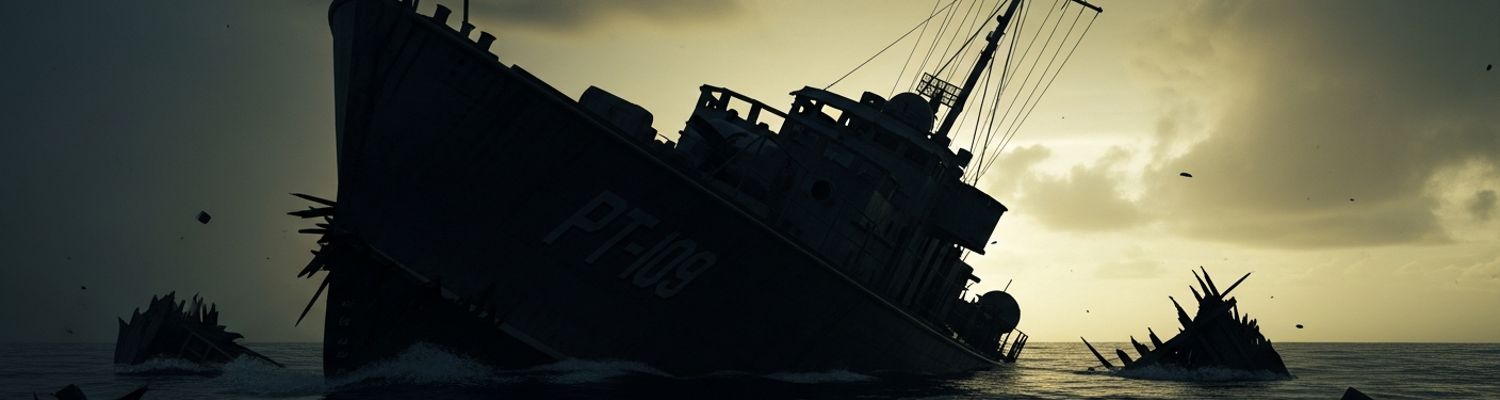

At approximately 02:30 on August 2, 1943, the operational life of Patrol Torpedo Boat 109 came to a violent end. The mission had begun hours earlier as part of a poorly coordinated naval action. Fifteen PT boats from the Rendova Island base were dispatched into the labyrinthine waterways of the Solomon Islands to intercept the so-called Tokyo Express, the Imperial Japanese Navy’s near-nightly resupply runs. Intelligence indicated a convoy of five destroyers would transit the Blackett Strait. Lieutenant John F. Kennedy’s PT-109 was part of a four-boat section assigned to patrol west of Makuti Island. A close review of operational logs (NARA Record Group 38) indicates the plan was deficient. Communications between boats were unreliable. Many craft, including PT-109, lacked radar, a substantial disadvantage in night actions. The American Mark 8 torpedoes themselves were notoriously unreliable, a fact that plagued both PT boat and submarine crews in the Pacific theater.
The night was profoundly dark. A cloudy, starless sky combined with a new moon, creating a disorienting blackness over the Blackett Strait. Visibility was near zero. This absence of ambient light neutralized the PT boats' primary advantages of speed and maneuverability. Earlier in the night, other PT boat sections had engaged the Japanese destroyers, firing a total of 30 torpedoes with no confirmed hits. This failed attack only alerted the Japanese convoy. Following the engagement, PT-109, along with PT-162 and PT-169, received orders to remain on station.
They were alone.
To minimize the phosphorescent wake from its three powerful Packard 4M-2500 marine engines, Kennedy had ordered PT-109 to loiter on just one engine. The boat moved at the slowest possible speed. Suddenly, a shape emerged from the blackness off the starboard bow, roughly 200 to 300 yards away. The crew first believed it to be another PT boat. It was not. It was the Japanese destroyer Amagiri, a 2,400-ton warship returning from its supply mission. It was traveling between 23 and 40 knots to clear the dangerous straits by dawn. There was less than a minute from sighting to impact. Kennedy attempted to turn the 56-ton wooden boat to starboard to fire torpedoes, but the maneuver was hopeless. The Amagiri struck PT-109 just forward of the starboard torpedo tube, slicing the boat in two. The impact instantly killed Torpedoman’s Mate Andrew Jackson Kirksey and Motor Machinist’s Mate Harold William Marney. Thousands of gallons of 100-octane aviation fuel ignited, turning the sea into a flaming pool and badly burning engineer Patrick McMahon.
The immediate aftermath was apocalyptic chaos. Archival evidence shows the result of a 2,400-ton steel destroyer colliding with a 56-ton wooden boat. The high-test gasoline vaporized and exploded, creating a massive conflagration that spread rapidly across the water’s surface. For the men thrown clear, the sea itself became an enemy. The initial explosion and intense heat badly burned Motor Machinist’s Mate Patrick McMahon, who was then thrown into the flaming water. The shock of the ramming, the deafening noise, and the sudden immolation of their vessel left the surviving crew scattered and disoriented in the pitch-black, fuel-choked water.
The two halves of PT-109 separated violently. The aft section, containing the engines and fuel, sank quickly.
A close examination of the boat’s design reveals the feature that prevented a total loss of life. The forward section of the Elco PT boat, containing crew quarters, was built with several watertight compartments. These compartments, designed to contain flooding from battle damage, performed their function. Though listing heavily, the bow section remained afloat, a small island of wreckage in a hostile sea. The eleven survivors, including Kennedy, found themselves struggling in the water. Their immediate objective was this floating piece of their former boat. One by one, injured and exhausted, they swam through the darkness toward the hulk, clinging to its splintered mahogany planks.
In the moments following the collision, Kennedy’s actions were instrumental in consolidating the survivors. Thrown against the cockpit wall, he recovered quickly. His priority shifted from command of a warship to the survival of his men. He began calling out for the crew, methodically working to gather the scattered men. Archival accounts from the crew detail how Kennedy swam to the badly burned Patrick McMahon. McMahon was unable to swim. Kennedy grabbed the strap of McMahon’s life vest between his teeth and, despite his own chronic back injuries, towed the wounded engineer through the dark water back to the floating bow section. He then went out again, finding and assisting other crewmen, guiding them to the relative safety of the wreckage. This effort took hours, a sustained feat of physical endurance that brought all eleven survivors together by dawn.
By late afternoon on August 2, the decision was made to abandon the floating forward section of PT-109. Crew testimony indicates the wreckage was becoming unstable, drifting deeper into Japanese-controlled territory. The nearest landmass was an islet named Kasolo, later called Plum Pudding Island, some 3.5 miles distant. It was a desperate gamble. The eleven survivors slid back into the gasoline-fouled water for a grueling swim. The journey took between four and five hours against a strong current. Timbers used to lash an anti-tank gun to the deck were repurposed into a crude flotation device, pushed by the men to support the weakest swimmers.
The movement of the wounded was a supreme challenge. Patrick McMahon, suffering from horrific burns, was completely incapacitated. Kennedy, despite the aggravation of his own back injury, took charge of McMahon’s transport. Gripping the engineer’s life vest strap between his teeth, he towed the injured man across the entire 3.5-mile distance. This physically punishing method, maintained for hours against the current, was an extraordinary feat of individual strength.
They were not swimming to safety. They were swimming to a different kind of peril.
Upon reaching the shore, the men were spent. They crawled onto the sharp coral beach one by one. Their new sanctuary was a disappointment. The islet was a mere 100 yards in diameter, a patch of sand and coral with a handful of coconut trees. An immediate assessment revealed a grim situation: no fresh water and no apparent food beyond coconuts. The relief of reaching solid ground was quickly replaced by the stark understanding of their isolation.
Naval charts from the period confirm the extreme tactical danger of their position. The islet was located in the shadow of Kolombangara, a major Japanese stronghold garrisoning over 10,000 troops. The sound of Japanese barge traffic was a constant, audible reminder of their proximity to the enemy. They were deep behind enemy lines, shipwrecked on an island that offered no sustenance and was directly observable by Japanese patrols. The initial assessment was clear: this island could not be a long-term haven.
The tactical situation on Kasolo Island was defined by a complete lack of essential resources. This forced a series of calculated risks. Crew testimony shows that Kennedy, accompanied by Ensign George Ross, undertook exploratory swims to the larger, nearby islands of Olasana and Naru. It was on Naru that Kennedy and Ross located a small cache of supplies left by the Japanese, including crackers, candy, and a fifty-gallon drum of potable water. They also discovered a small, abandoned canoe. Kennedy then paddled the canoe, loaded with the water and food, back to the crew on Olasana Island, to which the group had relocated for its greater number of coconut trees. For days, the men subsisted almost entirely on coconuts and the small amount of scavenged supplies.
The psychological burden was significant. Archival accounts from the survivors detail a pervasive sense of despair that grew with each passing day. The physical misery of hunger, thirst, and injury was compounded by the constant sound of Japanese barge traffic. The severe burns covering Patrick McMahon’s hands, face, and arms were a constant, grim visual. In this environment, Kennedy’s leadership was a major factor in maintaining group cohesion. He repeatedly swam out from the islands alone at night to place himself in the Ferguson Passage, a channel used by PT boats, in the hope of signaling a friendly vessel. These attempts, undertaken with a salvaged battle lantern, proved fruitless, but they served to demonstrate to the men that their commander had not given up.
Attempts to signal Allied forces were a study in improvisation. Allied aircraft were spotted flying overhead, completely oblivious to the men concealed below. Kennedy’s most audacious signaling attempts involved his night swims into Ferguson Passage. For hours, he would tread water in the shipping lane, using the salvaged lantern to flash a signal. On the night of August 2nd, he swam out from Kasolo Island into the passage but saw nothing. After the crew moved to Olasana on August 4th, he repeated the effort, again with no success. Their isolation was nearly complete. A chance encounter on August 6th provided a viable path to rescue. Two local islanders, Biuku Gasa and Eroni Kumana, operating as scouts for an Australian coastwatcher, discovered the Americans. This contact shifted the effort from blind signaling to targeted communication. Kennedy used his knife to carve a message onto the smooth green husk of a coconut. The text was a field dispatch, stating that eleven men were alive on Nauru Island, that the native scout knew their position and could pilot a boat, and that they needed a small boat. He signed it KENNEDY. This artifact, a fusion of primitive resource and modern military need, was handed to the scouts, who then began a perilous 35-nautical-mile canoe journey through enemy-patrolled waters.
The pivotal turn came not from an Allied patrol boat or a searching aircraft, but from a dugout canoe paddled by Biuku Gasa and Eroni Kumana. On August 6, 1943, the American sailors were discovered. Gasa and Kumana were not simply fishermen; they were part of a highly organized, clandestine intelligence network of coastwatchers operating under the command of Australian Sub-Lieutenant Reg Evans. Evans, positioned in a secret observation post on Kolombangara, had witnessed the explosion of PT-109 days earlier. After receiving radio traffic confirming a PT boat was missing, he had dispatched his teams of islander scouts to search the surrounding waters for survivors. Their arrival at Olasana was a deliberate act of reconnaissance.
This was not a rescue. It was first contact.
Initial communication was fraught with uncertainty and a near-total language barrier. The historical record shows that when the two groups first met, mutual suspicion was the dominant reaction. The scouts were wary of Japanese patrols. The Americans saw two men armed with rifles and had no way of knowing their allegiance. Kennedy possessed only a rudimentary knowledge of the local pidgin English. The conversation that followed was an exercise in pantomime and broken phrasing. The scouts offered the starving crew yams and other vegetables from their canoe, a gesture that began to build a fragile trust. The breakthrough reportedly came when Ensign Lenny Thom managed to establish a common acquaintance, confirming for Gasa and Kumana that they were dealing with Allied sailors.
Their understanding of the terrain was the key. Where Kennedy’s night swims were a blind gamble against currents and enemy patrols, the scouts possessed an encyclopedic and practical knowledge of the archipelago. Gasa and Kumana understood the complex web of currents, the safe channels hidden from Japanese observation, and the precise timing of enemy barge traffic. This was operational intelligence. They were part of a network that fed extraordinarily detailed information to the Allies. Entrusted with Kennedy’s location, they did not paddle directly to the main Allied base at Rendova. Instead, they first made for the island of Wana Wana to connect with a senior scout, Benjamin Kevu, who provided them with a better canoe for the next leg of the journey. From there, they undertook a 35-nautical-mile journey through waters actively controlled by the Japanese, paddling for fifteen hours through bad weather to deliver their intelligence.
The fate of the eleven survivors rested on a piece of fruit. The coconut message, handed to Biuku Gasa and Eroni Kumana, represented the crew’s final hope. The act was a transfer of trust across a cultural and linguistic chasm. The scouts, for their part, now held physical intelligence that made them high-value targets for any Japanese patrol.
Their mission was a study in calculated risk. The journey was a 35-nautical-mile gauntlet through enemy-controlled territory. Paddling a dugout canoe, they navigated the treacherous waters of the Blackett Strait. The scouts utilized their deep, generational knowledge of local currents, reefs, and hidden channels to remain undetected. Instead of making a direct run for the main Allied PT boat base at Rendova, they first paddled to Wana Wana island. There, they connected with a senior scout, Benjamin Kevu, who provided them with a larger, more stable canoe. The entire transit took them fifteen hours, much of it at night and in bad weather.
The message, delivered by hand, finally activated a dormant intelligence network. Gasa and Kumana delivered the coconut not directly to the American base, but into the clandestine network of Australian coastwatchers. The key recipient was Sub-Lieutenant A. Reginald Evans. From a concealed observation post high on the slopes of Kolombangara’s Mount Veve volcano, Evans had personally witnessed the fireball of PT-109’s destruction. Upon receiving the coconut, Evans had tangible proof of survivors. Using his Teleradio 3B, a portable transceiver, he sent a coded message to the Allied headquarters on Guadalcanal. The intelligence was then relayed to Commander Thomas G. Warfield at the Rendova PT base. The informal message carved on a coconut was transformed into a formal military intelligence report, initiating the rescue operation.
The arrival of the coconut message at the Rendova PT base triggered immediate action. Operational logs indicate that Commander Thomas G. Warfield promptly organized a rescue mission. The task was assigned to Lieutenant W. F. Liebenow, skipper of PT-157. His boat was to be the primary rescue vessel, assisted by PT-171 for escort and additional firepower. The plan was a high-stakes infiltration deep into enemy territory. The boats would depart under the cover of darkness on the night of August 7-8. The rescue party was comprehensive, including not just the boat crews but also two pharmacist's mates and, most importantly, the Solomon Islander scouts Biuku Gasa and Eroni Kumana to act as guides. Their intimate knowledge of the waters was the single most important navigational tool for the mission’s success.
This was a direct incursion into a Japanese-controlled strait.
The extraction plan required Kennedy to first meet the rescue boats alone. Following instructions delivered by the scouts, Kennedy was paddled in a canoe from Olasana to a rendezvous point on Gomu Island. As night fell, he paddled out into Ferguson Passage to meet the approaching PT boats. The prearranged signal was four shots. Kennedy, armed with a .45 caliber pistol, only had three rounds. He fired them. A louder shot came from his direction. At approximately 23:15, he made contact with PT-157 and climbed aboard. Now acting as the final guide, Kennedy directed Lieutenant Liebenow’s boat through the final, intricate passage toward Olasana Island. The PT boats, running quietly, slipped past enemy lookouts and eased up to the shore where the ten exhausted survivors were waiting.
The retrieval itself was executed in tense silence. The ten men were quickly brought aboard, with special care taken for the badly burned Patrick McMahon. The sight of their commander returning on a fully armed American torpedo boat was a moment of profound relief. After six days of isolation and near-starvation, they were finally safe. The entire extraction from the island was completed without incident. The two PT boats, loaded with the eleven survivors, immediately turned back toward Rendova. The return journey was tense but uneventful. They arrived at the base at 05:30 on August 8, seven days after PT-109 was sliced in two. The survivors were given immediate medical attention. Back at the base, where a memorial service had already been held for the crew presumed dead, their return was met with astonishment.