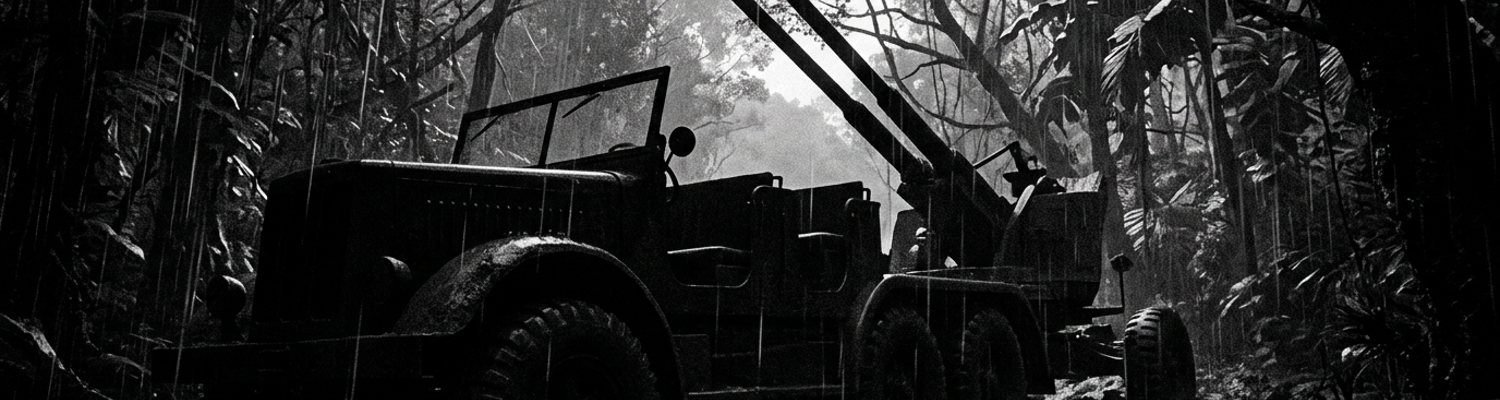

Silent Hours After the Munda Trail Drive
Private First Class Arthur Lemons of the 118th Engineer Battalion wiped a thick layer of asbestos-based waterproofing grease over the distributor cap of a Willys MB quarter-ton jeep. Tightening the 3/8 inch bolts on the exhaust extension pipe near the eastern bank of the Barike River secured the fitting. The transfer case was already caked in dried clay from the landing at Zanana beachhead. Dropping the tire pressure to 15 PSI to grip the slick terrain allowed the vehicle to advance.
It moved exactly fourteen feet.
The front differential buried itself entirely in a sinkhole of liquefied jungle rot.
The supply line died right there.
Archival evidence shows the immediate aftermath of the July 1943 assault on Munda Airfield left the American forces in a state of sudden stillness. Combat operations paused on July 17 after the 169th and 172nd Infantry Regiments of the 43rd Infantry Division battered themselves against the Japanese defensive perimeter at Laiana and the high ground of Shimizu Hill. The artillery batteries ceased firing 105mm howitzer shells from their M2A1 field guns. Infantrymen dropped into flooded coral foxholes. Shredded banyan trees surrounded them. The smell of cordite mixed with decomposing vegetation. Survivors stared blankly at the pulverized 4,000 foot coral airstrip located at 8.328 degrees South, 157.263 degrees East. Medical corpsmen moved through the lines counting bodies and administering 0.5 grain morphine syrettes to the wounded. The temperature hovered at 95 degrees Fahrenheit with 98 percent humidity. Troops checked their M1 Garand rifles. They found the gas cylinders completely fouled by volcanic sand and moisture.
A close review of operational logs indicates a frantic effort at the division command post near Zanana beach to document the mechanical and supply breakdowns. Staff officers from the G-4 section sat on empty .30 caliber ammunition crates. They wrote field reports by the light of kerosene lanterns. Ink bled onto the requisition forms. They recorded how standard supply protocols failed completely on the Munda Trail. The narrow track dissolved under the 14,000 pound weight of Caterpillar D4 tractors and continuous infantry foot traffic. Supply columns required twelve hours to move C-rations and medical supplies a distance of just two miles. Inspection of the 2.5 ton GMC CCKW trucks revealed blown transmissions, stripped gears, and snapped drive shafts. Axles had high-centered in the mud. The logs detailed the failure of indigenous carrying parties to keep up with the daily front-line sustainment requirement of 300 tons. Quartermasters tallied the lost tonnage of artillery shells. These munitions had sunk entirely beneath the surface of the trail.
Every mathematical formula for front-line sustainment collapsed.
Initial field reports drafted during these quiet hours exposed severe structural breakdowns across the entire 43rd Infantry Division. Major General John H. Hester read dispatches confirming his regiments were dissolving from within. They suffered from combat fatigue and disease. The 169th Infantry Regiment reported over 1,500 non-battle casualties within a two-week window. Dysentery, dengue fever, and severe fungal infections decimated the rifle companies. Rosters submitted by company commanders showed platoons operating at less than forty percent combat effectiveness. Moisture penetrating the vacuum tube seals of SCR-300 backpack radios caused complete communication blackouts across the sector. Wiremen could not lay WD-1 field telephone wire fast enough to replace lines severed by knee-mortar fire or crushed by sinking tracked vehicles.
Command structures fragmented into isolated squads.
The 118th Medical Battalion submitted forms detailing their inability to evacuate casualties back to the beachhead. Litter bearers slipped and fell constantly on the steep inclines of the trail. They dropped wounded men into the mud. Personnel officers from the G-1 section tabulated the statistics of psychiatric collapse. Medical staff diagnosed hundreds of soldiers with war neurosis. They documented an inability to function after consecutive nights of Japanese infiltration tactics. Already committed to the fight, the division reserve took heavy losses trying to secure the supply corridor. The 103rd Infantry Regiment suffered heavily. Platoon leaders resorted to writing SITREPs on the cardboard backing of C-ration boxes.
Blinded Artillery Observers in Mangrove Swamps
First Lieutenant David R. Kincaid wiped condensation from the ocular lenses of his M3 6x30 binoculars using a piece of burlap sandbag. He served as a forward observer attached to the 3rd Battalion, 169th Infantry Regiment. He stood waist-deep in brackish water at grid coordinate 8.319 degrees South, 157.271 degrees East. This position sat approximately one mile east of Munda Airfield. A close review of operational logs indicates the 169th Infantry Regiment deployed multiple specialized artillery liaison teams to coordinate supporting fires for the advancing rifle companies. Kincaid carried an EE-8 field telephone strapped to his chest. Its canvas case rotted from constant exposure to the humid environment. Two wiremen trailed behind him. They unspooled D-110 communication wire from heavy metal drums through the flooded undergrowth. The regimental advance stalled completely against Japanese Type 92 heavy machine gun positions hidden within the root systems ahead. Standard tactical doctrine required Kincaid to establish a fixed observation post, identify enemy muzzle flashes, and relay exact azimuth and elevation data back to the Fire Direction Center of the 192nd Field Artillery Battalion. The 169th Infantry Regiment depended on this precise flow of mathematical data to direct fire missions.
The visual horizon ended exactly twelve feet in front of his face.
Archival evidence shows the coastal approach to Munda Point was choked by a solid barrier of Rhizophora mangroves. Towering forty feet into the air, the interlocking prop roots created a dense wooden lattice. This barrier completely blocked any direct line of sight. Forward observers trying to map the terrain found their M2 compasses useless. The thick canopy kept the swamp in perpetual twilight even at midday. The dense vegetation absorbed light and distorted sound. Triangulating the origin of enemy rifle fire became impossible. Artillery spotting requires a clear view of a known geographical reference point to adjust the impact of incoming shells. The mangrove swamp obscured all topographical features. Observers could not see the ridgelines, the coastline, or the sky. Moisture trapped beneath the canopy caused the reticles inside aiming circles and battery commander telescopes to fog over internally within minutes of deployment. Infantry squads from the 169th took casualties from concealed pillboxes. The embedded observers stared at impenetrable walls of wet wood.
Every optical instrument issued by the War Department failed to penetrate the vegetation.
This total lack of visibility resulted in a complete inability to adjust or correct 105mm artillery fire missions. Four miles to the rear, the M2A1 howitzers of the supporting artillery battalions sat loaded with 33 pound high-explosive projectiles. They waited for target coordinates. When an observer called in a blind fire mission based on sound alone, the Fire Direction Center calculated the trajectory and fired a single white phosphorus spotting round. Standard procedure required the forward observer to see this initial explosion, measure the distance from the target, and call back mathematical corrections to bracket the enemy position. Observers in the mangrove swamps never saw the spotting rounds land. The heavy jungle canopy triggered the point-detonating fuses of the 105mm shells seventy feet in the air. Jagged steel shrapnel cut through the trees in unpredictable patterns. Without visual confirmation of the impact, Kincaid and the other observers could not issue the command to drop fifty yards or shift left one hundred yards. Firing blind risked dropping concentrated artillery barrages directly onto the isolated rifle platoons of the 169th Infantry Regiment.
Battery commanders at the gun line ordered their crews to stand down.
Historical after-action reports detail how the communication chain between the front line and the artillery batteries failed entirely. Field telephone operators at the Fire Direction Center listened to static. Frantic requests for fire support from the 169th Infantry Regiment went unfulfilled. Gun crews unloaded the 105mm shells from the breeches of their howitzers and placed them back into the mud. The infantry assaulted the Japanese bunker complexes using only M1 Garands, Mk 2 fragmentation grenades, and bayonets. Battery crews recorded zero rounds fired for the operational period.
Transport Breakdown Across Degraded Jungle Terrain
A close review of operational logs indicates the total mechanical failure of the 43rd Infantry Division heavy motor pool along the primary supply route. At grid coordinate 8.331 degrees South, 157.259 degrees East, a column of five Allis-Chalmers M1 heavy tractors sat abandoned in a continuous trench of liquefied clay. Operators from the 118th Engineer Battalion attempted to tow 105mm M2A1 howitzers inland from Zanana beach. Heavy ground pressure from the 18 inch steel track pads forced the machines downward. Topsoil dissolved instantly under the 14 ton weight of the tractors. Within the first two miles of the Munda Trail, mud swallowed the drive wheels entirely. Drivers pushed the throttle to maximum RPM. They tried to force the tracks to bite into the bedrock layer beneath the sludge. This action packed wet clay directly into the final drive sprockets and the suspension bogies. Hardened mud snapped the track pins. Torsion bars bent permanently out of alignment.
Mechanics recorded drive shafts shearing in half under the extreme torque.
Radiators choked on the thick slurry kicked up by the spinning tracks. Engine blocks overheated within twenty minutes of operation. They blew head gaskets and vented pressurized steam into the jungle canopy. Recovery vehicles dispatched to retrieve the stalled tractors suffered the exact same fate. Standard operating procedure dictated using heavy chains and winches to pull immobilized equipment free. Winch cables snapped under the tension. They whipped back and severed the limbs of engineer personnel standing nearby. By July 18, the entire mechanized supply effort stopped. Tracked equipment sank to the engine decks. A two-mile graveyard of stationary steel formed along the approach to Shimizu Hill.
Command officers officially reclassified the tractors as permanent geographical landmarks.
Quartermaster reports detail the rapid collapse of the animal transport alternative. Logistics officers deployed specialized pack mule companies to bypass the destroyed mechanized corridor. Handlers loaded the animals with Phillips pack saddles carrying 150 pounds of .30 caliber ammunition and plasma. Trail gradients climbing toward the Japanese defensive perimeter at Laiana exceeded forty-five degrees in several sectors. Constant tropical downpours stripped away all loose earth. Jagged limestone ridges coated in a friction-less layer of wet algae became exposed. Pack animals lost their footing immediately upon hitting the incline.
Mules slid backward down the slopes.
They crushed their handlers against the root systems of banyan trees.
Veterinary officers documented the physical deterioration of the herd in frantic dispatches to the rear. Herd animals suffered from severe hoof rot after standing in knee-deep water for five consecutive days. Canvas girth straps on the pack saddles absorbed water and stretched. The heavy ammunition loads shifted violently to one side as the mules navigated the narrow switchbacks. This imbalance dragged the animals over the edge of the trail. Hundreds of mules fell into the steep ravines flanking the Barike River. They shattered their legs on the coral outcroppings below. Veterinary detachments moved down into the gullies to euthanize the injured livestock with M1911 pistols.
Quartermasters crossed animal transport off the list of viable sustainment methods.
Archival evidence shows the 43rd Infantry Division abandoned the overland route entirely. They shifted all sustainment operations to the Roviana Lagoon. Planners at the division command post ordered a complete operational dependency on waterborne supply craft to keep the offensive alive. Navy amphibious forces mobilized a fleet of LCVPs and LCMs. They ferried C-rations, water, and artillery shells directly from the main depot on Rendova Island to the forward beachhead at Laiana. This bypass eliminated the need to traverse the Munda Trail. Coxswains navigated the flat-bottomed Higgins boats across the channel under cover of darkness to avoid Japanese coastal artillery fire. Shallow drafts on the LCVPs allowed them to approach within thirty yards of the shoreline before dropping their steel ramps.
The landing craft scraped violently against uncharted coral heads.
Supply platoons waded chest-deep into the surf to manually unload the cargo. Men carried wooden crates of mortar rounds on their shoulders through the breaking waves. Japanese Type 99 sniper fire impacted the water around them. Heavier cargo arrived via LCMs. They deposited field ambulances and replacement howitzers directly onto the sand. Beachmasters worked continuously to organize the incoming tonnage, stacking supplies behind the immediate tree line. Front line riflemen of the 43rd Infantry Division now relied exclusively on the nightly arrival of these wooden boats. If the Navy flotilla delayed a shipment due to tide conditions, the regiments fighting around Munda Airfield ran out of ammunition within four hours.
The division logistics officer recorded exactly three days of rations sitting on the wet sand at Laiana.
Twelve-Hour Evacuations by the 118th Medical Battalion
Archival evidence shows the complete degradation of the 118th Medical Battalion litter-bearer squads along the Munda Trail. Medical officers at the Zanana beachhead clearing station recorded the arrival of exhausted four-man teams collapsing alongside their patients. Standard table of organization and equipment protocols dictated that a four-man stretcher squad could transport a casualty over flat terrain at a pace of two miles per hour. Topography along the Barike River rendered this mathematical baseline entirely obsolete. Commanders of the 118th quickly realized four men could not physically lift a standard 15 pound canvas and wood litter bearing a 160 pound infantryman out of the suction of the jungle floor. Company commanders doubled the squad sizes to eight men. They stripped riflemen from the 103rd Infantry Regiment reserve to act as emergency bearers. These ad-hoc teams rotated positions every fifty yards. Even with twice the manpower, the physical exertion of lifting a stretcher while standing in a liquid environment caused severe muscle cramping and heat exhaustion among the medical personnel.
Men drank directly from canteens filled with unpurified swamp water just to stay conscious.
A close review of operational logs indicates stretcher movement through six miles of waist-deep mud became the primary cause of secondary casualties during the July offensive. The trail surface consisted of pulverized coral mixed with rotting vegetation and heavy rainfall. It created a thick, highly viscous slurry. Bearers sank to their belts with every step. Forward progress required a soldier to physically pull his own legs out of the mud before attempting to step forward. They did this while supporting twenty to forty pounds of dead weight on their shoulders. If one man on the eight-man team lost his footing on a submerged root, the entire litter tipped violently into the muck. Wounded men strapped to the stretchers faced an immediate drowning hazard. Medical corpsmen documented multiple instances of patients with chest wounds aspirating the liquefied clay after being dropped into the sinkholes. The 118th Medical Battalion ordered bearers to hold the stretchers at chest level. This forced the exhausted men to rely entirely on their upper body strength rather than their legs.
The mud stripped the canvas leggings and combat boots directly off the feet of the medics.
This complete loss of mobility resulted in twelve-hour evacuation timelines for single casualties. Medical logs from July 18 track the journey of a single wounded rifleman from the 169th Infantry Regiment. Shrapnel hit him near Shimizu Hill at grid coordinate 8.322 degrees South, 157.265 degrees East. The evacuation began at 0600 hours. The stretcher party covered less than half a mile per hour. They stopped constantly to steer around abandoned M1 tractors and rotting mule carcasses blocking the narrow corridor. By noon, the casualty required a second 0.5 grain morphine syrette and additional blood plasma. The bearers halted in the open rain to administer the fluids. Heavy Japanese mortar fire frequently forced the medical teams to drop the stretcher into the mud and take cover in flooded shell craters. The constant delays pushed the evacuations into the night. The dense mangrove canopy blocked all moonlight.
Moving down the trail in total darkness required bearers to feel for solid ground using their bare hands.
The arithmetic of these twelve-hour journeys halted the medical supply chain. A single eight-man team could only complete one round trip per day. Bringing one casualty from the front line back to the Zanana beachhead consumed the entire daily caloric and physical output of eight able-bodied men. Hundreds of wounded soldiers accumulated at forward battalion aid stations. They lay on palm fronds under ponchos as they waited for stretcher teams that never returned. Surgeons operating in the forward areas ran out of sterile bandages. They began wrapping wounds in torn uniform shirts. The 118th Medical Battalion reported that seventy percent of their assigned personnel were completely incapacitated by the fifth day of the offensive.
Division command logged a backlog of four hundred untreated casualties sitting in the jungle at 1800 hours.
Elevated Mortality Rates from Transport Shock
Medical officers assigned to the 118th Medical Battalion documented the complete collapse of forward field stabilization protocols just yards behind the front lines at Shimizu Hill. Battalion aid stations consisted of nothing more than standard-issue canvas ponchos tied between shredded banyan trees at grid coordinate 8.322 degrees South, 157.265 degrees East. Army surgeons attempted to treat traumatic shrapnel amputations and high-velocity gunshot wounds while kneeling directly in six inches of standing swamp water. Standard operating procedure required the immediate application of crystalline sulfanilamide powder and dry sterile dressings to all open wounds. The 98 percent humidity and constant tropical downpours saturated the paper packaging of the medical supply kits. This moisture turned the sulfa powder into a useless, chalky paste before it could reach the patients. Medical corpsmen opened sealed tins of surgical instruments only to find the high-carbon steel scalpels and hemostats already coated in heavy oxidation. Treating severe hemorrhage required the administration of dried blood plasma mixed with distilled water. The rubber stoppers on the plasma bottles degraded in the extreme heat. Jungle moisture contaminated the protein solids. The fluid turned toxic. Cotton tourniquets absorbed the stagnant water, losing their elasticity and failing to maintain arterial occlusion. Corpsmen exhausted their supply of 0.5 grain morphine tartrate syrettes within the first two hours of the Japanese counterattack.
Corpsmen discarded dozens of spoiled plasma units into the mud while infantrymen bled out on the surrounding palm fronds.
Archival evidence shows surviving the initial triage merely exposed the wounded to rapid, severe bacterial contamination along the extraction routes. Stretcher bearers carried stabilized patients away from the Laiana perimeter and directly into the flooded mangrove swamps flanking the Barike River. The trail surface contained high concentrations of decomposing vegetation, raw human waste from the 169th Infantry Regiment, and unburied Japanese casualties. Bearers slipping on the slick coral outcroppings frequently dropped their litters. They plunged men with open abdominal wounds and compound fractures completely underwater. The brackish sludge instantly bypassed the saturated field dressings. Suture lines snapped. The steep, forty-five degree inclines near Shimizu Hill forced bearers to tilt the stretchers at extreme angles. Patients slid down and tore their temporary bandages against the canvas. Medical logs recorded the onset of severe wound infections within four hours of these submersion events. Anaerobic bacteria, specifically Clostridium perfringens, thrived in the oxygen-deprived deep tissue injuries caused by Japanese 77mm artillery shrapnel. Gas gangrene spread rapidly up the extremities of the wounded as they lay strapped to the litters. The infection destroyed healthy muscle tissue at a rate of several inches per hour. Iodine swabs issued in the first-aid pouches proved completely ineffective against the heavy bacterial loads introduced by the swamp water.
Surgeons at the Zanana beachhead clearing station amputated infected limbs immediately upon the arrival of these contaminated casualties.
A close review of operational logs indicates the physical duration of the evacuation directly caused a spike in casualty mortality rates due to prolonged transport shock. Moving a wounded soldier from the forward aid stations back to the coastal triage centers took up to twelve hours of continuous physical trauma. Patients suffering from major blood loss lost their ability to thermoregulate. The ambient temperature hovered at 95 degrees Fahrenheit. The constant exposure to rain and wet canvas induced severe hypothermia. The erratic, violent bouncing of the stretchers as exhausted bearers stumbled over root systems prevented the formation of blood clots. Casualties continuously lost blood through their soaked bandages during the half day journey. This sustained hemorrhage triggered hypovolemic shock. The cardiovascular system failed to circulate enough oxygenated blood to the brain and vital organs. Peripheral veins collapsed. It became physically impossible for medics to insert intravenous needles for secondary plasma transfusions on the trail. Corpsmen halting to check radial pulses found them entirely absent. The lack of whole blood at the division level meant oxygen-carrying capacity could not be replaced in the field. The human body compensated by shunting remaining blood to the core. The soldiers extremities turned blue and cold to the touch. The twelve-hour transport window exceeded the maximum survival time for untreated hypovolemia.
Graves registration personnel recorded sixty-two men who died directly on their stretchers before reaching the beachhead on July 18.
Medical Rationing at Forward Aid Stations
A close review of operational logs indicates the sudden halt of infantry assaults on July 17 forced medical officers of the 118th Medical Battalion to inventory their forward aid stations. These positions consisted of canvas tarpaulins strung across splintered mahogany stumps near Shimizu Hill at grid coordinate 8.322 degrees South, 157.265 degrees East. Stretcher bearers sat on empty wooden ammunition crates in the sudden quiet. They wrote supply requisitions on the cardboard backing of C-ration boxes. Exhausted surgeons detailed the total depletion of their Class VIII medical stores. Front-line infantry units like the 169th Infantry Regiment consumed the entire division stockpile of 0.5 grain morphine tartrate syrettes during the previous forty-eight hours of continuous combat. Corpsmen documented opening standard-issue first aid kits to find the paper wrappers on compressed gauze bandages completely dissolved by the 98 percent humidity. Unprotected cotton absorbed ambient moisture and bacterial contaminants from the air long before it touched an open wound. Medical technicians lacked clean water to sterilize their high-carbon steel hemostats and scalpels. Oxidation coated the surgical instruments in a thick layer of rust. Doctors attempting to clamp severed arteries found the locking mechanisms on their forceps seized entirely by the heavy corrosion.
Medical personnel operated entirely without sterile field dressings.
Archival evidence shows this supply collapse triggered a rigid triage protocol regarding the administration of dried blood plasma. Battalion command posts issued direct orders to withhold the remaining plasma units from casualties suffering from penetrating abdominal or chest trauma. Medical officers calculated these patients possessed a statistical survival rate near zero given the twelve-hour evacuation times down the Munda Trail. Corpsmen redirected the limited fluid reserves exclusively to riflemen with traumatic extremity amputations who might survive the transport shock. Administering this plasma required a complex mechanical process of mixing dried protein solids with distilled water from sealed glass ampoules using double-ended needles and rubber tubing. The extreme jungle heat degraded the rubber stoppers on these containers. Microscopic fungi penetrated the vacuum seal. Technicians inspecting the remaining inventory found dozens of bottles contaminated with thick white mold. Triage officers stood over men bleeding from shrapnel wounds and physically counted the remaining intact plasma boxes before authorizing a transfusion. Medics inserted the thick intravenous needles into the collapsed veins of the selected patients. They ignored the frantic requests of other wounded men lying just feet away.
Corpsmen marked the foreheads of men denied transfusions with iodine swabs.
The administration of crystalline sulfanilamide powder relied entirely on the erratic arrival of Navy landing craft at Laiana beach. Overland transport of the five-gram sulfa packets stopped completely when the heavy tractors sank into the mud of the primary supply route. Division planners shifted the entire infection control strategy to the waterborne supply corridor operating across the Roviana Lagoon. Flat-bottomed LCVPs carrying wooden crates of the antibacterial powder navigated the shallow coastal waters under the cover of darkness. Japanese coastal artillery batteries frequently fired on these flotillas. Navy coxswains aborted their landing runs and turned back toward Rendova Island. This naval schedule directly dictated the spread of anaerobic bacteria in the forward aid stations. If the tide dropped or enemy fire delayed the boats, surgeons at Shimizu Hill ran out of sulfanilamide within hours. Untreated deep-tissue injuries caused by 77mm artillery shrapnel developed gas gangrene rapidly in the tropical heat. Medical officers recorded exact timelines of infection spreading up the limbs of waiting casualties while they listened for the diesel engines of the Higgins boats. Infantrymen with compound fractures waited in the flooded trenches for the coastal deliveries to bring the specific chemical compounds required to stop their tissues from necrotizing.
Quartermasters logged four hundred empty sulfa packets floating in the surf zone at 0400 hours.
Emergency Revisions to Army Jungle Logistics
Staff officers at the Zanana beachhead command post spent the early hours of July 18 frantically rewriting supply doctrines originally drafted in 1939. Clerks operating under kerosene lamps pulled copies of Field Manual 100-5 from their waterproof canvas dispatch cases. They cross-referenced these interwar texts with mimeographed after-action reports recently forwarded from the Buna-Gona campaign in New Guinea. Officers read typed accounts from the 32nd Infantry Division detailing how standard sustainment formulas collapsed in the Papuan swamps. Standard War Department mathematics dictated a daily requirement of exactly 34.5 pounds of supplies per combat soldier. Logistics planners sitting on wet sand calculated the extreme friction of the New Georgia jungle rendered this baseline obsolete. Moving a single wooden crate of C-rations inland required the caloric output of three indigenous carriers. The transport chain consumed the very rations it attempted to deliver. G-4 officers drafted emergency memorandums recalculating the division daily tonnage requirements. They discarded the European theater model of mechanized road networks. They substituted a localized supply matrix based entirely on the payload capacity of a single infantryman sinking waist-deep in mud. Quartermaster personnel cross-referenced ammunition expenditure rates from Guadalcanal. They discovered jungle fighting required four times the number of fragmentation grenades prescribed by pre-war doctrine.
Typewriters clattered over the sound of distant mortar fire.
Officers documented the total mathematical failure of standard quartermaster tables.
Medical commanders of the 118th Medical Battalion simultaneously dismantled the established table of organization for casualty extraction. The prescribed doctrine of moving wounded soldiers directly from battalion aid stations to rear clearing companies in a single, continuous journey killed dozens of men through transport shock. Medical officers redrew the evacuation maps of the Munda Trail using red grease pencils. They established a rigid relay system. Planners placed temporary medical collection points exactly five hundred yards apart along the Barike River axis. Stretcher teams now operated strictly within these isolated micro-sectors. Bearers carried a casualty to the next boundary line, handed the litter over to a fresh team, and immediately returned to their original starting point. This compartmentalized approach prevented the total physical exhaustion of the eight-man bearer squads. Surgeons ordered the immediate abandonment of the standard 15 pound wood and canvas litters. Medical mechanics at the beachhead stripped the aluminum frames from wrecked Piper L-4 Grasshopper liaison aircraft. They built lightweight, rigid field stretchers that would not absorb swamp water. Supply sergeants scrounged wire mesh from airfield repair kits to replace the rotting canvas bedding.
The new design cut extraction weights by forty percent.
Artillery liaison officers embedded with the 169th Infantry Regiment engineered immediate tactical shifts to bypass their complete lack of visual observation. Forward observers standing in the blind mangrove swamps at grid coordinate 8.319 degrees South, 157.271 degrees East discarded their fogged M3 binoculars. They established a sound-ranging protocol with the Fire Direction Center of the 192nd Field Artillery Battalion. Liaison teams ordered gun crews to replace the standard point-detonating fuses on their 105mm high-explosive shells with 0.15 second delay fuses. This mechanical adjustment allowed the 33 pound projectiles to penetrate entirely through the forty-foot Rhizophora canopy before detonating at ground level.
Shrapnel patterns shifted from the treetops to the jungle floor.
To adjust fire without a line of sight, officers relied entirely on acoustics. The Fire Direction Center fired a single shell. Forward observers counted the seconds between the shriek of the incoming projectile and the ground detonation. Lieutenants used standard-issue Elgin stopwatches to gauge the distance. Once the blast occurred, the officer radioed mathematical corrections based on the direction of the concussive wave pushing through the wet foliage. Gun crews four miles away adjusted their M2A1 howitzers blindly by dropping elevation dials two milliradians at a time based entirely on these auditory inputs. Platoon leaders crouched in the mud, listening to the explosions advance toward the Japanese bunker complexes in fifty-yard increments.