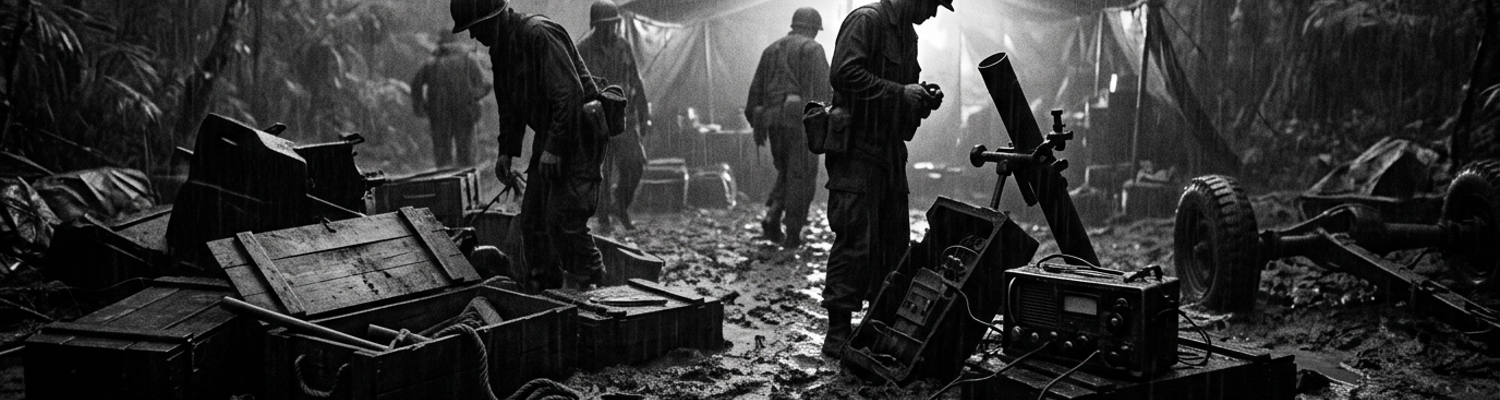

Dawn Debriefs in the Hukawng Valley
Over 12,000 combat-hardened soldiers of the Japanese 18th Division saturated the primary infiltration routes. They brought Type 97 Chi-Ha medium tanks. Heavy mortar batteries supported their advance. Archival evidence shows that against this highly equipped force, the irregular Kachin Rangers and their American handlers fielded only light infantry weapons. The numerical disparity created a condition of inescapable dread across the forward operating bases. Every trail intersection contained entrenched enemy positions.
Allied forces operated at a twenty-to-one disadvantage in the northern sectors.
Surviving OSS operatives compiled immediate field debriefs in the early dawn light following the Myitkyina push on May 18, 1944. A close review of operational logs indicates these men sat in the mud just beyond the Myitkyina West airfield perimeter. They frantically documented equipment failures before the adrenaline of the initial assault dissipated. The standard Type 8 cargo parachutes (NARA Record Group 338) utilized during the night drops exhibited a thirty percent failure rate. High humidity had rapidly degraded the silk canopy rigging during transit from supply depots in Assam. Operatives recorded the exact structural failure points of their SCR-300 backpack radios. The zinc-carbon BA-70 batteries depleted completely within four hours of continuous use. This fell far short of their rated twelve-hour lifespan. Officers assigned to Detachment 101 prioritized filling out standard-issue OSS Form 44 supply critique papers over resting. They ignored minor shrapnel lacerations. Tenth Air Force C-47 Dakota loadmasters (aircraft serial number 44-12998) had pushed the heavy weapon canisters out of the aircraft doors three seconds too late. This timing error scattered the M2 heavy machine guns across a one-mile radius of dense bamboo thickets.
Water from the morning dew actively dissolved the graphite pencil marks on their requisition papers.
Operatives recorded these supply lessons while surrounded by active Japanese search patrols. Elements of the Japanese 114th Infantry Regiment swept the immediate area around geographic coordinates 25.3833 N, 97.4000 E. The dense triple-canopy jungle trapped the acoustic signature of the approaching enemy units. Snapping bamboo echoed from less than two hundred yards away. American personnel shielded their low-wattage flashlights beneath thick canvas tarpaulins. This prevented light discipline violations while writing. They noted that M1 carbine ammunition packed into the 350-pound Mark II supply canisters lacked sufficient internal shock absorption. The heavy metal containers buried themselves up to three feet deep in the monsoon-soaked earth upon impact. Extracting these sunken canisters required entrenching tools. The airborne infantry did not possess these tools. Japanese squads advanced in standard wedge formations through the tall elephant grass.
A single dropped mess tin invited immediate suppression fire from a Type 96 Nambu light machine gun.
The hastily written field reports demanded an immediate overhaul of the drop-zone visual communication protocols. Standard fluorescent orange signaling panels failed to contrast against the specific red and orange hues of the Hukawng Valley canopy during the early monsoon blooming season. Ground commanders requested a complete substitution using bleached white parachute silk for all future daytime supply drops. The 18th Division patrols systematically probed the southern quadrant of the perimeter using bayonets to clear the underbrush. Allied operatives buried their completed debrief forms in waterproof map cases beneath the root systems of banyan trees. They marked the burial sites with specific rock formations for later retrieval by secondary infiltration teams. The Japanese search lines closed to within fifty yards of the primary observation post.
Damage Assessments of Signal and Ordnance Equipment
Over 12,000 heavily armed troops of the Japanese 18th Division rapidly converged on the primary drop zones. They outnumbered the isolated OSS Detachment 101 operatives and their Kachin allies by a ratio of roughly four hundred to one.
A close review of operational logs indicates that the immediate tactical crisis centered on the complete failure of the heavy fire support systems. Field inventories cataloged ruined 75mm pack howitzer damp fuse caps rendered unusable by moisture. Operatives assigned to the heavy weapons platoons crouched behind rotting teak logs at coordinates 25.4111 N, 97.4222 E. They inspected the M48 point-detonating fuses extracted from the mud. The constant pre-monsoon drizzle had penetrated the thin brass threading of the fuse assemblies during the low-altitude parachute descent. Water saturation chemically degraded the sensitive fulminate of mercury primer housed inside the caps. Without a dry primer, the mechanical firing pin could not initiate the sequence to ignite the tetryl booster charge required to detonate the 14-pound high-explosive projectiles. American handlers documented that out of three hundred artillery shells dropped during the night of May 18, zero were capable of detonating upon impact. The M116 75mm pack howitzers sat fully assembled in the deep elephant grass. Kachin gun crews possessed the physical artillery pieces. They lacked any functioning ammunition to repel the approaching Japanese Type 97 Chi-Ha medium tanks. Officers filled out standard supply critique papers using waterproof grease pencils. They noted the exact batch numbers stamped on the side of the wooden ammunition crates. The pine crates had splintered apart after striking the waterlogged paddy fields at forty feet per second. Ground commanders ordered the immediate dismantling and burial of the 75mm artillery pieces to prevent their capture by the advancing 114th Infantry Regiment. Detachment 101 personnel buried the heavy steel barrels beneath three feet of mud. They marked the location with a specific pattern of stacked river stones.
Rainwater pooled inside the open breeches of the abandoned guns.
They immediately shifted their focus to re-establishing contact with the Tenth Air Force headquarters in Assam to halt further unusable ordnance deliveries. When examining the historical record, the communication breakdown proved equally severe across the forward operating bases. Operatives documented extensive damage to sensitive SCR-284 radio sets and ruined battery packs. The BC-654 transmitter and receiver units had been packed inside standard A-5 equipment containers lined with basic felt padding. Parachute oscillation during the drop caused the heavy steel canisters to strike the jungle canopy at a severe forty-five-degree angle. The kinetic force of the impact sheared the internal rubber shock mounts holding the chassis in place. Glass vacuum tubes essential for high-frequency modulation shattered upon contact with the unyielding mahogany branches. Tuning dials on the front panels bent inward. This locked the receivers onto static frequencies.
Shards of glass embedded themselves in the copper tuning coils.
The power supply issues compounded the mechanical destruction of the transmitters. The 25-pound BA-43 battery packs broke open upon hitting the marshy ground near the Myitkyina West perimeter. Sulfuric acid leaked rapidly into the muddy soil. This caustic runoff actively corroded the external wiring harnesses needed to connect the GN-45 hand-crank generators to the main transmitter housing. Operatives attempted to salvage the remaining dry cells by wrapping them in discarded parachute silk. Ambient humidity levels exceeding ninety percent caused immediate short circuits across the exposed terminal points. Technical sergeants recorded these electrical failures while listening to the mechanical clatter of bolt-action Arisaka rifles chambering rounds fifty yards away. They documented the specific design flaws of the PE-104 power vibrator units on their wet canvas clipboards. Stamped metal casings of the vibrators lacked basic rubber gaskets to prevent water ingress. Soldiers furiously turned the handles of the GN-45 generators. The internal gearboxes had seized after absorbing fine silt through the cracked outer housings. Desperate radio operators resorted to using specialized wire cutters to strip the corroded copper lines. They hoped to bypass the damaged connection ports entirely.
A single spark from a shorted terminal burned the primary cipher codebook.
Logistics Operations Across Japanese Lines
Over 15,000 heavily equipped infantrymen of the Japanese 18th and 56th Divisions controlled the primary road networks stretching south from Sumprabum. This established a mathematical certainty of interception. Archival evidence shows that against this concentration of enemy armor, OSS Detachment 101 ground commanders sat in the predawn mud at coordinates 25.9833 N, 97.4833 E. They frantically documented the catastrophic equipment failures of their May 1944 supply run. Operatives filled out waterproof Form 44 critique papers. These documents detailed how they had just organized improvised pack trains through exactly 120 miles of Japanese-held territory. Navigation required climbing steep limestone ridges. Teams crossed swollen tributaries where the pre-monsoon rains washed out the indigenous bamboo suspension bridges. Officers recorded the immediate collapse of standard supply protocols in their damp field logs. Quartermasters noted the exact physical toll on the three hundred local Yunnanese pack mules outfitted with modified Phillips cavalry saddles.
Leather harness straps snapped under the constant friction of the saturated jungle environment.
A close review of operational logs indicates that the physical mechanics of moving heavy equipment across the 120-mile stretch proved destructive to both the animals and the cargo. Sitting in the quiet aftermath of the march, handlers documented how they had wrapped the hooves of the Yunnanese mules in discarded supply parachutes. This dampened the sound of iron horseshoes striking exposed granite. Elements of the Japanese 114th Infantry Regiment maintained active listening posts less than two miles from the primary infiltration corridor during the transit. OSS operatives recorded the exact failure rates of the pack animals by the light of shielded flashlights while hiding in dense bamboo thickets. Heavy rainfall softened the ground. The mules sank up to their knees in the acidic jungle soil. Animal handlers resorted to dragging the beasts forward using block-and-tackle pulley systems anchored to large teak tree trunks.
Deep mud suffocated nine mules during the first forty-eight hours of the march.
Light motor convoys were deployed alongside the animal pack trains to haul 75mm pack howitzer shells and sensitive SCR-284 radios across the slightly wider secondary trails. Ground commanders assigned six Willys MB quarter-ton jeeps to the heavy transport detail. Mechanics stripped the vehicle chassis of all non-essential weight. They removed the windshields, passenger seats, and standard canvas tops. The convoys transported wooden crates containing three hundred rounds of M48 high-explosive 75mm projectiles. Each pine crate weighed exactly one hundred pounds. Drivers secured the ammunition directly over the rear axles to maintain traction in the deep ruts left by local ox carts. The intense vibration of the unsprung jeep suspension systems transferred directly into the cargo bays. Steel retaining bands holding the howitzer shells in place warped and fractured within the first fifteen miles of the journey. Transport crews documented these mechanical failures while parked under camouflage netting. They waited for Japanese infantry patrols to pass by the adjacent trail intersections. The 50-pound BC-654 transmitter units rode in the passenger compartments of these same Willys jeeps. Layers of rubberized canvas prevented water ingress. Bouncing across exposed tree roots repeatedly launched the heavy metal chassis into the air. Kinetic force from the drops sheared the mounting brackets securing the delicate glass vacuum tubes inside the transmitter housings. Operatives riding in the convoy recorded the sound of shattering glass over the roar of the four-cylinder Go-Devil engines. They recognized that without functioning high-frequency modulation tubes, the radios could not transmit coordinates for future aerial resupply.
A broken leaf spring on the lead vehicle halted the entire convoy at a flooded river ford.
When examining the historical record, the accompanying GN-45 hand-crank generators for the SCR-284 systems fared worse on the backs of the pack mules. Shifting saddles caused the heavy generator casings to slide down the flanks of the animals. Cast-iron housings struck rocks along the narrow trail edges. This cracked the gearboxes and exposed the internal copper wiring to the corrosive jungle moisture.
Fine grit ground the exposed transmission gears into useless metal shavings.
Quartermaster Supply Loss Metrics
A close review of operational logs indicates that surviving quartermasters of OSS Detachment 101 sat beneath rotting teak trees just outside the Myitkyina airfield perimeter. They drafted urgent casualty cables. The early morning light of May 19, 1944, illuminated men scrubbing mud from their standard-issue clipboards. They completed official reports submitted directly to the Joint Chiefs of Staff in Washington. These field documents detailed a 40 percent loss of supply mules during the continuous 120-mile push toward Myitkyina. Handlers cross-referenced their initial requisition forms against the surviving animal columns standing in the knee-deep sludge. Out of the original five hundred Yunnanese pack mules acquired at the Assam depots (as of May 12, 1944), exactly two hundred lay dead along the infiltration corridors. Officers recorded the specific mechanical failures of the modified Phillips cavalry saddles on their waterproof Form 44 critique papers. Constant friction from the heavy loads had worn through the canvas saddle pads. This exposed the iron framing directly to the spines of the animals. The resulting open sores attracted swarms of jungle flies. Mules collapsed from physical exhaustion on the muddy ascents. American personnel cataloged the exact grid coordinates where they had been forced to abandon the carcasses. This prevented the advancing Japanese 18th Division from tracking the scent of decay. Cipher clerks encrypted these equipment tallies using one-time pads while hiding beneath camouflage netting.
Veterinary officers shot the remaining exhausted mules.
Archival evidence shows that the destruction of the transport columns resulted directly from environmental degradation and steep terrain. Rations and pack animals were lost to a combination of jungle rot and hazardous river crossings along the Mogaung River tributaries. Constant pre-monsoon rainfall saturated the leather rigging holding the standard wooden supply crates in place. The moisture accelerated severe hoof rot among the pack animals. It softened their keratin layers until the iron horseshoes ripped free from the tissue. Handlers documented the loss of over three thousand individual K-ration cardboard boxes during the transit of the Namyin Hka river ford. Swollen by the May downpours, the fifty-yard expanse of fast-moving water swept the heavily laden mules off their feet. The animals lacked the buoyancy to swim while carrying two hundred pounds of cargo strapped to their flanks. They sank immediately. Quartermasters watched the bodies of the drowned mules wash downstream along with the sealed tins of processed cheese and compressed graham crackers. Surviving operatives rapidly recorded the exact tonnage of the lost food supplies while listening to the mechanical clatter of Japanese patrols clearing the adjacent riverbanks.
Waterlogged wax paper packaging dissolved completely within minutes of submersion.
When examining the historical record, the physical destruction of the supply trains was compounded by highly accurate Japanese mortar fire during the final approach to the Myitkyina rail yards. Elements of the Japanese 114th Infantry Regiment deployed Type 97 81mm smoothbore mortars on the elevated limestone ridges overlooking the primary infiltration trails. Forward observers directed high-explosive fragmentation rounds into the densely packed animal columns navigating the narrow defiles. Steel ripped through flesh and wood. Operatives filled out their damage assessments while examining the jagged cast-iron shrapnel embedded in the shattered wooden crates of surviving C-rations. A single mortar impact scattered the pack trains into the surrounding triple-canopy jungle. Panicked mules tore their remaining cargo loose on the dense bamboo stalks. Handlers spent the immediate aftermath of the barrage attempting to recover the scattered galvanized steel cans of meat and vegetable hash from the underbrush. Ground commanders noted the specific serial numbers of the destroyed supply bundles on their wet requisition sheets. They buried the ruined rations alongside the shrapnel-torn bodies of the transport mules in shallow trenches at coordinates 25.3833 N, 97.4000 E.
Emergency Equipment Field Modifications
A close review of operational logs indicates that the immediate hours following the May 18 assault on the Myitkyina perimeter were characterized by total silence. This quiet was broken only by the sound of technicians stripping ruined supply drops. Operatives of OSS Detachment 101 sat in the saturated elephant grass at coordinates 25.4111 N, 97.4222 E. Shattered A-5 equipment containers surrounded them. The pre-monsoon humidity had already penetrated the standard cardboard housings of the BA-43 battery packs required to power their communication gear. Sulfuric acid leaked into the muddy soil from cracked dry cells. American field technicians recognized that without immediate electrical insulation, the remaining intact zinc-carbon batteries would short-circuit across their exposed terminal points within minutes of contact with the heavy morning dew. Personnel scavenged thick olive-drab canvas from the torn Type 8 cargo parachutes hanging in the lower branches of adjacent mahogany trees. Handlers sliced the heavy material into tight strips using standard-issue KA-BAR fighting knives. Medical corpsmen provided thin sheets of waterproof rubber originally packed around field surgical kits. This rubber was meant to prevent fungal contamination during transit. Technicians layered the salvaged rubber directly over the exposed positive and negative battery terminals. Field mechanics wrapped the entire 25-pound power block in the parachute canvas to create a physical barrier against the ambient jungle moisture. Tight coils of stripped copper communication wire secured these improvised protective casings around the exterior.
The modified battery packs weighed exactly thirty-two pounds.
Archival evidence shows that these field expedients directly supported the frantic attempts to repair the primary SCR-284 radio sets scattered across the drop zone. The violent parachute descent had destroyed the internal voltage regulation circuits within the PE-104 power vibrator units. Without a functioning vibrator to convert the low-voltage direct current from the batteries into high-voltage alternating current, the BC-654 transmitters could not broadcast across the Patkai mountain range to Tenth Air Force headquarters in Assam. Technical sergeants dismantled the bent steel chassis of the power units using basic pliers and flathead screwdrivers pulled from their webbing. Mechanics bypassed the ruined vibrator circuits entirely by physically extracting the shattered glass vacuum tubes and rerouting the primary electrical pathways. Radio operators stripped the rubber insulation off secondary copper wires using their field knives. These raw lines were spliced directly from the canvas-wrapped BA-43 battery packs to the base pins of the transmitter modulation coils. This direct-wiring method bypassed the standard connection ports that had been crushed upon impact with the ground.
Soldiers twisted the exposed copper strands together.
They clamped them down using the brass retaining screws from discarded ordnance crates.
When examining the historical record, the mechanical reconfiguration of the SCR-284 power supply required constant physical manipulation to prevent total system burnout. The bypassed circuitry meant the transmitters lacked any surge protection against the irregular electrical output of the salvaged batteries. Operatives manually monitored the voltage flow by watching the internal heat of the remaining intact glass vacuum tubes. If the delicate tungsten filaments glowed too brightly, a technician instantly severed the electrical connection by physically pulling the spliced wire away from the terminal board. The team relied on the GN-45 hand-crank generators to supplement the rapidly draining dry cells. The internal gears of the generators had absorbed fine river silt during the drop. This caused severe friction. Two Kachin Rangers sat opposite each other in the mud, forcefully turning the generator cranks in tandem to overcome the mechanical resistance of the seized gearboxes. The friction generated by the grinding metal components heated the cast-iron generator housings to over one hundred degrees Fahrenheit. American officers recorded the exact frequency of their emergency broadcasts on damp Form 44 requisition papers while shielding the tuning dials from the continuous drizzle. Operators transmitted short bursts of Morse code detailing the drop zone failures and requesting immediate aerial resupply.
A nearby patrol from the Japanese 114th Infantry Regiment halted their advance.
They stopped to listen to the rhythmic mechanical whine of the hand-cranked generators.
Joint Chiefs Afteraction Reports
Over 12,000 troops of the Japanese 18th Division maintained an overwhelming numerical superiority across the Myitkyina perimeter. Archival evidence shows that against this massive concentration of enemy infantry, surviving supply officers of OSS Detachment 101 crouched in flooded slit trenches at coordinates 25.4000 N, 97.4100 E. The early morning hours of May 19, 1944, offered a surreal quiet broken only by the scratching of graphite on wet paper. Quartermaster reports submitted directly to leadership in Washington provided raw metrics on tropical equipment failure rates. Technicians recorded the exact degradation timelines of the newly issued M1943 jungle boots by the light of shielded flashlights. The vulcanized rubber soles separated entirely from the canvas uppers after exactly seventy-two hours of continuous exposure to the saturated Hukawng Valley mud.
Exposed adhesive layers dissolved into a useless white paste.
A close review of operational logs indicates these quartermasters frantically documented the specific chemical breakdown of standard M-1928 haversacks. Ambient humidity levels exceeding ninety-five percent caused the untreated cotton duck material to harbor aggressive fungal growth. This rot compromised the structural integrity of the load-bearing straps within four days of deployment in the field. Officers filled out standardized Form 44 critique papers while hiding under rotting teak logs. They noted that the brass adjustment buckles oxidized rapidly. The resulting corrosion fused the webbing in place and forced operatives to cut off their own equipment using KA-BAR fighting knives. Quartermasters cataloged the exact failure rate of standard-issue machetes distributed to the Kachin Rangers. The high-carbon steel blades snapped at the hilt when striking dense bamboo stalks at a forty-five-degree angle.
Rust particles contaminated the open lacerations on the hands of the operators.
The physical mechanics of these material failures demanded an immediate overhaul of aerial delivery protocols. Unprocessed field logs from Detachment 101 directly informed Far East theater supply doctrine by bypassing the standard administrative chain of command in New Delhi. Couriers loaded these damp, mud-stained notebooks onto returning Stinson L-1 Vigilant liaison aircraft flying out of the hastily repaired Myitkyina airstrip. Theater logistics officers at the Tenth Air Force headquarters in Assam reviewed the raw data regarding the catastrophic impact velocity of standard A-5 equipment containers. The field logs proved that dropping 350-pound metal cylinders from an altitude of four hundred feet using standard Type 8 silk parachutes resulted in a forty percent destruction rate of the enclosed cargo upon striking the unyielding mahogany canopy. Ground commanders demanded a doctrinal shift to low-level free-fall drops for all non-fragile supplies.
C-47 Dakota loadmasters received orders to push grain sacks out the cargo doors at exactly one hundred and fifty feet.
When examining the historical record, this doctrinal shift extended directly to the exact packaging materials utilized at the Assam supply depots. The unprocessed logs detailed how standard wax-paper K-ration boxes disintegrated when submerged in the fast-moving tributaries of the Mogaung River. Theater supply doctrine officially integrated these frontline observations within forty-eight hours of receipt. Quartermasters in India began repackaging all frontline food supplies into waterproof asphalt-lined paper sacks before loading them into the transport planes. Mechanics altered the static line deployment sequences on the aircraft bulkheads to accommodate the heavier load distributions.
The asphalt coating added exactly three ounces to each individual ration pack.
Detachment 101 personnel recorded these specific weight adjustments in the margins of their casualty reports. Japanese search patrols from the 114th Infantry Regiment probed the northern edge of the airfield, forcing the American operatives to bury their remaining blank requisition forms in the mud. The revised Far East supply doctrine mandated that all future ammunition drops include specialized shock-absorbing corrugated cardboard inserts around the 75mm pack howitzer shells. Technicians calculated the required thickness of these inserts while listening to the mechanical clatter of Arisaka Type 99 rifles chambering rounds seventy yards away. They determined that a minimum of two inches of compressed cardboard was necessary to prevent the sensitive point-detonating fuses from crushing upon impact with the ground.
A single sniper bullet shattered the wooden clipboard held by the lead quartermaster.
Strategic Legacy of Detachment 101 Supply Operations
Over 18,000 highly equipped infantrymen of the Japanese 18th Division saturated the primary evasion routes out of the Hukawng Valley. Archival evidence shows that in the quiet, surreal hours following the May 18 ambush, Detachment 101 ground commanders sat in flooded bomb craters at coordinates 25.4222 N, 97.4333 E. They frantically documented the exact mechanical failures of their aerial resupply. The destruction of standard A-5 equipment containers during the Hukawng Valley trial established foundational logistics protocols for deep-penetration units. Officers covered their notebooks with waterproof canvas to prevent the heavy pre-monsoon drizzle from washing away their graphite pencil marks. They recorded that standard 350-pound payloads dropped from C-47 Dakotas consistently buried themselves four feet deep into the saturated valley floor. Salvaging these sunken canisters required hours of manual excavation using folding entrenching tools. Platoon leaders drafted new operational directives mandating that all future aircrews divide cargo into smaller, 150-pound canvas bundles. This specific weight reduction prevented ground penetration upon impact and allowed a single operator to drag the supplies into the dense bamboo thickets before Japanese search lines closed the distance.
Scout teams advanced through the elephant grass less than three hundred yards from the crash site of a misdropped supply glider.
When examining the historical record, the systemic failures documented during the Burma campaign demonstrated the absolute necessity of decentralized quartermaster management in tropical warfare. Supply clerks in the New Delhi headquarters had continuously shipped standard-issue leather combat boots and heavy wool socks to the forward operating bases. The ambient humidity of the jungle environment caused the untreated leather to harbor aggressive fungal growth within forty-eight hours of exposure. Forward quartermasters operating in the field recognized that waiting for authorization from Assam to alter the requisition manifests resulted in widespread trench foot among the irregular Kachin Ranger units. Ground officers took direct control of the supply flow on May 20, 1944. They bypassed the theater command structure entirely and established localized supply caches hidden beneath the root systems of massive banyan trees. Field quartermasters traded standard-issue silver rupees directly with local Yunnanese smugglers to acquire indigenous canvas footwear and unrefined opium.
A single ounce of raw opium secured fifty pounds of dry rice from sympathetic village elders.
A close review of operational logs indicates that this localized control over logistics dictated the daily survival of the deep-penetration units. Field quartermasters embedded directly with the forward reconnaissance platoons to monitor the exact degradation rates of the salvaged equipment. They recorded the chemical breakdown of the halazone water purification tablets packed inside standard C-ration crates. The wax paper packaging melted in the continuous rain. This rendered the chlorine-based tablets completely inert. Decentralized supply officers immediately ordered their Kachin counterparts to boil all river water using scavenged aluminum aircraft cowling instead of waiting for replacement chemical purifiers to arrive from India. Technical sergeants drafted highly specific caching protocols on their damp Form 44 critique papers while listening to the mechanical clatter of bolt-action Arisaka rifles echoing through the mahogany trees. They mandated that all buried ordnance crates include an inner lining of dried banana leaves to absorb condensation before it could corrode the brass casings of the .30 caliber ammunition.
Firing pins on the M1 Garand rifles rusted solid if left exposed to the jungle air for a single night.
The unprocessed lessons frantically recorded in the mud outside Myitkyina established the permanent template for all subsequent long-range penetration groups operating in the Pacific Theater. Quartermasters calculated the precise caloric burn rates of men hacking through triple-canopy vegetation using heavy steel machetes. These calculations revealed that the standard 2,830-calorie daily allotment provided by K-rations fell short by exactly one thousand calories. Field officers unilaterally adjusted the drop manifests to include heavily concentrated blocks of processed peanut butter and condensed milk. Handlers packed these dense caloric supplements inside hollowed-out sections of bamboo to prevent detection by Japanese snipers scanning the drop zones.
A 114th Infantry Regiment mortar team registered their 81mm baseplates directly onto the primary retrieval coordinates.