
Boiler Strain and Yangtze Patrol Constraints
Japanese infantry units and field artillery batteries pushed Chinese defenders through the broken gates of Nanking in early December 1937. Retreating soldiers and civilian crowds became trapped against the steep mud banks of the Yangtze River. Lieutenant Commander James J Hughes faced operational limitations under Commander Yangtze Patrol while serving as the station ship at the besieged capital. Standing orders from patrol command downstream barred American river vessels from intervening in combat or firing their weapons unless directly boarded. Hughes kept the twin boilers of USS Panay steaming continuously to counter the river current running at five knots. Firemen tended the oil burners day and night simply to hold the vessel steady against the swift river current and maintain steam for the engines.
Engines remained a constant threat as wooden gangways groaned under the boots of fleeing civilians using the pontoon landing as their final escape route. USS Panay took aboard embassy officials, foreign nationals, and newsmen, severely overloading the gunboat berths and subsistence supplies. Evacuees hauled heavy personal luggage, portable typewriters, and newsreel camera gear across the quarterdeck. The sudden intake added dozens of passengers to a gunboat built to accommodate only fifty four crewmen. Sailors stacked canvas cots inside the wardroom, gave up the captain quarters to older civilian refugees, and laid spare blankets across the bare deck plates of the radio room. Supply petty officers immediately cut meal rations in half to stretch the dwindling provisions.
Provisions carried back to the galley sat half empty when incoming artillery shells began detonating along the waterfront only yards from the hull. Artillery fire from advancing Imperial Japanese Army forces near Nanking forced the vessel away from city wharves into precarious holding positions. Hughes climbed to the bridge wings and watched explosive rounds shatter the wooden piers. Iron fragments from the artillery shells tore through the canvas awnings and dented the deckhouse armor. Hughes ordered the deck division to cut the mooring lines with fire axes so the ship could pull away before getting trapped against the collapsing pier. The helmsman backed the engines to clear the docks, swinging the bow out into the heavy brown current to put open water between the vessel and the burning city wharves.
Wharves offered little safety as anchor chains rattled through the hawseholes while deckhands tried to secure the ship in the deep river channel. Heavy current caught the flat bottom of the hull, dragging both iron anchor flukes through the soft river mud. USS Panay slid steadily downstream toward dangerous sandbars under the immense pressure of the winter river. The captain kept the steam engines turning over at low speed to fight the river current and maintain steerage. Engineers reported that this continuous low revolution steaming burned fuel oil at twice the normal anchored rate. Hughes decided to abandon the holding anchorage entirely, signaling three American commercial oil tankers to fall in behind USS Panay for an immediate run upriver toward Hohsien.
Hohsien Convoy and Fuel Vulnerabilities
Hohsien became the immediate destination as Mei Ping, Mei An, and Mei Hsia rattled their anchor winches in response to the signal. The three civilian Standard Oil vessels swung their blunt bows into single file behind USS Panay as brown foam broke over their low freeboards. Crews on the commercial tankers crowded the decks alongside hundreds of company employees, Chinese clerks, and their families. River pilots on the lead tanker struggled to balance engine revolutions against the swift five knot current. Firemen down in the civilian boiler rooms shoveled coal and adjusted fuel injectors to extract every pound of steam pressure. Quartermasters on the tankers swung lead weighted sounding lines from the bridge wings continuously to measure the depths along the outer edge of the shipping channel.
Channel edges presented constant hazards as sounding leads struck bottom at barely nine feet of depth in the narrow winter passages. Low seasonal river levels in December shrank the navigable water, forcing the heavy tankers to hug the center of the current. The twin boilers of the gunboat consumed scarce fuel oil at an alarming rate simply to maintain steerage speed behind the civilian vessels. Commercial kerosene and gasoline filled the holds of the Standard Oil vessels, but their cargo pumps could not safely transfer usable bunker fuel oil into the warship. Engineers below the water line of USS Panay watched the fuel oil storage gauges drop with every passing mile. Machinist mates wiped sweat from their faces in the cramped engine rooms, reporting to the bridge that the gunboat was rapidly exhausting her operational fuel.
Fuel remained a critical concern as navigators on the bridge guided the four ships past the river bend until the convoy reached a marker above Woosung. Dangerous sandbars and shifting shoals squeezed the safe water into a compact holding sector near Hohsien. All four vessels had to anchor close together in an oblong pocket of deep water between the main channel and the north bank. Deckhands let fly the heavy bow anchors into the river silt, paying out chain until the three commercial tankers swung abreast of the gunboat. Armed lookouts manned the bridge wings of the warship, watching the northern and southern shorelines while the civilian vessels swung on their chains. The engineering crew left only the auxiliary generators running to power the shipboard radios and keep the bilge pumps clear of river mud.
River Mud and Anti Aircraft Deficiencies
River mud and silt vibrated through the hull as generators kept the communication equipment running below deck. USS Panay carried two 3 inch 50 caliber naval rifles mounted on open centerline pedestals fore and aft. These 3 inch guns lacked dedicated antiaircraft fire-control directors, severely hindering gun crews from effectively tracking high-speed targets across the sky. Hand cranked brass gears ground heavily against the mounting rings as loaders spun the elevation wheels. Fire control equipment on the gun platforms consisted only of basic optical ring sights without dedicated aerial rangefinders or deflection calculators. Ordnancemen abandoned the futile handwheels as near miss explosions showered the forward deck with river water, leaving the immobilized main rifles pointed harmlessly toward the distant horizon.
Sailors scanning the horizon manned Lewis machine guns chambered in 30 caliber ammunition. Crewmen bolted pipe stanchions and exposed bridge rails across the upper superstructure to support these light infantry weapons. Gunners slapped circular pan magazines containing ninety seven rounds of rifle ammunition onto the top receivers. Loaders had to sprint back and forth across vibrating deck plates to retrieve replacement drums from canvas ammunition carriers. Thin sheet metal cooling jackets blistered the bare palms of gunners who had to hold the weapons steady against the vibration of the ship. Crews fired these light weapons in short bursts into the sky, tracking the incoming bombers entirely by the visual flight of tracer rounds.
Tracer rounds provided the only guidance as gunners fought without ballistic protection or dedicated anti aircraft directors. Japanese aircraft roared down over the river on low level strafing runs, targeting the unshielded bridge wings and open deck positions. Each machine gunner had to estimate speed and bullet deflection by naked eye over simple post sights. Splinters of cast steel and bomb casing tore through the canvas spray shields, inflicting severe shrapnel casualties among the exposed weapon crews. Wounded gunners slumped against the hot machine gun barrels while uninjured sailors dragged casualties into the protected radio compartment. The remaining loaders clamped fresh ammunition pans onto the surviving machine guns to meet the next wave of aircraft.
Aircraft Ordnance and Propulsion Plant Failure
Aircraft dropped heavy ordnance that struck the forward deck and exploded in the water alongside the hull. Concussive pressure waves tore the light steel plates away from their supporting ribs. Shock waves from the near misses buckled internal partition walls and distorted deck beams across the forward compartments. Cold river water rushed into the sick bay, the forward crew quarters, and the lower store compartments at hundreds of gallons per minute. Loose gear and wooden storage crates floated into companionways and blocked access to the lower forward holds. Structural rivets sheared off with loud cracks under the hydraulic impact of the river, which widened the breach across the forward sections of the ship.
Floodwaters surged through the torn forward sections and rapidly reached the fireroom and boiler spaces. The freezing river mud drowned the lower floor plates and poured directly into the furnace ash pits. Water wrapped around the lower boiler drums, dousing the oil burner flames and generating thick clouds of blinding white steam. Loss of boiler steam instantly starved the auxiliary turbo generators of operating pressure. Bilge pumps ground to a dead stop when the main switchboards went dead. Steam propulsion failed completely as the main engine throttles lost pressure, leaving the twin propeller shafts locked stationary and stripping the ship of any ability to hold her position in the five knot current.
Current pushed the dead ship sideways while radiomen in the communication shack scrambled to establish emergency power. Shock from the forward bomb detonations had cracked vacuum tubes inside the transmitter casing. The blasts snapped the lead in wires connecting the radio gear to the masthead antennas, making transmission impossible even on auxiliary battery circuits. Free surface water below deck simultaneously crossed into starboard fuel tanks and bilges. Sailors had to haul wounded men up to the high port rail to keep them out of the rising flood. Executive officer Lieutenant Arthur F Anders took charge on the tilting boat deck, ordering surviving crewmen to release the securing lines on the motor sampans.
Motor Sampans and Standard Oil Destruction
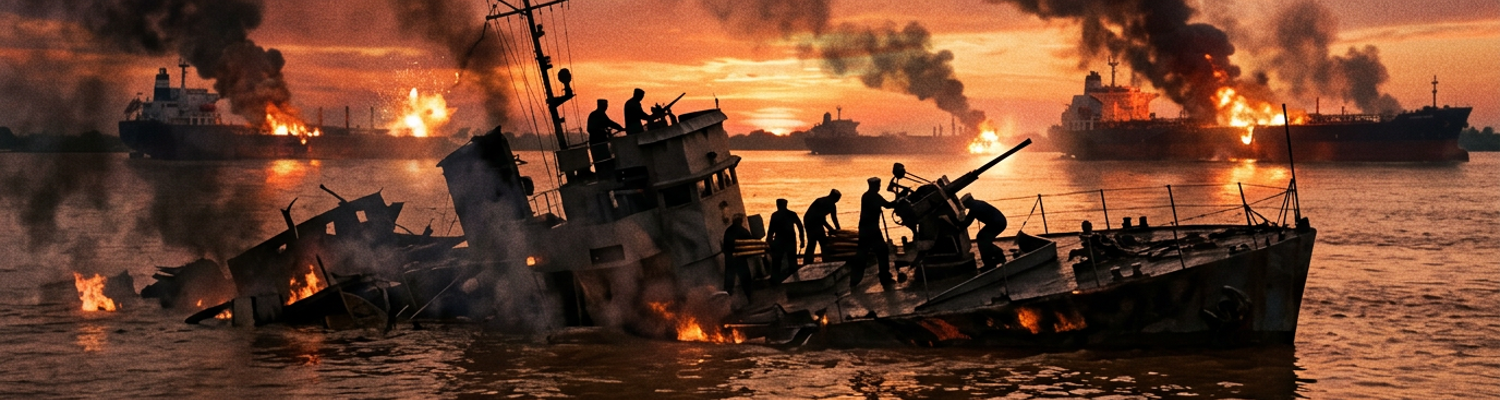
Motor sampans splashed into the brown river swells as crewmen slacked the davit falls. Japanese biplane dive bombers repeatedly struck Mei Ping, setting its cargo tanks on fire despite clearly painted American ensigns. The aircraft released hundred pound bombs that detonated across the forward deck and ruptured internal bulkheads. Shrapnel sliced through deck piping and punctured volatile fuel compartments, venting petroleum fumes that ignited into intense fires amidships. Flames spread across the wooden deck planking and threatened hundreds of Chinese clerks, deckhands, and company families. The civilian passengers retreated toward the stern in search of shelter behind steel ventilator shafts.
Steel ventilator shafts provided little protection for the Panay naval ratings stranded on Mei Ping. Crewmen unrolled canvas fire hoses across the blistering steel decks to spray the burning cargo hatches. Working alongside civilian engineers, the sailors manned auxiliary steam pumps and directed streams of river water directly onto the glowing fuel vents. Water pressure knocked down the initial surface blaze over the forward tanks, but a second flight of diving aircraft strafed the exposed fire parties. Heavy machine gun bullets tore through the unreinforced canvas hose lines and pierced the wheelhouse windows. The damage control party had to abandon the pumps and assist the civilian river pilot in slipping the anchor chains, leaving the adjacent tanker Mei Hsia following close behind.
Mei Hsia followed the chaotic wake while Carl H Carlson, the civilian captain of Mei An, maneuvered near the shoreline. Bomb splinters from an exploding stick of ordnance tore through the unarmored wooden wheelhouse. The shrapnel struck Carlson at the ship wheel just as he applied full rudder, killing him instantly. Loss of leadership and severed steering cables left the tanker completely out of control in the five knot current. Crewmen dropped an auxiliary stern anchor and threw their weight against the emergency manual tiller. The sailors finally grounded Mei An on a sloping sandbar along the north shore, allowing dozens of passengers to escape low level machine gun fire.
Machine gun fire continued as biplanes wheeled over the river and returned to strike Mei Ping and Mei Hsia. Fresh bomb strikes smashed through the superstructure of Mei Ping, rekindling the smothered oil fires. Explosive pressure waves ripped through the main engine spaces and shattered the steam lines. Sailors and civilian crewmen scrambled over the mooring bollards onto the pontoon dock. Flames quickly spread across the narrow gap to Mei Hsia, engulfing its forward cargo holds. Both burning tankers settled into the muddy riverbed along the southern shoreline, ending the engagement hard aground in the winter reeds.
Reeds and Shoreline Dispersal
Reeds offered the only concealment as USS Panay rolled heavily to starboard while the commercial tankers burned along the distant southern shoreline. Lieutenant Arthur F Anders assumed command on the tilting deck after Hughes suffered a fractured leg. Bomb shrapnel had torn through the neck of the executive officer and ripped his throat, leaving him completely unable to speak. Anders gripped a piece of chalk and scrawled orders to abandon ship across a steel cabin bulkhead. Sailors read the white letters on the bulkhead and immediately scrambled to unhook the davit falls of the surviving utility craft. The crew eased the boats into the swirling brown water as the flooded engine rooms dragging the hull downward.
Hull sinking accelerated as survivors lifted the wounded into the two small open sampans and pulling boats. Japanese aircraft wheeled overhead and dropped into low level strafing runs. The planes fired machine gun bursts that kicked up fountains of water around the wooden craft. Rounds pierced the thin wooden hulls and sprayed jagged splinters across the rowers. Coxswains drove the blunt bows directly into the north bank, grounding the loaded boats in knee deep freezing mud. Crewmen leaped into the icy muck and hoisted the stretchers above their shoulders, hauling the injured past the exposed shoreline and into the high grass.
Grass provided vital cover as crew members drew their pocketknives and slashed bundles of cut grasses from the surrounding wetland. Piles of yellow reeds quickly covered white cotton bandages, pale skin, and dark blankets. Sailors ordered all passengers and crew to lie flat on their bellies without shifting position whenever the roar of airplane engines passed over the marsh. Mud coated the hands and faces of the men as they packed wet river silt over shiny brass belt buckles and medical tins. This mud eliminated any glare that might catch the eye of a pilot. Every casualty remained motionless under the thick cover of river grass as they waited for the aircraft to depart.
Aircraft departed the immediate airspace just as armed river launches manned by Japanese troops chugged into the river reach. Troops aboard the launches raked the flooded upper works with light cannon and machine gun fire to verify that the vessel had been neutralized. Roving Japanese Army patrols appeared along the southern dikes and shoreline paths. These infantry units searched for survivors who had fled the destroyed Standard Oil tankers. Sailors hidden in the northern reeds watched through stalks of wild grass as the armed launches turned away from the submerged wreck. Anders lay quietly in the cold mire and carved new march orders into the bank with a sharp reed, preparing the survivors for a cross country withdrawal into the interior once dusk hid the river.
River Darkness and Overland Evacuation
Sailors used the river darkness to lift heavy wooden litters out of the freezing mud. Uninjured ratings had to haul sixteen severely wounded men across slick clay paths that measured barely two feet wide. Bearers rotated positions every ten minutes because the dead weight of the litters dragged their boots deep into the mire. Cold rain turned the earthen ridges into grease, sending carriers slipping off the dikes into flooded rice paddies. The column marched directly toward Hohsien after scouts led the wounded inland away from Japanese detachments patrolling the river wharves. Exhausted bearers carried the sixty four survivors across five miles of broken wetland, finally reaching the refuge of Hohsien just before daybreak.
Magistrates received the column at daybreak and quickly secured basic medical shelter and telephone access to foreign legations through local civilian networks. Medical staff dressed severe burns with clean linen and gave the injured warm water and straw mats inside brick rooms protected from the wind. Town authorities simultaneously assigned their municipal telephone switchboard to Embassy Secretary J Hall Paxton. Paxton hand cranked the field magneto and worked through multiple regional operators to reach American and British diplomatic missions in Hankow and Shanghai. The secretary dictated exact map coordinates and complete casualty rosters over the crackling wire. Paxton requested immediate river extraction before advancing Japanese army columns severed the roads.
Roads remained threatened while USS Oahu and HMS Bee received the urgent contact report at Shanghai. American and British naval officers cleared their sick bays, loaded emergency surgical gear, and embarked extra medical teams. Diplomatic representatives in Tokyo and Shanghai contacted the Imperial Japanese Navy to arrange safe passage across active front lines. Negotiators secured an armed truce with Japanese military authorities, clearing both gunboats to steam upriver under a formal Japanese naval escort. Japanese minesweepers and armed patrol launches took station ahead of the foreign warships. The escorts guided HMS Bee and USS Oahu through the wreckage of the river channel toward the agreed evacuation sector near Hohsien.
Hohsien mudflats served as the rendezvous point as crewmen aboard the relief vessels dropped anchor to coordinate the final retrieval. Chinese stretcher parties and local farmers carried the wounded back down from Hanshan to the riverbank. Motor cutters from HMS Bee and USS Oahu pushed through the muddy shallows under the guns of hovering Japanese patrol boats. Armed sailors and Navy doctors went ashore to establish a beachhead aid station on the riverbank. Corpsmen wrapped Hughes, Anders, and the civilian wounded in wool blankets before carrying them onto the open boats. Sailors hoisted the motor launches back onto their davits and secured the towing lines, swinging both gunboats downriver toward Shanghai as naval escorts screened their flanks to complete the extraction.