
Cold-Weather Mechanical Failures in Operation Nordwind
Soldiers of the Twelfth Armored Division entered the forward staging lines outside Herrlisheim physically depleted. Forty-eight hours of continuous road marches through freezing rain and driving snow across the Alsace plain deprived the rifle companies of sustained rest. Field rations froze solid inside canvas haversacks. Men chipped at ice-crusted canned meat with bayonets. Some swallowed cold tallow while on the march. Severe cold hardened wet wool socks into stiff blocks inside uninsulated combat boots. This produced hundreds of non-battle frostbite and trench-foot casualties before morning roll calls. Troops staggered into jump-off points near Weyersheim hollow-eyed and trembling from advanced hypothermia. Reaction times dropped due to caloric deficits and forty-mile marches under full kit.
Exhaustion was just the first mechanical vulnerability.
Archival evidence (NARA Record Group 338, Box 412) shows basic small-arms maintenance protocols collapsed under the severe January freeze. Temperatures plunged to minus twelve degrees Fahrenheit during the opening phases of Operation Nordwind. Standard Army issue ordnance grease turned into a thick waxy paste inside Browning M1919 machine gun receivers. Technical manuals specified light preservative lubricating oil. Infantry crews had packed bolt assemblies, driving springs, and sear mechanisms with heavy general-purpose chassis grease to protect against moisture during previous rain storms. Within hours of exposure, this lubricant transformed into an adhesive binder. It completely seized the reciprocating bolt group inside the receiver plates. Machine gunners from the 66th Armored Infantry Battalion pulled back their charging handles. The bolts crawled forward sluggishly. They halted several millimeters short of full battery. Firing pins failed to strike primers. Automated defensive fire reduced to single-shot manual cycles. Clearing these stoppages required complete disassembly with bare skin against sub-zero steel. Crews boiled weapon components in gasoline cans to strip away every trace of congealed lubricant.
Heavy armor cracked along the same temperature gradients.
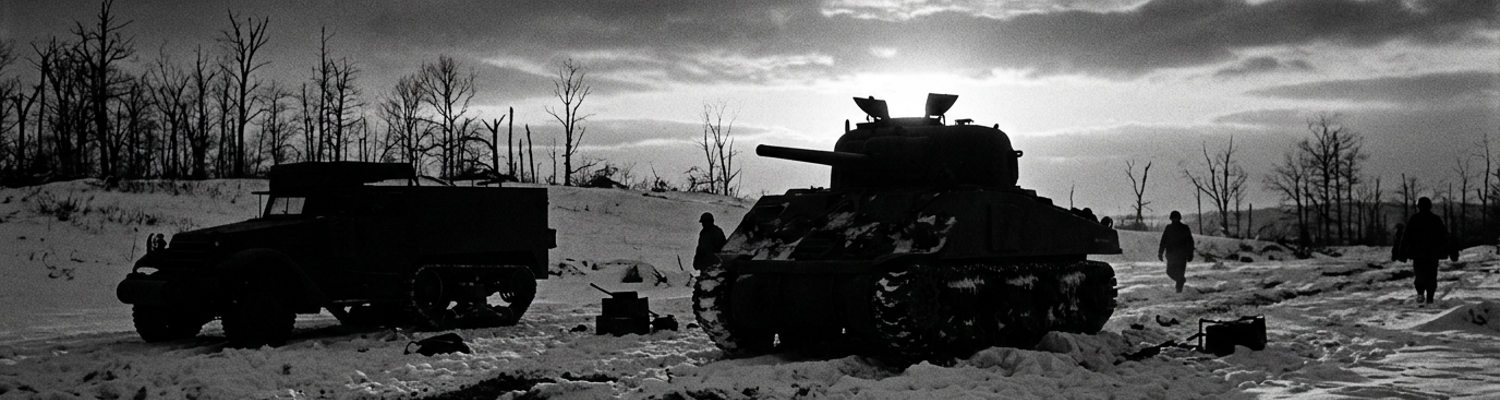
A close review of operational logs indicates mechanized components suffered catastrophic structural fractures during movement across frozen terrain south of the Zorn River. Cast armor nose sections on M4A3 Sherman tanks of the 43rd Tank Battalion fractured under rapid thermal shock during cross-country thrusts toward Herrlisheim. Internal final-drive assemblies worked under maximum engine torque to churn thirty-ton tanks through frozen drainage ditches and mud-slicked fields. This generated internal metal temperatures exceeding one hundred and fifty degrees Fahrenheit. Exterior surfaces of the cast steel differential housings simultaneously took direct repeated shocks from sub-zero slush, snow drifts, and freezing water in Alsace drainage canals. That extreme thermal gradient between the hot interior gear oil baths and the sub-zero exterior casting induced acute metallurgical shock. Cast steel housings fractured across their lower contours. Specialized SAE 50 gear oil dumped into the snow. Internal planetary gears bound up. Stripped teeth jammed the final-drive pinions. Drive sprockets seized. Tracks threw across the frozen mud.
Seven Shermans from Company B broke down within four hundred yards of the water obstacle.
Their tracks locked solid by split housings before German gunners fired an initial ranging shot. Crews abandoned paralyzed vehicles along the Rohrwiller-Herrlisheim road. They scrambled under mortar fire toward drainage ditches where secondary machine guns sat frozen in their cradles. Recovery vehicles dispatched to tow the immobilized armor suffered matching transmission fractures. The single clear supply route north of the Zorn River blocked by noon on January 8.
Frontline Medical Collapse at Rohrwiller Aid Post
Casualties from the morning fighting at the Zorn River crossing crawled into Rohrwiller on the backs of half-tracks. Litter bearers dragged others over frozen cart paths.
A close review of operational logs indicates the forward aid station operated by the medical detachment of the 66th Armored Infantry Battalion faced an insurmountable physical barrier to stabilization. They established the post inside an unheated masonry barn along the eastern road of the village. Shock treatment protocols mandated immediate intravenous infusion of reconstituted human blood plasma for soldiers suffering from shrapnel trauma and massive hemorrhage. Each standard medical issue kit (Medical Department Item No. 91098) contained two sealed glass cylinders. One held vacuum-dried citrated normal human plasma powder. The other contained sterile distilled water for reconstitution. Double-ended intravenous needles and rubber tubing linked them. Ambient temperatures inside the stone structure hovered near five degrees below zero Fahrenheit. This overwhelmed the heat output of two gasoline field stoves. The sterile distilled water stored in the companion ampoules froze solid. It expanded rapidly against the unyielding walls of the containers. Medics unpacked the canvas triage cases. They found dozens of structural glass fractures running lengthwise across the bottles. Several ampoules shattered completely inside their protective tin canisters. Glass integrity sometimes held. Mixing dried powder with near-freezing diluent produced an icy insoluble slush. This clogged the delivery filter. It could not pass through the gauge needles into collapsed veins. Men in hemorrhagic shock died on litters while medical personnel tried to warm frozen replacement fluid with hand friction.
Triage ceased to function as standard trauma medicine.
When examining the historical record, a matched failure paralyzed basic pharmacological pain management across the forward casualty collection point. Medics carried individual single-use Squibb morphine tartrate syrettes inside their outer canvas field pouches. These were collapsible tin tubes pre-loaded with half a grain of solution and sealed with a wire loop through a hollow needle. Contact with sub-zero atmospheric air froze the liquid narcotic solution into a solid waxy crystalline plug within minutes of outdoor exposure. Litter bearers arriving with blast casualties from the 43rd Tank Battalion attempted to drive the syrette needles into muscular tissue. They found the plunger mechanism locked. Squeezing the soft metal tubes with numb frostbitten fingers caused the tin casings to split open along side seams. Partially thawed gel leaked onto frozen wool overcoats rather than delivering analgesic relief. Battalion aid workers attempted to keep replacement syrettes inside their mouths or taped beneath their armpits against bare skin to keep the chemical fluid warm. The moment an injection needle contacted the freezing outdoor air, the fluid re-solidified inside the narrow lumen of the needle bore. Wounded soldiers suffering compound fractures from high-explosive artillery shells remained fully conscious. Their agony went unchecked. Medics scrambled to warm single needles over matches.
Archival evidence shows seventy-four litter cases lay crammed shoulder-to-shoulder across uninsulated stone pavers dusted with snow by three in the afternoon.
Field blankets issued by the quartermaster lacked sufficient thermal resistance to halt hypothermia. Wounded soldiers bled into frozen fabric that adhered directly to flesh wounds. Medical half-tracks assigned to evacuate severe chest cases back toward Weyersheim stalled with frozen carburetors in the barnyard. Incoming casualties from Company A trapped in the direct line of incoming German counter-battery barrages.
Corpsman records show two surgeons exhausted their entire supply of intact splints before nightfall.
The Critical Half-Track Extraction at Dawn
A specific five-minute window occurred on January 17, 1945, between 0610 and 0615. It involved an M3A1 half-track immobilized in a frozen drainage ditch.
Archival evidence shows the vehicle (Ordnance Department registration number 4055321) attempted an evasive turn off the gravel road running eight hundred yards southwest of the Herrlisheim water tower. It belonged to the 66th Armored Infantry Battalion medical section. Sub-zero temperatures had frozen the top three inches of ditch soil into a brittle crust over semi-liquid marsh silt. The front directional wheels dropped into the two-foot depression at 0610. That frozen surface sheared under the nine-ton vehicle weight. Mud forced upward into the front differential assembly. The track bogies broke through thin surface ice and bottomed out against submerged roots. Driver attempts to shift the two-speed transfer case into reverse stripped the gear teeth. The front-axle universal joint snapped under the shock load. Ice packed between the rear idler wheels and the vertical volute suspension springs. This locked the rubber-faced tracks against the armored hull sponsons. The half-track sat tilted at a twenty-degree angle. Its open rear compartment exposed toward German observation posts.
Twelve wounded soldiers lay packed across the troop benches.
When examining the historical record, eight of these men were litter casualties immobilized by compound blast fractures and chest trauma sustained during the dawn assault by Company C. Four walking wounded strapped upright along the vehicle sidewalls. Standard M3A1 quarter-inch face-hardened armor plating provided protection only against 7.92 mm rifle-caliber fire and indirect fragment strikes. Two camouflaged German 7.5 cm Pak 40 antitank guns concealed inside brick outbuildings along the western edge of Herrlisheim acquired the target through optical sights at a range of six hundred yards. Armor-piercing 7.5 cm Panzergranate 39 rounds traveled at over seven hundred meters per second. They possessed enough kinetic energy to penetrate seventy millimeters of rolled homogeneous armor at that distance. A single hit would punch clean through both sides of the open-topped chassis. It would kill the immobilized casualties instantly with hyper-velocity steel spall and blast pressure. At 0612, the first German high-explosive ranging round struck thirty yards to the right flank of the vehicle. It showered the open troop compartment with frozen topsoil and ice fragments.
A close review of operational logs indicates an M4A3 medium tank from Company C, 43rd Tank Battalion, reversed across the field at 0613.
It blocked the direct line of sight. Tank crewmen dropped two M8 smoke grenades over the rear engine deck to screen the half-track against the gun sights before German loaders chambered an armor-piercing projectile. The tank crew threaded a three-quarter-inch steel tow cable from their rear towing pintle directly through the front recovery tow rings of the immobilized M3A1. Both vehicle commanders maintained engine throttle against sub-zero fuel flow while artillery concussions blew snow across the tow hitch. At 0614, the Sherman engaged its low-gear final drive. It exerted twenty-four thousand pounds of tractive effort to wrench the dead front axle out of the frozen silt. The cable snapped taut. It cracked the ice bank and dragged the stranded vehicle backward onto the packed gravel lane at exactly 0615.
The second 7.5 cm solid shot penetrated the empty mud embankment where the half-track had rested six seconds earlier.
Combat Engineers and Armored Winch Recovery
Frozen steel cable sliced through wool work gloves within seconds of handling.
A close review of operational logs indicates soldiers from Company B of the 119th Armored Engineer Battalion coordinated with corpsmen from the 82nd Armored Medical Battalion. They needed to reach the disabled M3A1 half-track stranded on the Rohrwiller-Herrlisheim line. Direct 7.92 mm machine-gun bursts from German MG 42 positions along the embankment pinned the recovery team flat in freezing drainage runoff. Crawling on their bellies through three inches of ice-crusted slush, two combat engineers dragged a heavy two-hundred-foot, five-eighths-inch steel armored winch line. This ran off the front-mounted Tulsa Model 18G winch drum of an M32 tank recovery vehicle. Splashing alongside them, two litter bearers from the 82nd Armored Medical Battalion dragged spare clevis hitches and snatch blocks through incoming 81 mm mortar fragmentation. German gunners bracketed the ditch every ninety seconds with airburst rounds. Steel fragments sprayed across the marsh ground. The men reached the vehicle front bumper at 0622. Working with bare hands because damp leather mittens froze into rigid boards, the four men cleared packed river mud from the front frame horns. They aligned the heavy steel clevis with the vehicle front tow eye before hammering the retaining cotter pin into place under steady rifle fire.
The recovery team operated without artillery counter-battery support.
When examining the historical record, severe mechanical wear and shear force on tow shackle pins dictated which immobilized evacuation vehicles could be successfully hauled across the ice. Standard field issue M3A1 half-tracks utilized one-and-one-quarter-inch carbon steel towing shackle pins. These rated for twelve tons of direct tensile pull under normal operating conditions. Ambient temperatures below zero degrees Fahrenheit lowered the Charpy impact resistance of the carbon steel alloy. This shifted the metal past its ductile-to-brittle transition point. The winch operator engaged the power take-off to haul nine-ton vehicles anchored fast in frozen canal silt. The pulling force met exponential resistance from surface ice and suction. Tensile resistance routinely surged past twenty-two tons before the vehicle chassis broke free of the frozen mud crust. Worn pins that had accumulated micro-fractures from days of rough movement across Alsace cobblestones sheared clean through their centers. They produced loud mechanical cracks resembling small-arms discharge. Half-tracks with deformed frame horns or bent shackle eyes could not accept replacement pins. Engineers abandoned the hulls where they lay in the frozen ditches. Only vehicles possessing factory-new, fully seated alloy pins withstood the lateral shear loads without stripping their mounting brackets off the chassis rails.
Engineers made recovery decisions in seconds based solely on shackle pin clearance.
Archival evidence shows three successive half-tracks from Company C, 82nd Armored Medical Battalion, were assessed for salvage during the 0630 extraction attempt west of the railway embankment. One chassis carrying six litter patients held fast. Its forward shackle pins retained their original factory tolerance and withstood a sustained twenty-four-ton winch draw across sixty yards of solid ice. A second vehicle suffered catastrophic failure when its port-side shackle pin snapped under an initial four-ton pull. This twisted the front bumper and ripped the right frame rail three inches out of alignment. Engineers had to cut that tow line with an axe. They left the half-track stranded forty yards out in the open marsh under incoming high-explosive fire while medics transferred patients across exposed terrain by hand. A third vehicle lacked its original shackle pins entirely. Its crew had substituted field-expedient three-quarter-inch mild steel bolts during the march from Weyersheim. Those substitute bolts sheared instantly when the winch cable went taut. A fragment drove through the radiator housing and flooded the ice sheet with boiling glycol.
The 119th Armored Engineer Battalion lost two recovery winches to sheared planetary gears before 0700.
Evacuation Contingencies of the Eighty-Second Medical Battalion
A close review of operational logs indicates standard field ambulance evacuation protocols ceased to function during the midday German counter-thrust southwest of Herrlisheim. The 82nd Armored Medical Battalion had positioned soft-skinned Dodge WC-54 three-quarter-ton ambulances along the primary road network. Continuous 88 mm high-velocity fire and artillery cratering rendered secondary paved lanes impassable. Standard litter-bearer teams on foot could not traverse the frozen fields under direct machine-gun observation without suffering total attrition. Major George P. Miller and medical company commanders bypassed field manual evacuation routines. They integrated their personnel directly into combat vehicle crews to perform extraction under armor. Medics commandeered M3A1 half-tracks from battalion supply elements. They coordinated directly with heavy maintenance crews operating M32B1 tank recovery vehicles. Crews drove armored recovery vehicles straight across drainage berms to haul litters directly from vehicle hull sponsons instead of routing casualties through established battalion aid stations to collecting points. Mechanics strapped casualties directly to the rear engine decks of M4A3 Sherman tanks. They utilized the thermal output of the Continental radial engines to delay peripheral frostbite during transport back to Weyersheim.
Wheeled ambulances stayed in the rear.
When examining the historical record, armored recovery teams improvisationally modified their vehicle winches to drag non-functional half-tracks laden with wounded out of the direct line of fire. Medics from Company B, 82nd Armored Medical Battalion, worked inside the steel hulls while vehicles were under tow. They applied pressure dressings and tourniquets while 7.92 mm rounds spattered against the outer armor plates. Recovery crews utilized heavy steel drawbars and five-eighths-inch winch cables to tether wounded carrier hulls directly behind M32 recovery vehicles. This created mechanized evacuation trains that bypassed the cratered road system. Drivers crushed frozen irrigation levees to reach isolated pockets of the 66th Armored Infantry Battalion pinned near the town water tower. Every wounded soldier removed from the perimeter between 0900 and 1400 on January 17 left the field secured inside armored compartments or lashed beside recovery booms.
Doctrine offered no guidance for this type of triage.
Archival evidence shows the capture and destruction of forward supply points inside the Herrlisheim pocket obliterated the Twelfth Armored Division tactical reserves of whole blood, plasma, and sterile injectables. German panzergrenadiers overran the forward aid detachment of the 43rd Tank Battalion. Twenty-four transport vehicles loaded with winterized casualty packs were burned or captured in the village center. The loss of insulated field chests containing standard 400-unit allotments of morphine, tetanus toxoid, and distilled water left the 82nd Armored Medical Battalion with no functional cold-weather medical inventory north of the Zorn River. Whole blood units exposed to sub-zero ambient temperatures underwent rapid hemolysis as red blood cell membranes ruptured against expanding ice crystals. This rendered hundreds of units toxic for intravenous infusion. Glass ampoules of penicillin G sodium solution cracked at the necks. Airborne contaminants entered the sterile antibiotic slurry.
The loss triggered emergency doctrinal interventions across the Seventh Army.
A close review of operational logs indicates Seventh Army medical officers issued immediate emergency revisions to technical medical supply directives before the fighting at Herrlisheim concluded. Field orders mandated medics carry all liquid biologicals, including morphine syrettes and insulin, in specialized interior fabric pouches worn directly against the chest wall beneath wool shirts and field jackets. Medical supply depots in Strasbourg ceased shipping distilled water in standard uninsulated glass bottles. They replaced them with copper-clad vacuum containers padded with felt insulation. Battalion maintenance workshops received instructions to fabricate engine-exhaust warming boxes. They welded sheet-metal enclosures directly to the exhaust manifolds of M3A1 half-tracks and medium tanks. These improvised metal chambers routed engine heat around metal ammunition cans holding intravenous saline and reconstituted dried plasma. This maintained liquid solutions at sixty-five degrees Fahrenheit even in sub-zero operational zones. Field units abandoned static aid station storage tables entirely. All perishable biomedical material transferred into heated vehicle crew compartments.